I created this project five years ago.
Technologies
C#, Visual Studio 2008, Windows Forms, Visual C#
Topics
C#, Puzzles, 14 Peg Puzzle
Platforms
Desktop
Requirements
Primary language
en-US
Updated
10/16/2015
License
Introduction
The fourteen peg puzzle is a form of amusement which I have seen at my local Cracker Barrel. The puzzle involves fourteen pegs in fifteen holes in a triangular configuration. The top hole is empty. The object of the puzzle is to jump pegs over one another until only one peg is left. Jumped pegs are removed from the board.
Building the Sample
This project should build as is using Visual Studio 2008.
Description
This application was translated from a Turbo Pascal program found in Data Structure Using Turbo Pascal by Thomas M. Boger. Depth-first search with backtracking is utilized to find the solution in the allowed thirteen moves. Two stacks are used to store the moves a move stack and a reverse move stack. The translation process had to take into account a relatively strange Turbo Pascal table and an array whose base index was -1. Boger creates an array for the representation of the fourteen peg puzzle that is a right triangle for internal application operations.
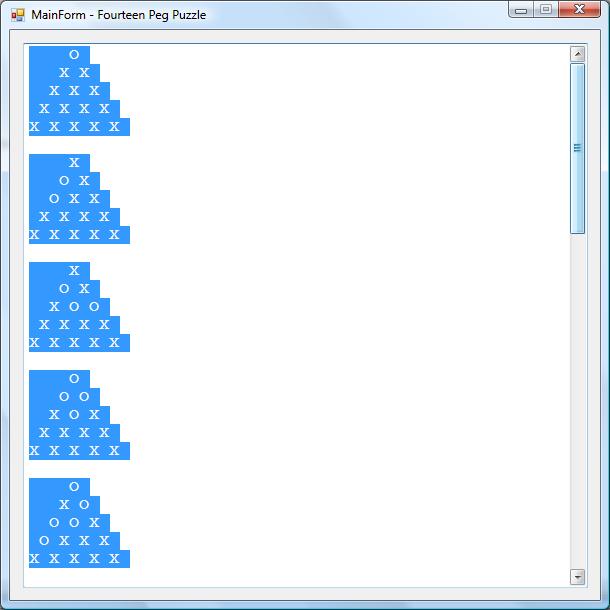

C#
using System;
using System.Collections.Generic;
using System.Windows.Forms;
namespace FourteenPegPuzzle
{
class PegPuzzle
{
private const int OverRow = 0;
private const int OverCol = 1;
private const int ToRow = 2;
private const int ToCol = 3;
private const int Addend = 0;
private int[,] moveTable =
{{1, 0, 2, 0}, {-1, 0, -2, 0},
{0, 1, 0, 2}, {0, -1, 0, -2},
{1, 1, 2, 2}, {-1, -1, -2, -2}};
private char[,] board;
public struct StatusRec
{
public int pegRow, pegCol, moveNumber;
}
private Stack<StatusRec> moveStack;
private Stack<StatusRec> reverseStack;
private bool blocked;
private int moveCount, totalMovePush;
private StatusRec currentMove, newMove;
private TextBox tb;
public PegPuzzle(TextBox tb)
{
this.tb = tb;
totalMovePush = 0;
board = new char[9, 9];
}
private void AdvancePeg()
{
currentMove.pegCol++;
if (currentMove.pegCol > currentMove.pegRow)
{
currentMove.pegCol = 2;
currentMove.pegRow++;
}
}
private void AdvanceMove()
{
currentMove.moveNumber++;
if (currentMove.moveNumber > 5)
{
currentMove.moveNumber = 0;
AdvancePeg();
}
}
private void InitializeBoard()
{
for (int row = 0; row < 9; row++)
for (int col = 0; col < 9; col++)
board[row, col] = ‘ ‘;
for (int row = 3; row <= 6; row++)
for (int col = 2; col <= row; col++)
board[row, col] = ‘X’;
board[2, 2] = ‘O’;
}
private bool LegalMove()
{
int overRow = moveTable[currentMove.moveNumber, OverRow] + Addend;
int overCol = moveTable[currentMove.moveNumber, OverCol] + Addend;
int toRow = moveTable[currentMove.moveNumber, ToRow] + Addend;
int toCol = moveTable[currentMove.moveNumber, ToCol] + Addend;
return board[currentMove.pegRow + overRow, currentMove.pegCol + overCol] == ‘X’ &&
board[currentMove.pegRow + toRow, currentMove.pegCol + toCol] == ‘O’;
}
private void PrintBoard()
{
for (int row = 2; row <= 6; row++)
{
for (int i = 1; i <= 6 – row; i++)
tb.Text += ‘ ‘;
for (int col = 2; col <= row; col++)
tb.Text += board[row, col] + ” “;
tb.Text += “\r\n”;
}
tb.Text += “\r\n”;
}
public void Solve()
{
moveStack = new Stack<StatusRec>();
InitializeBoard();
blocked = false;
moveCount = 0;
currentMove.pegRow = 2;
currentMove.pegCol = 2;
currentMove.moveNumber = 0;
while (moveCount < 13 && !blocked)
{
if (board[currentMove.pegRow, currentMove.pegCol] != ‘X’)
AdvancePeg();
else if (!LegalMove())
AdvanceMove();
else
{
newMove = new StatusRec();
newMove.moveNumber = currentMove.moveNumber;
newMove.pegCol = currentMove.pegCol;
newMove.pegRow = currentMove.pegRow;
moveStack.Push(newMove);
moveCount++;
totalMovePush++;
board[currentMove.pegRow, currentMove.pegCol] = ‘O’;
int overRow = moveTable[currentMove.moveNumber, OverRow] + Addend;
int overCol = moveTable[currentMove.moveNumber, OverCol] + Addend;
int toRow = moveTable[currentMove.moveNumber, ToRow] + Addend;
int toCol = moveTable[currentMove.moveNumber, ToCol] + Addend;
board[currentMove.pegRow + overRow, currentMove.pegCol + overCol] = ‘O’;
board[currentMove.pegRow + toRow, currentMove.pegCol + toCol] = ‘X’;
currentMove.pegRow = 2;
currentMove.pegCol = 2;
currentMove.moveNumber = 0;
}
while (currentMove.pegRow > 6 && !blocked)
{
if (moveStack.Count == 0)
blocked = true;
else
{
currentMove = moveStack.Pop();
board[currentMove.pegRow, currentMove.pegCol] = ‘X’;
int overRow = moveTable[currentMove.moveNumber, OverRow] + Addend;
int overCol = moveTable[currentMove.moveNumber, OverCol] + Addend;
int toRow = moveTable[currentMove.moveNumber, ToRow] + Addend;
int toCol = moveTable[currentMove.moveNumber, ToCol] + Addend;
board[currentMove.pegRow + overRow, currentMove.pegCol + overCol] = ‘X’;
board[currentMove.pegRow + toRow, currentMove.pegCol + toCol] = ‘O’;
moveCount–;
AdvanceMove();
}
}
}
if (!blocked)
{
InitializeBoard();
reverseStack = new Stack<StatusRec>();
while (moveStack.Count != 0)
{
currentMove = moveStack.Pop();
newMove = new StatusRec();
newMove.moveNumber = currentMove.moveNumber;
newMove.pegCol = currentMove.pegCol;
newMove.pegRow = currentMove.pegRow;
reverseStack.Push(newMove);
}
PrintBoard();
while (reverseStack.Count != 0)
{
currentMove = reverseStack.Pop();
board[currentMove.pegRow, currentMove.pegCol] = ‘O’;
int overRow = moveTable[currentMove.moveNumber, OverRow] + Addend;
int overCol = moveTable[currentMove.moveNumber, OverCol] + Addend;
int toRow = moveTable[currentMove.moveNumber, ToRow] + Addend;
int toCol = moveTable[currentMove.moveNumber, ToCol] + Addend;
board[currentMove.pegRow + overRow, currentMove.pegCol + overCol] = ‘O’;
board[currentMove.pegRow + toRow, currentMove.pegCol + toCol] = ‘X’;
PrintBoard();
}
}
}
}
}

 Numerical Explorations