Iterative Deepening A* Search to Solve the 8-Puzzle and 15-Puzzle by James Pate Williams, Jr.
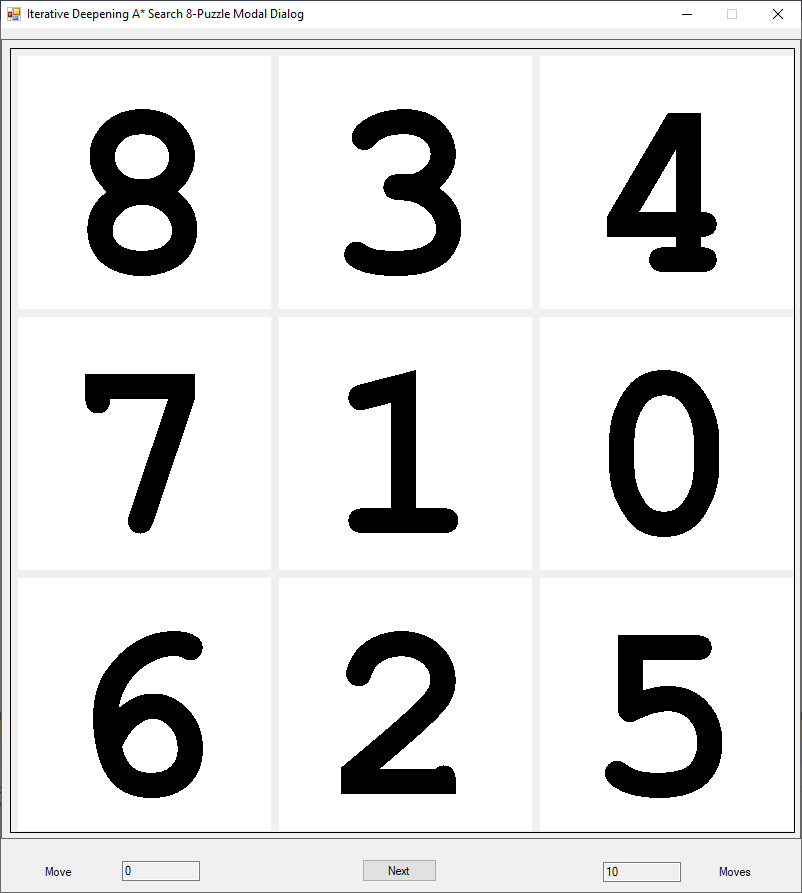
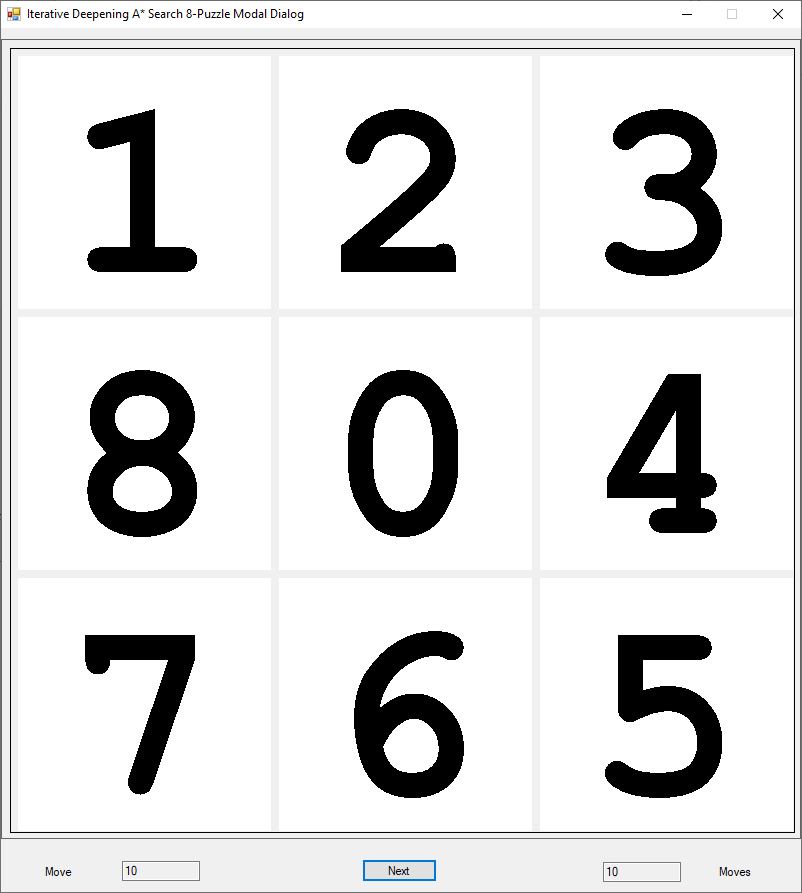
The 8-puzzle is a child’s tiled toy. The toy consists of 8 numbered tiles and a blank space. The object of the game is to get the tiles in the order 1 to 8 going from the top left hand corner for the number 1 tile around the perimeter clockwise and finish with the space in the center of the 3 x 3 board.
A* search is a complete and optimal informed or heuristic search algorithm. A good source for information on uniformed and informed search procedures is the tome “Artificial Intelligence A Modern Approach First and/or Second Edition” by Stuart Russell and Peter Norvig. The second edition has more info on the 8-puzzle and the 15-puzzle. Iterative deepening A* search is also a complete and optimal search algorithm. Below is an instance of the 8-puzzle that requires 10 steps to reach the goal state. I use a different goal state than Russell and Norvig in the second edition of their textbook.
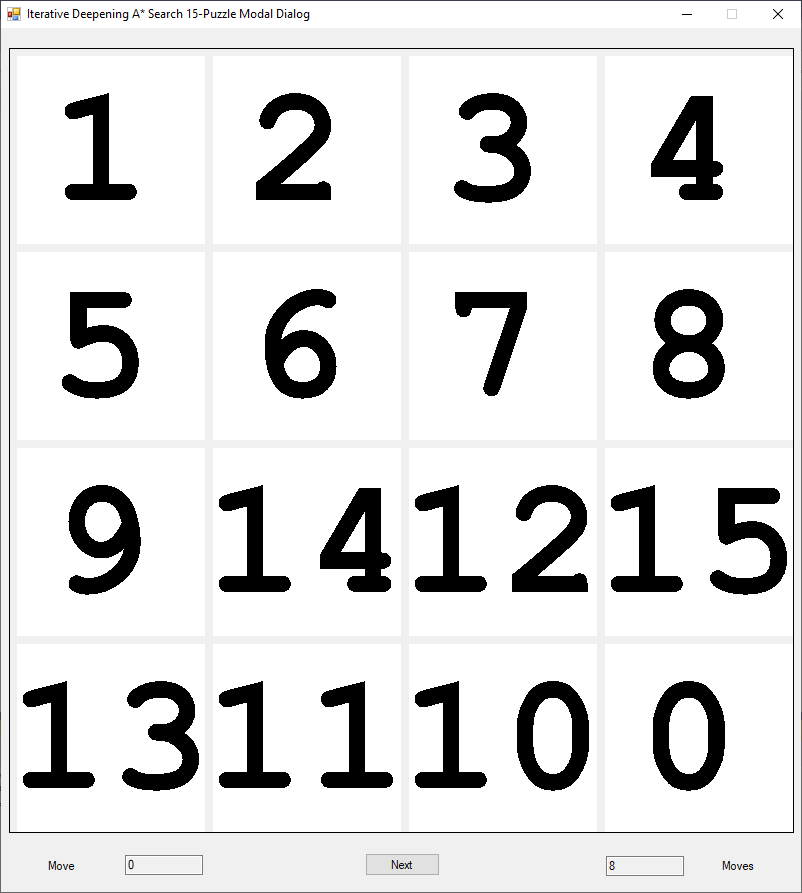
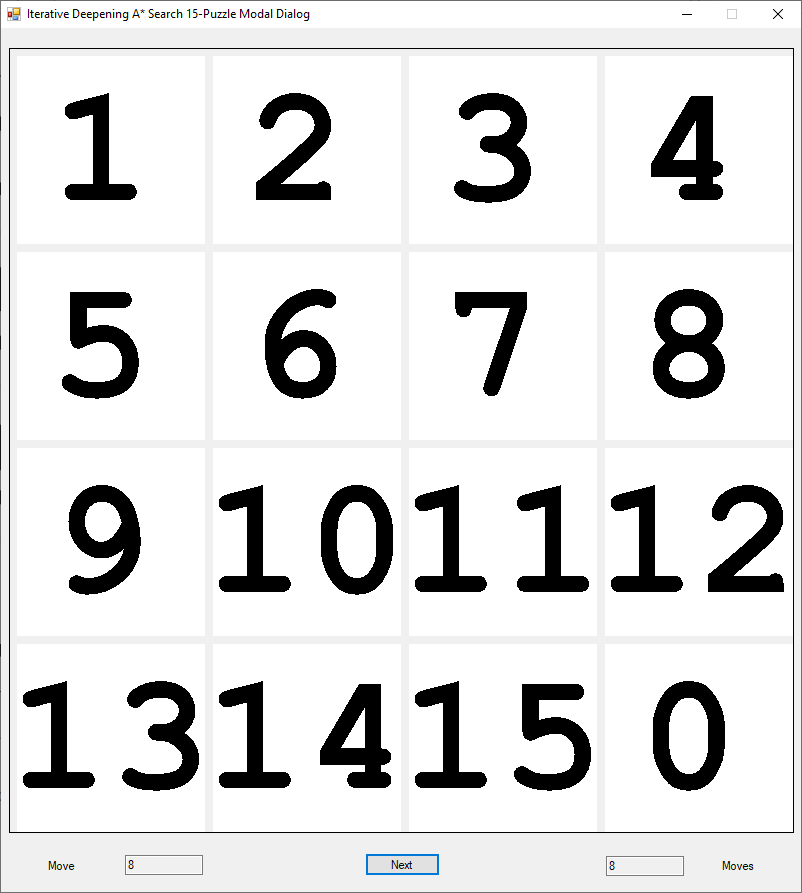
Initial State of a 8-Puzzle InstanceGoal State of a 8-Puzzle InstanceInitial State of a 15-Puzzle InstanceGoal State of a 15-Puzzle Instance
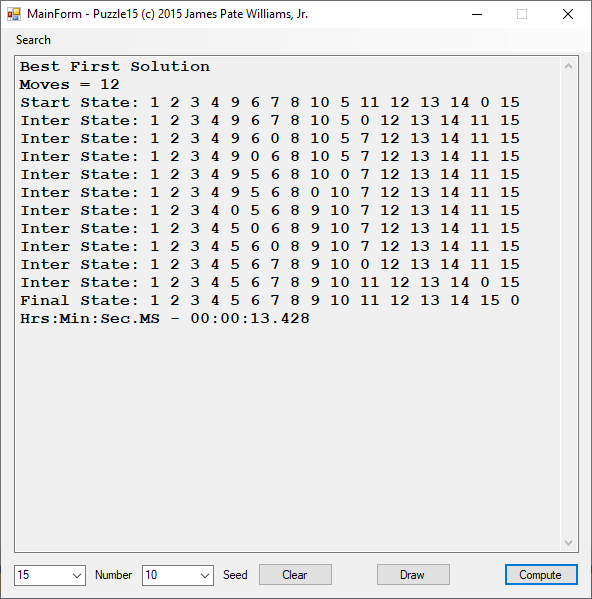
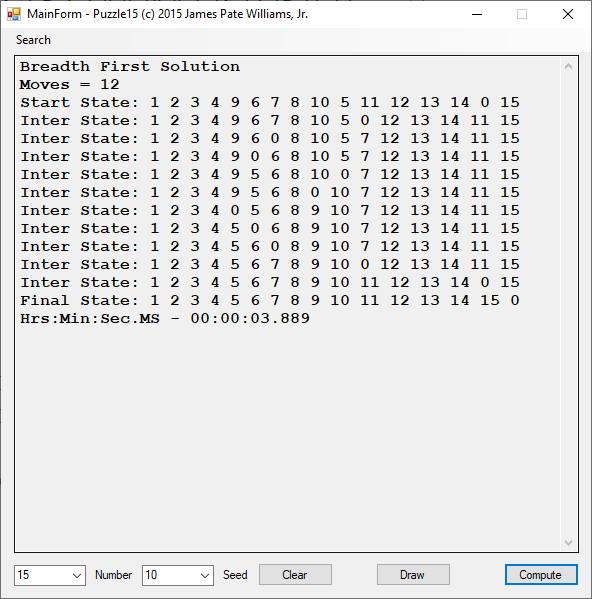
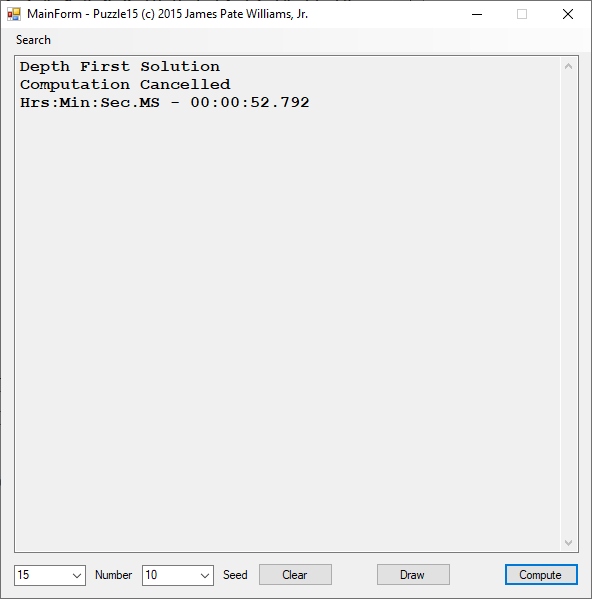
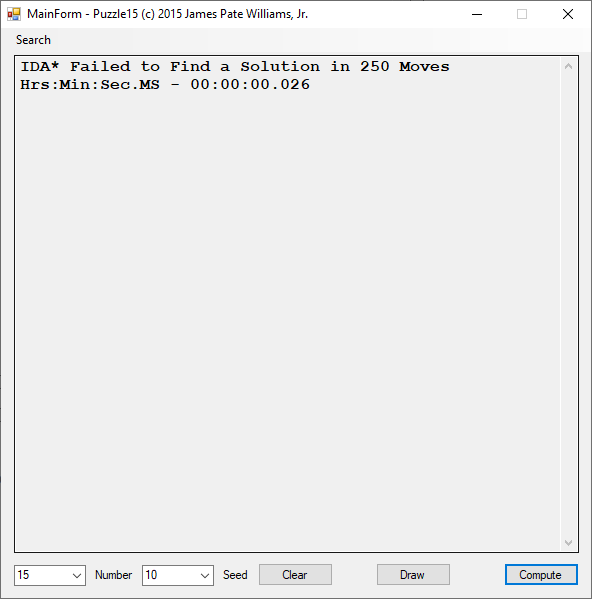
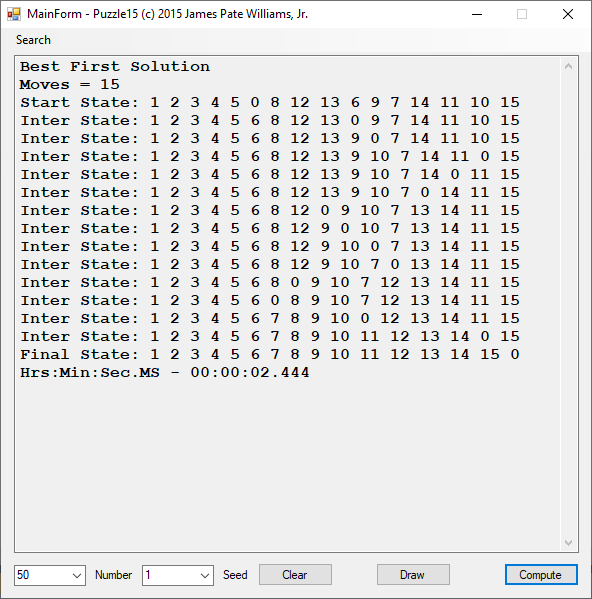
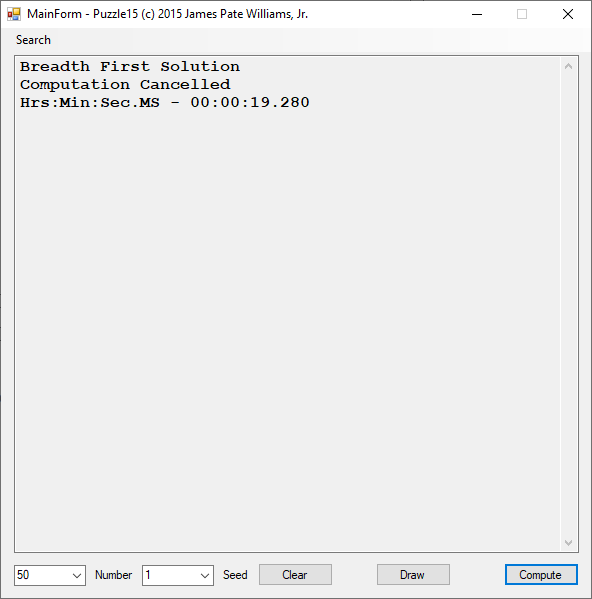
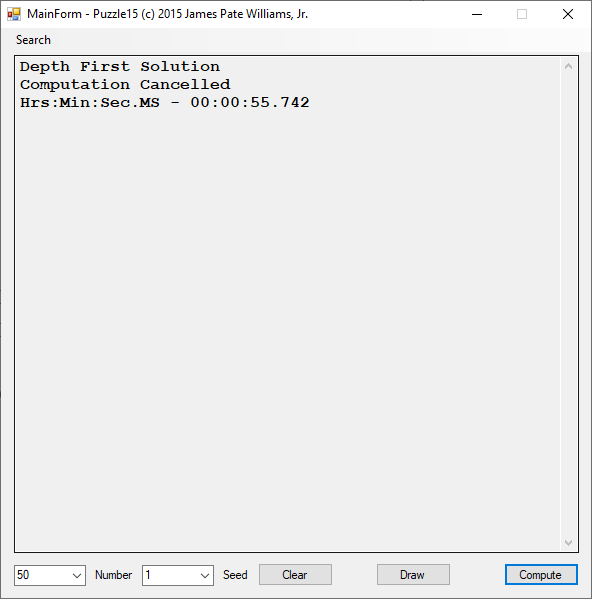
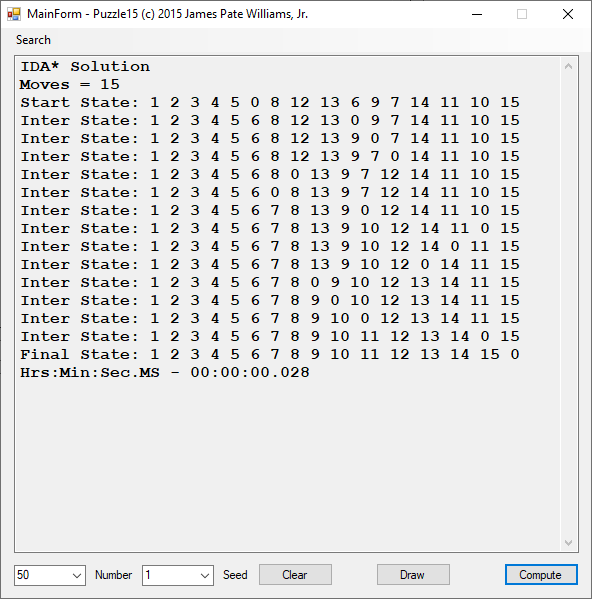
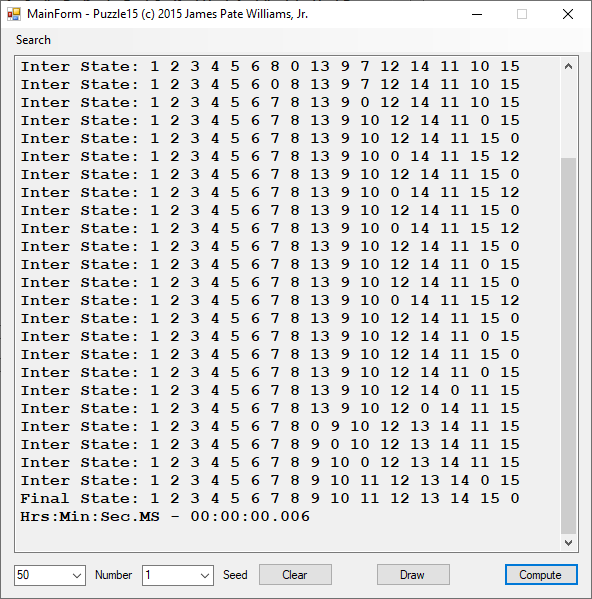
I developed an application in 2015 that uses 5 search algorithms to solve instances of the 15-puzzle.
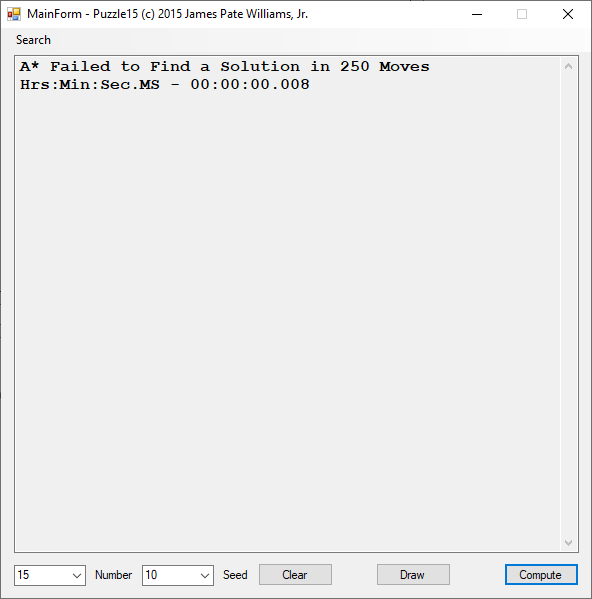
Best First Search AlgorithmBreadth First Search AlgorithmFailure of Depth First AlgorithmFailure of IDA* SearchFailure of the A* SearchBest First SearchFailure of Breadth First SearchFailure of Depth First SearchIDA* Search SolutionA* Search Solution
My whole legal name is James Pate Williams, Jr. I was born in LaGrange, Georgia approximately 70 years ago. I barely graduated from LaGrange High School with low marks in June 1971. Later in June 1979, I graduated from LaGrange College with a Bachelor of Arts in Chemistry with a little over a 3 out 4 Grade Point Average (GPA). In the Spring Quarter of 1978, I taught myself how to program a Texas Instruments desktop programmable calculator and in the Summer Quarter of 1978 I taught myself Dayton BASIC (Beginner's All-purpose Symbolic Instruction Code) on LaGrange College's Data General Eclipse minicomputer. I took courses in BASIC in the Fall Quarter of 1978 and FORTRAN IV (Formula Translator IV) in the Winter Quarter of 1979. Professor Kenneth Cooper, a genius poly-scientist taught me a course in the Intel 8085 microprocessor architecture and assembly and machine language. We would hand assemble our programs and insert the resulting machine code into our crude wooden box computer which was designed and built by Professor Cooper. From 1990 to 1994 I earned a Bachelor of Science in Computer Science from LaGrange College. I had a 4 out of 4 GPA in the period 1990 to 1994. I took courses in C, COBOL, and Pascal during my BS work. After graduating from LaGrange College a second time in May 1994, I taught myself C++. In December 1995, I started using the Internet and taught myself client-server programming. I created a website in 1997 which had C and C# implementations of algorithms from the "Handbook of Applied Cryptography" by Alfred J. Menezes, et. al., and some other cryptography and number theory textbooks and treatises.
View all posts by jamespatewilliamsjr

 Numerical Explorations