Rexx was a popular computer programming language on IBM main frame computers. I found an interesting website: https://en.wikipedia.org/wiki/Rexx#NUMERIC\
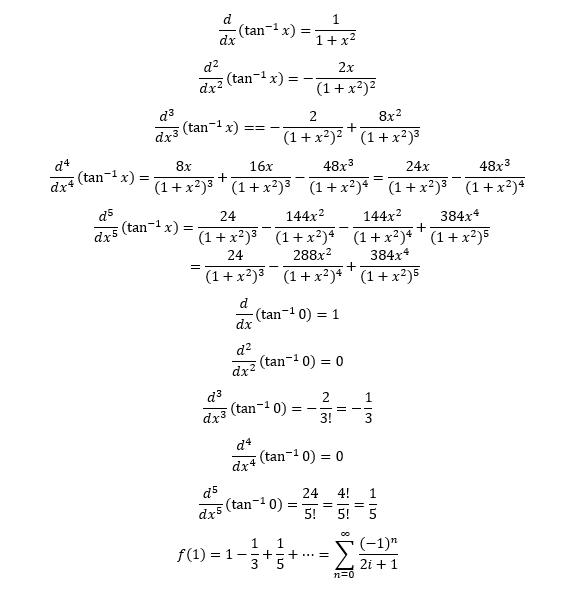
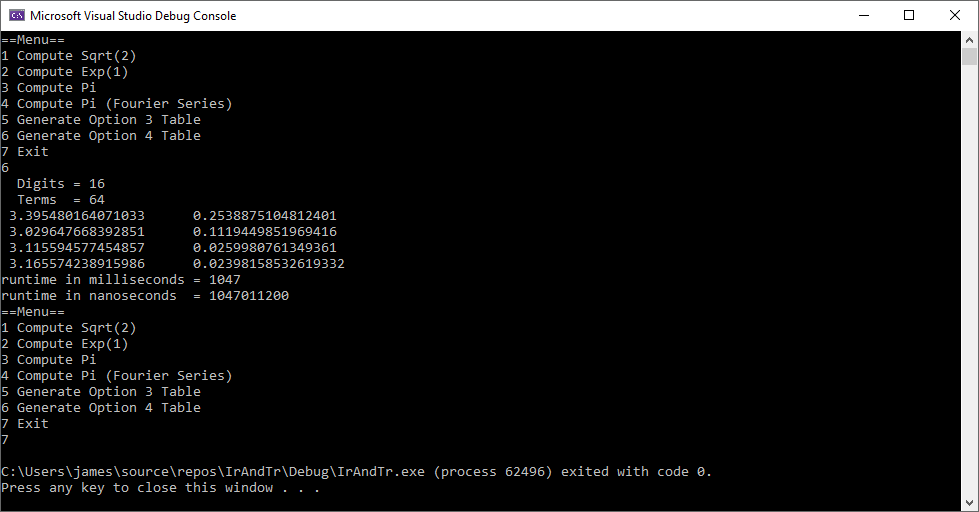
I use a very slowly converging infinite series and Fourier series to compute Pi.



// https://en.wikipedia.org/wiki/Rexx#NUMERIC\
// Translated from Rexx code
// by James Pate Williams, Jr.
// Added a lot of functionality
// Copyrighted February 7 - 10, 2023

#include "FourierSeries.h"
#include <stdlib.h>
#include <iomanip>
#include <iostream>
#include <chrono>
using namespace std;
typedef chrono::high_resolution_clock Clock;

void Option3(int digits, int N)
{
    long double i = 0;
    long double sgn = 1;
    long double sum = 0;
    long double pi0 = Pi;
    long double pi1 = 0.0;

    while (i <= N)
    {
        sum += sgn / (2.0 * i + 1);
        sgn *= -1;
        i = i + 1.0;
    }

    pi1 = 4.0 * sum;
    cout << setw(static_cast<std::streamsize>((int)digits) + 2);
    cout << setprecision(digits) << pi1 << '\t';
    cout << setprecision(digits) << (fabsl(pi0 - pi1)) << endl;
}

void Option4(int digits, int N)
{
    long double* a = new long double[N + 1];
    long double* b = new long double[N + 1];
    memset(a, 0, (N + 1) * sizeof(long double));
    memset(b, 0, (N + 1) * sizeof(long double));
    FourierSeries::CreateCosSeries(N, a);
    FourierSeries::CreateSinSeries(N, b);
    long double pi = 4.0 * FourierSeries::Series(N, 1.0, a, b);
    cout << setw(static_cast<std::streamsize>((int)digits) + 2);
    cout << setprecision(digits) << pi << '\t';
    cout << setprecision(digits) << (fabsl(pi - Pi)) << endl;
    delete[] a;
    delete[] b;
}

int main()
{
    int choice, digits, N = 0, N1 = 0;

    while (1)
    {
        cout << "==Menu==" << endl;
        cout << "1 Compute Sqrt(2)" << endl;
        cout << "2 Compute Exp(1)" << endl;
        cout << "3 Compute Pi" << endl;
        cout << "4 Compute Pi (Fourier Series)" << endl;
        cout << "5 Generate Option 3 Table" << endl;
        cout << "6 Generate Option 4 Table" << endl;
        cout << "7 Exit" << endl;
        cin >> choice;
        if (choice == 7)
            break;
        cout << "  Digits = ";
        cin >> digits;
        if (choice >= 3)
        {
            cout << "  Terms  = ";
            cin >> N;
            N1 = N + 1;
        }
        auto start_time = Clock::now();
        if (choice == 1)
        {
            long double n = 2;
            long double r = 1;
            while (1)
            {
                long double rr = (n / r + r) / 2;
                if (rr == r)
                    break;
                r = rr;
            }

            cout << setprecision(digits) << r << endl;
        }
        else if (choice == 2)
        {
            long double e = 2.5;
            long double f = 0.5;
            long double n = 3;
            do
            {
                f /= n;
                long double ee = e + f;
                if (ee == e)
                    break;
                e = ee;
                n += 1;
            } while (1);

            cout << setprecision(digits) << e << endl;
        }
        else if (choice == 3)
            Option3(digits, N);
        else if (choice == 4)
            Option4(digits, N);
        else if (choice == 5)
        {
            for (int n = 8; n <= N; n *= 2)
                Option3(digits, n);
        }
        else if (choice == 6)
        {
            for (int n = 8; n <= N; n *= 2)
                Option4(digits, n);
        }
        auto end_time = Clock::now();
        cout << "runtime in milliseconds = ";
        cout << std::chrono::duration_cast<std::chrono::milliseconds>
            (end_time - start_time).count();
        cout << endl;
        cout << "runtime in nanoseconds  = ";
        cout << std::chrono::duration_cast<std::chrono::nanoseconds>
            (end_time - start_time).count();
        cout << endl;
    }

    return 0;
}
#pragma once

const long double c = 2.0e9;
const long double Pi = 3.1415926535897932384626433832795;

class FourierSeries
{
private:
	static long double f(long double x);
	static long double cosTermFunction(int n, long double x);
	static long double sinTermFunction(int n, long double x);
public:
	static void CreateCosSeries(int N, long double a[]);
	static void CreateSinSeries(int N, long double b[]);
	static long double Series(int N, long double x,
		long double a[], long double b[]);
};
#include <math.h>
#include "FourierSeries.h"
#include "Integral.h"

long double FourierSeries::f(long double x)
{
    return atanl(x);
}

long double FourierSeries::cosTermFunction(int n, long double x)
{
    return cosl(n * x * Pi / c) * f(x);
}

long double FourierSeries::sinTermFunction(int n, long double x)
{
    return sinl(n * x * Pi / c) * f(x);
}

void FourierSeries::CreateCosSeries(int N, long double a[])
{
    long double e[7] = { 0 };

    e[1] = e[2] = 1.0e-12;

    for (int n = 0; n <= N; n++)
        a[n] = Integral::integral(
            n, -c, c, cosTermFunction, e, 1, 1) / c;
}

void FourierSeries::CreateSinSeries(int N, long double b[])
{
    long double e[7] = { 0 };

    e[1] = e[2] = 1.0e-12;

    for (int n = 1; n <= N; n++)
        b[n] = Integral::integral(
            n, -c, c, sinTermFunction, e, 1, 1) / c;
}

long double FourierSeries::Series(int N, long double x,
    long double a[], long double b[])
{
    long double sum = 0.0;

    for (int n = 1; n <= N; n++)
        sum += a[n] * cosl(2.0 * n * x) + b[n] * sinl(2.0 * n * x);

    return a[0] / 2.0 + sum / 2.0;
}
#pragma once

// Translated from C source code found in the tome
// "A Numerical Library in C for Scientists and
// Engineers" by H.T. Lau, PhD

class Integral
{
private:
	static long double integralqad(
		int n,
		int transf, long double (*fx)(int, long double), long double e[],
		long double* x0, long double* x1, long double* x2, long double* f0, long double* f1,
		long double* f2, long double re, long double ae, long double b1);
	static void integralint(
		int n,
		int transf, long double (*fx)(int, long double), long double e[],
		long double* x0, long double* x1, long double* x2, long double* f0, long double* f1,
		long double* f2, long double* sum, long double re, long double ae, long double b1,
		long double hmin);
public:
	static long double integral(int n, long double a, long double b,
		long double (*fx)(int, long double), long double e[],
		int ua, int ub);
};
#include <math.h>
#include "Integral.h"

long double Integral::integral(
	int n,
	long double a, long double b,
	long double (*fx)(int, long double), long double e[],
	int ua, int ub)
{
	long double x0, x1, x2, f0, f1, f2, re, ae, b1 = 0, x;

	re = e[1];
	if (ub)
		ae = e[2] * 180.0 / fabsl(b - a);
	else
		ae = e[2] * 90.0 / fabsl(b - a);
	if (ua) {
		e[3] = e[4] = 0.0;
		x = x0 = a;
		f0 = (*fx)(n, x);
	}
	else {
		x = x0 = a = e[5];
		f0 = e[6];
	}
	e[5] = x = x2 = b;
	e[6] = f2 = (*fx)(n, x);
	e[4] += integralqad(n, 0, fx, e, &x0, &x1, &x2, &f0, &f1, &f2, re, ae, b1);
	if (!ub) {
		if (a < b) {
			b1 = b - 1.0;
			x0 = 1.0;
		}
		else {
			b1 = b + 1.0;
			x0 = -1.0;
		}
		f0 = e[6];
		e[5] = x2 = 0.0;
		e[6] = f2 = 0.0;
		ae = e[2] * 90.0;
		e[4] -= integralqad(n, 1, fx, e, &x0, &x1, &x2, &f0, &f1, &f2, re, ae, b1);
	}
	return e[4];
}

long double Integral::integralqad(
	int n,
	int transf, long double (*fx)(int, long double), long double e[],
	long double* x0, long double* x1, long double* x2, long double* f0, long double* f1,
	long double* f2, long double re, long double ae, long double b1)
{
	/* this function is internally used by INTEGRAL */

	long double sum, hmin, x, z;

	hmin = fabs((*x0) - (*x2)) * re;
	x = (*x1) = ((*x0) + (*x2)) * 0.5;
	if (transf) {
		z = 1.0 / x;
		x = z + b1;
		(*f1) = (*fx)(n, x) * z * z;
	}
	else
		(*f1) = (*fx)(n, x);
	sum = 0.0;
	integralint(n, transf, fx, e, x0, x1, x2, f0, f1, f2, &sum, re, ae, b1, hmin);
	return sum / 180.0;
}

void Integral::integralint(
	int n,
	int transf, long double (*fx)(int, long double), long double e[],
	long double* x0, long double* x1, long double* x2, long double* f0, long double* f1,
	long double* f2, long double* sum, long double re, long double ae, long double b1,
	long double hmin)
{
	/* this function is internally used by INTEGRALQAD of INTEGRAL */

	int anew;
	long double x3, x4, f3, f4, h, x, z, v, t;

	x4 = (*x2);
	(*x2) = (*x1);
	f4 = (*f2);
	(*f2) = (*f1);
	anew = 1;
	while (anew) {
		anew = 0;
		x = (*x1) = ((*x0) + (*x2)) * 0.5;
		if (transf) {
			z = 1.0 / x;
			x = z + b1;
			(*f1) = (*fx)(n, x) * z * z;
		}
		else
			(*f1) = (*fx)(n, x);
		x = x3 = ((*x2) + x4) * 0.5;
		if (transf) {
			z = 1.0 / x;
			x = z + b1;
			f3 = (*fx)(n, x) * z * z;
		}
		else
			f3 = (*fx)(n, x);
		h = x4 - (*x0);
		v = (4.0 * ((*f1) + f3) + 2.0 * (*f2) + (*f0) + f4) * 15.0;
		t = 6.0 * (*f2) - 4.0 * ((*f1) + f3) + (*f0) + f4;
		if (fabsl(t) < fabsl(v) * re + ae)
			(*sum) += (v - t) * h;
		else if (fabsl(h) < hmin)
			e[3] += 1.0;
		else {
			integralint(n, transf, fx, e, x0, x1, x2, f0, f1, f2, sum,
				re, ae, b1, hmin);
			*x2 = x3;
			*f2 = f3;
			anew = 1;
		}
		if (!anew) {
			*x0 = x4;
			*f0 = f4;
		}
	}
}

 Numerical Explorations