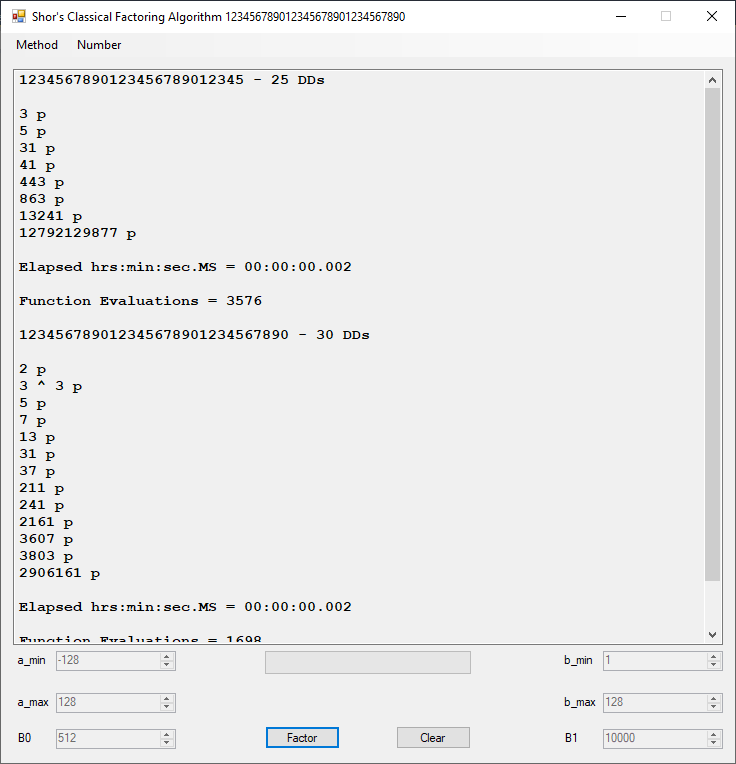
I implemented this algorithm for C long (32-bit) number in 1997, C# big integers in approximately 2015 or 2016, and C unsigned long long (64-bit) integers in March, 2023.
/*
Author:  Pate Williams (c) 1997 - 2023

"Algorithm 8.1.1 (Trial Division). We assume given
a table of prime numbers p[1] = 2, p[2] = 3,..., p[k],
with k > 3, an array t <- [6, 4, 2, 4, 4, 6, 2], and
an index j such that if p[k] mod 30 is equal to
1, 7, 11, 13, 17, 19, 23 or 29 then j is equal to
0, 1, 2, 3, 4, 5, 6 or 7 respectively. Finally, we
give ourselves an upper bound B such that B >= p[k],
essentially to avoid spending too much time. Then
given a positive integer N, this algorithm tries to
factor (or split N) and if it fails, N will be free
of prime factors less than or equal to B."
-Henri Cohen-
See "A Course in Computational Algebraic Number
Theory" by Henri Cohen page 420.
*/

#include <math.h>
#include <stdio.h>
#include <stdlib.h>
#include <string.h>
#include <time.h>

#define BITS_PER_LONG   32
#define BITS_PER_LONG_1 31
#define MAX_SIEVE 100000000L
#define LARGEST_PRIME 99999989L
#define SIEVE_SIZE (MAX_SIEVE / BITS_PER_LONG)

typedef unsigned long long ull;

struct factor { int expon;  ull prime; };
long *prime, sieve[SIEVE_SIZE];

int get_bit(long i, long *sieve) {
	long b = i % BITS_PER_LONG;
	long c = i / BITS_PER_LONG;

	return (sieve[c] >> (BITS_PER_LONG_1 - b)) & 1;
}

void set_bit(long i, long v, long *sieve) {
	long b = i % BITS_PER_LONG;
	long c = i / BITS_PER_LONG;
	long mask = 1 << (BITS_PER_LONG_1 - b);

	if (v == 1)
		sieve[c] |= mask;
	else
		sieve[c] &= ~mask;
}

void Sieve(long n, long *sieve) {
	int c, i, inc;

	set_bit(0, 0, sieve);
	set_bit(1, 0, sieve);
	set_bit(2, 1, sieve);
	for (i = 3; i <= n; i++)
		set_bit(i, i & 1, sieve);
	c = 3;
	do {
		i = c * c, inc = c + c;
		while (i <= n) {
			set_bit(i, 0, sieve);
			i += inc;
		}
		c += 2;
		while (!get_bit(c, sieve)) c++;
	} while (c * c <= n);
}

void get_bits(ull b, int *number, int *bits) {
	int i = 0;
	do {
		bits[i++] = b % 2;
		b = b / 2;
	} while (b > 0);
	*number = i;
}

 ull pow_mod(
	 ull x,
	 ull b,
	 ull n) {
	// Figure 4.4 in "Cryptography Theory and Practice"
	// by Douglas R. Stinson page 127
	int bits[64], i, l;
	ull z = 1, s = 0;

	get_bits(b, &l, bits);
	s = bits[l - 1];
	for (i = l - 2; i >= 0; i--)
		s = 2 * s + bits[i];
	if (b != s) {
		printf("Error in pow_mod function\n");
		exit(-1);
	}
	for (i = l - 1; i >= 0; i--) {
		z = (z * z) % n;
		if (bits[i] == 1)
			z = (z * x) % n;
	}
	return z;
}

ull rand_ull(void) {
	ull r = 0;
	for (int i = 0; i < 64; i += 15 /*30*/) {
		r = r * ((ull)RAND_MAX + 1) + rand();
	}
	return r;
}

int Miller_Rabin(ull n, int t) {
	// returns 1 for prime
	// returns 0 for composite
	// "Handbook of Applied Cryptography"
	// Alfred J. Menezes among others
	// 4.24 Algorithm page 139
	int i, j, s = 0;
	ull a, n1 = n - 1, r, y;

	r = n1;
	while ((r % 2) == 0) {
		s++;
		r /= 2;
	}
	for (i = 0; i < t; i++)
	{
		while (true)
		{
			a = rand_ull() % n;

			if (a >= 2 && a <= n - 2)
				break;
		}
		y = pow_mod(a, r, n);
		if (y != 1 && y != n1) {
			j = 1;
			while (j <= s - 1 && y != n1) {
				y = (y * y) % n;
				if (y == 1)
					return 0;
				j++;
			}
			if (y == n1)
				return 0;
		}
	}
	return 1;
}

int trial_division(ull *N, long *prime,
	struct factor *f, int *count) {
	int found;
	ull B, d;
	int e, i, j = 0, k, m, n;
	int t[8] = { 6, 4, 2, 4, 2, 4, 6, 2 };
	int table[8] = { 1, 7, 11, 13, 17, 19, 23, 29 };
	ull l, r;

	if (*N <= 5) {
		*count = 1;
		f[0].expon = 1;
		switch (*N) {
		case 1: f[0].prime = 1; break;
		case 2: f[0].prime = 2; break;
		case 3: f[0].prime = 3; break;
		case 4: f[0].expon = 2; f[0].prime = 2; break;
		case 5: f[0].prime = 5; break;
		}
		return 1;
	}
	*count = 0;
	B = LARGEST_PRIME;
	i = -1, l = (ull)sqrt((double)*N), m = -1;
L2:
	m++;
	if (i == MAX_SIEVE) {
		i = j - 1;
		goto L5;
	}
	d = prime[m];
	k = d % 30;
	found = 0;
	for (n = 0; !found && n < 8; n++) {
		found = k == table[n];
		if (found) j = n;
	}
L3:
	r = *N % d;
	if (r == 0) {
		e = 0;
		do {
			e++;
			*N /= d;
		} while (*N % d == 0);
		f[*count].expon = e;
		f[*count].prime = d;
		*count = *count + 1;
		if (*N == 1) return 1;
		goto L2;
	}
	if (d >= l) {
		if (*N > 1) {
			f[*count].expon = 1;
			f[*count].prime = *N;
			*count = *count + 1;
			*N = 1;
			return 1;
		}
	}
	else if (i < 0) goto L2;
L5:
	i = (i + 1) % 8;
	d = d + t[i];
	if (d > B) return 0;
	goto L3;
}

int main(void) {
	char e_buffer[256], n_buffer[256] = { 0 };
	long k, e_length, n_length = 0, valid;
	double time_spent;
	int count;
	long i, p = 2;
	ull largest_prime;
	long prime_count = 0;
	ull N, sqrtN;
	struct factor f[32];
	clock_t begin, end;

	begin = clock();
	Sieve(MAX_SIEVE, sieve);
	for (p = 2; p < MAX_SIEVE; p++) {
		while (!get_bit(p, sieve))
			p++;
		prime_count++;
	}
	prime_count--;
	prime = (long*)malloc(prime_count * sizeof(long));
	i = 0;
	p = 2;
	while (i < prime_count)
	{
		while (!get_bit(p, sieve))
			p++;
		prime[i++] = p++;
	}
	largest_prime = LARGEST_PRIME;
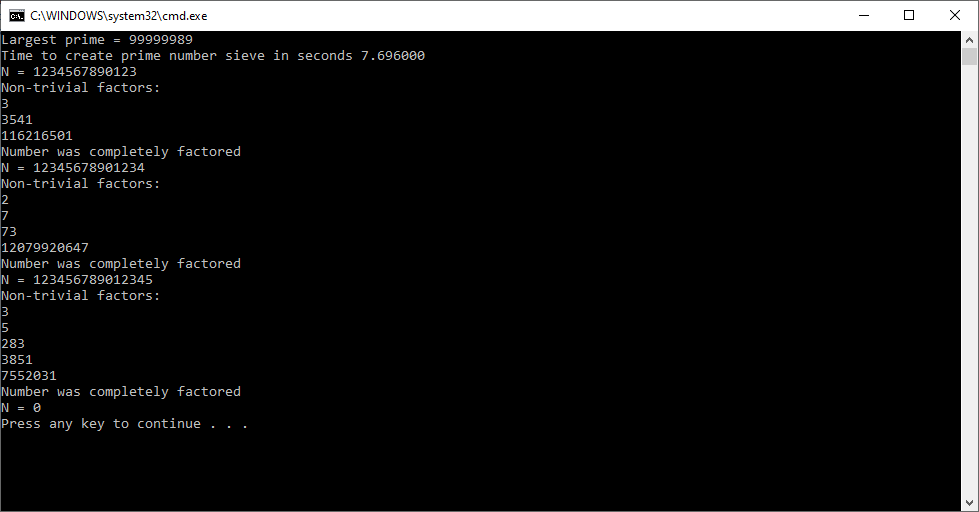
	printf("Largest prime = %I64u\n", largest_prime);
	end = clock();
	time_spent = (double)(end - begin) / CLOCKS_PER_SEC;
	printf("Time to create prime number sieve in seconds %lf\n", time_spent);
	for (;;) {
		printf("N = ");
		scanf_s("%s", e_buffer, 256);
		e_length = strlen(e_buffer);
		n_length = 0;
		valid = 1;
		for (k = 0; valid && k < e_length; k++) {
			if (e_buffer[k] >= '0' &&
				e_buffer[k] <= '9' ||
				e_buffer[k] == ',') {
				if (e_buffer[k] != ',') {
					n_buffer[n_length++] = e_buffer[k];
				}
			}
			else {
				valid = 0;
			}
		}
		if (!valid) {
			printf("Invalid character must in set {0, 1, ..., 9, ',')\n");
			continue;
		}
		else {
			n_buffer[n_length] = '\0';
			N = atoll(n_buffer);
			sqrtN = (ull)sqrt((double)N);
			if (sqrtN > largest_prime) {
				printf("Number is too large!\n");
				printf("Square root %I64u must be < %I64u\n", sqrtN, largest_prime);
				continue;
			}
		}
		if (N <= 0) break;
		trial_division(&N, prime, f, &count);
		printf("Non-trivial factors:\n");
		for (i = 0; i < count; i++) {
			printf("%I64u", f[i].prime);
			if (f[i].expon > 1) printf(" ^ %ld\n", f[i].expon);
			else printf("\n");
		}
		if (N != 1)
		{
			if (Miller_Rabin(N, 20) == 1)
				printf("Residue is a prime number\n");
			else
				printf("Last factor is composite\n");
		}
		else
			printf("Number was completely factored\n");
	}
	return 0;
}














 Numerical Explorations