All of the following computations were performed on a late 2015 Dell XPS 8900 personal computer with a 64-bit Intel Core I7 processor @ 4.0GHz with 16GB of DDR2 RAM.

Factorization of Six Fibonacci Sequence Numbers:


Fibonacci 500

# digits 105

5 ^ 2 p # digits 1

15 c # digits 2

101 p # digits 3

401 p # digits 3

1661 c # digits 4

3001 p # digits 4

10291 c # digits 5

570601 p # digits 6

112128001 p # digits 9

1353439001 p # digits 10

28143378001 p # digits 11

5465167948001 p # digits 13

84817574770589638001 p # digits 20

158414167964045700001 p # digits 21

Runtime (s) = 1.206000


Fibonacci 505

# digits 106

5 p # digits 1

743519377 p # digits 9

44614641121 p # digits 11

770857978613 p # digits 12

960700389041 p # digits 12

12588421794766514566269164716286291055826556238643852856601641 p # digits 62

Runtime (s) = 1.959000


Fibonacci 510

# digits 107

2 ^ 3 p # digits 1

11 p # digits 2

61 p # digits 2

1021 p # digits 4

1597 p # digits 4

3469 p # digits 4

3571 p # digits 4

9521 p # digits 4

53551 p # digits 5

95881 p # digits 5

142445 c # digits 6

1158551 p # digits 7

3415914041 p # digits 10

20778644396941 p # digits 14

20862774425341 p # digits 14

81358225616651 c # digits 14

162716451241291 p # digits 15

Runtime (s) = 2.682000


Fibonacci 515

# digits 108

5 p # digits 1

519121 p # digits 6

5644193 p # digits 7

512119709 p # digits 9

84388938382141 p # digits 14

300367026458796424297447559250634818495937628065437243817852436228914621 p # digits 72

Runtime (s) = 7.861000


Fibonacci 520

# digits 109

131 p # digits 3

451 c # digits 3

521 p # digits 3

2081 p # digits 4

2161 p # digits 4

3121 p # digits 4

24571 p # digits 5

90481 p # digits 5

2519895 c # digits 7

21183761 p # digits 8

57089761 p # digits 8

102193207 p # digits 9

1932300241 p # digits 10

14736206161 p # digits 11

5836312049326721 p # digits 16

42426476041450801 p # digits 17

Runtime (s) = 5.155000


Fibonacci 525

# digits 110

2 p # digits 1

5 p # digits 1

421 p # digits 3

701 p # digits 3

3001 p # digits 4

3965 c # digits 4

4201 p # digits 4

141961 p # digits 6

2553601 p # digits 7

230686501 p # digits 9

8288823481 p # digits 10

82061511001 p # digits 11

19072991752501 c # digits 14

8481116649425701 p # digits 16

17231203730201189308301 p # digits 23

Runtime (s) = 2.026000

Factorization of Six Lucas Sequence Numbers


Lucas 340

113709744839525149336680459091826532688903186653162057995534262332121127

# digits 72

7 p # digits 1

2161 p # digits 4

5441 p # digits 4

897601 p # digits 6

23230657239121 p # digits 14

17276792316211992881 p # digits 20

3834936832404134644974961 p # digits 25

Runtime (s) = 109.103000


Lucas 345

# digits 73

2 ^ 2 p # digits 1

31 p # digits 2

461 p # digits 3

1151 p # digits 4

1529 c # digits 4

324301 p # digits 6

686551 p # digits 6

1485571 p # digits 7

4641631 p # digits 7

19965899801 c # digits 11

117169733521 p # digits 12

3490125311294161 p # digits 16

Runtime (s) = 0.032000


Lucas 350

13985374084677485786380981408251904922622980674054858121032362563653278123

# digits 74

3 p # digits 1

401 p # digits 3

2801 p # digits 4

11521 c # digits 5

28001 p # digits 5

570601 p # digits 6

12317523121 p # digits 11

248773766357061401 p # digits 18

7358192362316341243805801 p # digits 25

Runtime (s) = 21.047000


Lucas 355

69362907070206748494476200566565775354902428015845969798000696945226974645

# digits 74

5 p # digits 1

4261 p # digits 4

6673 p # digits 4

75309701 p # digits 8

309273161 p # digits 9

46165371073 p # digits 11

9207609261398081 p # digits 16

49279722643391864192801 p # digits 23

Runtime (s) = 40.726000


Lucas 360

769246427201094785080787978422393713094534885688979999504447628313150135520

# digits 75

2 ^ 5 p # digits 1

3 ^ 2 p # digits 1

23 p # digits 2

41 p # digits 2

105 c # digits 3

107 p # digits 3

241 p # digits 3

2161 p # digits 4

2521 p # digits 4

3439 c # digits 4

8641 p # digits 4

20641 p # digits 5

103681 p # digits 6

109441 p # digits 6

191306797 c # digits 9

10783342081 p # digits 11

13373763765986881 p # digits 17

Runtime (s) = 0.032000


Lucas 365

19076060504701386559675231910437330047906343529583769121365013189782992678011

# digits 77

11 p # digits 2

151549 p # digits 6

514651 p # digits 6

7015301 p # digits 7

8942501 p # digits 7

9157663121 p # digits 10

11899937029 p # digits 11

3252336525249736694804553589211 p # digits 31

The following two numbers were first factorized by J. M. Pollard on an 8-bit Phillips P2012 personal computer with 64 KB RAM and two 640 KB disc drives. The times required by Pollard were 41 and 47 hours.

2^144-3
22300745198530623141535718272648361505980413

# digits 44

492729991333 p # digits 12

45259565260477899162010980272761 p # digits 32

Runtime (s) = 0.086000

2^153+3
11417981541647679048466287755595961091061972995

# digits 47

5 p # digits 1

11 p # digits 2

600696432006490087537 p # digits 21

345598297796034189382757 p # digits 24

Runtime (s) = 0.676000

Partial factorization of the Twelfth Fermat Number 2^4096+1
# digits 1234

114689 p # digits 6

26017793 p # digits 8

63766529 p # digits 8

190274191361 p # digits 12

Runtime (s) = 1532.878000
Category: Computer Science
Triple Integration of Three Functions Using a Monte Carlo Algorithm and an Adaptive Quadrature Method (c) January 15 – 17, January 2024 by James Pate Williams, Jr.
Back in 2015 I translated a multiple integration FORTRAN subroutine to C# using switch statements to emulate conditional and unconditional go to statements. On January 15 – January 16, 2024, I translated my C# source code to vanilla C. Below is the FORTRAN subroutine’s website:
Here are some web pages with examples of triple integration:
3.4: Numerical Approximation of Multiple Integrals – Mathematics LibreTexts
3.3: Triple Integrals – Mathematics LibreTexts
https://tutorial.math.lamar.edu/Classes/CalcIII/IteratedIntegrals.aspx
https://tutorial.math.lamar.edu/Solutions/CalcIII/TripleIntegrals/Prob1.aspx
https://tutorial.math.lamar.edu/Problems/CalcIII/TripleIntegrals.aspx
I created a C test application to attempt to verify some of the results in online sources. For one example I also used my C# program.
== Menu ==

1 f(x, y, z) = 8 * x * y * z

2 f(x, y, z) = 4 * x * x * y - z * z * z

3 f(x, y, z) = x * y + z

5 Exit

Option: 1

f(x, y, z) = 8 * x * y * z

[0.000000, 1.000000] x [1.000000, 2.000000] x [2.000000, 3.000000]

N       Integral        -+Error         % Error

10      0.754706        0.250631        94.968627

100     1.050263        0.126084        92.998246

1000    1.032125        0.036751        93.119165

10000   1.015068        0.011748        93.232880

100000  1.004080        0.003706        93.306131

1000000 1.000650        0.001169        93.329000

nQuadrature Integral Value and Percent Error: 15.000000 0.000000

== Menu ==

1 f(x, y, z) = 8 * x * y * z

2 f(x, y, z) = 4 * x * x * y - z * z * z

3 f(x, y, z) = x * y + z

5 Exit

Option:

== Menu ==

1 f(x, y, z) = 8 * x * y * z

2 f(x, y, z) = 4 * x * x * y - z * z * z

3 f(x, y, z) = x * y + z

5 Exit

Option: 2

f(x, y, z) = 4 * x * x * y - z * z * z

[2.000000, 3.000000] x [-1.000000, 4.000000] x [1.000000, 0.000000]

N       Integral        -+Error         % Error

10      -12.087502      -3.929801       93.596026

100     -17.622371      -1.969516       90.663644

1000    -17.963837      -0.612528       90.482735

10000   -18.129559      -0.197880       90.394936

100000  -18.018231      -0.062690       90.453917

1000000 -17.939045      -0.019779       90.495870

nQuadrature Integral Value and Percent Error: 188.750000        200.000000

== Menu ==

1 f(x, y, z) = 8 * x * y * z

2 f(x, y, z) = 4 * x * x * y - z * z * z

3 f(x, y, z) = x * y + z

5 Exit

Option:

== Menu ==

1 f(x, y, z) = 8 * x * y * z

2 f(x, y, z) = 4 * x * x * y - z * z * z

3 f(x, y, z) = x * y + z

5 Exit

Option: 3

f(x, y, z) = x * y + z

[0.000000, 3.000000] x [0.000000, 2.000000] x [0.000000, 1.000000]

N       Integral        -+Error         % Error

10      9.243858        2.121562        22.967849

100     12.062489       0.808150        0.520745

1000    12.096541       0.255335        0.804509

10000   12.094473       0.081030        0.787275

100000  12.051033       0.025704        0.425271

1000000 12.009588       0.008121        0.079900

nQuadrature Integral Value and Percent Error: 12.000000 0.000000

== Menu ==

1 f(x, y, z) = 8 * x * y * z

2 f(x, y, z) = 4 * x * x * y - z * z * z

3 f(x, y, z) = x * y + z

5 Exit

Option:
desired relative error 0.001


f#	integral		epsilon		number	err code

1	+1.4346639496E+000	1.295116E-003	257	0

2	+5.7531639665E-001	5.745470E-004	97	0

3	+2.1527578485E+000	1.793429E-003	45	0

4	+1.5998921741E+001	1.579802E-002	151	0

5	+1.8390615688E-001	6.510967E-005	97	0

6	-4.0003324629E+000	3.747971E-003	17	0

7	+8.6330831791E-001	8.563683E-004	45	0

8	+1.5000000000E+001	8.850520E-011	45	0

9	+1.8875000000E+002	1.109797E-009	45	0

10	+1.2000000000E+001	7.081136E-011	45	0


f#	abs errror		percent error

1	+9.7938837210E-005	+6.8261387483E-003

2	+4.7748257754E-005	+8.2987892410E-003

3	+6.1501589893E-004	+2.8576909005E-002

4	+1.0782593204E-003	+6.7391207526E-003

5	+9.9602348685E-007	+5.4159040098E-004

6	+3.3246288154E-004	+8.3115720386E-003

7	+2.6210055455E-004	+3.0369237392E-002

8	+8.8506979523E-011	+5.9004653015E-010

9	+1.1098109098E-009	+5.8797928998E-010

10	+7.0812689046E-011	+5.9010574205E-010
Numbers 8-10 in the preceding data correspond to the three three-dimensional functions in the menu illustrated above. The website claims option 2 in the Menu integral is -755 / 4 = -188.75. My calculation is the same magnitude but a positive sign.
Double Integration of Six Functions Using Three Different Quadrature Algorithms (c) January 15, 2024, by James Pate Williams, Jr. All Applicable Rights Reserved
I utilized six functions that have two independent variables. The integration methods were a Monte Carlo probabilistic procedure, TRICUB from “A Numerical Library in C for Scientists and Engineers” by H. T. Lau, PhD, and an algorithm from the ACM publication. I translated the ACM method from FORTRAN to C. See the following online references:
https://math.libretexts.org/Bookshelves/Calculus/Vector_Calculus_(Corral)/03%3A_Multiple_Integrals/3.04%3A_Numerical_Approximation_of_Multiple_Integrals
https://tutorial.math.lamar.edu/Classes/CalcIII/IteratedIntegrals.aspx
== Menu ==

1 8 * x + 6 * y

2 6 * x * y * y

3 2 * x - 4 * y * y * y

4 x * x * y * y + cos(pi * x) + sin(pi * y)

5 pow(2 * x + 3 * y, -2)

6 x * exp(x * y)

7 Exit

Option: 1

f(x, y) = 8x + 6y

[0.000000, 1.000000] x [0.000000, 2.000000]

N       Integral        +-Error         % Error

10      18.398218       2.687822        8.008911

100     19.546981       0.838888        2.265096

1000    19.859442       0.266101        0.702789

10000   20.152819       0.082772        0.764093

100000  20.014598       0.026273        0.072988

1000000 20.013430       0.008323        0.067150

NUMAL Integral Value and Percent Error: 22.666667       13.333333

nQuadrature Integral Value and Percent Error: 19.999968 0.000160

== Menu ==

1 8 * x + 6 * y

2 6 * x * y * y

3 2 * x - 4 * y * y * y

4 x * x * y * y + cos(pi * x) + sin(pi * y)

5 pow(2 * x + 3 * y, -2)

6 x * exp(x * y)

7 Exit

Option:

== Menu ==

1 8 * x + 6 * y

2 6 * x * y * y

3 2 * x - 4 * y * y * y

4 x * x * y * y + cos(pi * x) + sin(pi * y)

5 pow(2 * x + 3 * y, -2)

6 x * exp(x * y)

7 Exit

Option: 2

f(x, y) = 6 * x * y * y

[1.000000, 2.000000] x [2.000000, 4.000000]

N       Integral        +-Error         % Error

10      6.400786        2.133333        92.380017

100     7.528110        0.951714        91.037965

1000    7.951653        0.294436        90.533746

10000   8.083377        0.094959        90.376933

100000  8.001852        0.029859        90.473986

1000000 8.010457        0.009474        90.463742

NUMAL Integral Value and Percent Error: 204.800000      143.809524

nQuadrature Integral Value and Percent Error: 167.999730        99.999679

== Menu ==

1 8 * x + 6 * y

2 6 * x * y * y

3 2 * x - 4 * y * y * y

4 x * x * y * y + cos(pi * x) + sin(pi * y)

5 pow(2 * x + 3 * y, -2)

6 x * exp(x * y)

7 Exit

Option:

== Menu ==

1 8 * x + 6 * y

2 6 * x * y * y

3 2 * x - 4 * y * y * y

4 x * x * y * y + cos(pi * x) + sin(pi * y)

5 pow(2 * x + 3 * y, -2)

6 x * exp(x * y)

7 Exit

Option: 3

f(x, y) = 2 * x - 4 * y * y * y

[-5.000000, 4.000000] x [0.000000, 3.000000]

N       Integral        +-Error         % Error

10      -645.214459     239.379239      14.654172

100     -436.170436     84.138767       42.305498

1000    -471.478924     25.861533       37.635063

10000   -486.066536     8.338088        35.705485

100000  -484.301805     2.644031        35.938915

1000000 -486.527596     0.839338        35.644498

NUMAL Integral Value and Percent Error: -765.000000     1.190476

nQuadrature Integral Value and Percent Error: -755.998734       0.000167

== Menu ==

1 8 * x + 6 * y

2 6 * x * y * y

3 2 * x - 4 * y * y * y

4 x * x * y * y + cos(pi * x) + sin(pi * y)

5 pow(2 * x + 3 * y, -2)

6 x * exp(x * y)

7 Exit

Option:

== Menu ==

1 8 * x + 6 * y

2 6 * x * y * y

3 2 * x - 4 * y * y * y

4 x * x * y * y + cos(pi * x) + sin(pi * y)

5 pow(2 * x + 3 * y, -2)

6 x * exp(x * y)

7 Exit

Option: 4

f(x, y) = x * x * y * y + cos(pi * x) + sin(pi * y)

[-2.000000, -1.000000] x [0.000000, 1.000000]

N       Integral        +-Error         % Error

10      1.103184        0.173977        22.003269

100     0.708005        0.063869        49.942995

1000    0.757961        0.021546        46.411062

10000   0.744889        0.006866        47.335224

100000  0.748463        0.002171        47.082576

1000000 0.746892        0.000686        47.193609

NUMAL Integral Value and Percent Error: 1.449491        2.481177

nQuadrature Integral Value and Percent Error: 1.414395  0.000160

== Menu ==

1 8 * x + 6 * y

2 6 * x * y * y

3 2 * x - 4 * y * y * y

4 x * x * y * y + cos(pi * x) + sin(pi * y)

5 pow(2 * x + 3 * y, -2)

6 x * exp(x * y)

7 Exit

Option:

== Menu ==

1 8 * x + 6 * y

2 6 * x * y * y

3 2 * x - 4 * y * y * y

4 x * x * y * y + cos(pi * x) + sin(pi * y)

5 pow(2 * x + 3 * y, -2)

6 x * exp(x * y)

7 Exit

Option: 5

f(x, y) = pow(2 * x + 3 * y, -2)

[0.000000, 1.000000] x [1.000000, 2.000000]

N       Integral        +-Error         % Error

10      0.555876        0.235032        1394.669315

100     0.752953        0.323309        1924.579264

1000    0.826769        0.275474        2123.058629

10000   0.927229        0.177631        2393.180482

100000  0.995193        0.097358        2575.927399

1000000 1.291253        0.127325        3371.987619

NUMAL Integral Value and Percent Error: 0.034125        8.243058

nQuadrature Integral Value and Percent Error: 0.037190  0.000639

== Menu ==

1 8 * x + 6 * y

2 6 * x * y * y

3 2 * x - 4 * y * y * y

4 x * x * y * y + cos(pi * x) + sin(pi * y)

5 pow(2 * x + 3 * y, -2)

6 x * exp(x * y)

7 Exit

Option:

== Menu ==

1 8 * x + 6 * y

2 6 * x * y * y

3 2 * x - 4 * y * y * y

4 x * x * y * y + cos(pi * x) + sin(pi * y)

5 pow(2 * x + 3 * y, -2)

6 x * exp(x * y)

7 Exit

Option: 6

f(x, y) = x * exp(x * y)

[0.000000, 1.000000] x [-1.000000, 2.000000]

N       Integral        +-Error         % Error

10      3.217934        1.437426        inf

100     5.562365        0.873166        inf

1000    5.325378        0.225123        inf

10000   5.497069        0.075770        inf

100000  5.362919        0.023344        inf

1000000 5.371802        0.007410        inf

NUMAL Integral Value and Percent Error: 6.162907        inf

nQuadrature Integral Value and Percent Error: 2.562339  inf

Unknown option, please try again.== Menu ==

1 8 * x + 6 * y

2 6 * x * y * y

3 2 * x - 4 * y * y * y

4 x * x * y * y + cos(pi * x) + sin(pi * y)

5 pow(2 * x + 3 * y, -2)

6 x * exp(x * y)

7 Exit

Option:
Revisiting One-dimensional Definite Integration (c) January 15, 2024, by James Pate Williams, Jr.
These tests involve two integration methods from “A Numerical Library in C for Scientists and Engineers” by H. T. Lau, PhD, and two home-grown integration algorithms: Trapezoidal Rule and Simpson’s Rule. The second of the Lau algorithms performs the best.
Integral of f(x) = 10 / (x * x) for various a and b

INTEGRAL delivers:

 -5.000000e+00    0   -5.000000e+00    -2    2

 -7.499999e+00    0   -7.499999e+00    -4    1

 -9.499999e+00    0   -9.499999e+00   -20    0

 -9.999990e+00    1   -9.999990e+00     0    0

Integral of f(x) = sin(x) from 0 to pi

Delivers:   2.000000e+00    0

Approximation of the integral

x * x * exp(x) * sin(x) from 0 to pi

53.566456 0.000000

Steps   Trapezoidal     Simpson         Err Trap        Err Simp

16      52.835728       53.554295       1.364174        0.022724

32      53.383198       53.565685       0.342135        0.001460

48      53.484917       53.566315       0.152242        0.000285

64      53.520687       53.566395       0.085464        0.000135

80      53.537106       53.566418       0.054814        0.000093

96      53.546146       53.566395       0.037936        0.000135

Exact integral 53.566467
Lau’s Merge-Sort Versus Cormen et. al. Quick-Sort (c) January 13-14, 2024, by James Pate Williams, Jr.
The merge-sort I used was from “A Numerical Library in C for Scientists and Engineers” by H. T. Lau Translated from ALGOL NUMAL. The quick-sort algorithm was from “Introduction to Algorithms” by Thomas H. Cormen, Charles E. Leiserson, and Ronald L. Rivest.
== Menu ==

1 Side-by-Side Tests

2 Timing Comparisons

3 Exit

Enter an option: 1

Enter a PRNG Seed >= 1: 1

0.001251        0.001251        0.001251

0.563585        0.014985        0.014985

0.193304        0.174108        0.174108

0.808740        0.193304        0.193304

0.585009        0.303995        0.303995

0.479873        0.350291        0.350291

0.350291        0.479873        0.479873

0.895962        0.513535        0.513535

0.822840        0.563585        0.563585

0.746605        0.585009        0.585009

0.174108        0.710501        0.710501

0.858943        0.746605        0.746605

0.710501        0.808740        0.808740

0.513535        0.822840        0.822840

0.303995        0.858943        0.858943

0.014985        0.895962        0.895962

== Menu ==

1 Side-by-Side Tests

2 Timing Comparisons

3 Exit

Enter an option:
== Menu ==

1 Side-by-Side Tests

2 Timing Comparisons

3 Exit

Enter an option: 2

Enter a PRNG Seed >= 1: 1

mergesort mean runtime = 0.358999

QuickSort mean runtime = 0.290000

mergesort std dev = 0.005610

QuickSort std dev = 0.004532

== Menu ==

1 Side-by-Side Tests

2 Timing Comparisons

3 Exit

Enter an option:
Persides Solution of a Well-Known Space-Time Metric and the Legendre Functions (Polynomials) of the First and Second Kind
https://www.sciencedirect.com/science/article/pii/0022247X73902771
https://en.wikipedia.org/wiki/Laplace%27s_equation
https://math.libretexts.org/Bookshelves/Differential_Equations/A_First_Course_in_Differential_Equations_for_Scientists_and_Engineers_(Herman)/04%3A_Series_Solutions/4.05%3A_Legendre_Polynomials#:~:text=Solutions%20to%20this%20equation%2C%20Pm%20n%28x%29%20and%20Qm,Legendre%20functions%20of%20the%20first%20and%20second%20kind
Fast and Slow Matrix Multiplication by James Pate Williams, Jr. © January 13, 2024, All Applicable Rights Reserved
Note: For comparison with a paper on matrix operations, we use column major order also known as column major echelon order. Column major order is used in Fortran and row major order is utilized in C computations.
Here is the supposedly slow C source code:
void ColMajorSlowMatMul(double** a, double** b, double** c, int n)
{
    for (int j = 1; j <= n; j++)
        for (int k = 1; k <= n; k++)
            c[j][k] = 0.0;

    for (int j = 1; j <= n; j++)
    {
        for (int i = 1; i <= n; i++)
        {
            double t = 0;

            for (int k = 1; k <= n; k++)
                t += a[i][k] * b[k][j];

            c[i][j] = t;
        }
    }
}
And now we present the allegedly fast multiplication code:
void ColMajorFastMatMul(double** a, double** b, double** c, int n)
{
    for (int j = 1; j <= n; j++)
        for (int k = 1; k <= n; k++)
            c[j][k] = 0.0;

    for (int j = 1; j <= n; j++)
    {
        for (int k = 1; k <= n; k++)
        {
            double t = b[k][j];

            for (int i = 1; i <= n; i++)
                c[i][j] += a[i][k] * t;
        }
    }
}
Finally, we have another algorithm for matrix multiplication:
void ColMajorSemiMatMul(double** a, double** b, double** c, int n)
{
    for (int j = 1; j <= n; j++)
        for (int k = 1; k <= n; k++)
            c[j][k] = 0.0;

    for (int j = 1; j <= n; j++)
    {
        for (int i = 1; i <= n; i++)
        {
            for (int k = 1; k <= n; k++)
                c[i][j] += a[i][k] * b[k][j];
        }
    }
}
We performed the following experiments.
slow runtime in microseconds: 2736

semi runtime in microseconds: 4001

fast runtime in microseconds: 5293

n * n = 10000

equal = 10000

n * n = 10000

equal = 10000

slow runtime in microseconds: 21962

semi runtime in microseconds: 29585

fast runtime in microseconds: 28701

n * n = 40000

equal = 40000

n * n = 40000

equal = 40000

slow runtime in microseconds: 67256

semi runtime in microseconds: 101554

fast runtime in microseconds: 107969

n * n = 90000

equal = 90000

n * n = 90000

equal = 90000

slow runtime in microseconds: 183839

semi runtime in microseconds: 268616

fast runtime in microseconds: 244832

n * n = 160000

equal = 160000

n * n = 160000

equal = 160000

slow runtime in microseconds: 428263

semi runtime in microseconds: 638721

fast runtime in microseconds: 650535

n * n = 250000

equal = 250000

n * n = 250000

equal = 250000


C:\Users\james\source\repos\FastMatrixMultiplication\Debug\FastMatrixMultiplication.exe (process 29552) exited with code 0.

Press any key to close this window . . .
// FastMatrixMultiplication.cpp : This file contains the 'main' function. Program execution begins and ends there.
// https://www-users.york.ac.uk/~mijp1/teaching/grad_HPC_for_MatSci/Lecture4.pdf
// https://stackoverflow.com/questions/25483620/how-to-measure-running-time-of-specific-function-in-c-very-accurate

#include <stdlib.h>
#include <chrono>
#include <iostream>
using namespace std;

typedef chrono::high_resolution_clock Clock;

void ColMajorFastMatMul(double** a, double** b, double** c, int n)
{
    for (int j = 1; j <= n; j++)
        for (int k = 1; k <= n; k++)
            c[j][k] = 0.0;

    for (int j = 1; j <= n; j++)
    {
        for (int k = 1; k <= n; k++)
        {
            double t = b[k][j];

            for (int i = 1; i <= n; i++)
                c[i][j] += a[i][k] * t;
        }
    }
}

void ColMajorSemiMatMul(double** a, double** b, double** c, int n)
{
    for (int j = 1; j <= n; j++)
        for (int k = 1; k <= n; k++)
            c[j][k] = 0.0;

    for (int j = 1; j <= n; j++)
    {
        for (int i = 1; i <= n; i++)
        {
            for (int k = 1; k <= n; k++)
                c[i][j] += a[i][k] * b[k][j];
        }
    }
}

void ColMajorSlowMatMul(double** a, double** b, double** c, int n)
{
    for (int j = 1; j <= n; j++)
        for (int k = 1; k <= n; k++)
            c[j][k] = 0.0;

    for (int j = 1; j <= n; j++)
    {
        for (int i = 1; i <= n; i++)
        {
            double t = 0;

            for (int k = 1; k <= n; k++)
                t += a[i][k] * b[k][j];

            c[i][j] = t;
        }
    }
}

void GenerateMatrix(double** a, int n, int seed)
{
    srand(seed);

    for (int j = 1; j <= n; j++)
    {
        for (int k = 1; k <= n; k++)
        {
            a[j][k] = (double)rand() / RAND_MAX;
        }
    }
}

int main()
{
    for (int n = 100; n <= 500; n += 100)
    {
        double** a = new double* [n + 1];
        double** b = new double* [n + 1];
        double** c = new double* [n + 1];
        double** d = new double* [n + 1];
        double** e = new double* [n + 1];

        for (int j = 0; j < n + 1; j++)
        {
            a[j] = new double[n + 1];
            b[j] = new double[n + 1];
            c[j] = new double[n + 1];
            d[j] = new double[n + 1];
            e[j] = new double[n + 1];
        }

        GenerateMatrix(a, n, 1);
        GenerateMatrix(b, n, 2);

        auto clock1 = Clock::now();
        ColMajorSlowMatMul(a, b, c, n);
        auto clock2 = Clock::now();
        long long microseconds1 = chrono::duration_cast<chrono::microseconds>
            (clock2 - clock1).count();

        auto clock3 = Clock::now();
        ColMajorSemiMatMul(a, b, d, n);
        auto clock4 = Clock::now();
        long long microseconds2 = chrono::duration_cast<chrono::microseconds>
            (clock4 - clock3).count();

        auto clock5 = Clock::now();
        ColMajorFastMatMul(a, b, e, n);
        auto clock6 = Clock::now();
        long long microseconds3 = chrono::duration_cast<chrono::microseconds>
            (clock6 - clock5).count();

        cout << "slow runtime in microseconds: " << microseconds1 << endl;
        cout << "semi runtime in microseconds: " << microseconds2 << endl;
        cout << "fast runtime in microseconds: " << microseconds3 << endl;

        long long equal = 0;

        for (int j = 1; j <= n; j++)
            for (int k = 1; k <= n; k++)
                if (c[j][k] == d[j][k])
                    equal++;

        cout << "n * n = " << n * n << endl;
        cout << "equal = " << equal << endl;

        equal = 0;

        for (int j = 1; j <= n; j++)
            for (int k = 1; k <= n; k++)
                if (c[j][k] == e[j][k])
                    equal++;

        cout << "n * n = " << n * n << endl;
        cout << "equal = " << equal << endl;

        for (int j = 0; j < n + 1; j++)
        {
            delete[] a[j];
            delete[] b[j];
            delete[] c[j];
            delete[] d[j];
            delete[] e[j];
        }

        delete[] a;
        delete[] b;
        delete[] c;
        delete[] d;
        delete[] e;
    }
}
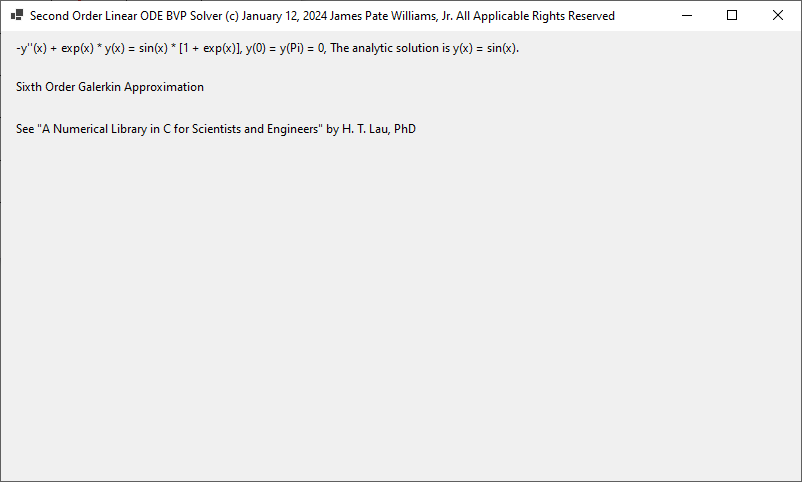
Sixth Order Galerkin Approximate Solution of a Second Order Linear Ordinary Differential Equation by James Pate Williams, Jr. January 12, 2024
Second Order Linear Boundary Value Problem Solution

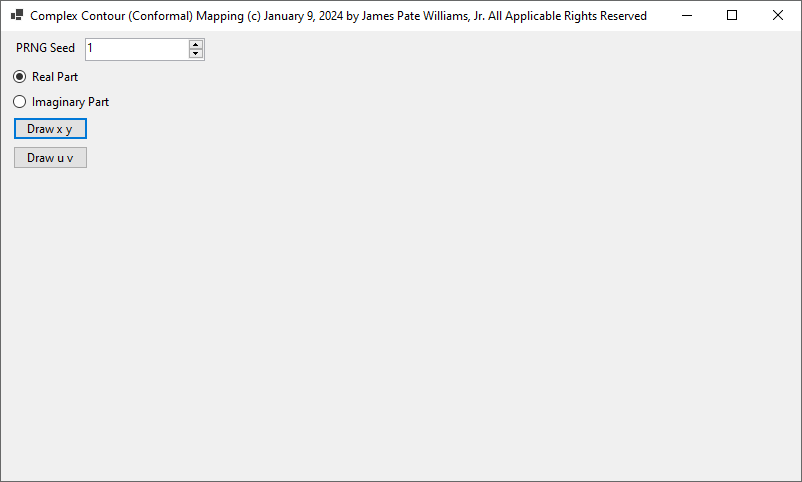
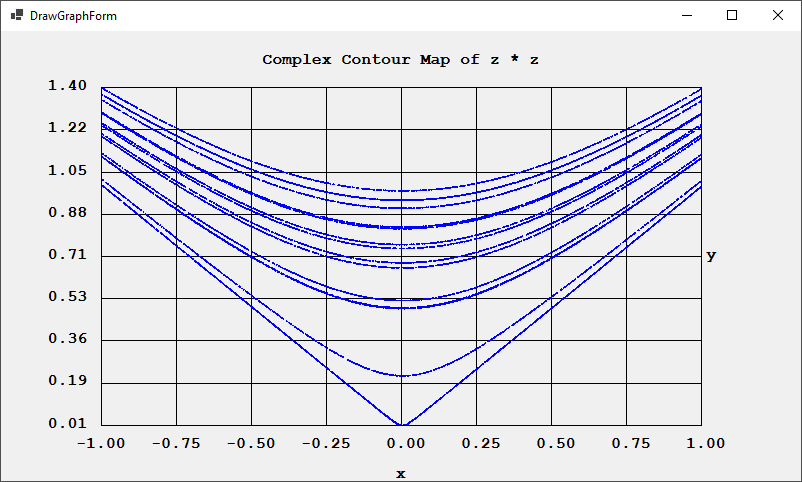
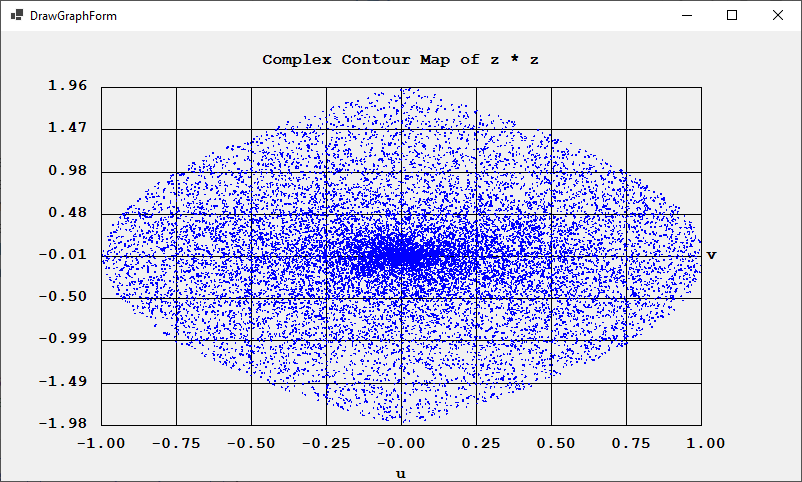
Complex Contour (Conformal) Mapping by James Pate Williams, Jr. on January 9, 2024
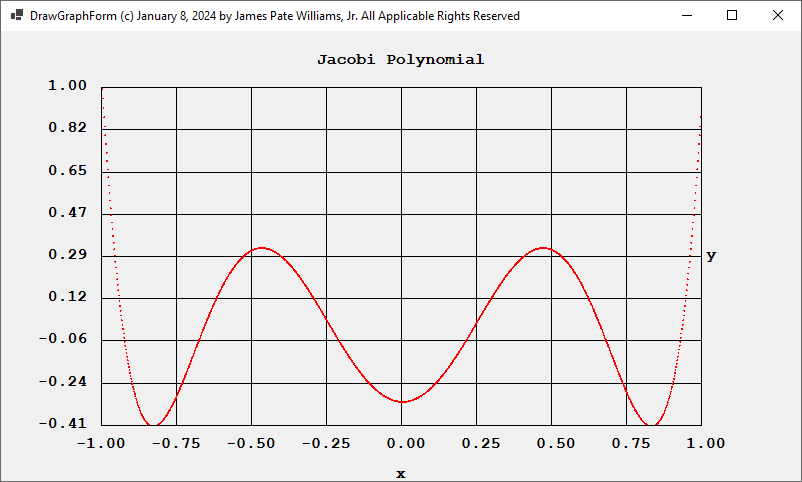
New Jacobi Polynomials Application January 8, 2024, by James Pate Williams, Jr.
The two primary references used to create my application were: “A Numerical Library in C for Scientists and Engineers” by H. T. Lau and the following website: https://en.wikipedia.org/wiki/Jacobi_polynomials.
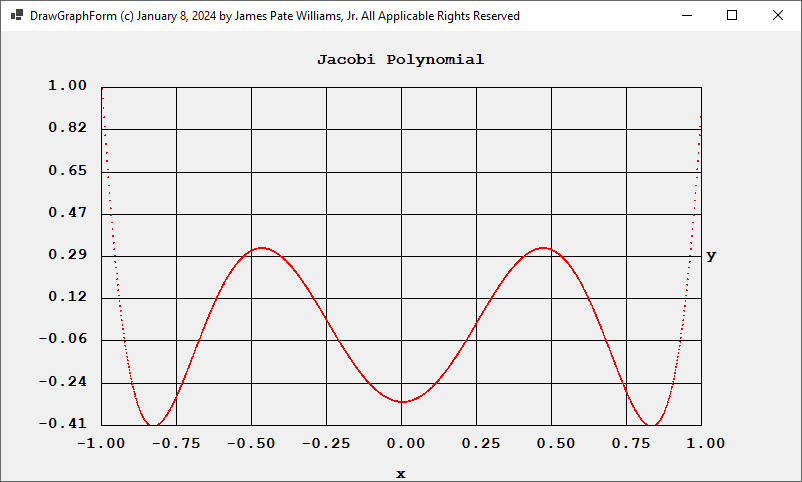
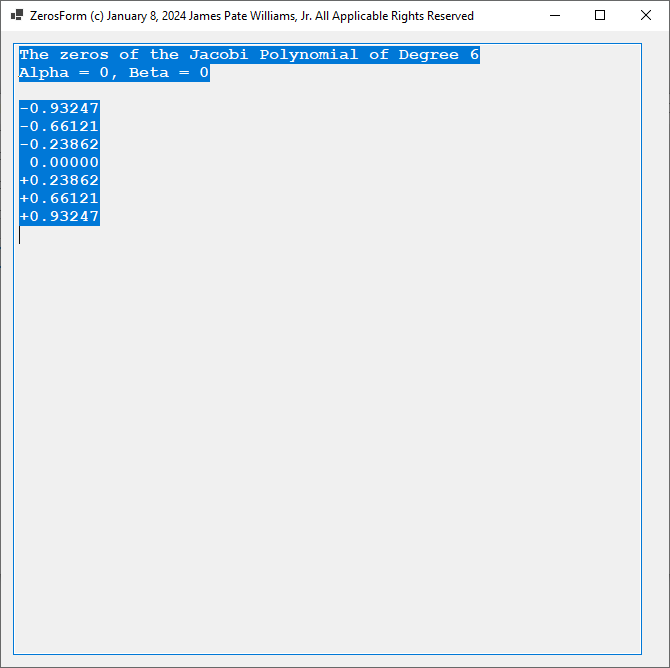
Using the Jacobi parameters alpha = 0 and beta = 0, we have the Legendre polynomials for degrees 4 and 6 and their associated roots:


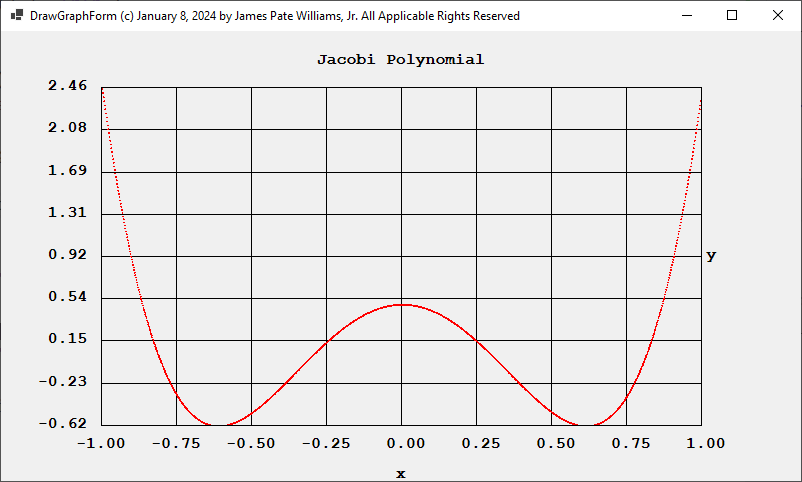
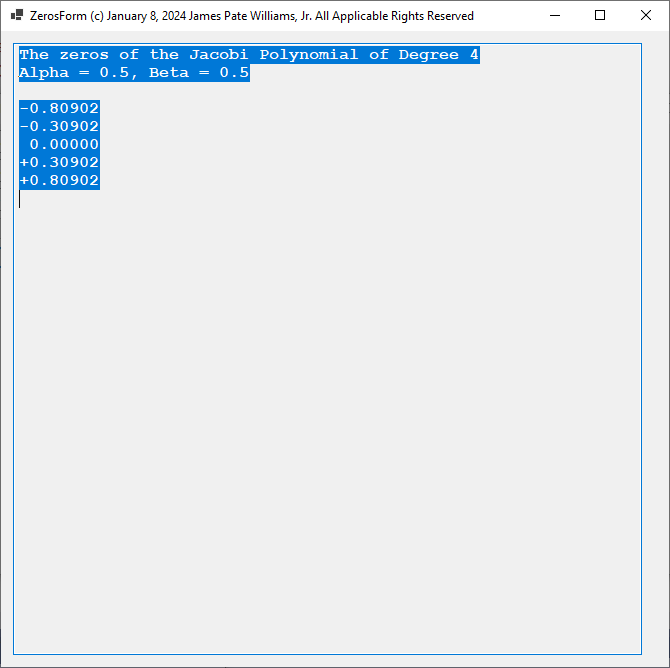
Using alpha = 0.5 and beta= 0.5 we obtain for degrees 4 and 6:

 Numerical Explorations