I tested NUMAL’s integration function versus homegrown trapezoidal rule and Simpson’s rule. The second and third algorithms were closed (included both endpoints). There exist higher order Newton-Cotes integration formulas. I did not test the Gauss-Legendre and/or Gauss-Laguerre integration method(s). The trapezoidal rule can be improved if the derivative of the integrand is known and is easily calculated.
Category: Computer Science
C Sorting DLL Experimental Results by James Pate Williams, Jr. (c) March 22, 2024, All Applicable Rights Reserved
Microsoft Visual Studio 2019 Community Version – Creating and Using a C Based Dynamic Link Library © March 22, 2024, by James Pate Williams, Jr.
Create a solution using the DLL C++ DLL template. Rename pch.cpp to pch.c and dllmain.cpp to dllmain.c. Add a header file for the DLL containing the following macro:
#define DLL_Export __declspec(dllexport)
Mark all the exportable functions in the DLL header file with the DLL_Export macro. Suppose the DLL is named CSortingDLL. Next create a console C++ project in the DLL solution to use the DLL. Open the Properties page of the console app. If you want to use the ASCII character set, select the Advanced Configuration Properties, and set the Character Set to Not Set. Now open the C/C++ General Property and under Additional Include Directories add ..\CSortingDLL\;. Do not include the previous period mark. Next open the Linker General Property page. Set Additional Library Directories to ..\CSortingDLL\$(IntDir);. The penultimate step is to set the Linker Input Additional Dependencies to CSortingDLL.lib;. The final step for the app is to add a reference to CSortingDLL. Now you have a functioning DLL and an app using the DLL. If you have any questions, please contact me via email at jamespate@mac.com. Also, Microsoft has a DLL walkthrough complete with source code. I will add my CSortingDLL header source code as a PDF document.
BigInteger Multitasking Agrawal, Kayal, and Saxena (AKS) Primality Test (c) June 19, 2016, by James Pate Williams, Jr. Microsoft TechNet Project Description
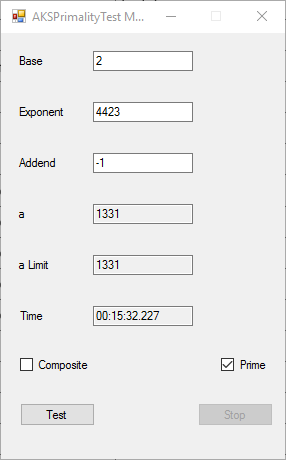
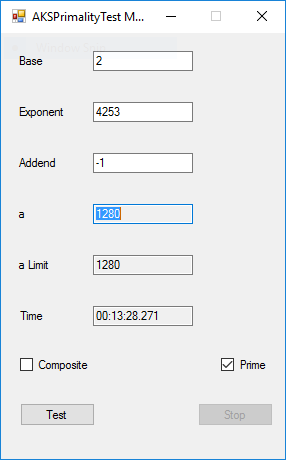
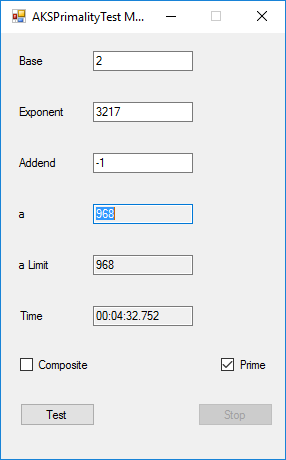
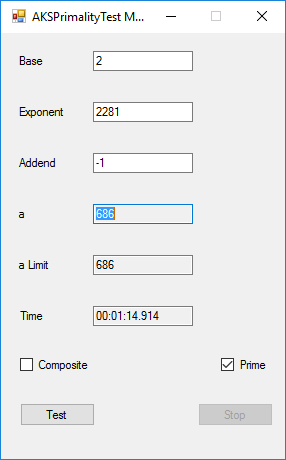
This application implements the algorithm described in the paper at the URL http://www.cse.iitk.ac.in/users/manindra/algebra/primality_v6.pdf. I replaced Step 1 of the algorithm with the Miller-Rabin probabilistic primality test. If that test shows that the number is composite, I return the value COMPOSITE. This algorithm is much easier to implement and understand that Wieb Bosmer’s Primality Proving with Cyclotomy also known as the Jacobi sums primality test. As a test we determine that the following Mersenne numbers are prime: M_1279, M_2203, M_2281, M_3217, and M_4253 where M_n = 2 ^ n – 1, and the primes have 386, 664, 687, 969, and 1281 decimal digits, respectively. M_1279 was first proven prime by Raphael M. Robinson on June 25, 1952, using the Lucas-Lehmer test on a SWAC computer. The same author found that M_2203 was prime on October 7, 1952, and M_2281 was prime on October 9, 1952, using the same method and computer. Hans Riesel determined that M_3217 was prime on September 8, 1957, using the Lucas-Lehmer test on a BESK computer. M_4253 was proven prime on November 3, 1961 by Alexander Hurwitz using the Lucas-Lehmer test on an IBM 7090 mainframe computer. See http://www.mersenne.org/primes/ for many more Mersenne primes. All of the computations illustrated below were performed on a late November 2015 Dell XPS 8900 computer with 16 GB RAM Intel(R) Core(TM) i7-6700K CPU @ 4.00 GHz running Windows 10 Pro. The .Net framework is .Net 4.5.2. This is a multitasking version of the original BigInteger variant of the application. Someone with a quad core CPU with 8 virtual processors can try NumberTasks = 8 to see if that speeds up this application more or less. I usually try to limit the number of tasks to actual number of cores.
Preliminary Factorization Results of the Thirteenth Fermat Number (c) February 5, 2024, by James Pate Williams, Jr.
I am working on a factorization of the Thirteenth Fermat number which is 2 ^ 8192 + 1 and is 2,467 decimal digits in length. I am using Pollard’s factoring with cubic integers on the number (2 ^ 2731) ^ 3 + 2. I am also utilizing a homegrown variant of the venerable Pollard and Brent rho method and Arjen K. Lenstra’s Free LIP Elliptic Curve Method. I can factor the seventh Fermat number 2 ^ 128 + 1 in five to thirty minutes using my C# code. The factoring with cubic integers code is in C and uses Free-LIP.
Fermat factoring status (prothsearch.com)
The following is a run of Lenstra’s ECM algorithm:
== Data Menu ==
1 Simple Number
2 Fibonacci Sequence Number
3 Lucas Sequence Number
4 Exit
Enter option (1 – 4): 1
Enter a number to be factored: 2^8192+1
Enter a random number generator seed: 1
== Factoring Menu ==
1 Lenstra’s ECM
2 Lenstra’s Pollard-Rho
3 Pollard’s Factoring with Cubic Integers
Option (1 – 3): 1
2710954639361 p # digits 13
3603109844542291969 p # digits 19
Runtime (s) = 17015.344000
I aborted the previous computation due to the fact I was curious about the number of prime factors that could be found on personal computer. I will try a lot more calculation time in a future run. My homegrown application is able to at least find the first factor of Fermat Number 13.
Latest Factoring Results (c) February 4, 2024, by James Pate Williams, Jr.
I am testing two factoring algorithms: Pollard-Shor-Williams’s method, a home-grown version of the venerable Pollard rho algorithm and Pollard’s factoring with cubic integers. The second recipe is from “The Development of the Number Field Sieve” edited by Arjen K. Lenstra and Hendrik W. Lenstra, Jr. I use the 20-digit test number, 2 ^ 66 + 2 = 73786976294838206466. My method is very fast with this number as shown below:
2^66+2
73786976294838206466 20
Pseudo-Random Number Generator Seed = 1
Number of Tasks = 1
2 p 1
3 p 1
11 p 2
131 p 3
2731 p 4
409891 p 6
7623851 p 7
Elapsed hrs:min:sec.MS = 00:00:00.652
Function Evaluations = 1995
The Pollard factoring with cubic integers takes a long time but is capable of factoring much larger numbers. The results of the full factorization of my test number are:
== Data Menu ==
1 Simple Number
2 Fibonacci Sequence Number
3 Lucas Sequence Number
4 Exit
Enter option (1 – 4): 1
Enter a number to be factored: 2^66+2
Enter a random number generator seed: 1
== Factoring Menu ==
1 Lenstra’s ECM
2 Lenstra’s Pollard-Rho
3 Pollard’s Factoring with Cubic Integers
Option (1 – 3): 3
73786976294838206466
Enter a lower bound : -50000
Enter a upper bound : +50000
Enter b lower bound : +1
Enter b upper bound : +50000
Enter maximum kernels : 1024
Enter algebraic prime count: 300
Enter rational prime count: 300
Enter lo large prime bound: 10000
Enter hi large prime bound: 11000
Numbers sieved = 452239293
Successes 0 gcd(a, b) is 1 = 274929004
Successes 1 rational smooth a + b * r = 181838258
Successes 2 long long smooth = 68959
Successes 3 kernels tested = 535
2 p # digits 1
3 p # digits 1
11 p # digits 2
131 p # digits 3
2731 p # digits 4
409891 p # digits 6
7623851 p # digits 7
Runtime (s) = 36383.696000
It took over ten hours to fully factor, 2 ^ 66 + 2. I am currently attempting to factor the Thirteenth Fermat number which is 2 ^ (2 ^ 13) + 1 = 2 ^ 8192 + 1. The number has 2,467 decimal digits. I am using 399 algebraic prime numbers, 600 rational prime numbers, and 316 “large prime numbers” (primes between 12,000 and 15,000). I have to find the kernels of a 1316 by 1315 matrix. I am trying the factorization using a maximum of 8192 kernels. I suspect this computation will take about a week on my desktop workstation. There is no guarantee that I will find a non-trivial factor of 2 * (2731 ^ 3) + 2.
Open Assault on the Fret Board (c) February 3, 2024, by James Pate Williams, Jr. Using Universal Audio’s Waterfall B3 Hammond Organ Software Emulator with Nomad Factory VST2 Audio Effects in SONAR Platinum Digital Audio Workstation
Up and Down the Stairway to Another Realm Instrumental Rock (c) January 31, 2024, by James Pate Williams, Jr. Using SONAR Platinum and the Universal Audio MOOG Mini-Moog Plug-In
Factorizations of Some Fibonacci Sequence Numbers, Lucas Sequence Numbers and Some Other Numbers Using Arjen K. Lenstra’s Free Large Integer Package and the Elliptic Curve Method (c) January 28, 2024, by James Pate Williams, Jr.
All of the following computations were performed on a late 2015 Dell XPS 8900 personal computer with a 64-bit Intel Core I7 processor @ 4.0GHz with 16GB of DDR2 RAM.

Factorization of Six Fibonacci Sequence Numbers:


Fibonacci 500

# digits 105

5 ^ 2 p # digits 1

15 c # digits 2

101 p # digits 3

401 p # digits 3

1661 c # digits 4

3001 p # digits 4

10291 c # digits 5

570601 p # digits 6

112128001 p # digits 9

1353439001 p # digits 10

28143378001 p # digits 11

5465167948001 p # digits 13

84817574770589638001 p # digits 20

158414167964045700001 p # digits 21

Runtime (s) = 1.206000


Fibonacci 505

# digits 106

5 p # digits 1

743519377 p # digits 9

44614641121 p # digits 11

770857978613 p # digits 12

960700389041 p # digits 12

12588421794766514566269164716286291055826556238643852856601641 p # digits 62

Runtime (s) = 1.959000


Fibonacci 510

# digits 107

2 ^ 3 p # digits 1

11 p # digits 2

61 p # digits 2

1021 p # digits 4

1597 p # digits 4

3469 p # digits 4

3571 p # digits 4

9521 p # digits 4

53551 p # digits 5

95881 p # digits 5

142445 c # digits 6

1158551 p # digits 7

3415914041 p # digits 10

20778644396941 p # digits 14

20862774425341 p # digits 14

81358225616651 c # digits 14

162716451241291 p # digits 15

Runtime (s) = 2.682000


Fibonacci 515

# digits 108

5 p # digits 1

519121 p # digits 6

5644193 p # digits 7

512119709 p # digits 9

84388938382141 p # digits 14

300367026458796424297447559250634818495937628065437243817852436228914621 p # digits 72

Runtime (s) = 7.861000


Fibonacci 520

# digits 109

131 p # digits 3

451 c # digits 3

521 p # digits 3

2081 p # digits 4

2161 p # digits 4

3121 p # digits 4

24571 p # digits 5

90481 p # digits 5

2519895 c # digits 7

21183761 p # digits 8

57089761 p # digits 8

102193207 p # digits 9

1932300241 p # digits 10

14736206161 p # digits 11

5836312049326721 p # digits 16

42426476041450801 p # digits 17

Runtime (s) = 5.155000


Fibonacci 525

# digits 110

2 p # digits 1

5 p # digits 1

421 p # digits 3

701 p # digits 3

3001 p # digits 4

3965 c # digits 4

4201 p # digits 4

141961 p # digits 6

2553601 p # digits 7

230686501 p # digits 9

8288823481 p # digits 10

82061511001 p # digits 11

19072991752501 c # digits 14

8481116649425701 p # digits 16

17231203730201189308301 p # digits 23

Runtime (s) = 2.026000

Factorization of Six Lucas Sequence Numbers


Lucas 340

113709744839525149336680459091826532688903186653162057995534262332121127

# digits 72

7 p # digits 1

2161 p # digits 4

5441 p # digits 4

897601 p # digits 6

23230657239121 p # digits 14

17276792316211992881 p # digits 20

3834936832404134644974961 p # digits 25

Runtime (s) = 109.103000


Lucas 345

# digits 73

2 ^ 2 p # digits 1

31 p # digits 2

461 p # digits 3

1151 p # digits 4

1529 c # digits 4

324301 p # digits 6

686551 p # digits 6

1485571 p # digits 7

4641631 p # digits 7

19965899801 c # digits 11

117169733521 p # digits 12

3490125311294161 p # digits 16

Runtime (s) = 0.032000


Lucas 350

13985374084677485786380981408251904922622980674054858121032362563653278123

# digits 74

3 p # digits 1

401 p # digits 3

2801 p # digits 4

11521 c # digits 5

28001 p # digits 5

570601 p # digits 6

12317523121 p # digits 11

248773766357061401 p # digits 18

7358192362316341243805801 p # digits 25

Runtime (s) = 21.047000


Lucas 355

69362907070206748494476200566565775354902428015845969798000696945226974645

# digits 74

5 p # digits 1

4261 p # digits 4

6673 p # digits 4

75309701 p # digits 8

309273161 p # digits 9

46165371073 p # digits 11

9207609261398081 p # digits 16

49279722643391864192801 p # digits 23

Runtime (s) = 40.726000


Lucas 360

769246427201094785080787978422393713094534885688979999504447628313150135520

# digits 75

2 ^ 5 p # digits 1

3 ^ 2 p # digits 1

23 p # digits 2

41 p # digits 2

105 c # digits 3

107 p # digits 3

241 p # digits 3

2161 p # digits 4

2521 p # digits 4

3439 c # digits 4

8641 p # digits 4

20641 p # digits 5

103681 p # digits 6

109441 p # digits 6

191306797 c # digits 9

10783342081 p # digits 11

13373763765986881 p # digits 17

Runtime (s) = 0.032000


Lucas 365

19076060504701386559675231910437330047906343529583769121365013189782992678011

# digits 77

11 p # digits 2

151549 p # digits 6

514651 p # digits 6

7015301 p # digits 7

8942501 p # digits 7

9157663121 p # digits 10

11899937029 p # digits 11

3252336525249736694804553589211 p # digits 31

The following two numbers were first factorized by J. M. Pollard on an 8-bit Phillips P2012 personal computer with 64 KB RAM and two 640 KB disc drives. The times required by Pollard were 41 and 47 hours.

2^144-3
22300745198530623141535718272648361505980413

# digits 44

492729991333 p # digits 12

45259565260477899162010980272761 p # digits 32

Runtime (s) = 0.086000

2^153+3
11417981541647679048466287755595961091061972995

# digits 47

5 p # digits 1

11 p # digits 2

600696432006490087537 p # digits 21

345598297796034189382757 p # digits 24

Runtime (s) = 0.676000

Partial factorization of the Twelfth Fermat Number 2^4096+1
# digits 1234

114689 p # digits 6

26017793 p # digits 8

63766529 p # digits 8

190274191361 p # digits 12

Runtime (s) = 1532.878000
Triple Integration of Three Functions Using a Monte Carlo Algorithm and an Adaptive Quadrature Method (c) January 15 – 17, January 2024 by James Pate Williams, Jr.
Back in 2015 I translated a multiple integration FORTRAN subroutine to C# using switch statements to emulate conditional and unconditional go to statements. On January 15 – January 16, 2024, I translated my C# source code to vanilla C. Below is the FORTRAN subroutine’s website:
Here are some web pages with examples of triple integration:
3.4: Numerical Approximation of Multiple Integrals – Mathematics LibreTexts
3.3: Triple Integrals – Mathematics LibreTexts
https://tutorial.math.lamar.edu/Classes/CalcIII/IteratedIntegrals.aspx
https://tutorial.math.lamar.edu/Solutions/CalcIII/TripleIntegrals/Prob1.aspx
https://tutorial.math.lamar.edu/Problems/CalcIII/TripleIntegrals.aspx
I created a C test application to attempt to verify some of the results in online sources. For one example I also used my C# program.
== Menu ==

1 f(x, y, z) = 8 * x * y * z

2 f(x, y, z) = 4 * x * x * y - z * z * z

3 f(x, y, z) = x * y + z

5 Exit

Option: 1

f(x, y, z) = 8 * x * y * z

[0.000000, 1.000000] x [1.000000, 2.000000] x [2.000000, 3.000000]

N       Integral        -+Error         % Error

10      0.754706        0.250631        94.968627

100     1.050263        0.126084        92.998246

1000    1.032125        0.036751        93.119165

10000   1.015068        0.011748        93.232880

100000  1.004080        0.003706        93.306131

1000000 1.000650        0.001169        93.329000

nQuadrature Integral Value and Percent Error: 15.000000 0.000000

== Menu ==

1 f(x, y, z) = 8 * x * y * z

2 f(x, y, z) = 4 * x * x * y - z * z * z

3 f(x, y, z) = x * y + z

5 Exit

Option:

== Menu ==

1 f(x, y, z) = 8 * x * y * z

2 f(x, y, z) = 4 * x * x * y - z * z * z

3 f(x, y, z) = x * y + z

5 Exit

Option: 2

f(x, y, z) = 4 * x * x * y - z * z * z

[2.000000, 3.000000] x [-1.000000, 4.000000] x [1.000000, 0.000000]

N       Integral        -+Error         % Error

10      -12.087502      -3.929801       93.596026

100     -17.622371      -1.969516       90.663644

1000    -17.963837      -0.612528       90.482735

10000   -18.129559      -0.197880       90.394936

100000  -18.018231      -0.062690       90.453917

1000000 -17.939045      -0.019779       90.495870

nQuadrature Integral Value and Percent Error: 188.750000        200.000000

== Menu ==

1 f(x, y, z) = 8 * x * y * z

2 f(x, y, z) = 4 * x * x * y - z * z * z

3 f(x, y, z) = x * y + z

5 Exit

Option:

== Menu ==

1 f(x, y, z) = 8 * x * y * z

2 f(x, y, z) = 4 * x * x * y - z * z * z

3 f(x, y, z) = x * y + z

5 Exit

Option: 3

f(x, y, z) = x * y + z

[0.000000, 3.000000] x [0.000000, 2.000000] x [0.000000, 1.000000]

N       Integral        -+Error         % Error

10      9.243858        2.121562        22.967849

100     12.062489       0.808150        0.520745

1000    12.096541       0.255335        0.804509

10000   12.094473       0.081030        0.787275

100000  12.051033       0.025704        0.425271

1000000 12.009588       0.008121        0.079900

nQuadrature Integral Value and Percent Error: 12.000000 0.000000

== Menu ==

1 f(x, y, z) = 8 * x * y * z

2 f(x, y, z) = 4 * x * x * y - z * z * z

3 f(x, y, z) = x * y + z

5 Exit

Option:
desired relative error 0.001


f#	integral		epsilon		number	err code

1	+1.4346639496E+000	1.295116E-003	257	0

2	+5.7531639665E-001	5.745470E-004	97	0

3	+2.1527578485E+000	1.793429E-003	45	0

4	+1.5998921741E+001	1.579802E-002	151	0

5	+1.8390615688E-001	6.510967E-005	97	0

6	-4.0003324629E+000	3.747971E-003	17	0

7	+8.6330831791E-001	8.563683E-004	45	0

8	+1.5000000000E+001	8.850520E-011	45	0

9	+1.8875000000E+002	1.109797E-009	45	0

10	+1.2000000000E+001	7.081136E-011	45	0


f#	abs errror		percent error

1	+9.7938837210E-005	+6.8261387483E-003

2	+4.7748257754E-005	+8.2987892410E-003

3	+6.1501589893E-004	+2.8576909005E-002

4	+1.0782593204E-003	+6.7391207526E-003

5	+9.9602348685E-007	+5.4159040098E-004

6	+3.3246288154E-004	+8.3115720386E-003

7	+2.6210055455E-004	+3.0369237392E-002

8	+8.8506979523E-011	+5.9004653015E-010

9	+1.1098109098E-009	+5.8797928998E-010

10	+7.0812689046E-011	+5.9010574205E-010
Numbers 8-10 in the preceding data correspond to the three three-dimensional functions in the menu illustrated above. The website claims option 2 in the Menu integral is -755 / 4 = -188.75. My calculation is the same magnitude but a positive sign.

