Category: Constraint Satisfaction Problems
Microsoft C# Constraint Satisfaction Dynamic Link Library (DLL) and Test Application





Constraint Satisfaction DLL Source Code Files
Source Code File 	Lines of Code
Arc.cs	42
Common.cs	214
Label.cs	62
NQPArcConsisitencies.cs	148
NQPBacktrack.cs	51
NQPSosicGu.cs	234
Vertex.cs	18
YakooGCPWCSA.cs	160
Total	929

Source Code File	Lines of Code
GCPGraphForm.cs	173
MainForm.cs	42
NQPGraphForm.cs	137
NQPTableForm.cs	223
Total	575

Source
1.	Foundations of Constraint Satisfaction by Edward Tsang
Sosic and Gu Fast N-Queens Problem Solver Implemented by James Pate Williams, Jr.
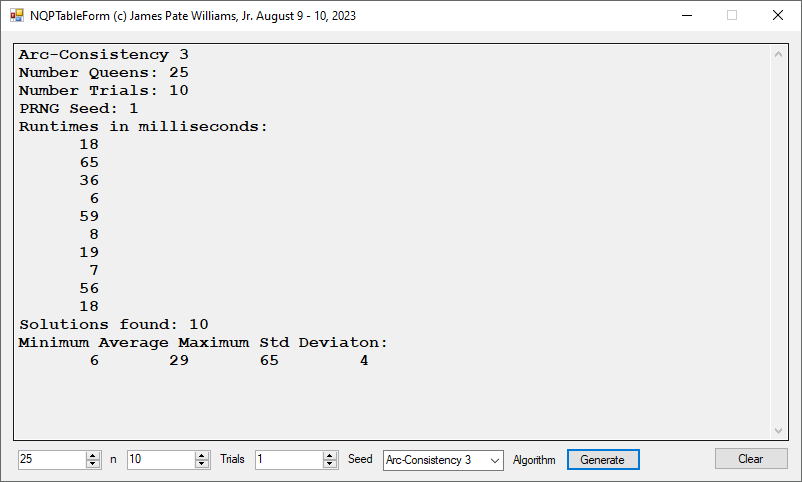
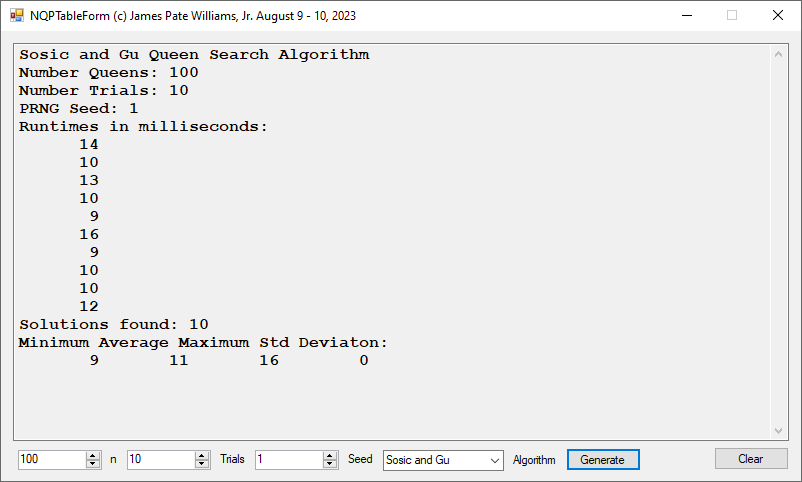
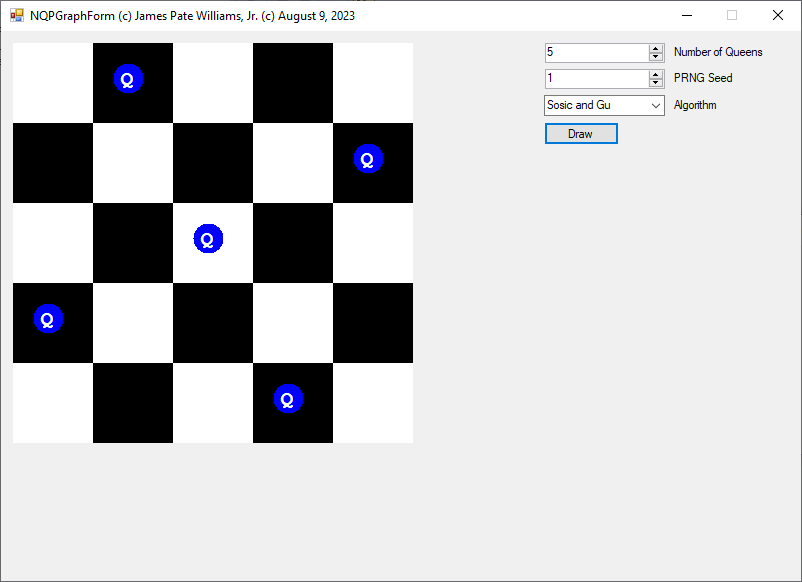
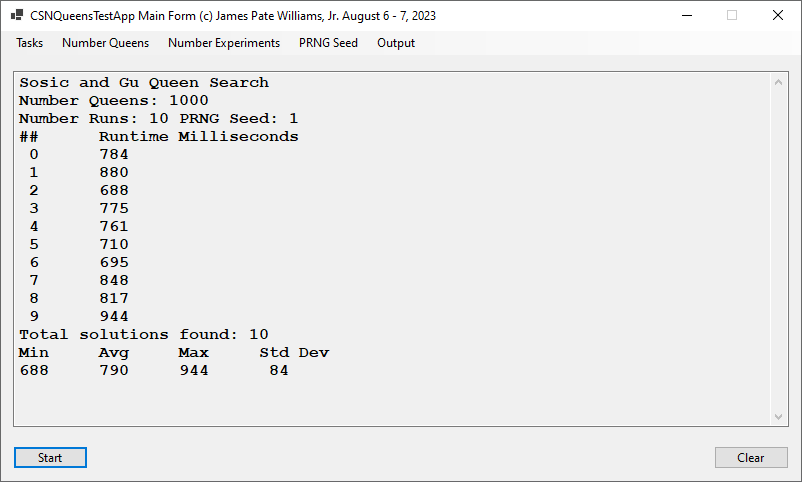
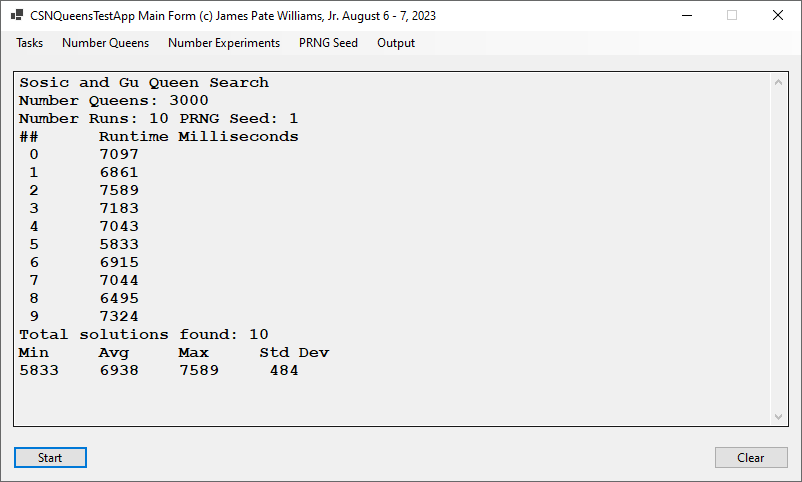
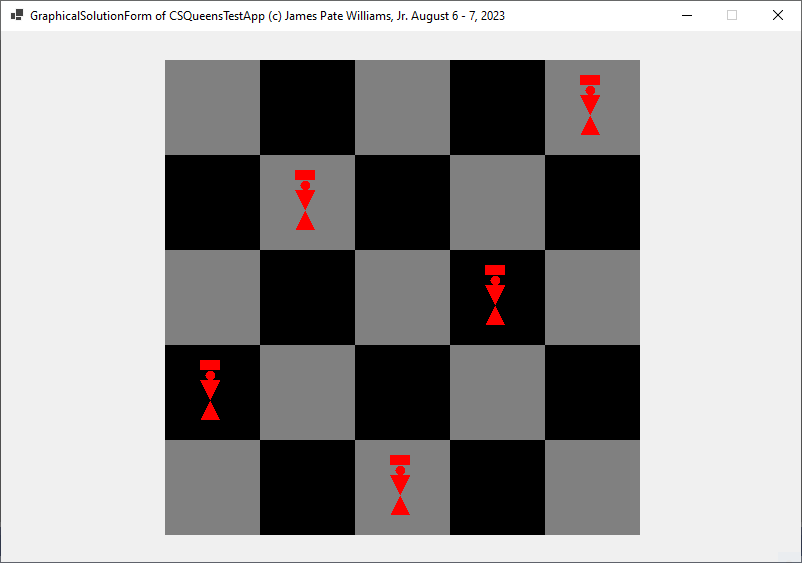
I implemented the Sosic and Gu fast N-Queens solver first in C++ and later in C#. The five screen shots below were created by latest C# application. None of my other algorithms can compete with this method.


More N-Queens Puzzle Results by James Pate Williams, Jr.
N-Queens Tests
8 Queens	Microseconds		50 Samples
Algorithm	Minimum	Average	Maximum	Std Dev
Arc-Consistency 3	1846	4148	14220	2294
Arc-Consistency 4	3850	8987	27903	5022
Backjump	175	1057	3873	883
Backmark	198	737	3323	596
Backtracking	171	789	3132	652
Hill-Climber	1991	2097	2913	157

9 Queens	Microseconds		50 Samples
Algorithm	Minimum	Average	Maximum	Std Dev
Arc-Consistency 3	2628	5785	15748	3202
Arc-Consistency 4	7492	18057	56587	11114
Backjump	208	1410	6184	1325
Backmark	214	866	4468	880
Backtracking	210	1269	6156	1186
Hill-Climber	1309	1398	1953	102

10 Queens	Microseconds		50 Samples
Algorithm	Minimum	Average	Maximum	Std Dev
Arc-Consistency 3	3820	10680	30708	6963
Arc-Consistency 4	12624	46645	148221	31212
Backjump	248	3970	16736	3805
Backmark	283	1504	7613	1433
Backtracking	227	2857	12882	3022
Hill-Climber	24575	25608	33563	2037
My hill-climber results are pretty disappointing. I have gotten some decent runs of back-marking for n = 50 and n = 60 queens. I show the n = 60 queens experiment below.
==Menu==
**Instance Submenu**
1 Single Instance Test
2 Multiple Instances Test
3 Exit
Enter an option '1' to '3': 2
**Algorithm Submenu**
1 Arc-Consistency 3
2 Arc-Consistency 4
3 Backjump
4 Backmark
5 Chronological Bactracking
6 Evolutionary Hill-Climber
7 Exit
Enter an algorithm ('1' to '7'): 4
Enter the number of queens for option '2': 60
Enter the number of samples to be analyzed: 10
Minimum Runtime in Microseconds: 4819
Average Runtime in Microseconds: 10419330
Maximum Runtime in Micorseconds: 45439444
Standard Sample Deviation: 16665688
Notice the misspelling of microseconds.
Six C++ Algorithms to Solve the N-Queens Puzzle (Problem) by James Pate Williams, Jr.
Most of the six algorithms were developed back in the years 1999 to 2001 when I was a Master of Software Engineering and Doctoral candidate at Auburn University. Professor Gerry V. Dozier was my Master research advisor. The algorithms developed were in alphabetical order:
- Arc-Consistency 3
- Arc-Consistency 4
- Backjump
- Backmark
- Chronological Backtracking
- Evolutionary Hill-Climber (My algorithm)
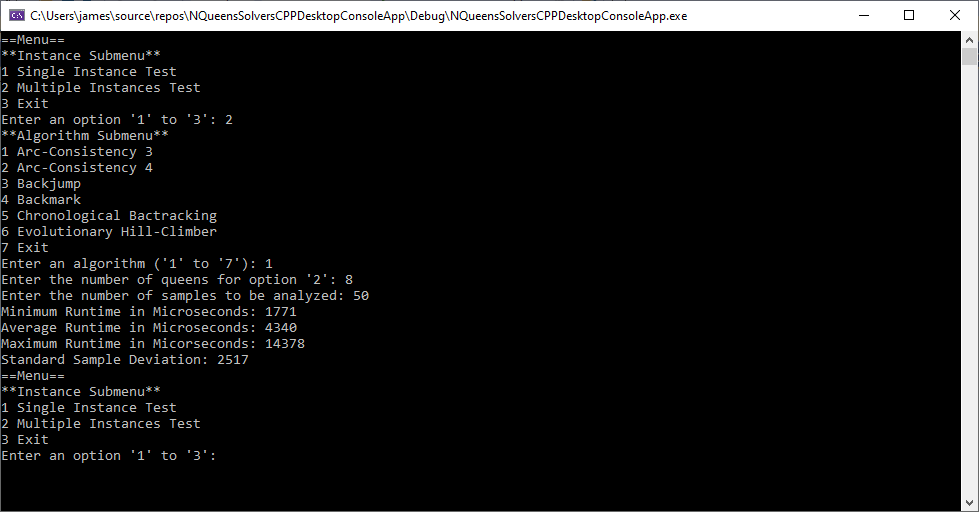
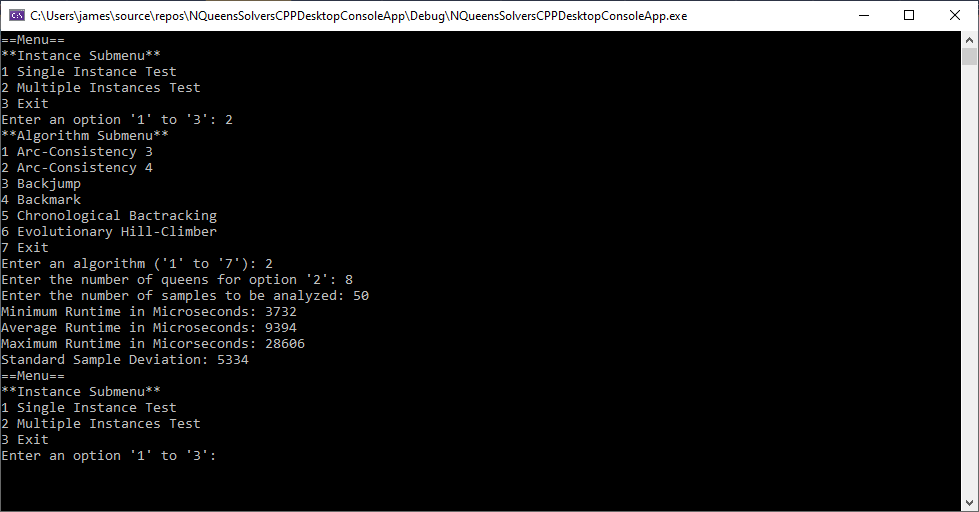
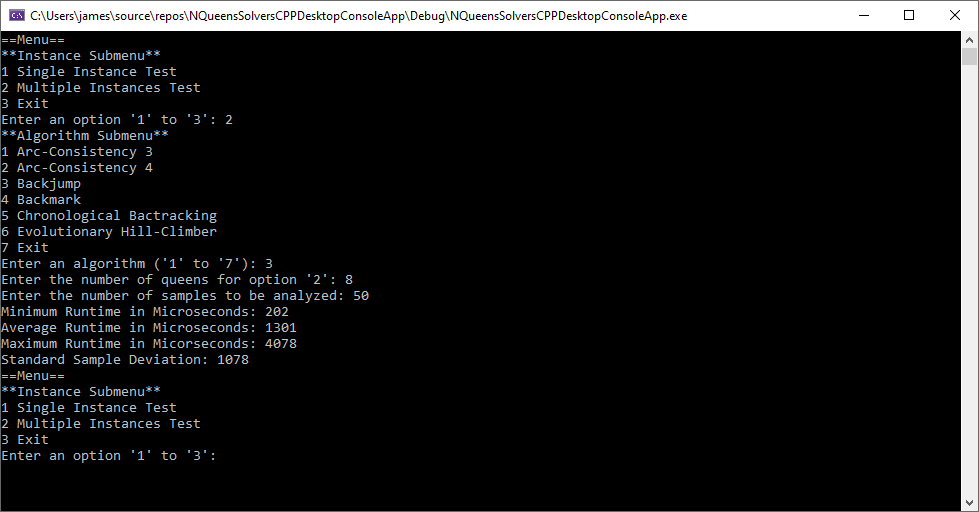
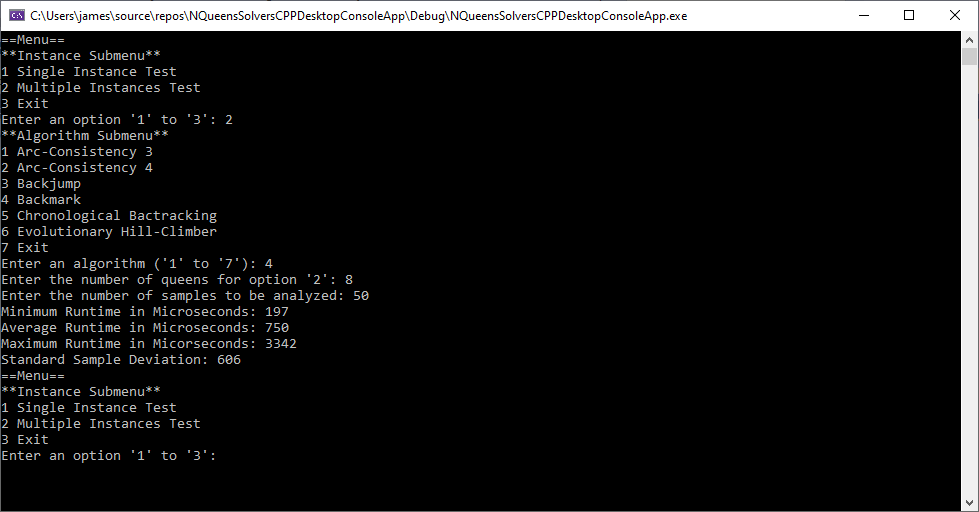
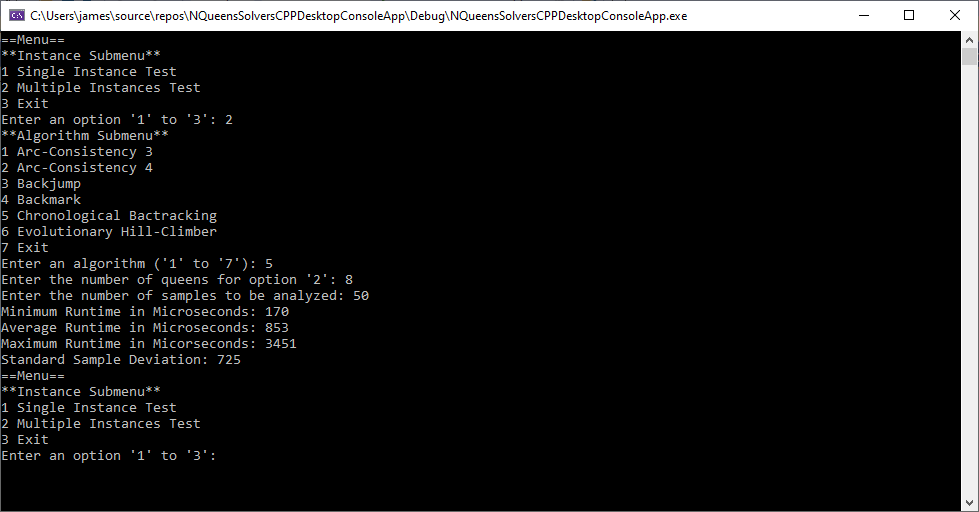
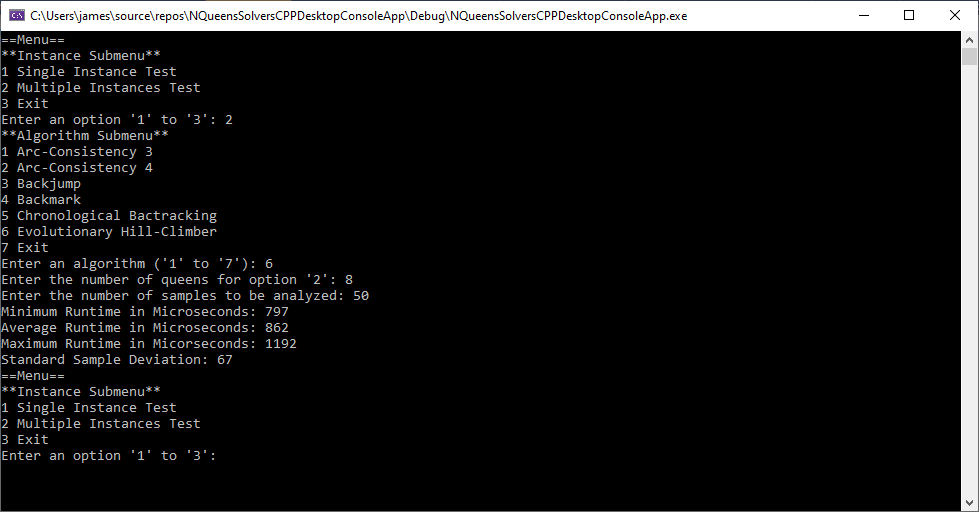
The first five algorithms were stated in pseudocode in the excellent treatise Foundations of Constraint Satisfaction by Edward Tsang. Below are six runs of my test C++ application (Win32 Console App) using 8 queens and 50 samples.
The Graph Coloring Problem by James Pate Williams, Jr.
The Graph Coloring Problem and N-Queens Puzzle are both NP-Complete constraint satisfaction problems. There does not exist polynomial time algorithms to solve large instances of either problem. The Graph Coloring Problem is given a graph of n-vertices and m-edges find the minimum number of colors such that no two connected vertices are of the same color. The N-Queens Puzzle is given a n-by-n chessboard and n-queens place the queens such that no two queens are attacking one another. A queen in chess can move any number of squares diagonally, horizontally, or vertically.
As a Master of Software Engineering graduate student in the era 1998 to 2000, I majored in the subdiscipline of artificial intelligence known as constraint satisfaction. I developed evolutionary hill-climbing algorithms to solve constraint satisfaction problems. I specifically solved instances of the Graph Coloring Problem and the N-Queens Puzzle. I compared my algorithms with other researchers’ algorithms. One of the algorithms tested was Makato Yokoo’s Weak-Commitment Search Algorithm (WCSA). Yakoo wrote a very nice book named “Distributed Constraint Satisfaction” which has excellent flow-charts of several algorithms including the Min-Conflicts Search Algorithm (MCSA) and his WCSA. I implemented both algorithms in the C++ and Java computer languages.
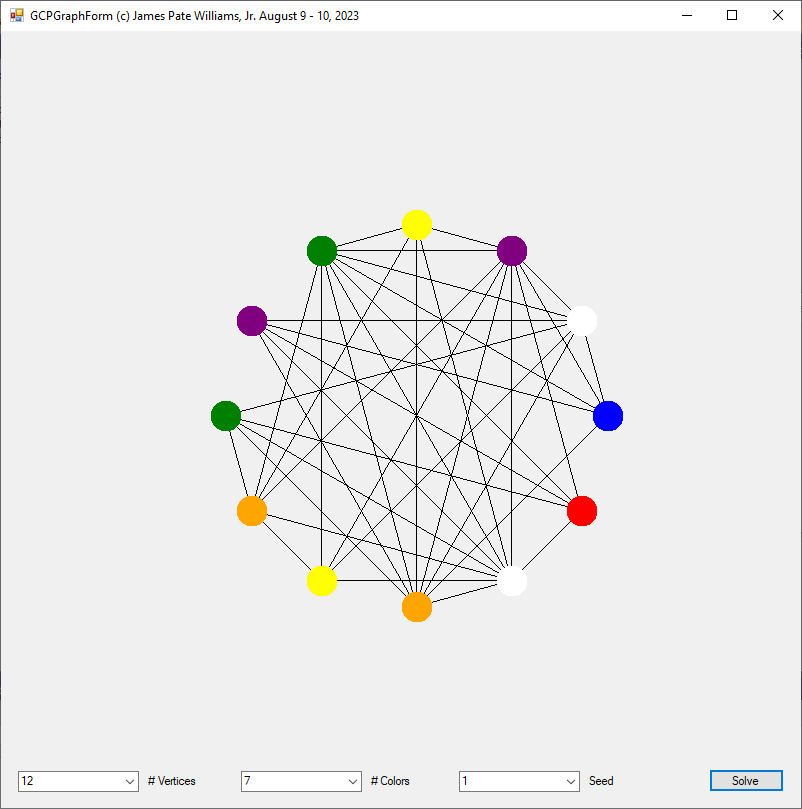
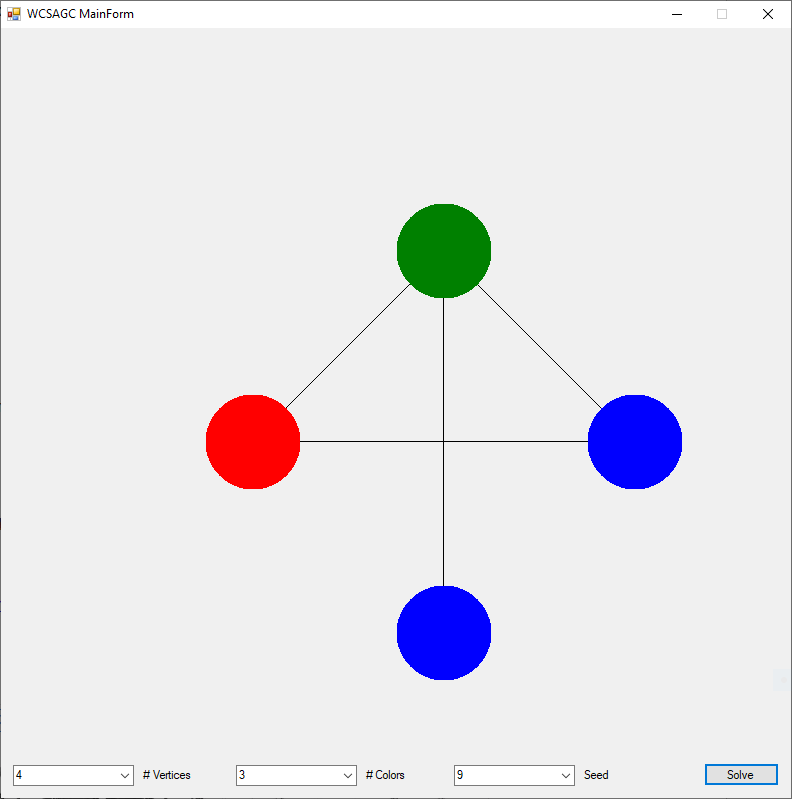
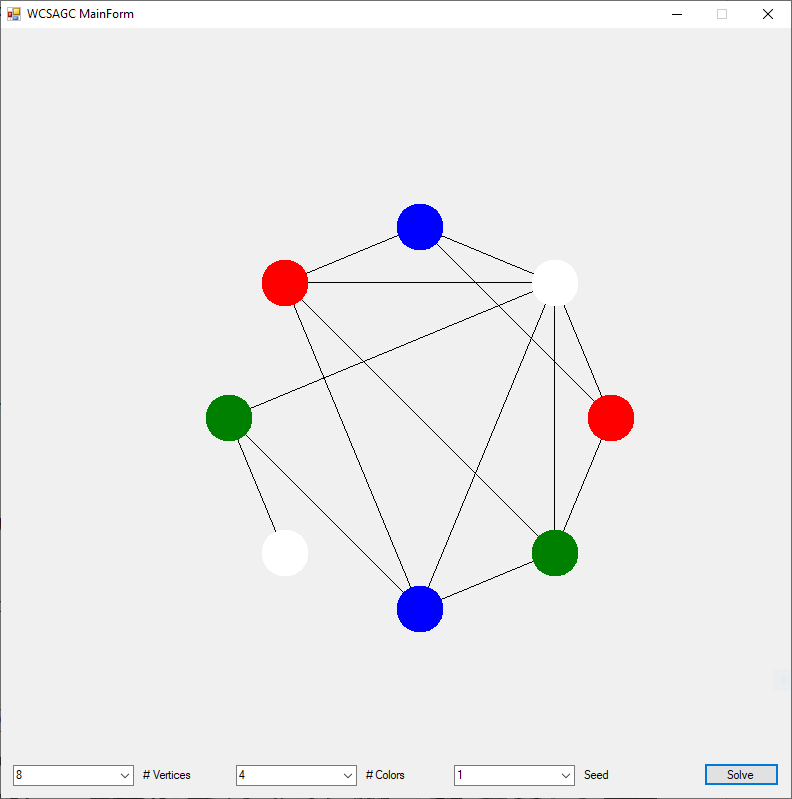
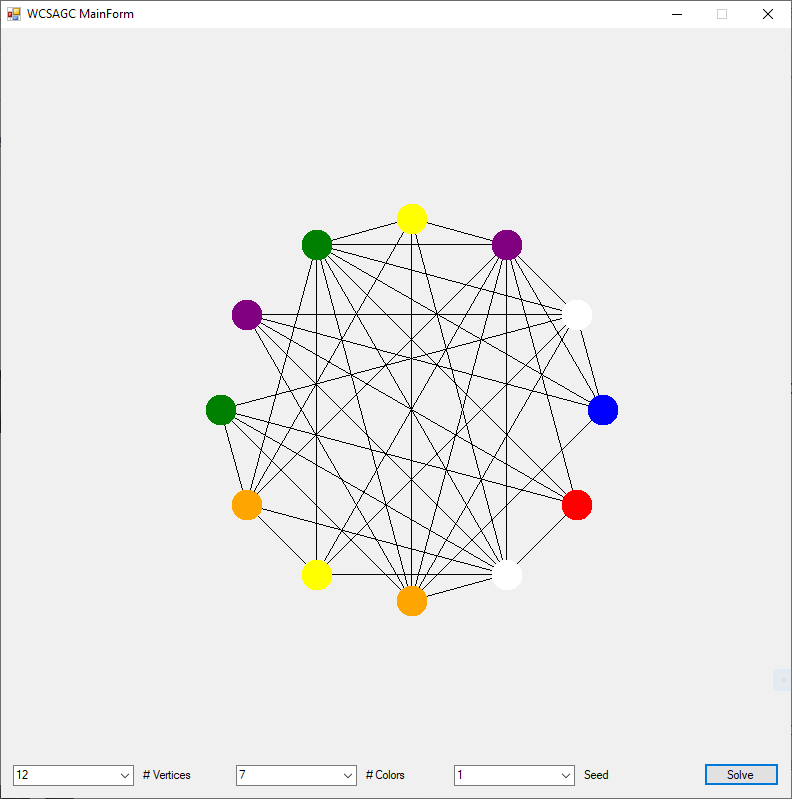
I rewrote the preceding two algorithms in the C# computer language sometime in the epoch 2008 – 2009. Below are three instances of the Graph Coloring Problem with four, eight, and twelve vertices solved by the Yakoo’s WCSA.
 Numerical Explorations