Blog Entry © Wednesday, June 4, 2025, Differential Cryptanalysis of DES by James Pate Williams, Jr.

Below are outputs from three different apps perform differential cryptanalysis on three, four, and six round DES algorithms. Three round is first etc.

E  = 007e0e80 680c0000
E* = bf02ac05 40520000
C' = 965d5b67
E = a0bff415 02f60000
E* = 8a6a5ebf 28aa0000
C' = 9c9c1f56
E = ef15068f 695f0000
E* = 05e9a2bf 56040000
C' = d575db2b

1 0 0 0 0 1 0 1 0 0 0 0 0 0 0 0
0 0 0 0 0 1 1 0 0 0 0 1 1 0 0 0
0 1 0 0 0 1 0 0 1 0 0 0 0 0 0 3
0 0 0 0 0 0 0 0 0 0 0 0 0 0 0 1

0 0 0 1 0 3 0 0 1 0 0 1 0 0 0 0
0 1 0 0 0 2 0 0 0 0 0 0 1 0 0 0
0 0 0 0 0 1 0 0 1 0 1 0 0 0 1 0
0 0 1 1 0 0 0 0 1 0 1 0 2 0 0 0

0 0 0 0 1 1 0 0 0 0 0 0 0 0 1 0
0 0 0 3 0 0 0 0 0 0 0 0 0 0 1 1
0 2 0 0 0 0 0 0 0 0 0 0 1 1 0 0
0 0 0 0 0 0 1 0 0 0 0 0 1 0 0 0

3 1 0 0 0 0 0 0 0 0 2 2 0 0 0 0
0 0 0 0 1 1 0 0 0 0 0 0 1 0 1 1
1 1 1 0 1 0 0 0 0 1 1 1 0 0 1 0
0 0 0 0 1 1 0 0 0 0 0 0 0 0 2 1

0 0 0 0 0 0 1 0 0 0 1 0 0 0 0 0
0 0 0 0 2 0 0 0 3 0 0 0 0 0 0 0
0 0 0 0 0 0 0 0 0 0 0 0 0 0 0 0
0 0 2 0 0 0 0 0 0 1 0 0 0 0 2 0

1 0 0 1 1 0 0 3 0 0 0 0 1 0 0 1
0 0 0 0 1 1 0 0 0 0 0 0 0 0 0 0
0 0 0 0 1 1 0 1 0 0 0 0 0 0 0 0
1 0 0 1 1 0 1 1 0 0 0 0 0 0 0 0

0 0 2 1 0 1 0 3 0 0 0 1 1 0 0 0
0 1 0 0 0 0 0 0 0 0 0 1 0 0 0 1
0 0 2 0 0 0 2 0 0 0 0 1 2 1 1 0
0 0 0 0 0 0 0 0 0 0 1 0 0 0 1 1

0 0 0 0 0 0 0 0 0 0 0 0 0 0 0 0
0 0 0 0 0 0 0 0 0 0 0 0 0 0 0 0
0 0 0 0 0 0 0 0 1 0 1 0 0 1 0 1
0 3 0 0 0 0 1 0 0 0 0 0 0 0 0 0

47 05 19 00 24 07 07 49
J = bc54c060 71f10000
key = 0001101P0110001P01?01?0P1?00100P0101001P0000??0P111?11?P?100011P
88
Unknown bit count = 8

key = 0001101001100010010011001000100101010010000011011110110001000110
key = 1a624c89 520dec46
E  = f069a40a a8a70000
E* = c0e9f28f 810f0000
C' = fa719d15

E = dabefbef 01a70000
E* = c03fa95f 29570000
C' = ea5605a1

E = ca7d095a 815f0000
E* = d57d094a 800f0000
C' = 0b00c0cb

E = 7fbf56aa 43050000
E* = 65945eba 55550000
C' = 0923cbd6

0 0 0 0 0 0 0 0 0 0 0 0 0 0 0 0
0 0 0 0 0 0 0 0 0 0 0 0 0 0 0 0
0 1 0 0 0 0 1 0 0 0 0 0 0 0 0 0
0 0 0 0 1 0 0 0 1 0 0 0 0 0 0 0

2 0 2 1 1 0 0 0 2 1 0 0 1 0 0 0
1 0 0 1 1 0 0 2 0 1 0 1 0 0 0 2
4 1 1 0 2 0 1 0 1 1 1 0 1 0 1 0
1 0 1 0 0 1 0 0 0 1 0 0 0 1 0 0

1 1 2 1 1 1 1 2 3 2 1 2 1 1 2 1
1 1 2 1 1 1 1 2 1 2 2 1 1 2 1 2
2 3 1 1 4 2 2 2 1 1 1 1 2 2 1 1
1 2 1 1 1 2 1 1 1 1 1 1 1 1 2 2

1 1 1 1 1 1 1 1 1 1 2 1 1 1 1 1
1 1 1 1 1 1 1 1 2 1 1 1 1 1 1 1
1 1 1 2 2 4 1 1 1 1 2 1 2 2 1 2
1 1 1 2 1 2 1 2 1 2 1 1 2 1 1 1

0 1 1 0 0 0 1 0 0 1 0 0 1 1 1 0
0 1 0 1 0 0 0 1 2 0 1 0 3 0 1 0
4 0 1 1 2 1 1 0 0 0 1 1 1 0 0 2
2 0 0 0 0 0 0 0 0 0 0 0 0 0 0 0

1 2 1 2 1 1 1 1 1 1 1 1 2 4 1 2
1 1 1 1 1 1 1 1 1 1 2 2 1 2 1 3
1 1 1 1 2 1 2 1 1 1 1 1 1 1 1 1
1 2 1 2 3 1 3 1 1 1 1 1 1 1 1 1

1 0 2 2 0 0 0 1 0 2 1 0 2 0 0 0
1 1 0 0 0 1 0 0 0 1 4 1 0 0 0 1
1 1 1 0 0 2 0 1 0 0 1 0 1 0 0 0
0 0 1 1 0 0 0 0 1 1 0 0 1 0 0 0

0 0 0 0 0 0 0 0 1 0 4 2 1 1 1 0
0 0 0 0 0 0 0 1 0 0 3 2 0 1 0 1
1 0 1 1 1 0 1 0 0 0 2 0 0 1 0 0
0 0 0 1 0 0 0 1 0 0 2 0 0 1 0 1

00 32 36 37 32 13 26 10
J = 02092580 d68a0000
key = 10?10?0P???1101P0011000P0000??0P00??01?P??00100P?101000P11?0101P

Unknown bit Count = 14

7774

key = 1001010011111011001100010000000100100110110010001101000011001011
key = 94fb3101 26c8d0cb
Plaintext-Ciphertext Pairs:
0 748502cd 38451097 03c70306 d8a09f10
0 38747564 38451097 78560a09 60e6d4cb
1 48691102 6acdff31 45fa285b e5adc730
1 375bd31f 6acdff31 134f7915 ac253457
2 357418da 013fec86 d8a31b2f 28bbc5cf
2 12549847 013fec86 0f317ac2 b23cb944

Possible J Values:
J # J Cnt J-Value(s):
0 1 47
1 1 5
2 1 19
3 1 0
4 1 24
5 1 7
6 1 7
7 1 49

key = 0001101001100010010011001000100101010010000011011110110001000110
tst = 0001101001100010010011001000100101010010000011011110110001000110
key = 1a624c89 520dec46
tst = 1a624c89 520dec46

J # J-Value True J-Value:
0 47 47
1 5 5
2 19 19
3 0 0
4 24 24
5 7 7
6 7 7
7 49 49

Tested Keys # = 1073
Runtime (s) = 0

Runtime per test (s) = 0.000028
Runtime max estimated (s) = 0.029784
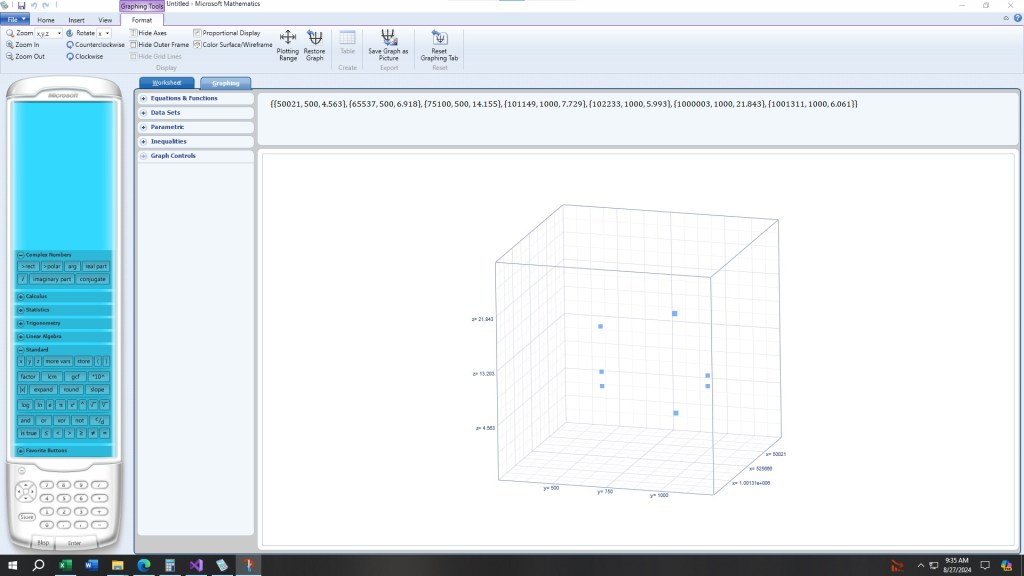
Blog Entry (c) Tuesday, August 27, 2024, Graphing New Goldwasser-Kilian Primality Test Results by James Pate Williams, Jr.

The x -axis is the number to be tested, the y-axis is prime number bound for factoring, and the z-axis is the runtime in seconds.

Blog Entry (c) Wednesday, August 21, 2024, by James Pate Williams, Jr. New and Improved Version of the Goldwasser-Kilian Primality Test

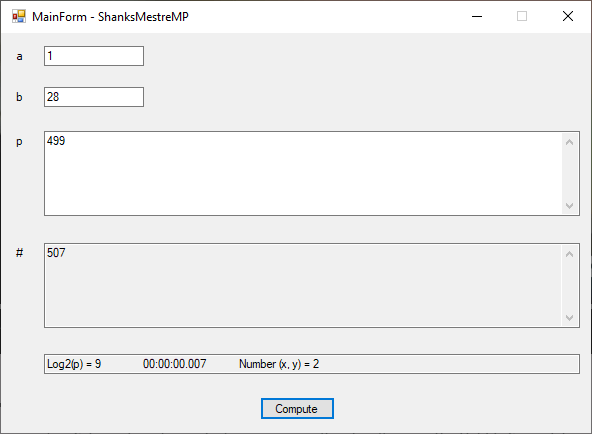
I corrected my powering modulo a prime routine. I added Pollard’s p – 1 factoring method and Shanks-Mestre elliptic curve point counting algorithm.

number to be tested or 0 to quit:
10000019
number of primes in factor base:
10000
Prime sieving time = 3.220000
N[0] = 10000019
a = 7838973
b = 2449531
m = 9995356
q = 356977
P = (9786147, 3226544)
P1 = (0, 1)
P2 = (5887862, 8051455)
N[1] = 356977
a = 45561
b = 178451
m = 357946
q = 178973
P = (80627, 163299)
P1 = (0, 1)
P2 = (52101, 282559)
N[2] = 178973
a = 135281
b = 76426
m = 178996
q = 73
P = (10238, 98035)
P1 = (0, 1)
P2 = (46702, 94326)
number is proven prime
runtime in seconds = 35.471000

number to be tested or 0 to quit:
10015969
number of primes in factor base:
10000
Prime sieving time = 3.424000
N[0] = 10015969
a = 6613193
b = 3951715
m = 10013908
q = 2503477
P = (998314, 8329764)
P1 = (0, 1)
P2 = (6944357, 1053776)
N[1] = 2503477
a = 1175442
b = 379813
m = 2505736
q = 293
P = (646462, 1631861)
P1 = (0, 1)
P2 = (1477980, 88719)
number is proven prime
runtime in seconds = 5.612000

number to be tested or 0 to quit:
99997981
number of primes in factor base:
10000
Prime sieving time = 4.152000
N[0] = 99997981
a = 34129462
b = 80482974
m = 100001414
q = 181
P = (19305995, 40493835)
P1 = (0, 1)
P2 = (33828245, 72969559)
number is proven prime
runtime in seconds = 11.500000

number to be tested or 0 to quit:
100001819
number of primes in factor base:
100000
Prime sieving time = 3.218000
N[0] = 100001819
a = 2694060
b = 17329746
m = 100008102
q = 5569
P = (124594, 14596756)
P1 = (0, 1)
P2 = (32514144, 56926555)
number is proven prime
runtime in seconds = 76.301000

number to be tested or 0 to quit:
100005317
number of primes in factor base:
100000
Prime sieving time = 3.269000
N[0] = 100005317
a = 45478318
b = 328034
m = 99988256
q = 3124633
P = (62548529, 30179124)
P1 = (0, 1)
P2 = (70379514, 76899689)
N[1] = 3124633
a = 2605576
b = 1809212
m = 3127654
q = 503
P = (1236288, 2081401)
P1 = (0, 1)
P2 = (2264479, 2583693)
number is proven prime
runtime in seconds = 459.979000

number to be tested or 0 to quit:
100000007
number of primes in factor base:
100000
Prime sieving time = 3.209000
N[0] = 100000007
a = 50593669
b = 72502607
m = 100005736
q = 2053
P = (72365335, 69885097)
P1 = (0, 1)
P2 = (55023241, 20078454)
number is proven prime
runtime in seconds = 163.705000

number to be tested or 0 to quit:
100014437
number of primes in factor base:
100000
Prime sieving time = 3.919000
N[0] = 100014437
a = 49955472
b = 45482796
m = 100024160
q = 263
P = (41650735, 8652103)
P1 = (0, 1)
P2 = (53790105, 37282431)
number is proven prime
runtime in seconds = 12.915000

Blog Entry (c) Wednesday, August 21, 2024, by James Pate Williams, Jr. Single Precision (64-Bit) Version of Pollard’s P-1 Factoring Method

prime number sieve creation
time in seconds = 3.483000
number to be factored or 0 to quit:
2111222333
1 11 1 p
2 17 1 p
3 11289959 1 p
factoring time in seconds = 0.063000
number to be factored or 0 to quit:
1234567890
1 2 1 p
2 3 2 p
3 5 1 p
4 3607 1 p
5 3803 1 p
factoring time in seconds = 0.133000
number to be factored or 0 to quit:
2^30+0
prime powers are not allowed
number to be factored or 0 to quit:
0

Blog Entry (c) Tuesday, August 20, 2024, by James Pate Williams, Jr. More Goldwasser-Kilian Primality Results (64-Bit Version which I call Single Precision)

Blog Entry (c) Monday, August 19, 2024, by James Pate Williams, Jr. Results from a Corrected Version of my Implementation of the 64-Bit Goldwasser-Kilian Primality Test

Blog Entry Wednesday, August 14, 2024 (c) James Pate Williams, Jr. Goldwasser-Kilian Primality Test

The Goldwasser-Kilian Primality proving algorithm was the first method to utilize elliptic curves to generate primality proving certificates. What follows is a file of two certificates and the single precision C source code.

Blog Entry (c) Saturday, August 10, 2024, by James Pate Williams, Jr. The LLL Lattice Reduction Algorithm

Blog Entry Wednesday, July 10, 2024, © James Pate Williams, Jr. My Dual Interests in Cryptography and Number Theory

I became fascinated with secret key cryptography as a child. Later, as an adult, in around 1979, I started creating crude symmetric cryptographic algorithms. I became further enthralled with cryptography and number theory in 1996 upon reading Applied CryptographySecond EditionProtocolsAlgorithmsand Source Code in C by Bruce Schneier and later the Handbook of Applied Cryptography by Alfred J. Menezes, Paul C. van Oorschot, and Scott A. Vanstone. After implementing many of the algorithms in both tomes, I communicated my results to two of the authors namely Bruce Schneier and Professor Alfred J. Menezes. In 1997 I developed a website devoted to constraint satisfaction problems and their solutions, cryptography, and number theory. I posted legal C and C++ source code. Professor Menezes advertised my website along with his treatise. See the following blurb:

In the spirit of my twin scientific infatuations, I offer yet another C integer factoring implementation utilizing the Free Large Integer Package (known more widely as lip) which was created by Arjen K. Lenstra (now a Professor Emeritus). This implementation includes Henri Cohen’s Trial Division algorithm, the Brent-Cohen-Pollard rho method, the Cohen-Pollard p – 1 stage 1 method, and the Lenstra lip Elliptic Curve Method. If I can get the proper authorization, I will later post the source code.

total time required for initialization: 0.056000 seconds
enter number below:
2^111+2
== Menu ==
1 Trial Division
2 Pollard-Brent-Cohen rho
3 p - 1 Pollard-Cohen
4 Lenstra's Elliptic Curve Method
5 Pollard-Lenstra rho
1
2596148429267413814265248164610050
number is composite
factors:
total time required factoring: 0.014000 seconds:
2
5 ^ 2
41
397
2113
enter number below:
0
total time required for initialization: 0.056000 seconds
enter number below:
2^111+2
== Menu ==
1 Trial Division
2 Pollard-Brent-Cohen rho
3 p - 1 Pollard-Cohen
4 Lenstra's Elliptic Curve Method
5 Pollard-Lenstra rho
2
2596148429267413814265248164610050
number is composite
factors:
total time required factoring: 1.531000 seconds:
2
5 ^ 2
41
397
2113
415878438361
3630105520141
enter number below:
0
total time required for initialization: 0.055000 seconds
enter number below:
2^111+2
== Menu ==
1 Trial Division
2 Pollard-Brent-Cohen rho
3 p - 1 Pollard-Cohen
4 Lenstra's Elliptic Curve Method
5 Pollard-Lenstra rho
3
2596148429267413814265248164610050
number is composite
factors:
total time required factoring: 0.066000 seconds:
2
5 ^ 2
41
838861
415878438361
3630105520141
enter number below:
0
total time required for initialization: 0.056000 seconds
enter number below:
2^111+2
== Menu ==
1 Trial Division
2 Pollard-Brent-Cohen rho
3 p - 1 Pollard-Cohen
4 Lenstra's Elliptic Curve Method
5 Pollard-Lenstra rho
4
2596148429267413814265248164610050
number is composite
factors:
total time required factoring: 0.013000 seconds:
2
5
205
838861
415878438361
3630105520141
enter number below:
0

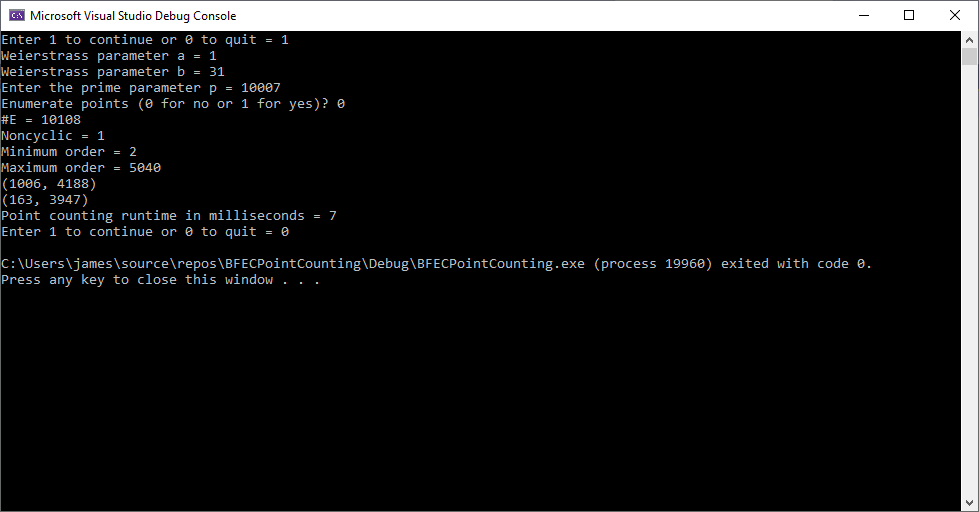
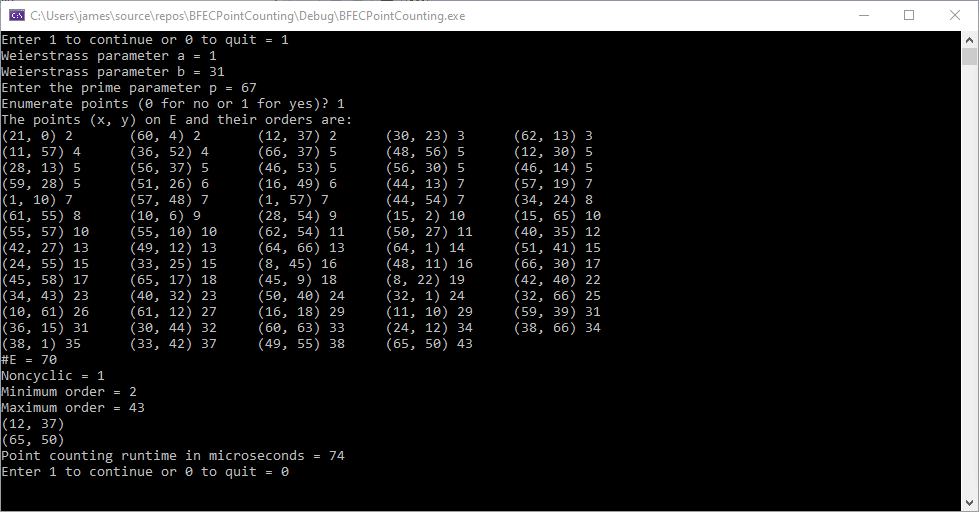
Brute Force Elliptic Curve Point Counting Algorithm Implementation by James Pate Williams, Jr.

#include <algorithm>
#include <iomanip>
#include <iostream>
#include <chrono>
#include <vector>
using namespace std;

typedef long long ll;

typedef struct ecPoint
{
	ll x, y;
} ECPOINT, *PECPOINT;

typedef struct ecPointOrder
{
	ll order;
	ECPOINT pt;
} ECPOINTORDER, * PECPOINTORDER;

int JACOBI(ll a, ll n)
{
	int e = 0, s;
	ll a1, b = a, m, n1;

	if (a == 0) return 0;
	if (a == 1) return 1;
	while ((b & 1) == 0)
	{
		b >>= 1;
		e++;
	}
	a1 = b;
	m = n % 8;
	if (!(e & 1)) s = 1;
	else if (m == 1 || m == 7) s = +1;
	else if (m == 3 || m == 5) s = -1;
	if (n % 4 == 3 && a1 % 4 == 3) s = -s;
	if (a1 != 1) n1 = n % a1; else n1 = 1;
	return s * JACOBI(n1, a1);
}

ll ExpMod(ll x, ll b, ll n)
/* returns x ^ b mod n */
{
	ll a = 1LL, s = x;

	if (b == 0)
		return 1LL;
	while (b != 0) {
		if (b & 1l) a = (a * s) % n;
		b >>= 1;
		if (b != 0) s = (s * s) % n;
	}
	if (a < 0)
		a += n;
	return a;
}

ll ExtendedEuclidean(ll b, ll n)
{
	ll b0 = b, n0 = n, t = 1, t0 = 0, temp, q, r;

	q = n0 / b0;
	r = n0 - q * b0;

	while (r > 0) {
		temp = t0 - q * t;
		if (temp >= 0) temp = temp % n;
		else temp = n - (-temp % n);
		t0 = t;
		t = temp;
		n0 = b0;
		b0 = r;
		q = n0 / b0;
		r = n0 - q * b0;
	}
	if (b0 != 1) return 0;
	else return t % n;
}

ll Weierstrass(ll a, ll b, ll x, ll p)
{
	return ((((x * x) % p) * x) % p + (a * x) % p + b) % p;
}

ll EPoints(
	bool print,
	ll a, ll b, ll p,
	vector<ECPOINT>& e)
	/* returns the number of points on the elliptic
	curve y ^ 2 = x ^ 3 + ax + b mod p */
{
	ll count = 0, m = (p + 1) / 4, x, y;
	ECPOINT pt{};

	if (p % 4 == 3) {
		for (x = 0; x < p; x++) {
			y = Weierstrass(a, b, x, p);
			if (JACOBI(y, p) != -1) {
				y = ExpMod(y, m, p);
				if (print)
				{
					cout << "(" << setw(2) << x << ", ";
					cout << y << ") " << endl;
				}
				pt.x = x;
				pt.y = y;
				e.push_back(pt);
				count++;
				y = -y % p;
				if (y < 0) y += p;
				if (y != 0)
				{
					if (print)
					{
						cout << "(" << setw(2) << x << ", ";
						cout << y << ") " << endl;
					}
					pt.x = x;
					pt.y = y;
					e.push_back(pt);
					count++;
				}
				if (print && count % 5 == 0)
					cout << endl;
			}
		}
		if (print && count % 5 != 0)
			cout << endl;
	}
	return count;
}

void Add(ll a, ll p, ECPOINT P,
	ECPOINT Q, ECPOINT& R)
	/* elliptic curve point partial addition */
{
	ll i, lambda;

	if (P.x == Q.x && P.y == 0 && Q.y == 0) {
		R.x = 0;
		R.y = 1;
		return;
	}
	if (P.x == Q.x && P.y == p - Q.y) {
		R.x = 0;
		R.y = 1;
		return;
	}
	if (P.x == 0 && P.y == 1) {
		R = Q;
		return;
	}
	if (Q.x == 0 && Q.y == 1) {
		R = P;
		return;
	}
	if (P.x != Q.x) {
		i = Q.x - P.x;
		if (i < 0) i += p;
		i = ExtendedEuclidean(i, p);
		lambda = ((Q.y - P.y) * i) % p;
	}
	else {
		i = ExtendedEuclidean((2 * P.y) % p, p);
		lambda = ((3 * P.x * P.x + a) * i) % p;
	}
	if (lambda < 0) lambda += p;
	R.x = (lambda * lambda - P.x - Q.x) % p;
	R.y = (lambda * (P.x - R.x) - P.y) % p;
	if (R.x < 0) R.x += p;
	if (R.y < 0) R.y += p;
}

void Multiply(
	ll a, ll k, ll p,
	ECPOINT P,
	ECPOINT& R)
{
	ECPOINT S;

	R.x = 0;
	R.y = 1;
	S = P;
	while (k != 0) {
		if (k & 1) Add(a, p, R, S, R);
		k >>= 1;
		if (k != 0) Add(a, p, S, S, S);
	}
}

ll Order(ll a, ll p, ECPOINT P)
{
	ll order = 1;
	ECPOINT Q = P, R{};

	do {
		order++;
		Add(a, p, P, Q, R);
		Q = R;
	} while (R.x != 0 && R.y != 1);
	return order;
}

const int PrimeSize = 10000000;
bool sieve[PrimeSize];

void PopulateSieve() {

	// sieve of Eratosthenes

	int c, inc, i, n = PrimeSize - 1;

	for (i = 0; i < n; i++)
		sieve[i] = false;

	sieve[1] = false;
	sieve[2] = true;

	for (i = 3; i <= n; i++)
		sieve[i] = (i & 1) == 1 ? true : false;

	c = 3;

	do {
		i = c * c;
		inc = c + c;

		while (i <= n) {
			sieve[i] = false;
			i += inc;
		}

		c += 2;
		while (!sieve[c])
			c++;
	} while (c * c <= n);
}

ll Partition(
	vector<ECPOINTORDER>& a, ll n, ll lo, ll hi)
{
	ll pivotIndex = lo + (hi - lo) / 2;
	ECPOINTORDER po = a[(unsigned int)pivotIndex];
	ECPOINTORDER x = po;
	ECPOINTORDER t = x;

	a[(unsigned int)pivotIndex] = a[(unsigned int)hi];
	a[(unsigned int)hi] = t;

	ll storeIndex = lo;

	for (unsigned int i = (unsigned int)lo; i < (unsigned int)hi; i++)
	{
		if (a[i].order < x.order)
		{
			t = a[i];
			a[i] = a[(unsigned int)storeIndex];
			a[(unsigned int)(storeIndex++)] = t;
		}
	}

	t = a[(unsigned int)storeIndex];
	a[(unsigned int)storeIndex] = a[(unsigned int)hi];
	a[(unsigned int)hi] = t;

	return storeIndex;
}

static void DoQuickSort(
	vector<ECPOINTORDER>& a, ll n, ll p, ll r)
{
	if (p < r)
	{
		ll q = Partition(a, n, p, r);

		DoQuickSort(a, n, p, q - 1);
		DoQuickSort(a, n, q + 1, r);
	}
}

void QuickSort(vector<ECPOINTORDER>& a, ll n)
{
	DoQuickSort(a, n, 0, n - 1);
}

int main()
{
	PopulateSieve();

	while (true)
	{
		bool noncyclic = false;
		int option;
		ll a, b, p;

		cout << "Enter 1 to continue or 0 to quit = ";
		cin >> option;

		if (option == 0)
			break;

		cout << "Weierstrass parameter a = ";
		cin >> a;
		cout << "Weierstrass parameter b = ";
		cin >> b;
		cout << "Enter the prime parameter p = ";
		cin >> p;

		if (!sieve[p])
		{
			cout << "p is not a prime number. " << endl;
			continue;
		}

		if (p % 4 != 3)
		{
			cout << "p mod 4 must be 3 for this algorithm." << endl;
			continue;
		}

		bool print = false, enumerate = false;
		vector<ECPOINT> e;
		vector<ECPOINTORDER> eOrder;

		cout << "Enumerate points (0 for no or 1 for yes)? ";
		cin >> option;

		enumerate = option == 1;
		auto time0 = chrono::high_resolution_clock::now();
		ll count = EPoints(print, a, b, p, e);
		auto time1 = chrono::high_resolution_clock::now();
		auto elapsed = time1 - time0;
		ll h = count + 1;
		ll maxOrder = 0;
		ll minOrder = h;
		ll order = -1;
		ECPOINT P{}, Q{};

		if (enumerate)
			cout << "The points (x, y) on E and their orders are:" << endl;

		for (unsigned int i = 0; i < count; i++)
		{
			ECPOINTORDER ptOrder{};

			order = Order(a, p, e[i]);
			ptOrder.order = order;
			ptOrder.pt = e[i];
			eOrder.push_back(ptOrder);

			if (order < h)
				noncyclic = true;
			if (order < minOrder) {
				P = e[i];
				minOrder = order;
			}
			if (order > maxOrder) {
				Q = e[i];
				maxOrder = order;
			}
		}
		if (enumerate)
		{
			QuickSort(eOrder, count);

			for (unsigned int i = 0; i < eOrder.size(); i++)
			{
				cout << "(" << eOrder[i].pt.x << ", ";
				cout << eOrder[i].pt.y << ") ";
				cout << eOrder[i].order << "\t";
				if ((i + 1) % 5 == 0)
					cout << endl;
			}
			if (count % 5 != 0)
				cout << endl;
		}
		cout << "#E = " << h << endl;
		cout << "Noncyclic = " << noncyclic << endl;
		cout << "Minimum order = " << minOrder << endl;
		cout << "Maximum order = " << maxOrder << endl;
		cout << "(" << P.x << ", " << P.y << ")" << endl;
		cout << "(" << Q.x << ", " << Q.y << ")" << endl;

		long long runtime = chrono::duration_cast<chrono::milliseconds>(elapsed).count();
		if (runtime != 0)
			cout << "Point counting runtime in milliseconds = " << runtime << endl;
		else
		{
			runtime = chrono::duration_cast<chrono::microseconds>(elapsed).count();
			cout << "Point counting runtime in microseconds = " << runtime << endl;
		}
	}
	return 0;
}