I corrected my powering modulo a prime routine. I added Pollard’s p – 1 factoring method and Shanks-Mestre elliptic curve point counting algorithm.

number to be tested or 0 to quit:
10000019
number of primes in factor base:
10000
Prime sieving time = 3.220000
N[0] = 10000019
a = 7838973
b = 2449531
m = 9995356
q = 356977
P = (9786147, 3226544)
P1 = (0, 1)
P2 = (5887862, 8051455)
N[1] = 356977
a = 45561
b = 178451
m = 357946
q = 178973
P = (80627, 163299)
P1 = (0, 1)
P2 = (52101, 282559)
N[2] = 178973
a = 135281
b = 76426
m = 178996
q = 73
P = (10238, 98035)
P1 = (0, 1)
P2 = (46702, 94326)
number is proven prime
runtime in seconds = 35.471000

number to be tested or 0 to quit:
10015969
number of primes in factor base:
10000
Prime sieving time = 3.424000
N[0] = 10015969
a = 6613193
b = 3951715
m = 10013908
q = 2503477
P = (998314, 8329764)
P1 = (0, 1)
P2 = (6944357, 1053776)
N[1] = 2503477
a = 1175442
b = 379813
m = 2505736
q = 293
P = (646462, 1631861)
P1 = (0, 1)
P2 = (1477980, 88719)
number is proven prime
runtime in seconds = 5.612000

number to be tested or 0 to quit:
99997981
number of primes in factor base:
10000
Prime sieving time = 4.152000
N[0] = 99997981
a = 34129462
b = 80482974
m = 100001414
q = 181
P = (19305995, 40493835)
P1 = (0, 1)
P2 = (33828245, 72969559)
number is proven prime
runtime in seconds = 11.500000

number to be tested or 0 to quit:
100001819
number of primes in factor base:
100000
Prime sieving time = 3.218000
N[0] = 100001819
a = 2694060
b = 17329746
m = 100008102
q = 5569
P = (124594, 14596756)
P1 = (0, 1)
P2 = (32514144, 56926555)
number is proven prime
runtime in seconds = 76.301000

number to be tested or 0 to quit:
100005317
number of primes in factor base:
100000
Prime sieving time = 3.269000
N[0] = 100005317
a = 45478318
b = 328034
m = 99988256
q = 3124633
P = (62548529, 30179124)
P1 = (0, 1)
P2 = (70379514, 76899689)
N[1] = 3124633
a = 2605576
b = 1809212
m = 3127654
q = 503
P = (1236288, 2081401)
P1 = (0, 1)
P2 = (2264479, 2583693)
number is proven prime
runtime in seconds = 459.979000

number to be tested or 0 to quit:
100000007
number of primes in factor base:
100000
Prime sieving time = 3.209000
N[0] = 100000007
a = 50593669
b = 72502607
m = 100005736
q = 2053
P = (72365335, 69885097)
P1 = (0, 1)
P2 = (55023241, 20078454)
number is proven prime
runtime in seconds = 163.705000

number to be tested or 0 to quit:
100014437
number of primes in factor base:
100000
Prime sieving time = 3.919000
N[0] = 100014437
a = 49955472
b = 45482796
m = 100024160
q = 263
P = (41650735, 8652103)
P1 = (0, 1)
P2 = (53790105, 37282431)
number is proven prime
runtime in seconds = 12.915000
Category: Number Theory
Blog Entry (c) Wednesday, August 21, 2024, by James Pate Williams, Jr. Single Precision (64-Bit) Version of Pollard’s P-1 Factoring Method
prime number sieve creation
time in seconds = 3.483000
number to be factored or 0 to quit:
2111222333
1       11      1       p
2       17      1       p
3       11289959        1       p
factoring time in seconds = 0.063000
number to be factored or 0 to quit:
1234567890
1       2       1       p
2       3       2       p
3       5       1       p
4       3607    1       p
5       3803    1       p
factoring time in seconds = 0.133000
number to be factored or 0 to quit:
2^30+0
prime powers are not allowed
number to be factored or 0 to quit:
0
Blog Entry (c) Tuesday, August 20, 2024, by James Pate Williams, Jr. More Goldwasser-Kilian Primality Results (64-Bit Version which I call Single Precision)
Blog Entry (c) Monday, August 19, 2024, by James Pate Williams, Jr. Results from a Corrected Version of my Implementation of the 64-Bit Goldwasser-Kilian Primality Test
Blog Entry Wednesday, August 14, 2024 (c) James Pate Williams, Jr. Goldwasser-Kilian Primality Test
The Goldwasser-Kilian Primality proving algorithm was the first method to utilize elliptic curves to generate primality proving certificates. What follows is a file of two certificates and the single precision C source code.
Blog Entry (c) Saturday, August 10, 2024, by James Pate Williams, Jr. The LLL Lattice Reduction Algorithm
Blog Entry Tuesday, July 16, 2024, Prime Number Zeta Function Values for s = 2 and Primes < 1,000,000 (c) James Pate Williams, Jr.
Runtime in seconds to build sieve: 4.462000
N = <= 1000000 17
s > 1 = 2
prime zeta = 0.449282078106864
N = <= 1000000 257
s > 1 = 2
prime zeta = 0.452175428603043
N = <= 1000000 65537
s > 1 = 2
prime zeta = 0.452247336475390
N = <= 1000000 100003
s > 1 = 2
prime zeta = 0.452247368830138
N = <= 1000000 900001
s > 1 = 2
prime zeta = 0.452247415884861
N = <= 1000000 0

C:\Users\james\source\repos\PrimeZetaFunction\Debug\PrimeZetaFunction.exe (process 20584) exited with code 0.
Press any key to close this window . . .
/*
* PrimeZetaFunction.c (c) Monday, July 15, 2024
* by James Pate Williams, Jr.
*/
#include <math.h>
#include <stdio.h>
#include <stdlib.h>
#include <time.h>

#define BITS_PER_LONG   32
#define BITS_PER_LONG_1 31
#define MAX_SIEVE 100000000
#define MAX_PRIME_INDEX 5761454
#define SIEVE_SIZE (MAX_SIEVE / BITS_PER_LONG + 1)

long prime[MAX_PRIME_INDEX], sieve[SIEVE_SIZE];

long get_bit(long i, long* sieve)
{
    long b = i % BITS_PER_LONG;
    long c = i / BITS_PER_LONG;

    return (sieve[c] >> (BITS_PER_LONG_1 - b)) & 1;
}

void set_bit(long i, long v, long* sieve)
{
    long b = i % BITS_PER_LONG;
    long c = i / BITS_PER_LONG;
    long mask = 1 << (BITS_PER_LONG_1 - b);

    if (v == 1)
        sieve[c] |= mask;
    else
        sieve[c] &= ~mask;
}

void Sieve(long n, long* sieve)
{
    long c, i, inc;

    set_bit(0, 0, sieve);
    set_bit(1, 0, sieve);
    set_bit(2, 1, sieve);
    for (i = 3; i <= n; i++)
        set_bit(i, i & 1, sieve);
    c = 3;
    do {
        i = c * c, inc = c + c;
        while (i <= n) {
            set_bit(i, 0, sieve);
            i += inc;
        }
        c += 2;
        while (!get_bit(c, sieve)) c++;
    } while (c * c <= n);
}

long double primeZetaFunction(long N, long s)
{
    long n, p;
    long double sum = 0.0L;

    for (n = N; n >= 0; n--)
    {
        p = prime[n];
        sum += 1.0 / powl((long double)p, (long double)s);
    }

    return sum;
}

int main()
{
    long N = 0, i = 0, p = 2, s = 0;
    double runtime = 0.0;
    clock_t time0 = clock(), time1 = 0;

    Sieve(MAX_SIEVE, sieve);

    for (i = 0; i <= MAX_PRIME_INDEX; i++) {
        while (!get_bit(p, sieve)) p++;
        prime[i] = p++;
    }

    time1 = clock();
    runtime = ((double)time1 - time0) / CLOCKS_PER_SEC;
    printf_s("Runtime in seconds to build sieve: %Lf\n", runtime);
    for (;;) {
        printf_s("N = <= %ld ", 1000000);
        scanf_s("%ld", &N);

        if (N == 0)
            break;

        printf_s("s > 1 = ");
        scanf_s("%ld", &s);
        printf_s("prime zeta = %16.15Lf\n", primeZetaFunction(N, s));
    }

    return 0;
}
Blog Entry Monday, July 15, 2024, (c) James Pate Williams, Jr. Some Values of the Riemann Zeta Function Computed with Fast and Very Slow Algorithms
The slow computations used 999,999,999 terms. I seem to recall from my first numerical analysis (Scientific Computing I) course in the Mathematics Department at the Georgia Institute of Technology with Professor Gunter Meyer in the Summer of 1982 that computing a truncated infinite series is more accurate to start with the smallest terms.
// RiemannZetaFunctionWin32Console.c (c) Saturday, July 13-15, 2024
// James Pate Williams, Jr. some computations use 999,999,998 terms

#include <math.h>
#include <stdio.h>
#include <stdlib.h>
#include <time.h>

typedef signed long long sll;

// https://en.wikipedia.org/wiki/Particular_values_of_the_Riemann_zeta_function#cite_note-7

long double EvenZeta(int n)
{
    sll A[12] = { 0ll,
        6ll, 90ll, 945ll, 9450ll, 93555ll, 638512875ll,
        18243225ll, 325641566250ll, 38979295480125ll,
        1531329465290625ll, 13447856940643125ll };
    sll B[12] = { 0ll, 1ll, 1ll, 1ll, 1ll, 1ll, 691ll, 2ll,
        3617ll, 43867ll, 174611ll, 155366ll };
    long double pi = 4.0 * atan(1.0);

    return (long double)B[n / 2] * powl(pi, n) / (long double)A[n / 2];
}

long double Zeta(long s, long *terms)
{
    int n = 0;
    long double sum = 0.0;

    *terms = 0;

    for (n = 1000000000; n >= 2; n--)
    {
        sum += 1.0 / powl(n, s);
        (*terms)++;
    }

    return sum + 1.0;
}

void PrintEvenZetaValue(int n)
{
    clock_t time0 = clock();
    long double ez = EvenZeta(n);
    clock_t time1 = clock();
    double runtime = ((double)time1 - time0) / CLOCKS_PER_SEC;
    printf_s("Runtime in seconds to compute Zeta(%ld) = %16.15Lf: %Lf\n",
        n, ez, runtime);
}

void PrintZetaValue(int n)
{
    clock_t time0 = clock();
    long terms = 0;
    long double zeta = Zeta(n, &terms);
    clock_t time1 = clock();
    double runtime = ((double)time1 - time0) / CLOCKS_PER_SEC;
    printf_s("Runtime in seconds to compute Zeta(%ld) = %16.15Lf terms = %ld: time = %Lf\n",
        n, zeta, terms, runtime);
}

int main()
{
    PrintEvenZetaValue(2);
    PrintEvenZetaValue(4);
    PrintEvenZetaValue(6);
    PrintEvenZetaValue(8);
    PrintZetaValue(2);
    PrintZetaValue(4);
    PrintZetaValue(6);
    PrintZetaValue(8);
    PrintZetaValue(3);
    PrintZetaValue(5);
    PrintZetaValue(7);
    PrintZetaValue(9);
    return 0;
}
Blog Entry Friday, July 12, 2024, © James Pate Williams, Jr.
I was performing an Internet search for prime counting functions, and I ran across the following PDF:
It was made available online in April of 2021. That made me remember the opening line of Geoffery Chaucer’s “Canterbury Tales”:
Whan that Aprill with his shoures soote
I seem to recall that in my English literature textbook ‘with’ was replaced with the German ‘mit’. Middle English was related to the old French and German languages I seem to recall.
Blog Entry Wednesday, July 10, 2024, © James Pate Williams, Jr. My Dual Interests in Cryptography and Number Theory
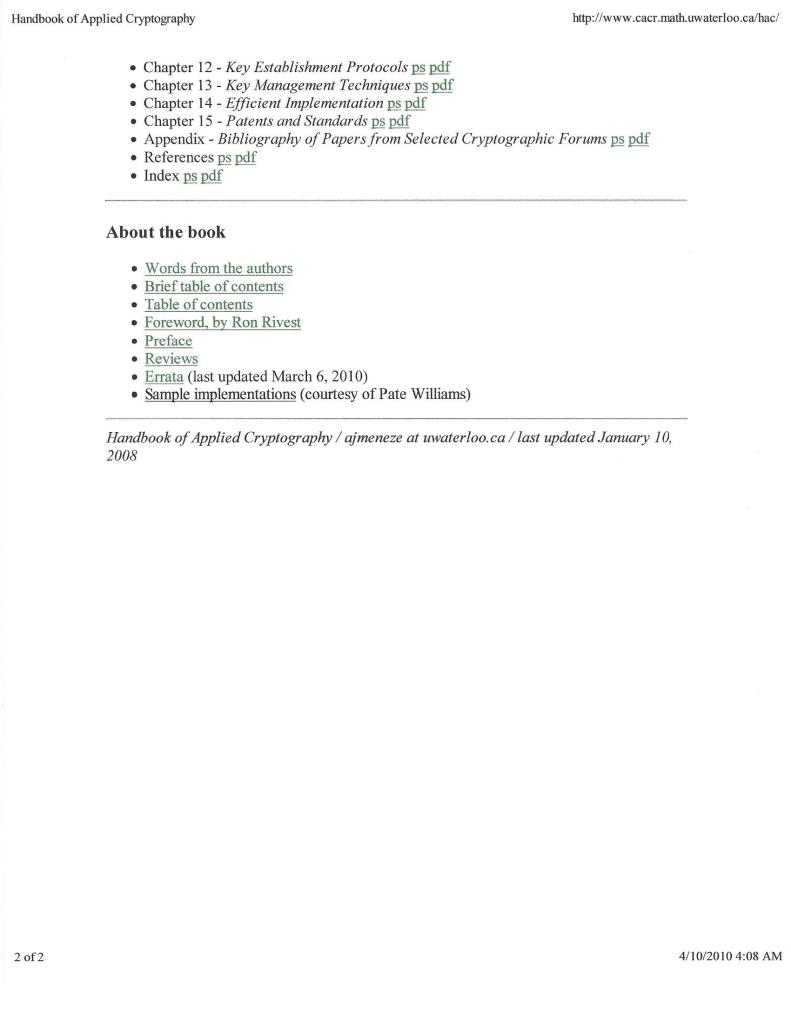
I became fascinated with secret key cryptography as a child. Later, as an adult, in around 1979, I started creating crude symmetric cryptographic algorithms. I became further enthralled with cryptography and number theory in 1996 upon reading Applied Cryptography, Second Edition: Protocols, Algorithms, and Source Code in C by Bruce Schneier and later the Handbook of Applied Cryptography by Alfred J. Menezes, Paul C. van Oorschot, and Scott A. Vanstone. After implementing many of the algorithms in both tomes, I communicated my results to two of the authors namely Bruce Schneier and Professor Alfred J. Menezes. In 1997 I developed a website devoted to constraint satisfaction problems and their solutions, cryptography, and number theory. I posted legal C and C++ source code. Professor Menezes advertised my website along with his treatise. See the following blurb:
In the spirit of my twin scientific infatuations, I offer yet another C integer factoring implementation utilizing the Free Large Integer Package (known more widely as lip) which was created by Arjen K. Lenstra (now a Professor Emeritus). This implementation includes Henri Cohen’s Trial Division algorithm, the Brent-Cohen-Pollard rho method, the Cohen-Pollard p – 1 stage 1 method, and the Lenstra lip Elliptic Curve Method. If I can get the proper authorization, I will later post the source code.
total time required for initialization: 0.056000 seconds
enter number below:
2^111+2
== Menu ==
1 Trial Division
2 Pollard-Brent-Cohen rho
3 p - 1 Pollard-Cohen
4 Lenstra's Elliptic Curve Method
5 Pollard-Lenstra rho
1
2596148429267413814265248164610050
number is composite
factors:
total time required factoring: 0.014000 seconds:
2
5 ^ 2
41
397
2113
enter number below:
0
total time required for initialization: 0.056000 seconds
enter number below:
2^111+2
== Menu ==
1 Trial Division
2 Pollard-Brent-Cohen rho
3 p - 1 Pollard-Cohen
4 Lenstra's Elliptic Curve Method
5 Pollard-Lenstra rho
2
2596148429267413814265248164610050
number is composite
factors:
total time required factoring: 1.531000 seconds:
2
5 ^ 2
41
397
2113
415878438361
3630105520141
enter number below:
0
total time required for initialization: 0.055000 seconds
enter number below:
2^111+2
== Menu ==
1 Trial Division
2 Pollard-Brent-Cohen rho
3 p - 1 Pollard-Cohen
4 Lenstra's Elliptic Curve Method
5 Pollard-Lenstra rho
3
2596148429267413814265248164610050
number is composite
factors:
total time required factoring: 0.066000 seconds:
2
5 ^ 2
41
838861
415878438361
3630105520141
enter number below:
0
total time required for initialization: 0.056000 seconds
enter number below:
2^111+2
== Menu ==
1 Trial Division
2 Pollard-Brent-Cohen rho
3 p - 1 Pollard-Cohen
4 Lenstra's Elliptic Curve Method
5 Pollard-Lenstra rho
4
2596148429267413814265248164610050
number is composite
factors:
total time required factoring: 0.013000 seconds:
2
5
205
838861
415878438361
3630105520141
enter number below:
0
 Numerical Explorations