Category: Number Theory
Blog Entry © Sunday, July 27, 2025, A Bit of Programming Nostalgia Prime Number Related Programs by James Williams, Jr.
/*
  Author:  Pate Williams c 1995

  The following program is a solution to problem 18.15
  in Pascalgorithms by Edwin D. Reilly and Francis D.
  Federighi page 627. The program uses Simpson's rule
  to calculate the number of primes less than or equal
  a given number.
*/

#include <math.h>
#include <stdio.h>

typedef double real;

static real f(real x)
{
	return(1.0 / log(x));
}

static real simpson(int n, real a, real b)
{
	int i;
	real evensum, h, oddsum, twoh, x;

	if (n % 2 == 1) n = n - 1;
	h = (b - a) / n;
	twoh = h + h;
	x = h + a;
	oddsum = 0.0;
	for (i = 1; i <= n / 2; i++)
	{
		oddsum += f(x);
		x = twoh + x;
	}
	x = twoh + a;
	evensum = 0.0;
	for (i = 1; i <= n / 2 - 1; i++)
	{
		evensum += f(x);
		x = twoh + x;
	}
	return(h / 3.0 * (f(a) + f(b) + 4.0 * oddsum + 2.0 * evensum));
}

int main(void)
{
	int i, n, Nmaximum = 0, Nminimum = 0, Nstep;

	printf("n = ");			scanf_s("%d", &n);
	printf("N minimum = "); scanf_s("%d", &Nminimum);
	printf("N maximum = "); scanf_s("%d", &Nmaximum);
	printf("N step = ");	scanf_s("%d", &Nstep);
	printf("\n");
	printf("----------------------------------------\n");
	printf("Min\t\tMax\t\tprimes\n");
	printf("----------------------------------------\n");
	for (i = Nminimum; i <= Nmaximum; i += Nstep)
	{
		printf("%8d\t%8d\t%8.0lf\n", Nminimum, i + Nstep,
			simpson(n, Nminimum, i + Nstep));
	}
	printf("----------------------------------------\n");
	return(0);
}
n = 1024
N minimum = 0
N maximum = 10000000
N step = 1000000

----------------------------------------
Min             Max             primes
----------------------------------------
       0         1000000           78551
       0         2000000          148923
       0         3000000          216788
       0         4000000          283122
       0         5000000          348361
       0         6000000          412754
       0         7000000          476461
       0         8000000          539590
       0         9000000          602224
       0        10000000          664424
       0        11000000          726239
----------------------------------------

D:\PrimeCounter\x64\Release\PrimeCounter.exe (process 51884) exited with code 0 (0x0).
Press any key to close this window . . .
/*
  Author:  Pate Williams c 1995

  The following is a translation of the Pascal program
  sieve found in Pascalgorithms by Edwin D. Reilly and
  Francis D. Federighi page 652. This program uses sets
  to represent the sieve (see C Programming Language An
  Applied Perspective by Lawrence Miller and Alec Qui-
  lici pages 160 - 162).
*/

#include <math.h>
#include <stdio.h>

#define _WORD_SIZE 32
#define _VECT_SIZE 524288
#define SET_MIN    0
#define SET_MAX    16777215

typedef unsigned long SET[_VECT_SIZE];
typedef long ELEMENT;
typedef unsigned long LONG;

SET set;

static int get_bit_pos(int* long_ptr, int* bit_ptr,
	ELEMENT element)
{
	*long_ptr = element / _WORD_SIZE;
	*bit_ptr = element % _WORD_SIZE;
	return(element >= SET_MIN && element <= SET_MAX);
}

static void set_bit(ELEMENT element, int inset)
{
	int bit, word;

	if (get_bit_pos(&word, &bit, element))
	{
		if (inset > 0)
			set[word] |= (01 << bit);
		else
			set[word] &= ~(01 << bit);
	}
}

static int get_bit(ELEMENT element)
{
	int bit, word;

	return(get_bit_pos(&word, &bit, element) ?
		(set[word] >> bit) & 01 : 0);
}

static void set_Add(ELEMENT element)
{
	set_bit(element, 1);
}

static void set_Del(ELEMENT element)
{
	set_bit(element, 0);
}

static int set_Mem(ELEMENT element)
{
	return get_bit(element);
}

static void primes(long n)
{
	long c, i, inc, k;
	double x;

	set_Add(2);
	for (i = 3; i <= n; i++)
		if ((i + 1) % 2 == 0)
			set_Add(i);
		else
			set_Del(i);
	c = 3;
	do
	{
		i = c * c;
		inc = c + c;
		while (i <= n)
		{
			set_Del(i);
			i = i + inc;
		}
		c += 2;
		while (set_Mem(c) == 0) c += 1;
	} while (c * c <= n);
	k = 0;
	for (i = 2; i <= n; i++)
		if (set_Mem(i) == 1) k++;
	x = n / log(n) - 5.0;
	x = x + exp(1.0 + 0.15 * log(n) * sqrt(log(n)));
	printf("%8ld\t%8ld\t%8.0lf\n", n, k, x);
}

int main(void)
{
	long n = 100L;

	printf("----------------------------------------\n");
	printf("n\t\tprimes\t\ttheory\n");
	printf("----------------------------------------\n");
	do
	{
		primes((int)n);
		n = 10L * n;
	} while (n < (long)SET_MAX);
	printf("----------------------------------------\n");
	return(0);
}
----------------------------------------
n               primes          theory
----------------------------------------
     100              25              29
    1000             168             181
   10000            1229            1261
  100000            9592            9634
 1000000           78498           78396
10000000          664579          665060
----------------------------------------

D:\Sieve\x64\Release\Sieve.exe (process 60092) exited with code 0 (0x0).
Press any key to close this window . . .
Blog Entry (c) Thursday, June 19, 2025, Factorizations of Some Composite Integers Using Two Different Computer Languages and Methods
Factorizations of the Seventh Fermat Number
and Other Composite Integers Using the
Pollard-Shor-Williams C# App and the LIP
Lenstra Elliptic Curve Method

It took 20.1 hours for J. M. Pollard to
factor the Seventh Fermat Number in
December 1988. He was using an 8-bit
Philips P2012 personal computer with
64k RAM and two 640k floppy drives.
His seven programs were written in the
Pascal computer language. The current
author was using a 64-bit Core i5 Dell
Latitude 3410 notebook computer with
8 GB RAM and a 235 GB solid state
hard drive. The computer language was
Windows 32 vanilla C in the Release x64
Configuration. The operating system was
Windows 11 Pro with the Visual Studio
2022 Community Version Integrated
Development Environment and C#.

2^128+1
340282366920938463463374607431768211457 39
Pseudo-Random Number Generator Seed = 1
Number of Tasks = 1
59649589127497217 p 17
5704689200685129054721 p 22
Total Elapsed Runtime Hrs:Min:Sec.MS = 00:20:31.359
Function Evaluations = 661379586
2^128+1
340282366920938463463374607431768211457 39
Pseudo-Random Number Generator Seed = 1
Number of Tasks = 2
59649589127497217 p 17
5704689200685129054721 p 22
Total Elapsed Runtime Hrs:Min:Sec.MS = 00:12:31.146
Function Evaluations = 283327140
2^128+1
340282366920938463463374607431768211457 39
Pseudo-Random Number Generator Seed = 1
Number of Tasks = 3
59649589127497217 p 17
5704689200685129054721 p 22
Total Elapsed Runtime Hrs:Min:Sec.MS = 00:21:53.637
Function Evaluations = 371472150
2^128+1
340282366920938463463374607431768211457 39
Pseudo-Random Number Generator Seed = 1
Number of Tasks = 4
59649589127497217 p 17
5704689200685129054721 p 22
Total Elapsed Runtime Hrs:Min:Sec.MS = 00:15:25.712
Function Evaluations = 197866620
2^128+1
340282366920938463463374607431768211457 39
Pseudo-Random Number Generator Seed = 1
Number of Tasks = 5
59649589127497217 p 17
5704689200685129054721 p 22
Total Elapsed Runtime Hrs:Min:Sec.MS = 00:03:06.030
Function Evaluations = 19501012
2^128+1
340282366920938463463374607431768211457 39
Pseudo-Random Number Generator Seed = 1
Number of Tasks = 6
59649589127497217 p 17
5704689200685129054721 p 22
Total Elapsed Runtime Hrs:Min:Sec.MS = 00:12:25.076
Function Evaluations = 198404541
2^128+1
340282366920938463463374607431768211457 39
Pseudo-Random Number Generator Seed = 1
Number of Tasks = 7
59649589127497217 p 17
5704689200685129054721 p 22
Total Elapsed Runtime Hrs:Min:Sec.MS = 00:20:59.172
Function Evaluations = 168943987
2^128+1
340282366920938463463374607431768211457 39
Pseudo-Random Number Generator Seed = 1
Number of Tasks = 8
59649589127497217 p 17
5704689200685129054721 p 22
Total Elapsed Runtime Hrs:Min:Sec.MS = 00:04:58.588
Function Evaluations = 13754504

Using Lenstra's Elliptic Curve Method

enter the number to be factored below:
2^128+1
340282366920938463463374607431768211457
number has 39 digits
== Menu ==
1 Cohen's Brent-Pollard Method
2 Cohen's Trial Division
3 Lenstra's Elliptic Curve Method
4 Pollard p-1 Method First Stage
5 Pollard p-1 Both Stages
6 Pollard-Shor-Williams Method
7 Exit Application
Enter an option '1' to '7':
3
factorization is complete
Runtime in seconds:
 1.00000 sec.
original number has 39-decimal digits
'c' means composite and 'p' means prime
59649589127497217 17-decimal digits p
5704689200685129054721 22-decimal digits p
enter the number to be factored below:

Miscellaneous numbers using the C# app:

2^32+1
4294967297 10
Pseudo-Random Number Generator Seed = 1
Number of Tasks = 1
641 p 3
6700417 p 7
Total Elapsed Runtime Hrs:Min:Sec.MS = 00:00:00.034
Function Evaluations = 57
2^41-1
2199023255551 13
Pseudo-Random Number Generator Seed = 1
Number of Tasks = 1
13367 p 5
164511353 p 9
Total Elapsed Runtime Hrs:Min:Sec.MS = 00:00:00.003
Function Evaluations = 1128
2^67-1
147573952589676412927 21
Pseudo-Random Number Generator Seed = 1
Number of Tasks = 1
193707721 p 9
761838257287 p 12
Total Elapsed Runtime Hrs:Min:Sec.MS = 00:00:00.065
Function Evaluations = 30519
2^144-3
22300745198530623141535718272648361505980413 44
Pseudo-Random Number Generator Seed = 1
Number of Tasks = 1
492729991333 p 12
45259565260477899162010980272761 p 32
Total Elapsed Runtime Hrs:Min:Sec.MS = 00:00:04.804
Function Evaluations = 2458746
2^32+1
4294967297 10
Pseudo-Random Number Generator Seed = 1
Number of Tasks = 5
641 p 3
6700417 p 7
Total Elapsed Runtime Hrs:Min:Sec.MS = 00:00:00.001
Function Evaluations = 81
2^41-1
2199023255551 13
Pseudo-Random Number Generator Seed = 1
Number of Tasks = 5
13367 p 5
164511353 p 9
Total Elapsed Runtime Hrs:Min:Sec.MS = 00:00:00.002
Function Evaluations = 174
2^67-1
147573952589676412927 21
Pseudo-Random Number Generator Seed = 1
Number of Tasks = 5
193707721 p 9
761838257287 p 12
Total Elapsed Runtime Hrs:Min:Sec.MS = 00:00:00.050
Function Evaluations = 35949
2^144-3
22300745198530623141535718272648361505980413 44
Pseudo-Random Number Generator Seed = 1
Number of Tasks = 5
492729991333 p 12
45259565260477899162010980272761 p 32
Total Elapsed Runtime Hrs:Min:Sec.MS = 00:00:01.613
Function Evaluations = 632928

Now Lenstra's ECM:

enter the number to be factored below:
2^32+1
4294967297
number has 10 digits
== Menu ==
1 Cohen's Brent-Pollard Method
2 Cohen's Trial Division
3 Lenstra's Elliptic Curve Method
4 Pollard p-1 Method First Stage
5 Pollard p-1 Both Stages
6 Pollard-Shor-Williams Method
7 Exit Application
Enter an option '1' to '7':
3
factorization is complete
Runtime in seconds:
 0.00000 sec.
original number has 10-decimal digits
'c' means composite and 'p' means prime
641 3-decimal digits p
6700417 7-decimal digits p
enter the number to be factored below:
2^41-1
2199023255551
number has 13 digits
== Menu ==
1 Cohen's Brent-Pollard Method
2 Cohen's Trial Division
3 Lenstra's Elliptic Curve Method
4 Pollard p-1 Method First Stage
5 Pollard p-1 Both Stages
6 Pollard-Shor-Williams Method
7 Exit Application
Enter an option '1' to '7':
3
factorization is complete
Runtime in seconds:
 0.00000 sec.
original number has 13-decimal digits
'c' means composite and 'p' means prime
13367 5-decimal digits p
164511353 9-decimal digits p
enter the number to be factored below:
2^67-1
147573952589676412927
number has 21 digits
== Menu ==
1 Cohen's Brent-Pollard Method
2 Cohen's Trial Division
3 Lenstra's Elliptic Curve Method
4 Pollard p-1 Method First Stage
5 Pollard p-1 Both Stages
6 Pollard-Shor-Williams Method
7 Exit Application
Enter an option '1' to '7':
3
factorization is complete
Runtime in seconds:
 0.00000 sec.
original number has 21-decimal digits
'c' means composite and 'p' means prime
193707721 9-decimal digits p
761838257287 12-decimal digits p
enter the number to be factored below:
2^144-3
22300745198530623141535718272648361505980413
number has 44 digits
== Menu ==
1 Cohen's Brent-Pollard Method
2 Cohen's Trial Division
3 Lenstra's Elliptic Curve Method
4 Pollard p-1 Method First Stage
5 Pollard p-1 Both Stages
6 Pollard-Shor-Williams Method
7 Exit Application
Enter an option '1' to '7':
3
factorization is complete
Runtime in seconds:
 0.00000 sec.
original number has 44-decimal digits
'c' means composite and 'p' means prime
492729991333 12-decimal digits p
45259565260477899162010980272761 32-decimal digits p
enter the number to be factored below:

For the last number 2^144-3 it took J. M. Pollard's
factoring with cubic integers 47 hours in 1988.
Live Person-to-Person Tutoring
Blog Entry (c) Monday September 16, 2024, by James Pate Williams, Jr. Ramanujan Highly Composite Numbers
Ramanujan Highly Composite Numbers
##              2       3       5       7       11      13
 1            2 1
 2            4 2
 3            6 1       1
 4           12 2       1
 5           24 3       1
 6           36 2       2
 7           48 4       1
 8           60 2       1       1
 9          120 3       1       1
10          180 2       2       1
11          240 4       1       1
12          360 3       2       1
13          720 4       2       1
14          840 3       1       1       1
15         1260 2       2       1       1
16         1680 4       1       1       1
17         2520 3       2       1       1
18         5040 4       2       1       1
19         7560 3       3       1       1
20        10080 5       2       1       1
21        15120 4       3       1       1
22        20160 6       2       1       1
23        25200 4       2       2       1
24        27720 3       2       1       1       1
25        45360 4       4       1       1
26        50400 5       2       2       1
27        55440 4       2       1       1       1
28        83160 3       3       1       1       1
29       110880 5       2       1       1       1
30       166320 4       3       1       1       1
31       221760 6       2       1       1       1
32       277200 4       2       2       1       1
33       332640 5       3       1       1       1
34       498960 4       4       1       1       1
35       554400 5       2       2       1       1
36       665280 6       3       1       1       1
37       720720 4       2       1       1       1       1
38      1081080 3       3       1       1       1       1
39      1441440 5       2       1       1       1       1
40      2162160 4       3       1       1       1       1
Runtime in seconds = 182.490
Type any character to exit application
Blog Entry (c) Saturday, September 14, 2024, by James Pate Williams, Jr. Comparison of Two Prime Number Sieves
Blog Entry (c) Friday, September 13, 2024, by James Pate Williams, Jr.
Blog Entry (c) Tuesday September 3, 2024, by James Pate Williams, Jr.
Blog Entry (c) Tuesday, August 27, 2024, Graphing New Goldwasser-Kilian Primality Test Results by James Pate Williams, Jr.
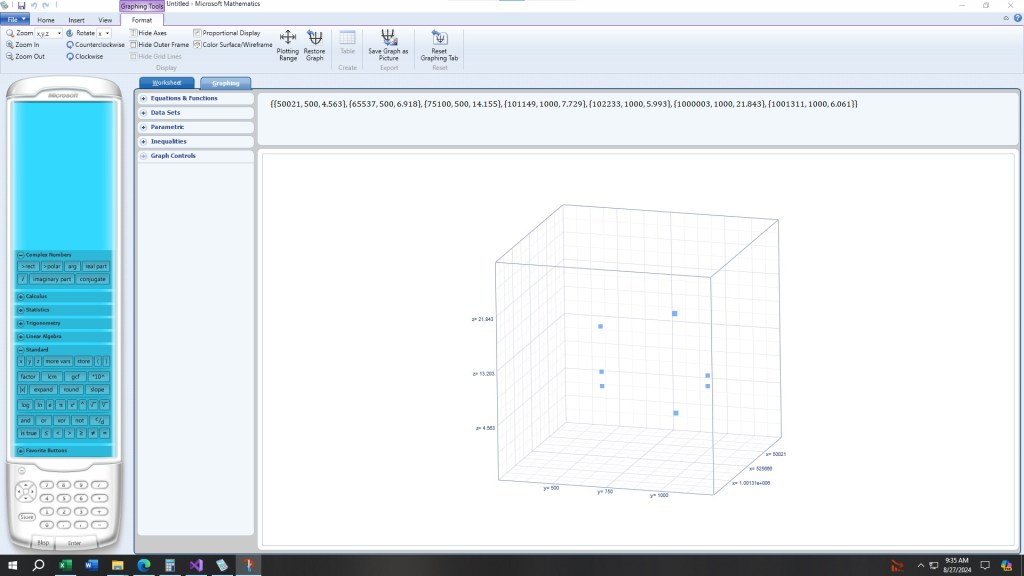
The x -axis is the number to be tested, the y-axis is prime number bound for factoring, and the z-axis is the runtime in seconds.
Blog Entry (c) Wednesday, August 21, 2024, by James Pate Williams, Jr. New and Improved Version of the Goldwasser-Kilian Primality Test
I corrected my powering modulo a prime routine. I added Pollard’s p – 1 factoring method and Shanks-Mestre elliptic curve point counting algorithm.

number to be tested or 0 to quit:
10000019
number of primes in factor base:
10000
Prime sieving time = 3.220000
N[0] = 10000019
a = 7838973
b = 2449531
m = 9995356
q = 356977
P = (9786147, 3226544)
P1 = (0, 1)
P2 = (5887862, 8051455)
N[1] = 356977
a = 45561
b = 178451
m = 357946
q = 178973
P = (80627, 163299)
P1 = (0, 1)
P2 = (52101, 282559)
N[2] = 178973
a = 135281
b = 76426
m = 178996
q = 73
P = (10238, 98035)
P1 = (0, 1)
P2 = (46702, 94326)
number is proven prime
runtime in seconds = 35.471000

number to be tested or 0 to quit:
10015969
number of primes in factor base:
10000
Prime sieving time = 3.424000
N[0] = 10015969
a = 6613193
b = 3951715
m = 10013908
q = 2503477
P = (998314, 8329764)
P1 = (0, 1)
P2 = (6944357, 1053776)
N[1] = 2503477
a = 1175442
b = 379813
m = 2505736
q = 293
P = (646462, 1631861)
P1 = (0, 1)
P2 = (1477980, 88719)
number is proven prime
runtime in seconds = 5.612000

number to be tested or 0 to quit:
99997981
number of primes in factor base:
10000
Prime sieving time = 4.152000
N[0] = 99997981
a = 34129462
b = 80482974
m = 100001414
q = 181
P = (19305995, 40493835)
P1 = (0, 1)
P2 = (33828245, 72969559)
number is proven prime
runtime in seconds = 11.500000

number to be tested or 0 to quit:
100001819
number of primes in factor base:
100000
Prime sieving time = 3.218000
N[0] = 100001819
a = 2694060
b = 17329746
m = 100008102
q = 5569
P = (124594, 14596756)
P1 = (0, 1)
P2 = (32514144, 56926555)
number is proven prime
runtime in seconds = 76.301000

number to be tested or 0 to quit:
100005317
number of primes in factor base:
100000
Prime sieving time = 3.269000
N[0] = 100005317
a = 45478318
b = 328034
m = 99988256
q = 3124633
P = (62548529, 30179124)
P1 = (0, 1)
P2 = (70379514, 76899689)
N[1] = 3124633
a = 2605576
b = 1809212
m = 3127654
q = 503
P = (1236288, 2081401)
P1 = (0, 1)
P2 = (2264479, 2583693)
number is proven prime
runtime in seconds = 459.979000

number to be tested or 0 to quit:
100000007
number of primes in factor base:
100000
Prime sieving time = 3.209000
N[0] = 100000007
a = 50593669
b = 72502607
m = 100005736
q = 2053
P = (72365335, 69885097)
P1 = (0, 1)
P2 = (55023241, 20078454)
number is proven prime
runtime in seconds = 163.705000

number to be tested or 0 to quit:
100014437
number of primes in factor base:
100000
Prime sieving time = 3.919000
N[0] = 100014437
a = 49955472
b = 45482796
m = 100024160
q = 263
P = (41650735, 8652103)
P1 = (0, 1)
P2 = (53790105, 37282431)
number is proven prime
runtime in seconds = 12.915000

