




#include <algorithm>
#include <iomanip>
#include <iostream>
#include <chrono>
#include <vector>
using namespace std;

typedef long long ll;

typedef struct ecPoint
{
	ll x, y;
} ECPOINT, *PECPOINT;

typedef struct ecPointOrder
{
	ll order;
	ECPOINT pt;
} ECPOINTORDER, * PECPOINTORDER;

int JACOBI(ll a, ll n)
{
	int e = 0, s;
	ll a1, b = a, m, n1;

	if (a == 0) return 0;
	if (a == 1) return 1;
	while ((b & 1) == 0)
	{
		b >>= 1;
		e++;
	}
	a1 = b;
	m = n % 8;
	if (!(e & 1)) s = 1;
	else if (m == 1 || m == 7) s = +1;
	else if (m == 3 || m == 5) s = -1;
	if (n % 4 == 3 && a1 % 4 == 3) s = -s;
	if (a1 != 1) n1 = n % a1; else n1 = 1;
	return s * JACOBI(n1, a1);
}

ll ExpMod(ll x, ll b, ll n)
/* returns x ^ b mod n */
{
	ll a = 1LL, s = x;

	if (b == 0)
		return 1LL;
	while (b != 0) {
		if (b & 1l) a = (a * s) % n;
		b >>= 1;
		if (b != 0) s = (s * s) % n;
	}
	if (a < 0)
		a += n;
	return a;
}

ll ExtendedEuclidean(ll b, ll n)
{
	ll b0 = b, n0 = n, t = 1, t0 = 0, temp, q, r;

	q = n0 / b0;
	r = n0 - q * b0;

	while (r > 0) {
		temp = t0 - q * t;
		if (temp >= 0) temp = temp % n;
		else temp = n - (-temp % n);
		t0 = t;
		t = temp;
		n0 = b0;
		b0 = r;
		q = n0 / b0;
		r = n0 - q * b0;
	}
	if (b0 != 1) return 0;
	else return t % n;
}

ll Weierstrass(ll a, ll b, ll x, ll p)
{
	return ((((x * x) % p) * x) % p + (a * x) % p + b) % p;
}

ll EPoints(
	bool print,
	ll a, ll b, ll p,
	vector<ECPOINT>& e)
	/* returns the number of points on the elliptic
	curve y ^ 2 = x ^ 3 + ax + b mod p */
{
	ll count = 0, m = (p + 1) / 4, x, y;
	ECPOINT pt{};

	if (p % 4 == 3) {
		for (x = 0; x < p; x++) {
			y = Weierstrass(a, b, x, p);
			if (JACOBI(y, p) != -1) {
				y = ExpMod(y, m, p);
				if (print)
				{
					cout << "(" << setw(2) << x << ", ";
					cout << y << ") " << endl;
				}
				pt.x = x;
				pt.y = y;
				e.push_back(pt);
				count++;
				y = -y % p;
				if (y < 0) y += p;
				if (y != 0)
				{
					if (print)
					{
						cout << "(" << setw(2) << x << ", ";
						cout << y << ") " << endl;
					}
					pt.x = x;
					pt.y = y;
					e.push_back(pt);
					count++;
				}
				if (print && count % 5 == 0)
					cout << endl;
			}
		}
		if (print && count % 5 != 0)
			cout << endl;
	}
	return count;
}

void Add(ll a, ll p, ECPOINT P,
	ECPOINT Q, ECPOINT& R)
	/* elliptic curve point partial addition */
{
	ll i, lambda;

	if (P.x == Q.x && P.y == 0 && Q.y == 0) {
		R.x = 0;
		R.y = 1;
		return;
	}
	if (P.x == Q.x && P.y == p - Q.y) {
		R.x = 0;
		R.y = 1;
		return;
	}
	if (P.x == 0 && P.y == 1) {
		R = Q;
		return;
	}
	if (Q.x == 0 && Q.y == 1) {
		R = P;
		return;
	}
	if (P.x != Q.x) {
		i = Q.x - P.x;
		if (i < 0) i += p;
		i = ExtendedEuclidean(i, p);
		lambda = ((Q.y - P.y) * i) % p;
	}
	else {
		i = ExtendedEuclidean((2 * P.y) % p, p);
		lambda = ((3 * P.x * P.x + a) * i) % p;
	}
	if (lambda < 0) lambda += p;
	R.x = (lambda * lambda - P.x - Q.x) % p;
	R.y = (lambda * (P.x - R.x) - P.y) % p;
	if (R.x < 0) R.x += p;
	if (R.y < 0) R.y += p;
}

void Multiply(
	ll a, ll k, ll p,
	ECPOINT P,
	ECPOINT& R)
{
	ECPOINT S;

	R.x = 0;
	R.y = 1;
	S = P;
	while (k != 0) {
		if (k & 1) Add(a, p, R, S, R);
		k >>= 1;
		if (k != 0) Add(a, p, S, S, S);
	}
}

ll Order(ll a, ll p, ECPOINT P)
{
	ll order = 1;
	ECPOINT Q = P, R{};

	do {
		order++;
		Add(a, p, P, Q, R);
		Q = R;
	} while (R.x != 0 && R.y != 1);
	return order;
}

const int PrimeSize = 10000000;
bool sieve[PrimeSize];

void PopulateSieve() {

	// sieve of Eratosthenes

	int c, inc, i, n = PrimeSize - 1;

	for (i = 0; i < n; i++)
		sieve[i] = false;

	sieve[1] = false;
	sieve[2] = true;

	for (i = 3; i <= n; i++)
		sieve[i] = (i & 1) == 1 ? true : false;

	c = 3;

	do {
		i = c * c;
		inc = c + c;

		while (i <= n) {
			sieve[i] = false;
			i += inc;
		}

		c += 2;
		while (!sieve[c])
			c++;
	} while (c * c <= n);
}

ll Partition(
	vector<ECPOINTORDER>& a, ll n, ll lo, ll hi)
{
	ll pivotIndex = lo + (hi - lo) / 2;
	ECPOINTORDER po = a[(unsigned int)pivotIndex];
	ECPOINTORDER x = po;
	ECPOINTORDER t = x;

	a[(unsigned int)pivotIndex] = a[(unsigned int)hi];
	a[(unsigned int)hi] = t;

	ll storeIndex = lo;

	for (unsigned int i = (unsigned int)lo; i < (unsigned int)hi; i++)
	{
		if (a[i].order < x.order)
		{
			t = a[i];
			a[i] = a[(unsigned int)storeIndex];
			a[(unsigned int)(storeIndex++)] = t;
		}
	}

	t = a[(unsigned int)storeIndex];
	a[(unsigned int)storeIndex] = a[(unsigned int)hi];
	a[(unsigned int)hi] = t;

	return storeIndex;
}

static void DoQuickSort(
	vector<ECPOINTORDER>& a, ll n, ll p, ll r)
{
	if (p < r)
	{
		ll q = Partition(a, n, p, r);

		DoQuickSort(a, n, p, q - 1);
		DoQuickSort(a, n, q + 1, r);
	}
}

void QuickSort(vector<ECPOINTORDER>& a, ll n)
{
	DoQuickSort(a, n, 0, n - 1);
}

int main()
{
	PopulateSieve();

	while (true)
	{
		bool noncyclic = false;
		int option;
		ll a, b, p;

		cout << "Enter 1 to continue or 0 to quit = ";
		cin >> option;

		if (option == 0)
			break;

		cout << "Weierstrass parameter a = ";
		cin >> a;
		cout << "Weierstrass parameter b = ";
		cin >> b;
		cout << "Enter the prime parameter p = ";
		cin >> p;

		if (!sieve[p])
		{
			cout << "p is not a prime number. " << endl;
			continue;
		}

		if (p % 4 != 3)
		{
			cout << "p mod 4 must be 3 for this algorithm." << endl;
			continue;
		}

		bool print = false, enumerate = false;
		vector<ECPOINT> e;
		vector<ECPOINTORDER> eOrder;

		cout << "Enumerate points (0 for no or 1 for yes)? ";
		cin >> option;

		enumerate = option == 1;
		auto time0 = chrono::high_resolution_clock::now();
		ll count = EPoints(print, a, b, p, e);
		auto time1 = chrono::high_resolution_clock::now();
		auto elapsed = time1 - time0;
		ll h = count + 1;
		ll maxOrder = 0;
		ll minOrder = h;
		ll order = -1;
		ECPOINT P{}, Q{};

		if (enumerate)
			cout << "The points (x, y) on E and their orders are:" << endl;

		for (unsigned int i = 0; i < count; i++)
		{
			ECPOINTORDER ptOrder{};

			order = Order(a, p, e[i]);
			ptOrder.order = order;
			ptOrder.pt = e[i];
			eOrder.push_back(ptOrder);

			if (order < h)
				noncyclic = true;
			if (order < minOrder) {
				P = e[i];
				minOrder = order;
			}
			if (order > maxOrder) {
				Q = e[i];
				maxOrder = order;
			}
		}
		if (enumerate)
		{
			QuickSort(eOrder, count);

			for (unsigned int i = 0; i < eOrder.size(); i++)
			{
				cout << "(" << eOrder[i].pt.x << ", ";
				cout << eOrder[i].pt.y << ") ";
				cout << eOrder[i].order << "\t";
				if ((i + 1) % 5 == 0)
					cout << endl;
			}
			if (count % 5 != 0)
				cout << endl;
		}
		cout << "#E = " << h << endl;
		cout << "Noncyclic = " << noncyclic << endl;
		cout << "Minimum order = " << minOrder << endl;
		cout << "Maximum order = " << maxOrder << endl;
		cout << "(" << P.x << ", " << P.y << ")" << endl;
		cout << "(" << Q.x << ", " << Q.y << ")" << endl;

		long long runtime = chrono::duration_cast<chrono::milliseconds>(elapsed).count();
		if (runtime != 0)
			cout << "Point counting runtime in milliseconds = " << runtime << endl;
		else
		{
			runtime = chrono::duration_cast<chrono::microseconds>(elapsed).count();
			cout << "Point counting runtime in microseconds = " << runtime << endl;
		}
	}
	return 0;
}

/*
Author:  Pate Williams (c) 1997

Exercise
"5.6 The field GF(2 ^ 5) can be constructed as
Z_2[x]/(x ^ 5 + x ^ 2 + 1). Perform the following
computations in this field.
(a) Compute (x ^ 4 + x ^ 2) * (x ^ 3 + x + 1).
(b) Using the Extended Euclidean algorithm
compute (x ^ 3 + x ^ 2) ^ - 1.
(c) Using the square and multiply algorithm,
compute x ^ 25." -Douglas R. Stinson-
See "Cryptography: Theory and Practice" by
Douglas R. Stinson page 201.
*/

#include <math.h>
#include <stdio.h>

#define SIZE 32l

void poly_mul(long m, long n, long *a, long *b, long *c, long *p)
{
	long ai, bj, i, j, k, sum;

	*p = m + n;
	for (k = 0; k <= *p; k++) {
		sum = 0;
		for (i = 0; i <= k; i++) {
			j = k - i;
			if (i > m) ai = 0; else ai = a[i];
			if (j > n) bj = 0; else bj = b[j];
			sum += ai * bj;
		}
		c[k] = sum;
	}
}

void poly_div(long m, long n, long *u, long *v,
	long *q, long *r, long *p, long *s)
{
	long j, jk, k, nk, vn = v[n];

	for (j = 0; j <= m; j++) r[j] = u[j];
	if (m < n) {
		*p = 0, *s = m;
		q[0] = 0;
	}
	else {
		*p = m - n, *s = n - 1;
		for (k = *p; k >= 0; k--) {
			nk = n + k;
			q[k] = r[nk] * pow(vn, k);
			for (j = nk - 1; j >= 0; j--) {
				jk = j - k;
				if (jk >= 0)
					r[j] = vn * r[j] - r[nk] * v[j - k];
				else
					r[j] = vn * r[j];
			}
		}
		while (*p > 0 && q[*p] == 0) *p = *p - 1;
		while (*s > 0 && r[*s] == 0) *s = *s - 1;
	}
}

void poly_exp_mod(long degreeA, long degreem, long n,
	long modulus, long *A, long *m, long *s,
	long *ds)
{
	int zero;
	long dp, dq, dx = degreeA, i;
	long p[SIZE], q[SIZE], x[SIZE];

	*ds = 0, s[0] = 1;
	for (i = 0; i <= dx; i++) x[i] = A[i];
	while (n > 0) {
		if ((n & 1) == 1) {
			/* s = (s * x) % m; */
			poly_mul(*ds, dx, s, x, p, &dp);
			poly_div(dp, degreem, p, m, q, s, &dq, ds);
			for (i = 0; i <= *ds; i++) s[i] %= modulus;
			zero = s[*ds] == 0, i = *ds;
			while (i > 0 && zero) {
				if (zero) *ds = *ds - 1;
				zero = s[--i] == 0;
			}
		}
		n >>= 1;
		/* x = (x * x) % m; */
		poly_mul(dx, dx, x, x, p, &dp);
		poly_div(dp, degreem, p, m, q, x, &dq, &dx);
		for (i = 0; i <= dx; i++) x[i] %= modulus;
		zero = x[dx] == 0, i = dx;
		while (i > 0 && zero) {
			if (zero) dx--;
			zero = x[--i] == 0;
		}
	}
}

void poly_copy(long db, long *a, long *b, long *da)
/* a = b */
{
	long i;

	*da = db;
	for (i = 0; i <= db; i++) a[i] = b[i];
}

int poly_Extended_Euclidean(long db, long dn,
	long *b, long *n,
	long *t, long *dt)
{
	int nonzero;
	long db0, dn0, dq, dr, dt0 = 0, dtemp, du, i;
	long b0[SIZE], n0[SIZE], q[SIZE];
	long r[SIZE], t0[SIZE], temp[SIZE], u[SIZE];

	*dt = 0;
	poly_copy(dn, n0, n, &dn0);
	poly_copy(db, b0, b, &db0);
	t0[0] = 0;
	t[0] = 1;
	poly_div(dn0, db0, n0, b0, q, r, &dq, &dr);
	nonzero = r[0] != 0;
	for (i = 1; !nonzero && i <= dr; i++)
		nonzero = r[i] != 0;
	while (nonzero) {
		poly_mul(dq, *dt, q, t, u, &du);
		if (dt0 < du)
			for (i = dt0 + 1; i <= du; i++) t0[i] = 0;
		for (i = 0; i <= du; i++)
			temp[i] = t0[i] - u[i];
		dtemp = du;
		poly_copy(*dt, t0, t, &dt0);
		poly_copy(dtemp, t, temp, dt);
		poly_copy(db0, n0, b0, &dn0);
		poly_copy(dr, b0, r, &db0);
		poly_div(dn0, db0, n0, b0, q, r, &dq, &dr);
		nonzero = r[0] != 0;
		for (i = 1; !nonzero && i <= dr; i++)
			nonzero = r[i] != 0;
	}
	if (db0 != 0 && b0[0] != 1) return 0;
	return 1;
}

void poly_mod(long da, long p, long *a, long *new_da)
{
	int zero;
	long i;

	for (i = 0; i <= da; i++) {
		a[i] %= p;
		if (a[i] < 0) a[i] += p;
	}
	zero = a[da] == 0;
	for (i = da - 1; zero && i >= 0; i--) {
		da--;
		zero = a[i] == 0;
	}
	*new_da = da;
}

void poly_write(char *label, long da, long *a)
{
	long i;

	printf("%s", label);
	for (i = da; i >= 0; i--)
		printf("%ld ", a[i]);
	printf("\n");
}

int main(void)
{
	long da = 4, db = 3, dc = 3, dd = 5;
	long de, dq, dr, ds, p = 2;
	long a[5] = { 0, 0, 1, 0, 1 };
	long b[4] = { 1, 1, 0, 1 };
	long c[4] = { 0, 0, 1, 1 };
	long d[6] = { 1, 0, 1, 0, 0, 1 };
	long e[SIZE], q[SIZE], r[SIZE], s[SIZE];

	poly_write("A = ", da, a);
	poly_write("B = ", db, b);
	poly_write("C = ", dc, c);
	poly_write("D = ", dd, d);
	poly_mul(da, db, a, b, e, &de);
	poly_mod(de, p, e, &de);
	poly_div(de, dd, e, d, q, r, &dq, &dr);
	poly_mod(dq, p, q, &dq);
	poly_mod(dr, p, r, &dr);
	poly_write("A * B mod 2 = ", de, e);
	poly_write("A * B / D mod 2 = ", dq, q);
	poly_write("A * B mod D, 2  = ", dr, r);
	if (!poly_Extended_Euclidean(dc, dd, c, d, e, &de))
		printf("*error*\in poly_Extended_Euclidean\n");
	poly_mod(de, p, e, &de);
	poly_write("C ^ - 1 mod D = ", de, e);
	poly_mul(dc, de, c, e, s, &ds);
	poly_mod(ds, p, s, &ds);
	poly_div(ds, dd, s, d, q, r, &dq, &dr);
	poly_mod(dr, p, r, &dr);
	poly_write("C * C ^ - 1 mod D, 2 = ", dr, r);
	dq = 1;
	q[0] = 0;
	q[1] = 1;
	poly_exp_mod(dq, dd, 7, p, q, d, s, &ds);
	poly_mod(ds, p, s, &ds);
	poly_write("x ^  7 mod D, 2 = ", ds, s);
	poly_exp_mod(dq, dd, 9, p, q, d, s, &ds);
	poly_mod(ds, p, s, &ds);
	poly_write("x ^  9 mod D, 2 = ", ds, s);
	poly_exp_mod(dq, dd, 10, p, q, d, s, &ds);
	poly_mod(ds, p, s, &ds);
	poly_write("x ^ 10 mod D, 2 = ", ds, s);
	poly_exp_mod(dq, dd, 25, p, q, d, s, &ds);
	poly_mod(ds, p, s, &ds);
	poly_write("x ^ 25 mod D, 2 = ", ds, s);
	return 0;
}


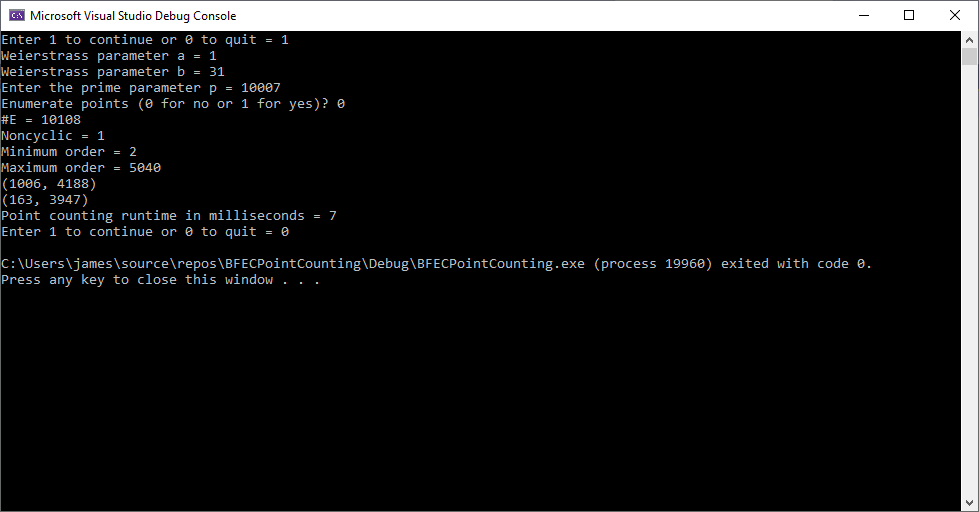
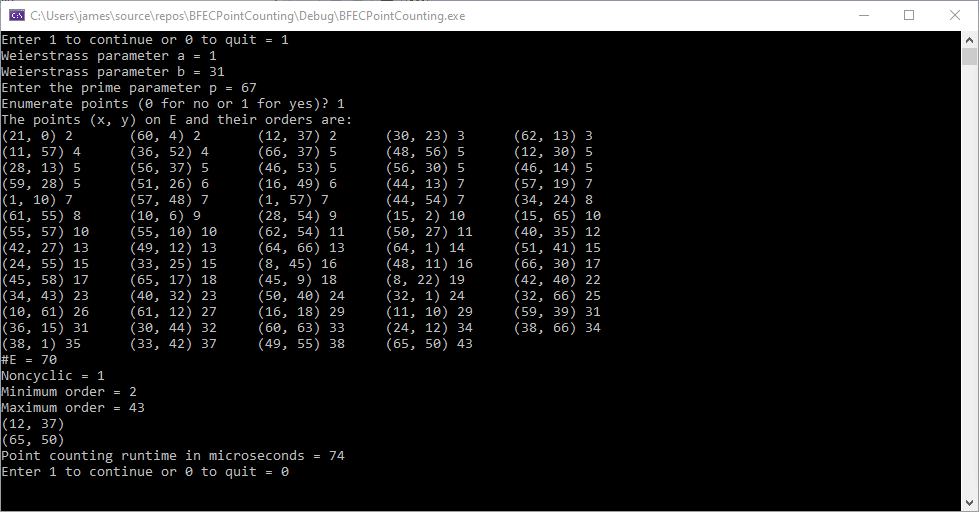
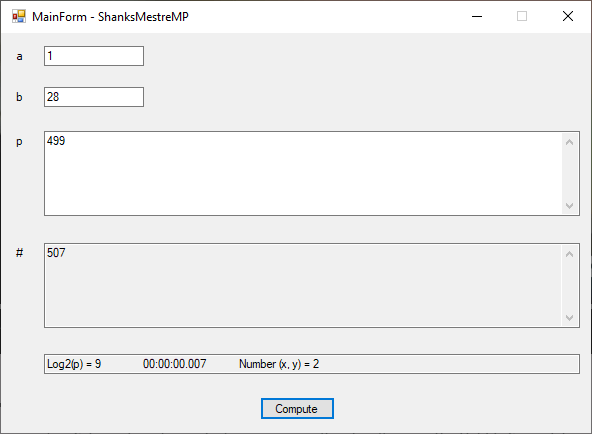
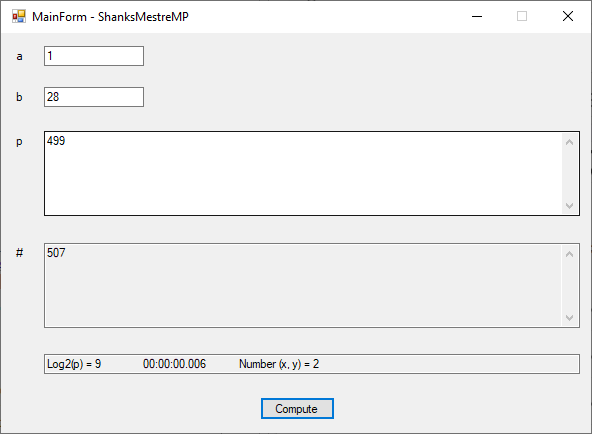
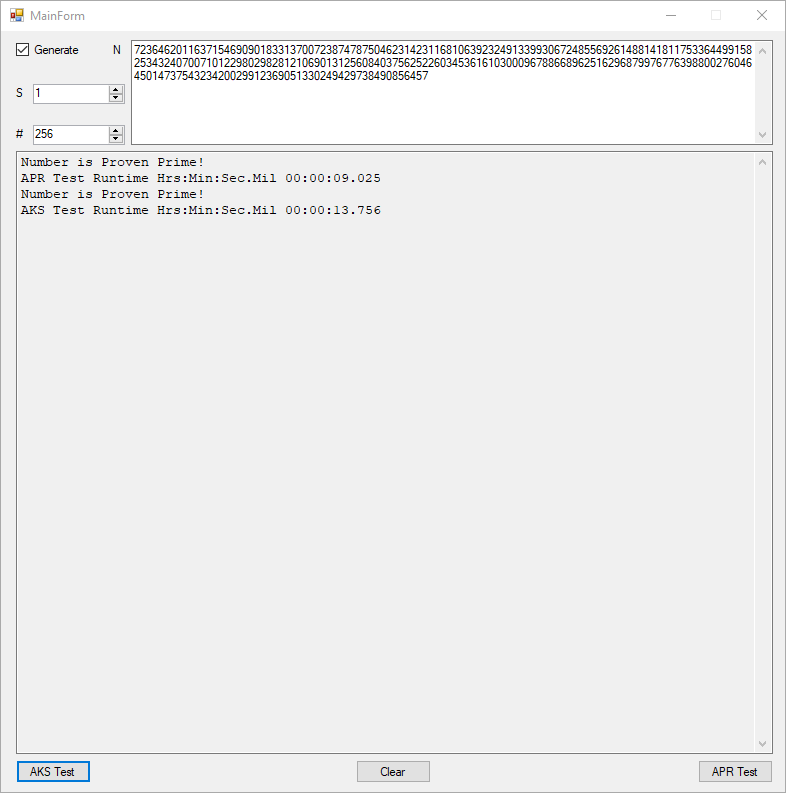
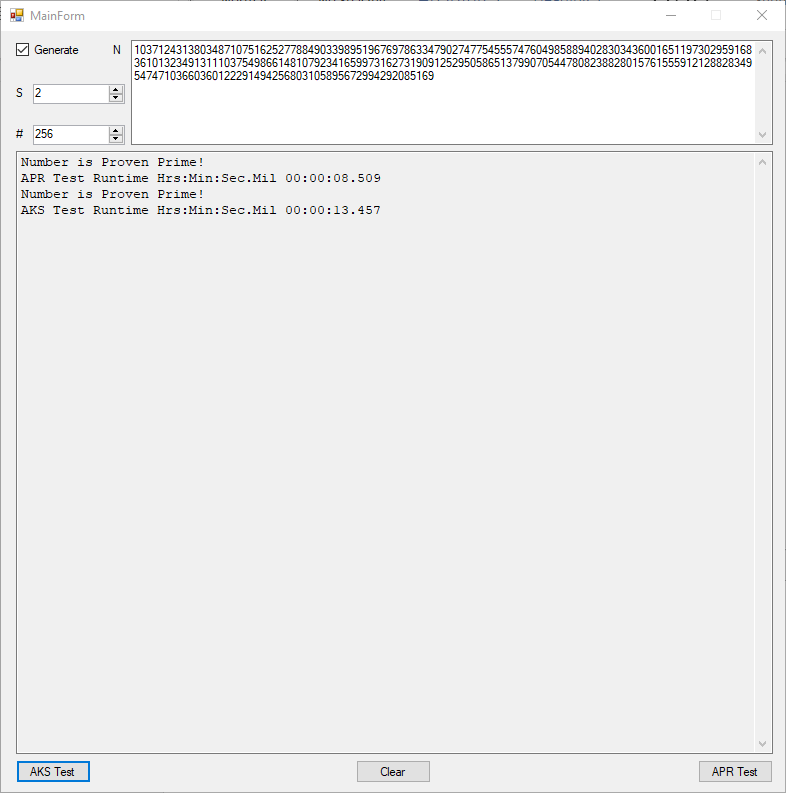
As can be seen the C++ application appears to be much faster than the C# application. Also, in my humble opinion, C++ with header files and C++ source code files is much more elegant than C# with only class source code. I leave it to someone else to add C# interfaces to my class source code files.
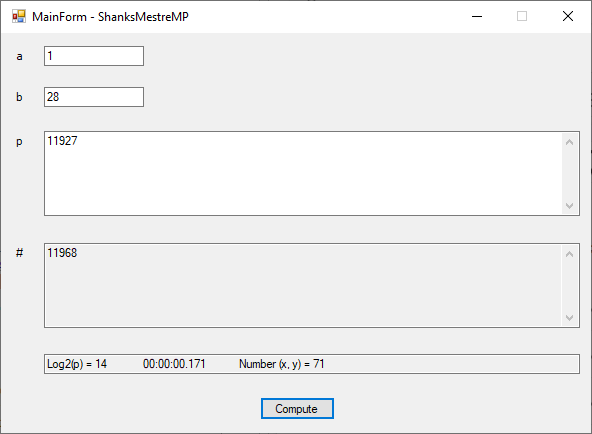
A few years ago, I implemented the Shanks-Mestre elliptic curve point counting algorithm in C# using the BigInteger data structure and the algorithm found in Henri Cohen’s textbook A Course in Computational Algebraic Number Theory. I translated the C# application to C++ in August 21-22, 2023. The C++ code uses the long long 64-bit signed integer data type. Below are some results. I also implemented Schoof’s point counting algorithm in C#.




/*
  Author:  Pate Williams (c) 1997

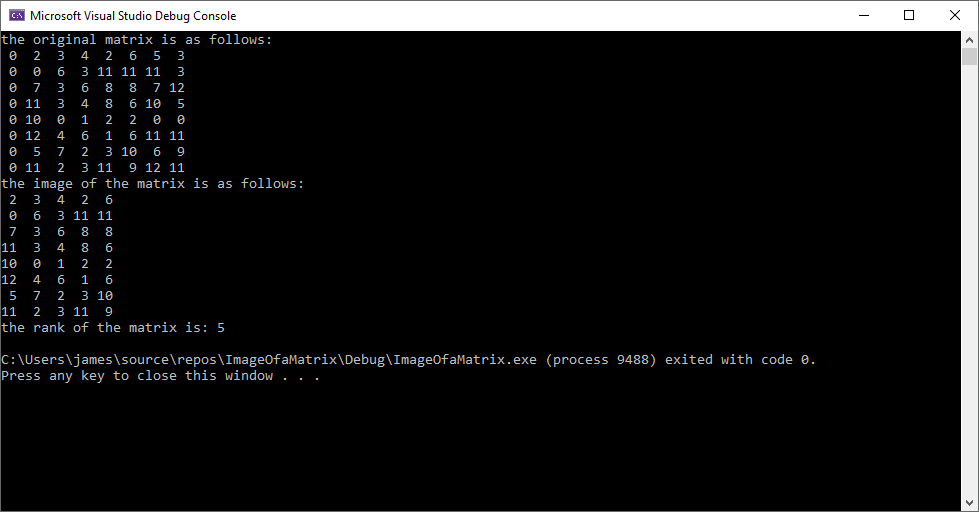
  "Algorithm 2.3.2 (Image of a Matrix). Given an
  m by n matrix M = (m[i][i]) with 1 <= i <= m and
  1 <= j <= n having coefficients in the field K,
  this algorithm outputs a basis of the image of
  M, i. e. vector space spanned by the columns of
  M." -Henri Cohen- See "A Course in Computational
  Algebraic Number Theory" by Henri Cohen pages
  58-59. We specialize the code to the field Zp.
*/

#include <stdio.h>
#include <stdlib.h>

long** create_matrix(long m, long n)
{
    long i, ** matrix = (long**)calloc(m, sizeof(long*));

    if (!matrix) {
        fprintf(stderr, "fatal error\ninsufficient memory\n");
        fprintf(stderr, "from create_matrix\n");
        exit(1);
    }
    for (i = 0; i < m; i++) {
        matrix[i] = (long*)calloc(n, sizeof(long));
        if (!matrix[i]) {
            fprintf(stderr, "fatal error\ninsufficient memory\n");
            fprintf(stderr, "from create_matrix\n");
            exit(1);
        }
    }
    return matrix;
}

void delete_matrix(long m, long** matrix)
{
    long i;

    for (i = 0; i < m; i++) free(matrix[i]);
    free(matrix);
}

void Euclid_extended(long a, long b, long* u,
    long* v, long* d)
{
    long q, t1, t3, v1, v3;

    *u = 1, * d = a;
    if (b == 0) {
        *v = 0;
        return;
    }
    v1 = 0, v3 = b;
#ifdef DEBUG
    printf("----------------------------------\n");
    printf(" q    t3   *u   *d   t1   v1   v3\n");
    printf("----------------------------------\n");
#endif
    while (v3 != 0) {
        q = *d / v3;
        t3 = *d - q * v3;
        t1 = *u - q * v1;
        *u = v1, * d = v3;
#ifdef DEBUG
        printf("%4ld %4ld %4ld ", q, t3, *u);
        printf("%4ld %4ld %4ld %4ld\n", *d, t1, v1, v3);
#endif
        v1 = t1, v3 = t3;
    }
    *v = (*d - a * *u) / b;
#ifdef DEBUG
    printf("----------------------------------\n");
#endif
}

long inv(long number, long modulus)
{
    long d, u, v;

    Euclid_extended(number, modulus, &u, &v, &d);
    if (d == 1) return u;
    return 0;
}

void image(long m, long n, long p,
    long** M, long** X, long* r)
{
    int found;
    long D, i, j, k, s;
    long* c = (long*)calloc(m, sizeof(long));
    long* d = (long*)calloc(n, sizeof(long));
    long** N = create_matrix(m, n);

    if (!c || !d) {
        fprintf(stderr, "fatal error\ninsufficient memory\n");
        fprintf(stderr, "from kernel\n");
        exit(1);
    }
    for (i = 0; i < m; i++) {
        c[i] = -1;
        for (j = 0; j < n; j++) N[i][j] = M[i][j];
    }
    *r = 0;
    for (k = 0; k < n; k++) {
        found = 0, j = 0;
        while (!found && j < m) {
            found = M[j][k] != 0 && c[j] == -1;
            if (!found) j++;
        }
        if (found) {
            D = p - inv(M[j][k], p);
            M[j][k] = p - 1;
            for (s = k + 1; s < n; s++)
                M[j][s] = (D * M[j][s]) % p;
            for (i = 0; i < m; i++) {
                if (i != j) {
                    D = M[i][k];
                    M[i][k] = 0;
                    for (s = k + 1; s < n; s++) {
                        M[i][s] = (M[i][s] + D * M[j][s]) % p;
                        if (M[i][s] < 0) M[i][s] += p;
                    }
                }
            }
            c[j] = k;
            d[k] = j;
        }
        else {
            *r = *r + 1;
            d[k] = -1;
        }
    }
    for (j = 0; j < m; j++) {
        if (c[j] != -1) {
            for (i = 0; i < n; i++) {
                if (i < m) X[i][j] = N[i][c[j]];
                else X[i][j] = 0;
            }
        }
    }
    delete_matrix(m, N);
    free(c);
    free(d);
}

void print_matrix(long m, long n, long** a)
{
    long i, j;

    for (i = 0; i < m; i++) {
        for (j = 0; j < n; j++)
            printf("%2ld ", a[i][j]);
        printf("\n");
    }
}

int main(void)
{
    long i, j, m = 8, n = 8, p = 13, r;
    long a[8][8] = { {0,  0,  0,  0,  0,  0,  0,  0},
                    {2,  0,  7, 11, 10, 12,  5, 11},
                    {3,  6,  3,  3,  0,  4,  7,  2},
                    {4,  3,  6,  4,  1,  6,  2,  3},
                    {2, 11,  8,  8,  2,  1,  3, 11},
                    {6, 11,  8,  6,  2,  6, 10,  9},
                    {5, 11,  7, 10,  0, 11,  6, 12},
                    {3,  3, 12,  5,  0, 11,  9, 11} };
    long** M = create_matrix(m, n);
    long** X = create_matrix(n, n);

    for (i = 0; i < m; i++)
        for (j = 0; j < n; j++)
            M[i][j] = a[j][i];
    printf("the original matrix is as follows:\n");
    print_matrix(m, n, M);
    image(m, n, p, M, X, &r);
    printf("the image of the matrix is as follows:\n");
    print_matrix(n, n - r, X);
    printf("the rank of the matrix is: %ld\n", n - r);
    delete_matrix(m, M);
    delete_matrix(n, X);
    return 0;
}
/*
  Author:  Pate Williams (c) 1997

  "Algorithm 2.3.5 (Inverse Image Matrix). Let M be
  an m by n matrix and V be an m by r matrix, where
  n <= m. This algorithm either outputs a message
  saying that some column vector of V is not in the
  image of M, or outputs an n by r matrix X such
  that V = MX." -Henri Cohen- See "A Course in Com-
  putational Algebraic Number Theory" by Henri
  Cohen pages 60-61. We specialize to the field Q.
*/

#include <stdio.h>
#include <stdlib.h>

double** create_matrix(long m, long n)
{
    double** matrix = (double**)calloc(m, sizeof(double*));
    long i;

    if (!matrix) {
        fprintf(stderr, "fatal error\ninsufficient memory\n");
        fprintf(stderr, "from create_matrix\n");
        exit(1);
    }
    for (i = 0; i < m; i++) {
        matrix[i] = (double*)calloc(n, sizeof(double));
        if (!matrix[i]) {
            fprintf(stderr, "fatal error\ninsufficient memory\n");
            fprintf(stderr, "from create_matrix\n");
            exit(1);
        }
    }
    return matrix;
}

void delete_matrix(long m, double** matrix)
{
    long i;

    for (i = 0; i < m; i++) free(matrix[i]);
    free(matrix);
}

void inverse_image_matrix(long m, long n, long r,
    double** M, double** V,
    double** X)
{
    double ck, d, sum, t;
    double** B = create_matrix(m, r);
    int found;
    long i, j, k, l;

    for (i = 0; i < m; i++)
        for (j = 0; j < r; j++)
            B[i][j] = V[i][j];
    for (j = 0; j < n; j++) {
        found = 0, i = j;
        while (!found && i < m) {
            found = M[i][j] != 0;
            if (!found) i++;
        }
        if (!found) {
            fprintf(stderr, "fatal error\nnot linearly independent\n");
            fprintf(stderr, "from inverse_image_matrix\n");
            exit(1);
        }
        if (i > j) {
            for (l = 0; l < n; l++)
                t = M[i][l], M[i][l] = M[j][l], M[j][l] = t;
            for (l = 0; l < r; l++)
                t = B[i][l], B[i][l] = B[j][l], B[j][l] = t;
        }
        d = 1.0 / M[j][j];
        for (k = j + 1; k < m; k++) {
            ck = d * M[k][j];
            for (l = j + 1; l < n; l++)
                M[k][l] -= ck * M[j][l];
            for (l = 0; l < r; l++)
                B[k][l] -= ck * B[j][l];
        }
    }
    for (i = n - 1; i >= 0; i--) {
        for (k = 0; k < r; k++) {
            sum = 0;
            for (j = i + 1; j < n; j++)
                sum += M[i][j] * X[j][k];
            X[i][k] = (B[i][k] - sum) / M[i][i];
        }
    }
    for (k = n + 1; k < m; k++) {
        for (j = 0; j < r; j++) {
            sum = 0;
            for (i = 0; i < n; i++)
                sum += M[k][i] * X[i][j];
            if (sum != B[k][j]) {
                fprintf(stderr, "fatal error\ncolumn not in image\n");
                fprintf(stderr, "from inverse_image_matrix\n");
                exit(1);
            }
        }
    }
    delete_matrix(m, B);
}

void matrix_multiply(long m, long n, long r,
    double** a, double** b,
    double** c)
    /* c = a * b */
{
    double sum;
    long i, j, k;

    for (i = 0; i < m; i++) {
        for (j = 0; j < r; j++) {
            sum = 0.0;
            for (k = 0; k < n; k++)
                sum += a[i][k] * b[k][j];
            c[i][j] = sum;
        }
    }
}

void print_matrix(long m, long n, double** a)
{
    long i, j;

    for (i = 0; i < m; i++) {
        for (j = 0; j < n; j++)
            printf("%+10.6lf ", a[i][j]);
        printf("\n");
    }
}

int main(void)
{
    long i, j, m = 4, n = 4, r = 4;
    double** c = create_matrix(m, n);
    double** M = create_matrix(m, n);
    double** V = create_matrix(m, r);
    double** X = create_matrix(n, r);

    for (i = 0; i < m; i++) {
        c[i][i] = M[i][i] = 2.0;
        if (i > 0)
            c[i][i - 1] = M[i][i - 1] = -1.0;
        if (i < m - 1)
            c[i][i + 1] = M[i][i + 1] = -1.0;
    }
    for (i = 0; i < m; i++)
        for (j = 0; j < r; j++)
            V[i][j] = i + j + 1;
    printf("M is as follows:\n");
    print_matrix(m, n, M);
    printf("V is as follows:\n");
    print_matrix(m, r, V);
    inverse_image_matrix(m, n, r, M, V, X);
    printf("X is as follows:\n");
    print_matrix(n, r, X);
    matrix_multiply(m, n, r, c, X, M);
    printf("MX is as follows:\n");
    print_matrix(m, r, M);
    delete_matrix(m, c);
    delete_matrix(m, M);
    delete_matrix(m, V);
    delete_matrix(n, X);
    return 0;
}

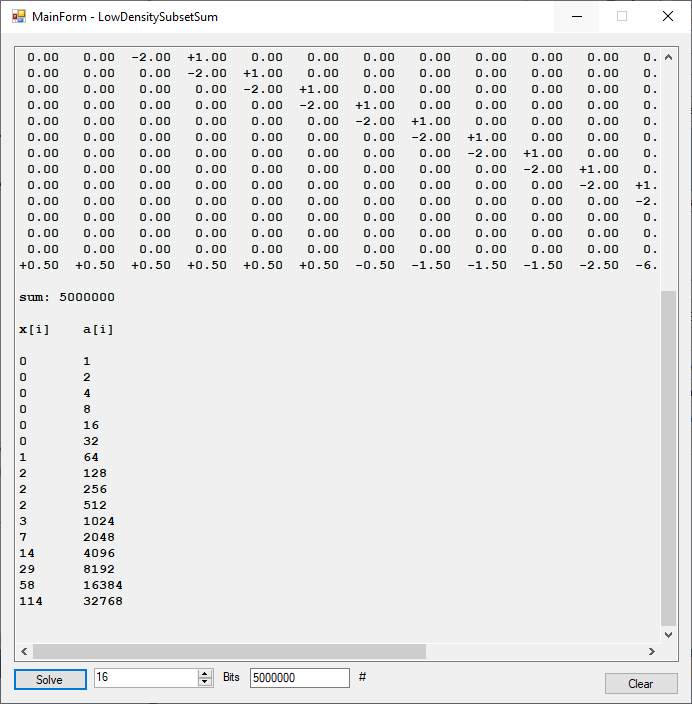
A few years ago, I implemented the LLL lattice reduction algorithm found in two references: “Handbook of Applied Cryptography” Edited by Alfred J. Menezes et al and “A Course in Computational Algebraic Number Theory” by Henri Cohen. My new implementation in C# uses 64-bit integers and BigIntegers. Here are some results.



27-Decimal Digit Number 123456789012345678901234567

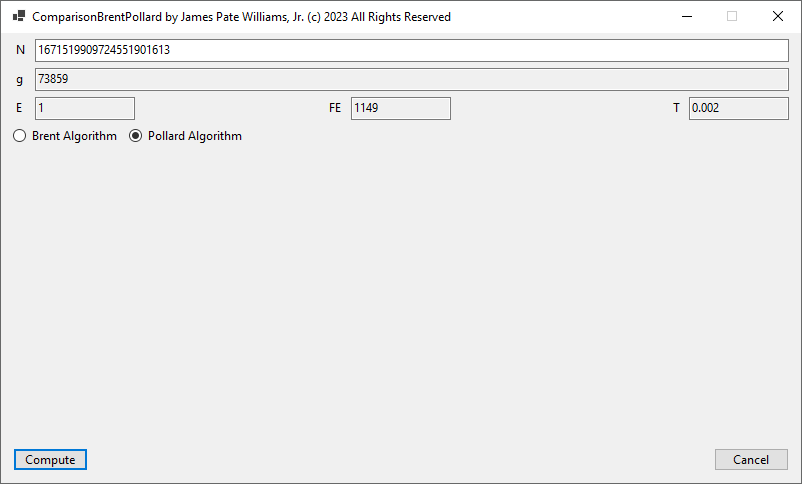
31-Digit Decimal Number 1234567890123456789012345678901 Pollard Failed


The same factorizations by the Classical Shor-Pollard- James Pate Williams, Jr. algorithm.
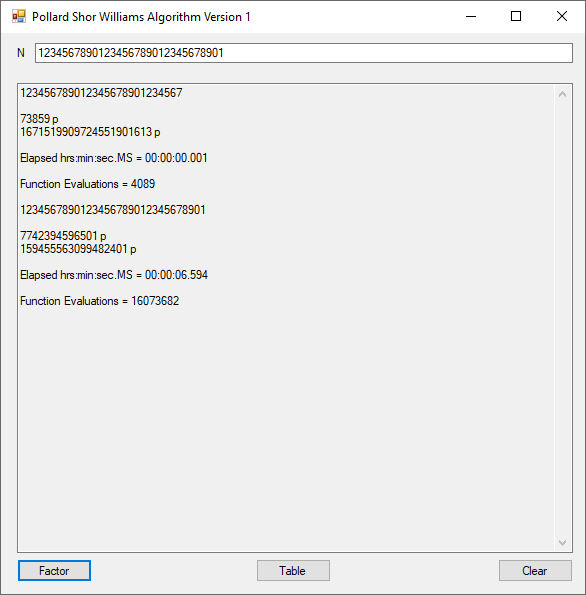
 Numerical Explorations