Battle of the Denmark Strait by James Pate Williams, Jr., BA, BS, MSwE, PhD

We are rapidly converging on the 79th Anniversary of the Battle of Denmark Strait which was a battle between the Royal Navy’s HMS Hood, a battlecruiser, and HMS Prince of Wales, a newly built battleship, and the Nazi Kriegsmarine’s Bismarck, a battleship, and Prinz Eugen, a heavy cruiser. The battle took place on Saturday, May 24, 1941 at approximately 5:52 AM to 6:02 AM local time. The Prince of Wales fired the first salvo at a range of 26,500 yards which is about 15.06 miles towards the lead Nazi ship which was the heavy cruiser Prinz Eugen. The Nazis held their fire until 5:55 AM. At 6:00 AM a 15 inch = 38 cm = 380 mm armor piercing shell from the Bismarck probably blew the HMS Hood to smithereens by hitting one of her magazines. Unfortunately, 1415 members of the HMS Hood’s crew died in the explosion. There were only three survivors from the doomed battlecruiser and pride of the Royal Navy. The HMS Prince of Wales was also badly damaged and forced to withdraw from the scene of the battle making smoke. The Battle of the Denmark Strait was a tactical victory for the Nazis. However, on the morning of Tuesday, May 27, 1941 the Royal Navy exacted its revenge for the loss of HMS Hood by forcing the sinking of the Bismarck. The Prinz Eugen survived the Battle of the Denmark Strait and World War II. The HMS Prince of Wales was sunk in the Pacific Theater of the War by Japanese aircraft on Wednesday, December 10, 1941.

https://en.wikipedia.org/wiki/Battle_of_the_Denmark_Strait

https://www.bing.com/videos/search?q=battle+of+the+denmark+strait&view=detail&mid=D95A7793E832DD0C0189D95A7793E832DD0C0189&FORM=VIRE

Thanks,

Pate

Siacci’s Method by James Pate Williams, Jr. BA, BS, MSwE, PhD

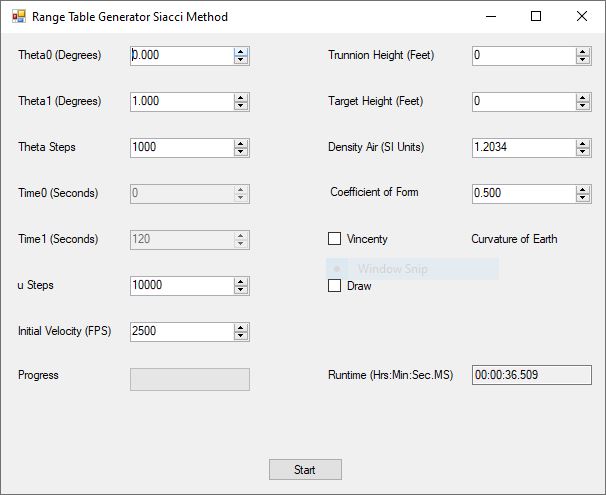
Siacci’s Method Chapter 5 and Appendix A of “Exterior Ballistics, 1935” by Lieutenant Commander Ernest Edward Herrmann of the United States Naval Academy. This is an approximate technique for solving exterior ballistics trajectories with between 12 to 15 degrees of elevation. The artillery is the 16 inch / 50 caliber rifled guns of the Iowa class of fast battleships (BB-61 USS Iowa, BB-62 USS New Jersey, BB-63 USS Missouri, and BB-64 USS Wisconsin).

Range Table 0Range Table 2Range Table 1ExteriorBallisticsRK5 Main Form


My Near-Term Agenda by James Pate Williams, Jr. BA, BS, MSwE, PhD

Merry Christmas to all you devout Christians. I am not one of you. I am about to embark on a mission to carefully annotate with open source C# computer code my copy of “Exterior Ballistics, 1935” by Professor Ernest Edward Herrmann of then the United States Naval Academy at Annapolis, Maryland. This book set the standard for naval gunnery in World War II. Of course, our navy and especially our battle-wagons had the largest rifled artillery of any United States service. The 105 mm = 105 mm / 25.4 mm / inch = 4.13 inches, 120 mm / 25.4 mm / inch = 4.72 inches, and 155 mm / 25.4 mm / inch = 6.10 inch of our excellent United States Army and United States Marine Corps (semper fidelis) are puny in comparison to the mighty 8, 10, 12, 14, and finally 16 inch mostly rifled artillery of our incredible navy’s cruisers, dreadnoughts, and battleships of the World War I and World War II era ships. Even a destroyer of the USN Fletcher class had 5-inch (127 mm) / 38 caliber rifled artillery which had a 5 inch * 38 = 190-inch barrel length. Our mightiest naval artillery was, of course, my favorite the mighty 16 inch (406.4 mm) / 50 caliber rifles that had a barrel length of 16 * 50 inches = 800 inches = 66.6 feet!

Thanks,

James Pate Williams, Jr.

Bachelor of Arts Chemistry LaGrange College 1979

Bachelor of Science Computer Science LaGrange College 1994

Master of Software Engineering Auburn University 2000

Doctor of Philosophy Computer Science Auburn University 2005

Gratis Open Source Computer Software Developer Since Summer 1978

1980 – 1983 Graduate Work in Chemistry and Mathematics at Georgia Tech

A Current Website I developed for my friends Wesley “Wes” and Missy Cochran:

http://thecochrancollection.com/Home

2nd Lt James “Jim” William Jordan’s World War II Missions by James Pate Williams, Jr. BA, BS, MSwE, PhD

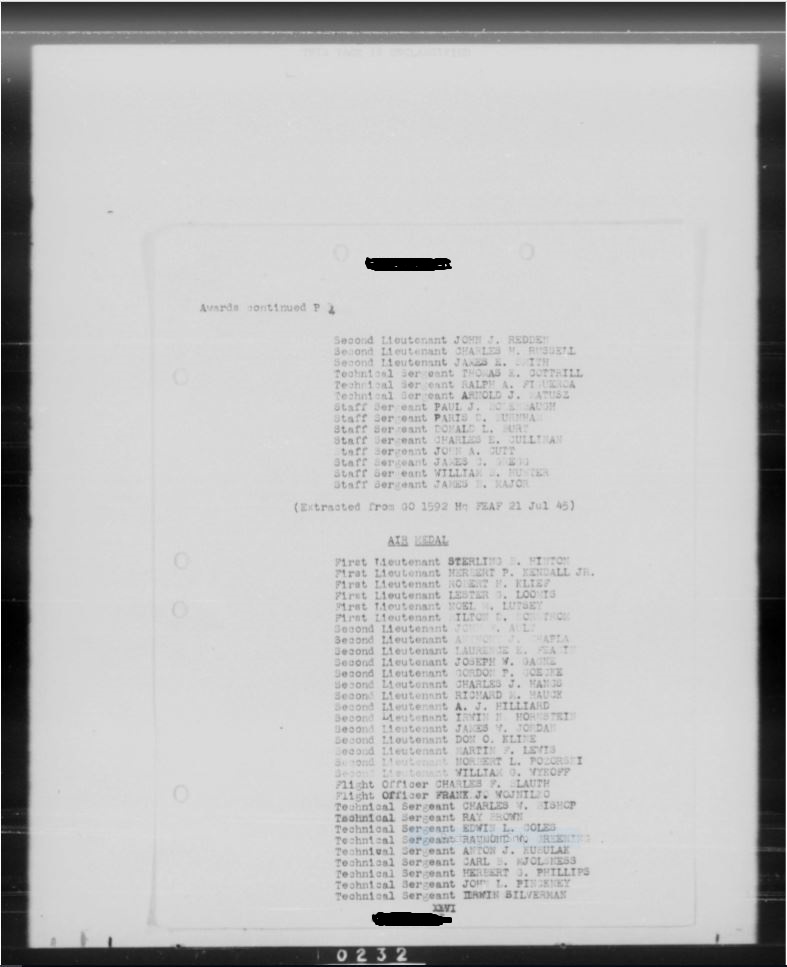
My uncle was James “Jim” William Jordan who was born on September 5, 1920 and died January 27, 1970 at the relatively young age of 49 years old. He was born in Randolph County Alabama to Charles Webster Jordan and Ida Jane Kenady Jordan. His dad was at the time of his birth a postal clerk and his mother was trained as a school teacher but was a stay at home mom.

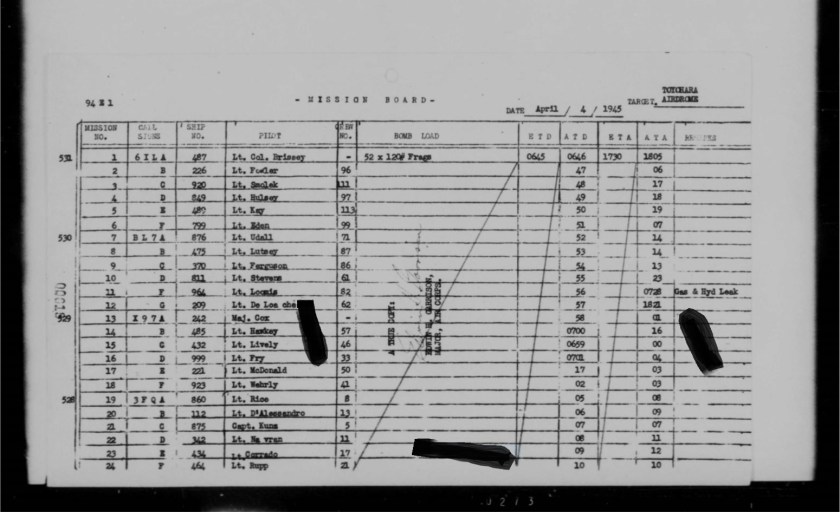
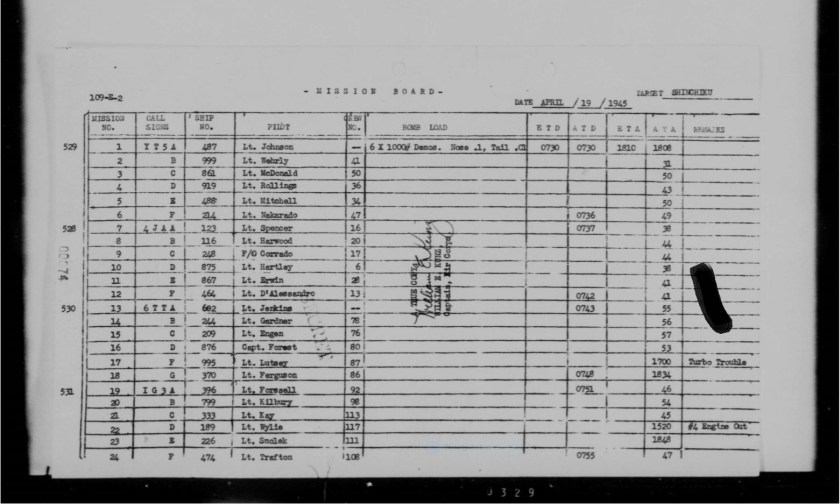
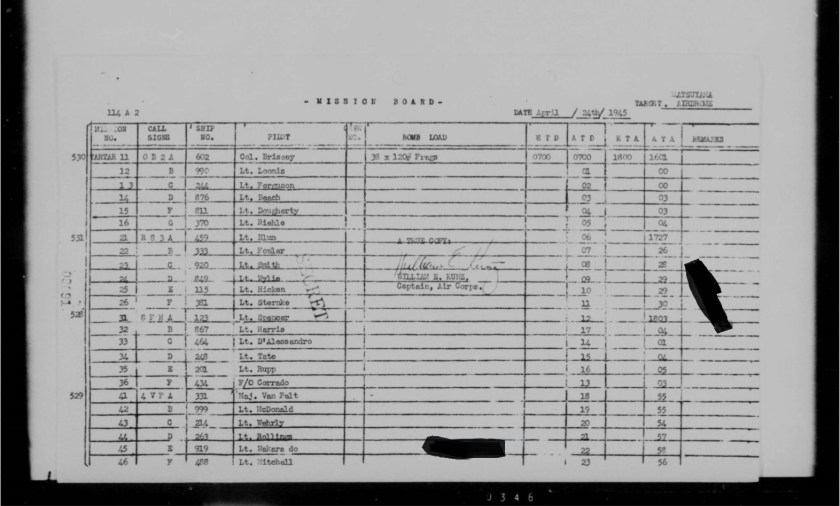
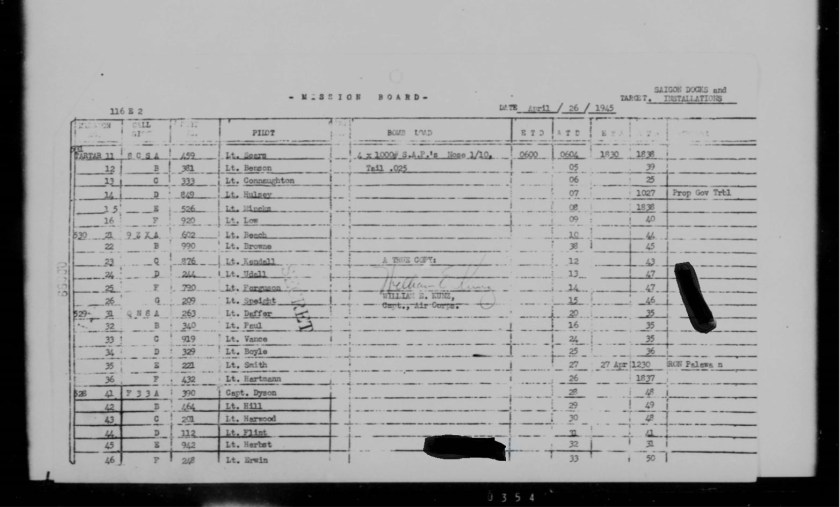
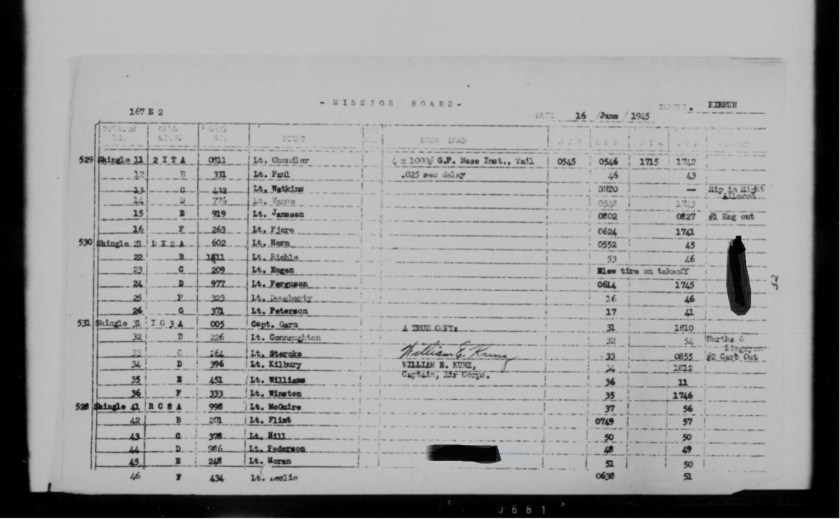
In early 1945 my uncle was stationed at Murtha Strip, Mindoro in the Philippines Islands. My uncle was a 2nd Lt. regular bombardier in a Consolidated B-24 Liberator heavy bomber. My uncle was in 1st Lt Robert R. Ferguson’s Aircrew Number 86 in the 530th Bombardment Squadron of the 380th Bombardment Group of the 310th Bomb Wing of the V Bomber Command of the 5th Air Force of the United States Army Air Forces (USAAF). Using the information which I received from the United States Air Force Historical Research Agency (AFHRA) Reel B0369 that contains the Histories of the 380th Bombardment Group for the year 1945 I found mission boards for twelve missions flown by 1st Lt Ferguson in the months April through June 1945. The mission boards are given below:

Mission Board Plate 0273Mission Board Plate 0292Mission Board Plate 0308Mission Board Plate 0329Mission Board Plate 0346Mission Board Plate 0354Mission Board Plate 0476Mission Board Plate 0501Mission Board Plate 0643Mission Board Plate 0661Mission Board Plate 0681Mission Board Plate 0701

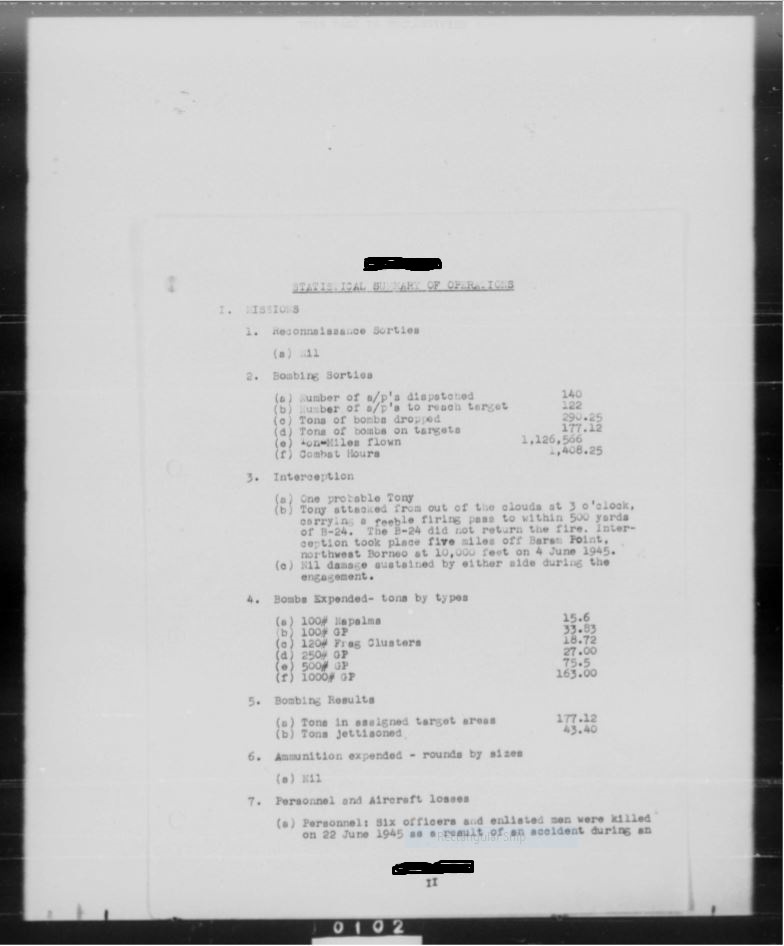
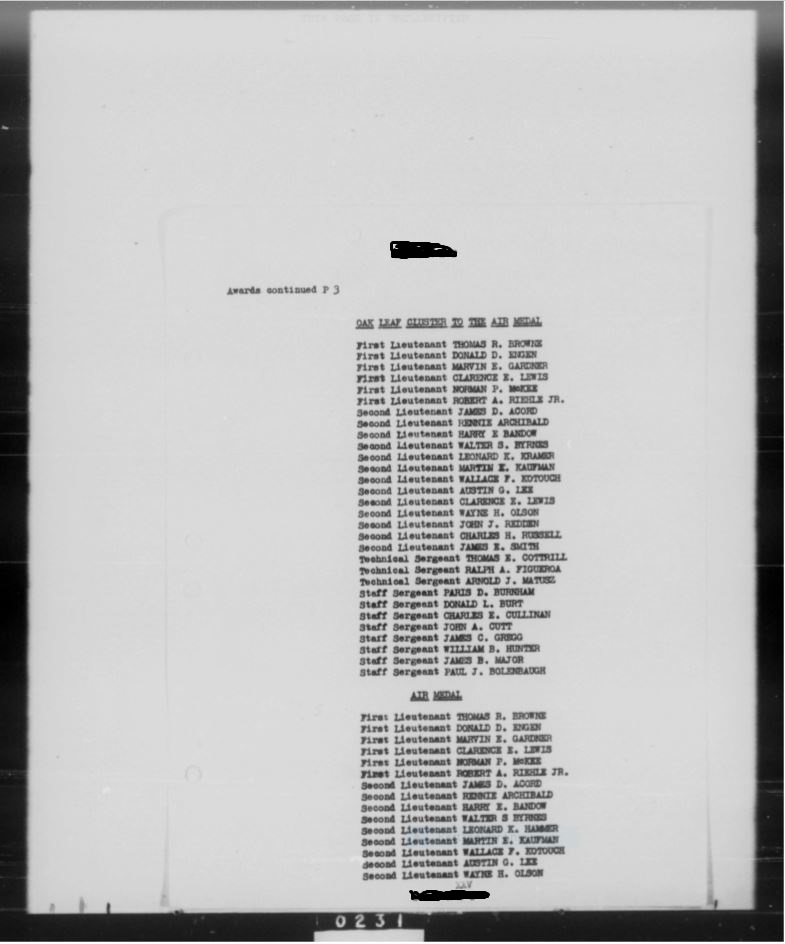
The following information is from AFHRA Reel A0636A which contains the 530th Bombardment Squadron Histories for June, July and August 1945.

June 1945 Bombing Mission Map RedactedJune 1945 Plate 102 RedactedJune 1945 Plate 103June 1945 Plate 104Overview of Ditching Plate 0030 RedactedOverview of Ditching Plate 0031 RedactedJune 1945 Plate 105June 1945 Plate 106June 1945 Plate 107June 1945 Plate 108June 1945 Plate 099July 1945 plate 231July 1945 plate 232