The six-dimensional Cartesian coordinate wavefunction is calculated by the C# method:
public double Psi(double[] x, double[] alpha)
        {
            double r1 = Math.Sqrt(x[0] * x[0] + x[1] * x[1] + x[2] * x[2]);
            double r2 = Math.Sqrt(x[3] * x[3] + x[4] * x[4] + x[5] * x[5]);
            double r12 = Math.Sqrt(Math.Pow(x[0] - x[3], 2.0) +
                Math.Pow(x[1] - x[4], 2.0) + Math.Pow(x[2] - x[5], 2.0));
            double exp1 = Math.Exp(-alpha[0] * r1);
            double exp2 = Math.Exp(-alpha[1] * r2);
            double exp3 = Math.Exp(-alpha[2] * r12);

            return exp1 * exp2 * exp3;
        }

        public double Psi2(double[] x, double[] alpha)
        {
            double psi = Psi(x, alpha);

            return psi * psi;
        }
The wavefunction normalization method is:
public double Normalize(double[] alpha, int nSteps)
        {
            double[] lower = new double[6];
            double[] upper = new double[6];
            int[] steps = new int[6];

            lower[0] = 0.001;
            lower[1] = 0.001;
            lower[2] = 0.001;
            lower[3] = 0.001;
            lower[4] = 0.001;
            lower[5] = 0.001;

            upper[0] = 10.0;
            upper[1] = 10.0;
            upper[2] = 10.0;
            upper[3] = 10.0;
            upper[4] = 10.0;
            upper[5] = 10.0;

            for (int i = 0; i < 6; i++)
                steps[i] = nSteps;

            double norm = Math.Sqrt(integ.Integrate(
                lower, upper, alpha, Psi2, 6, steps));

            return norm;
        }
The two kinetic energy integrands are encapsulated in the following two methods:
private double Integrand1(double[] x, double[] alpha)
        {
            double r1 = Math.Sqrt(x[0] * x[0] + x[1] * x[1] + x[2] * x[2]);
            double r2 = Math.Sqrt(x[3] * x[3] + x[4] * x[4] + x[5] * x[5]);
            double r12 = Math.Sqrt(Math.Pow(x[0] - x[3], 2.0) +
                Math.Pow(x[1] - x[4], 2.0) + Math.Pow(x[2] - x[5], 2.0));
            double term = -2.0 * alpha[0] / r1 + alpha[0] * alpha[0];
            double mul1 = Math.Exp(-2.0 * alpha[0] * r1);
            double mul2 = Math.Exp(-2.0 * alpha[1] * r2);
            double mul3 = Math.Exp(-2.0 * alpha[2] * r12);

            return N * N * term * mul1 * mul2 * mul3;
        }

        private double Integrand2(double[] x, double[] alpha)
        {
            double r1 = Math.Sqrt(x[0] * x[0] + x[1] * x[1] + x[2] * x[2]);
            double r2 = Math.Sqrt(x[3] * x[3] + x[4] * x[4] + x[5] * x[5]);
            double r12 = Math.Sqrt(Math.Pow(x[0] - x[3], 2.0) +
                Math.Pow(x[1] - x[4], 2.0) + Math.Pow(x[2] - x[5], 2.0));
            double term = -2.0 * alpha[1] / r1 + alpha[1] * alpha[1];
            double mul1 = Math.Exp(-2.0 * alpha[0] * r1);
            double mul2 = Math.Exp(-2.0 * alpha[1] * r2);
            double mul3 = Math.Exp(-2.0 * alpha[2] * r12);

            return N * N * term * mul1 * mul2 * mul3;
        }
The two potential energy terms use the following two integrands:
private double Integrand3(double[] x, double[] alpha)
        {
            double r1 = Math.Sqrt(x[0] * x[0] + x[1] * x[1] + x[2] * x[2]);
            double r2 = Math.Sqrt(x[3] * x[3] + x[4] * x[4] + x[5] * x[5]);
            double r12 = Math.Sqrt(Math.Pow(x[0] - x[3], 2.0) +
                Math.Pow(x[1] - x[4], 2.0) + Math.Pow(x[2] - x[5], 2.0));
            double term = 1.0 / r1;
            double mul =
                Math.Exp(-2.0 * alpha[0] * r1) *
                Math.Exp(-2.0 * alpha[1] * r2) *
                Math.Exp(-2.0 * alpha[2] * r12);

            return -N * N * Z * term * mul;
        }

        private double Integrand4(double[] x, double[] alpha)
        {
            double r1 = Math.Sqrt(x[0] * x[0] + x[1] * x[1] + x[2] * x[2]);
            double r2 = Math.Sqrt(x[3] * x[3] + x[4] * x[4] + x[5] * x[5]);
            double r12 = Math.Sqrt(Math.Pow(x[0] - x[3], 2.0) +
                Math.Pow(x[1] - x[4], 2.0) + Math.Pow(x[2] - x[5], 2.0));
            double term = 1.0 / r2;
            double mul =
                Math.Exp(-2.0 * alpha[0] * r1) *
                Math.Exp(-2.0 * alpha[1] * r2) *
                Math.Exp(-2.0 * alpha[2] * r12);

            return -N * N * Z * term * mul;
        }
The electron-electron repulsion integrand is given by:
private double Integrand5(double[] x, double[] alpha)
        {
            double r1 = Math.Sqrt(x[0] * x[0] + x[1] * x[1] + x[2] * x[2]);
            double r2 = Math.Sqrt(x[3] * x[3] + x[4] * x[4] + x[5] * x[5]);
            double r12 = Math.Sqrt(Math.Pow(x[0] - x[3], 2.0) +
                Math.Pow(x[1] - x[4], 2.0) + Math.Pow(x[2] - x[5], 2.0));

            if (r12 == 0)
                r12 = 0.01;

            double term = 1.0 / r12;
            double mul =
                Math.Exp(-2.0 * alpha[0] * r1) *
                Math.Exp(-2.0 * alpha[1] * r2) *
                Math.Exp(-2.0 * alpha[2] * r12);

            return N * N * term * mul;
        }
The ground state non-relativistic energy is computed by the method:
public double Energy(double[] alpha, int nSteps, int Z)
        {
            double[] lower = new double[6];
            double[] upper = new double[6];
            int[] steps = new int[6];

            lower[0] = lower[1] = lower[2] = lower[3] = lower[4] = lower[5] = 0.001;
            upper[0] = upper[1] = upper[2] = upper[3] = upper[4] = upper[5] = 10.0;
            steps[0] = steps[1] = steps[2] = steps[3] = steps[4] = steps[5] = nSteps;

            N = Normalize(alpha, nSteps);

            this.Z = Z;

            double integ1 = integ.Integrate(lower, upper, alpha, Integrand1, 6, steps);
            double integ2 = integ.Integrate(lower, upper, alpha, Integrand2, 6, steps);
            double integ3 = integ.Integrate(lower, upper, alpha, Integrand3, 6, steps);
            double integ4 = integ.Integrate(lower, upper, alpha, Integrand4, 6, steps);
            double integ5 = integ.Integrate(lower, upper, alpha, Integrand5, 6, steps);

            return integ1 + integ2 - integ3 - integ4 + integ5;
        }
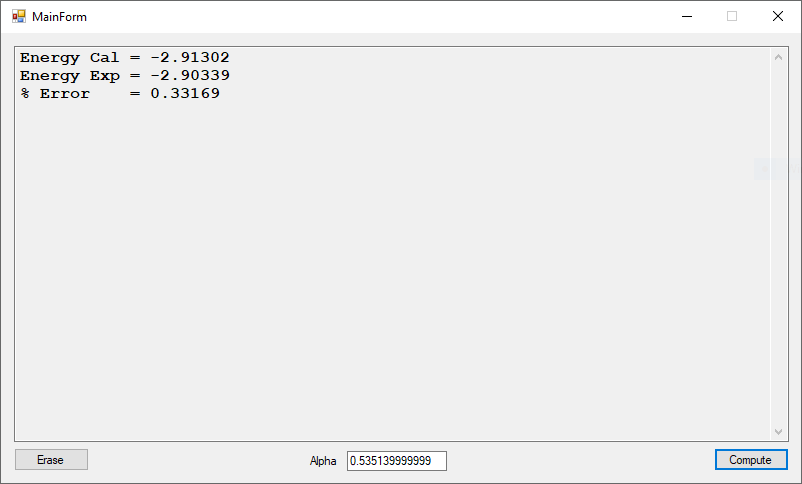
Using trial and error we calculate Alpha as: 0.535139999999
public double Integrate(double[] lower, double[] upper, double[] alpha,
            Func<double[], double[], double> f, int n, int[] steps)
        {
            double p = 1;
            double[] h = new double[n];
            double[] h2 = new double[n];
            double[] s = new double[n];
            double[] t = new double[n];
            double[] x = new double[n];
            double[] w = new double[n];

            for (int i = 0; i < n; i++)
            {
                h[i] = (upper[i] - lower[i]) / steps[i];
                h2[i] = 2.0 * h[i];
            }

            for (int i = 0; i < n; i++)
            {
                for (int j = 0; j < n; j++)
                    x[j] = lower[j];

                x[i] = lower[i] + h[i];

                for (int j = 1; j < steps[i]; j += 2)
                {
                    s[i] += f(x, alpha);
                    x[i] += h2[i];
                }

                for (int j = 0; j < n; j++)
                    x[j] = lower[j];

                x[i] = lower[i] + h2[i];

                for (int j = 2; j < steps[i]; j += 2)
                {
                    t[i] += f(x, alpha);
                    x[i] += h2[i];
                }

                w[i] = h[i] * (f(lower, alpha) + 4 * s[i] + 2 * t[i] + f(upper, alpha)) / 3.0;
            }

            for (int i = 0; i < n; i++)
                p *= w[i];

            return p;
        }


