Author: jamespatewilliamsjr
My whole legal name is James Pate Williams, Jr. I was born in LaGrange, Georgia approximately 70 years ago. I barely graduated from LaGrange High School with low marks in June 1971. Later in June 1979, I graduated from LaGrange College with a Bachelor of Arts in Chemistry with a little over a 3 out 4 Grade Point Average (GPA). In the Spring Quarter of 1978, I taught myself how to program a Texas Instruments desktop programmable calculator and in the Summer Quarter of 1978 I taught myself Dayton BASIC (Beginner's All-purpose Symbolic Instruction Code) on LaGrange College's Data General Eclipse minicomputer. I took courses in BASIC in the Fall Quarter of 1978 and FORTRAN IV (Formula Translator IV) in the Winter Quarter of 1979. Professor Kenneth Cooper, a genius poly-scientist taught me a course in the Intel 8085 microprocessor architecture and assembly and machine language. We would hand assemble our programs and insert the resulting machine code into our crude wooden box computer which was designed and built by Professor Cooper. From 1990 to 1994 I earned a Bachelor of Science in Computer Science from LaGrange College. I had a 4 out of 4 GPA in the period 1990 to 1994. I took courses in C, COBOL, and Pascal during my BS work. After graduating from LaGrange College a second time in May 1994, I taught myself C++. In December 1995, I started using the Internet and taught myself client-server programming. I created a website in 1997 which had C and C# implementations of algorithms from the "Handbook of Applied Cryptography" by Alfred J. Menezes, et. al., and some other cryptography and number theory textbooks and treatises.
Blog Entry © Saturday, November 16, 2024, by James Pate Williams, Jr., The Microsoft Copilot
Blog Entry © Thursday, November 14, 2024, by James Pate Williams, Jr.
Blog Entry © Wednesday, November 6, 2024, by James Pate Williams, Jr. Particle in a Finite Spherical Three-Dimensional Potential Well
The Bessel functions are from A Numerical Library in C for Scientists and Engineers (c) 1995 by H. T. Lau, PhD.
Blog Entry (c) Wednesday, November 6, 2024, by James Pate Williams, Jr. Small Angular Momentum Quantum Numbers Gaunt Coefficients
// GauntCoefficients.cpp (c) Monday, November 4, 2024
// by James Pate Williams, Jr., BA, BS, MSWE, PhD
// Computes the Gaunt angular momentum coefficients
// Also the Wigner-3j symbols are calculated
// https://en.wikipedia.org/wiki/3-j_symbol
// https://doc.sagemath.org/html/en/reference/functions/sage/functions/wigner.html#
// https://www.geeksforgeeks.org/factorial-large-number/
#include <iostream>
using namespace std;
typedef long double real;
real pi;
// iterative n-factorial function
real Factorial(int n)
{
    real factorial = 1;

    for (int i = 2; i <= n; i++)
        factorial *= i;
    if (n < 0)
        factorial = 0;
    return factorial;
}
real Delta(int lt, int rt)
{
    return lt == rt ? 1.0 : 0.0;
}
real Wigner3j(
    int j1, int j2, int j3,
    int m1, int m2, int m3)
{
    real delta = Delta(m1 + m2 + m3, 0) *
        powl(-1.0, j1 - j2 - m3);
    real fact1 = Factorial(j1 + j2 - j3);
    real fact2 = Factorial(j1 - j2 + j3);
    real fact3 = Factorial(-j1 + j2 + j3);
    real denom = Factorial(j1 + j2 + j3 + 1);
    real numer = delta * sqrt(
        fact1 * fact2 * fact3 / denom);
    real fact4 = Factorial(j1 - m1);
    real fact5 = Factorial(j1 + m1);
    real fact6 = Factorial(j2 - m2);
    real fact7 = Factorial(j2 + m2);
    real fact8 = Factorial(j3 - m3);
    real fact9 = Factorial(j3 + m3);
    real sqrt1 = sqrtl(
        fact4 * fact5 * fact6 * fact7 * fact8 * fact9);
    real sumK = 0;
    int K = (int)fmaxl(0, fmaxl((real)j2 - j3 - m1,
        (real)j1 - j3 + m2));
    int N = (int)fminl((real)j1 + j2 - j3,
        fminl((real)j1 - m1, (real)j2 + m2));
    for (int k = K; k <= N; k++)
    {
        real f0 = Factorial(k);
        real f1 = Factorial(j1 + j2 - j3 - k);
        real f2 = Factorial(j1 - m1 - k);
        real f3 = Factorial(j2 + m2 - k);
        real f4 = Factorial(j3 - j2 + m1 + k);
        real f5 = Factorial(j3 - j1 - m2 + k);
        sumK += powl(-1.0, k) / (f0 * f1 * f2 * f3 * f4 * f5);
    }
    return numer * sqrt1 * sumK;
}
real GauntCoefficient(
    int l1, int l2, int l3, int m1, int m2, int m3)
{
    real factor = sqrtl(
        (2.0 * l1 + 1.0) *
        (2.0 * l2 + 1.0) *
        (2.0 * l3 + 1.0) /
        (4.0 * pi));
    real wigner1 = Wigner3j(l1, l2, l3, 0, 0, 0);
    real wigner2 = Wigner3j(l1, l2, l3, m1, m2, m3);
    return factor * wigner1 * wigner2;
}
int main()
{
    pi = 4.0 * atanl(1.0);
    cout << "Gaunt(1, 0, 1, 1, 0, 0)  = ";
    cout << GauntCoefficient(1, 0, 1, 1, 0, 0);
    cout << endl;
    cout << "Gaunt(1, 0, 1, 1, 0, -1) = ";
    cout << GauntCoefficient(1, 0, 1, 1, 0, -1);
    cout << endl;
    real number = -1.0 / 2.0 / sqrtl(pi);
    cout << "-1.0 / 2.0 / sqrt(pi)    = ";
    cout << number << endl;
    return 0;
}
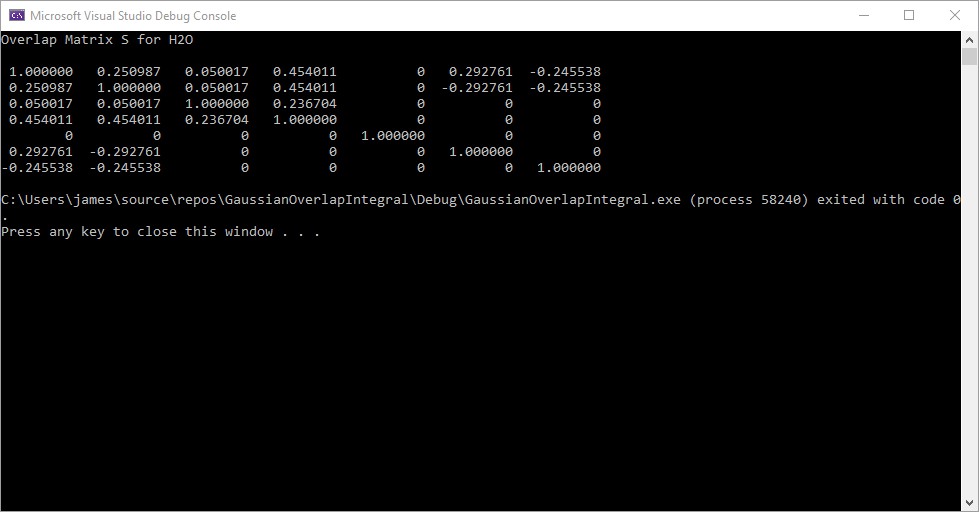
Blog Entry © Friday, November 1, 2024, by James Pate Williams, Jr. Calculation of the Overlap Matrix for the Water Molecule (H2O) Using a Contracted Set of Gaussian Orbitals
Reference: https://content.wolfram.com/sites/19/2012/02/Ho.pdf
I reproduced most of the computations in the MATHMATICA reference. The water molecule is a planar molecule that lies in the YZ-plane.