Determining if a Mersenne Number is a Mersenne Prime by James Pate Williams, Jr., BA, BS, MSwE, PhD

A Mersenne number is of the form M_n = 2 ^ n – 1. For M_n to be prime, n must be prime.

M_2 = 4 – 1 = 3 prime

M_3 = 8 – 1 = 7 prime

M_4 = 16 – 1 = 15 = 3 * 5

M_5 = 32 – 1 = 31 prime

M_6 = 64 – 1 = 63 = 7 * 9

M_7 = 128 – 1 = 127 prime

M_8 = 256 – 1 = 255 = 5 * 51 = 3 * 5 * 17 = M_4 * 17

M_9 = 512 – 1 = 511 = 7 * 73

M_10 = 1024 – 1 = 1023 = 3 * 341 = 3 * 11 * 31

M_11 = 2048 – 1 = 2047 = 23 * 89

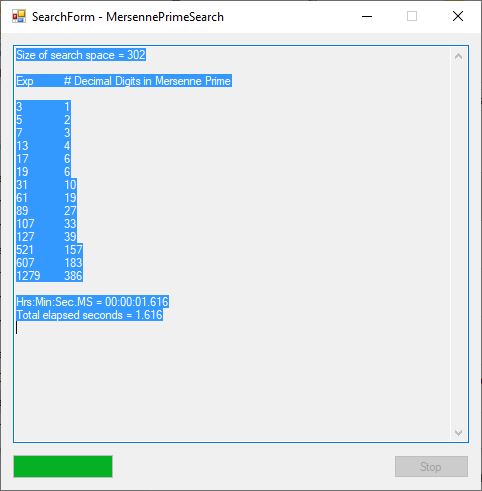
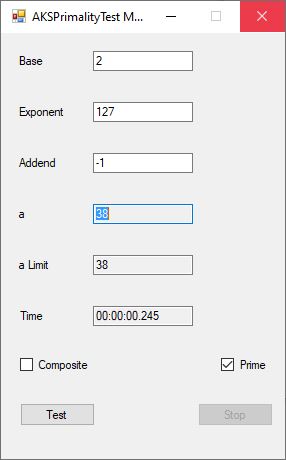
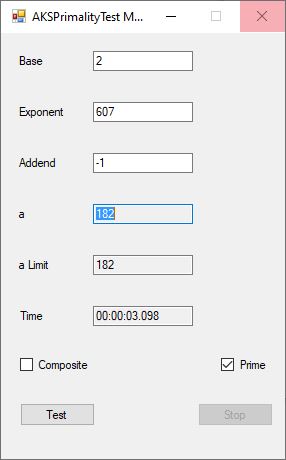
I wrote a program to determine if a number M_p = 2 ^ p – 1 with p prime is also a Mersenne prime. I used the Lucas-Lehmer test.

Anagrams and Their Computer Solution by James Pate Williams, Jr., BA, BS, MSwE, PhD

An anagram is also known as a word jumble. You take a word and apply a permutation to the word to get an alphabetic jumble of the word. A permutation of three distinct characters is based on three index permutation table:

123 132 213 231 312 321.

So, the scrambling of the word “THE” is as follows:

THE TEH HTE HET ETH EHT.

As you can see there are n-factorial permutations of n objects.

0! = 1

1! = 1

2! = 2 * 1 = 2

3! = 3 * 2 * 1 = 6

4! = 4 * 3 * 2 * 1 = 4 * 3! = 24

Etc. Several years ago I created a program to solve single word anagrams of length less than or equal about a dozen.

12! = 479,001,600

This is about the limit of finding all the permutations of up to length twelve on a desktop computer. The algorithm is extremely easy to understand and implement. First find a suitable list of English words and if the list is unsorted then sort the list alphabetically in ascending order. Hash the dictionary words using a hash table of length 128 * 128 + 128 = 16,512 elements. The dictionary I used has 152,512 words so there are hash table collisions. The hash value is computed using the first three characters of the word in ASCII (7-bit) encoding. Then for each permutation of the anagram a hash value is computed and if the current permutation is found in the hash table the word associated with the hash table entry is returned and the algorithm is finished.

Min-Max Polynomial Curve Fitting by James Pate Williams, Jr., BA, BS, MSwE, PhD

On Sunday, ‎August ‎28, ‎2016, ‏‎3:57:53 PM I created a C# program to fit a given curve to a polynomial of a specified degree and number of points. Here are ten experiments with a continuous function to be discretely fitted by a polynomial.

My First MeetUp.com Group, Ballistics by James Pate Williams, Jr., BA, BS, MSwE, PhD

MeetUp.com is a website that allows a MeetUp.com Group Coordinator to hold in person (offline) and virtual (online via Zoom.com) groups. My first group is “Ballistics” which should be more exactly “Exterior Ballistics”. Below is the MeetUp.com blurb:

This group is dedicated to the study of the United States Naval Academy textbook “Exterior Ballistics, 1935” by Ernest Edward Herrmann. The contents of this book was used extensively in World War II by the United States Navy and its battleships. The group should be able to carry out ballistic calculations both classical and including drag and other trajectory corrections. Exterior ballistics is applicable to the flights of all sorts of balls including baseballs and golf balls. It is also useful for large artillery, handgun, and rifle projectile exterior ballistics. Here is an application of the methods to the Iowa class of fast battleships and their heavy armament, the 16 inch 50 caliber rifled artillery:

The first meeting in the future will cover Classical Ballistics using an Windows Form Application or an online application I may create in the future.

Hopefully, some MeetUp.com users will find my group and will signup to be a free group attendee. As of today I am the only member of the group.

Early Electronic Nose Research by James Pate Williams, Jr., BA, BS, MSwE, PhD

Back in 1982 research into electronic olfaction (electronic sense of smell, electronic nose) began. By the mid-1990s and late 1990s viable electronic nose systems were coming into existence. That means that before the 2000s we had tackled 60% of human senses via electronic means: sight, hearing and smell. That left only the senses of feel (tactile responses) and taste were yet to be conquered. The senses of smell and taste are chemically coupled. Here is a December 1995 paper on electrochemical noses their applications: https://www.researchgate.net/publication/2747174_Electronic_Noses_And_Their_Applications This maybe of interest since covid-19 may cause temporary loss of the senses of smell and taste.

Fifty Years Ahead of the Private Sector by James Pate Williams, Jr, BA, BS, MSwE, PhD

I have heard some former or want to be National Security Officers suggest that the National Security Agency is and has been since 1952 fifty years ahead of the private sector in many active areas of research. I have clear evidence based on one 1941 document that the United States Navy was at least fifty years ahead of the war-by -wireless technology in the Ordnance Pamphlet 770 which was printed in October 1941:

https://eugeneleeslover.com/USN-GUNS-AND-RANGE-TABLES/OP-770-1.html

The approximate maximum range of the 16-inch by 50 caliber fast battleship class Iowa artillery is around 24 miles at a maximum elevation of 45 degrees. The horizon can be calculated to be at height of 60 feet above sea level to be 1.22 * (60)^(1/2) = 9.45 miles. So, the question is how can you guarantee an accurate shot at 24 miles even with the crude radar of the day? One uses a spotter aircraft to give the accurate longitude-latitude coordinates of the enemy ship. Thus, we have GPS gunnery in 1930s-1940s technology.  We are a country of warfare geniuses in the United States of North America.

I am sure there are many other examples of the U.S. getting a lot of bang for our tax dollars.

Realistic Predator-Prey Model by James Pate Williams, Jr., BA, BS, MSwE, PhD

Realistic Predator Prey Model

dN / dt = N * [r * (1 – N / K) – k * P / (N + D)] (Prey Equation)

dP/ dt = P * [s * (1 – h * P / N)] (Predator Equation)

To reduce the six-parameter model to a more manageable three parameter one introduce the following variables and parameters

u(w) = N(t) / K

v(w) = h * P(t) / K

w = r * t

a = k / (h * r)

b = s / r

d = D / K

du / dw = u – (1 – u) – a * u * v / (u + d)

dv / dw = b * v * (1 – v / u)

In my program a = alpha, d = beta, and b = gamma

More Fractals by James Pate Williams, Jr., BA, BS, MSwE, PhD

All the images were generated using the complex polynomial as shown below:

z1 = z0 ^ n + c0

Where c0 and z0 are random complex numbers of the form:

z = x + i * y

where x and y are real numbers and i is the imaginary square root -1. The first three images use n = 3, the next one n = 4, the next four n = 5, and the last three n = 6.

z1 = z0 ^ 2 + c0 = z0 * z0 + c0