Category: C++ Computer Applications
Blog Entry Wednesday, August 14, 2024 (c) James Pate Williams, Jr. Goldwasser-Kilian Primality Test
The Goldwasser-Kilian Primality proving algorithm was the first method to utilize elliptic curves to generate primality proving certificates. What follows is a file of two certificates and the single precision C source code.
Blog Entry (c) Saturday, August 10, 2024, by James Pate Williams, Jr. The LLL Lattice Reduction Algorithm
Blog Entry August 9, 2024, (c) James Pate Williams, Jr. Another Online Math Problem
The problem is to find the real root of the equation: f(x)=x^(x^8)-8=0. I use the Newton-Raphson method, a root finding algorithm. A first guess is x = 2. The solution is: x = 1.2968395547, f(x) = -2.6645353e-15. I compute the necessary derivative using central-finite differences with a step size of h = 2/10000.
Blog Entry August 1, 2024, (c) James Pate Williams, Jr. Online Math Problem
Blog Entry Thursday, July 25, 2024, (c) James Pate Williams, Jr. Newton’s Method for Finding the Real Roots of a Real Polynomial
degree (0 to quit) = 5

a[5] = 1
a[4] = -15.5
a[3] = 77.5
a[2] = -155
a[1] = 124
a[0] = -32

x[0] = 0.45
x[1] = 0.9
x[2] = 1.8
x[3] = 3.6
x[4] = 7.2

iterations = 31

root[0] =  5.0000000000e-01
root[1] =  1.0000000000e+00
root[2] =  2.0000000000e+00
root[3] =  4.0000000000e+00
root[4] =  8.0000000000e+00

func[0] =  0.0000000000e+00
func[1] =  0.0000000000e+00
func[2] =  0.0000000000e+00
func[3] =  0.0000000000e+00
func[4] =  0.0000000000e+00

degree (0 to quit) =
Blog Entry (c) Tuesday, July 23, 2024, by James Pate Williams, Jr. Mueller’s Method for Finding the Complex and/or Real Roots of a Complex and/or Real Polynomial
I originally implemented this algorithm in FORTRAN IV in the Summer Quarter of 1982 at the Georgia Institute of Technology. I was taking a course named “Scientific Computing I” taught by Professor Gunter Meyer. I made a B in the class. Later in 2015 I re-implemented the recipe in C# using Visual Studio 2008 Professional. VS 2015 did not have support for complex numbers nor large integers. In December of 2015 I upgraded to Visual Studio 2015 Professional which has support for big integers and complex numbers. I used Visual Studio 2019 Community version for this project. Root below should be function.
Degree (0 to quit) = 2
coefficient[2].real = 1
coefficient[2].imag = 0
coefficient[1].real = 1
coefficient[1].imag = 0
coefficient[0].real = 1
coefficient[0].imag = 0

zero[0].real = -5.0000000000e-01        zero[0].imag =  8.6602540378e-01
zero[1].real = -5.0000000000e-01        zero[1].imag = -8.6602540378e-01

root[0].real =  0.0000000000e+00        root[0].imag = -2.2204460493e-16
root[1].real =  3.3306690739e-16        root[1].imag = -7.7715611724e-16

Degree (0 to quit) = 3
coefficient[3].real = 1
coefficient[3].imag = 0
coefficient[2].real = 0
coefficient[2].imag = 0
coefficient[1].real = -18.1
coefficient[1].imag = 0
coefficient[0].real = -34.8
coefficient[0].imag = 0

zero[0].real = -2.5026325486e+00        zero[0].imag = -8.3036679880e-01
zero[1].real = -2.5026325486e+00        zero[1].imag =  8.3036679880e-01
zero[2].real =  5.0052650973e+00        zero[2].imag =  2.7417672687e-15

root[0].real =  0.0000000000e+00        root[0].imag =  1.7763568394e-15
root[1].real =  3.5527136788e-14        root[1].imag = -1.7763568394e-14
root[2].real =  2.8421709430e-14        root[2].imag =  1.5643985575e-13

Degree (0 to quit) = 5
coefficient[5].real = 1
coefficient[5].imag = 0
coefficient[4].real = 2
coefficient[4].imag = 0
coefficient[3].real = 3
coefficient[3].imag = 0
coefficient[2].real = 4
coefficient[2].imag = 0
coefficient[1].real = 5
coefficient[1].imag = 0
coefficient[0].real = 6
coefficient[0].imag = 0

zero[0].real = -8.0578646939e-01        zero[0].imag =  1.2229047134e+00
zero[1].real = -8.0578646939e-01        zero[1].imag = -1.2229047134e+00
zero[2].real =  5.5168546346e-01        zero[2].imag =  1.2533488603e+00
zero[3].real =  5.5168546346e-01        zero[3].imag = -1.2533488603e+00
zero[4].real = -1.4917979881e+00        zero[4].imag =  1.8329656063e-15

root[0].real =  8.8817841970e-16        root[0].imag =  4.4408920985e-16
root[1].real = -2.6645352591e-15        root[1].imag = -4.4408920985e-16
root[2].real =  8.8817841970e-16        root[2].imag =  1.7763568394e-15
root[3].real =  3.4638958368e-14        root[3].imag = -1.4210854715e-14
root[4].real =  8.8817841970e-16        root[4].imag =  2.0710031449e-14
Blog Entry Sunday, July 21, 2024 (c) James Pate Williams, Jr. Another Easy Internet Mathematics Problem
x = 1.2679491924e+00 y = 4.7320508076e+00
f = 0.0000000000e+00 g = 0.0000000000e+00
iterations = 100
legend: f = x + y – 6, g = x * y – 6
The solution was found via my Win32 C application whose source code is presented below (the method is the Newton iteration for systems of linear and/or non-linear equations):
Blog Entry Friday, July 19, 2024, Easy Internet Math “Puzzle” (c) James Pate Williams, Jr.
#include <math.h>
#include <iostream>
using namespace std;

long double f(long double x)
{
	return powl(8.0, x) - powl(2.0, x) -
		2.0 * (powl(6.0, x) - powl(3.0, x));
}

long double g(long double x)
{
	return powl(8.0, x) * logl(8.0) - powl(2.0, x) * logl(2.0) -
		2.0 * (powl(6.0, x) * logl(6.0) - powl(3.0, x) * logl(3.0));
}

long double Newton(long double x, int maxIts, int& iterations)
{
	long double x0 = x;
	long double x1 = 0.0;

	iterations = 0;

	while (true) {
		long double dx = 0.0;
		long double fx = f(x0);
		long double gx = g(x0);
		x1 = x0 - fx / gx;
		dx = fabsl(x1 - x0);
		iterations++;
		if (dx < 1.0e-15)
			break;
		if (fabsl(fx) < 1.0e-15)
			break;
		if (iterations == maxIts)
			break;
		x0 = x1;
	}

	return x1;
}

int main() {
	int iterations = 0, maxIts;
	long double x0 = 0.0, x1 = 0.0;

	while (true) {
		cout << "x0 = ";
		cin >> x0;
		if (x0 == 0)
			break;
		cout << "maximum iterations = ";
		cin >> maxIts;
		x1 = Newton(x0, maxIts, iterations);
		cout << "x1 = " << x1 << endl;
		cout << "iterations = ";
		cout << iterations << endl;
	}

	return 0;
}
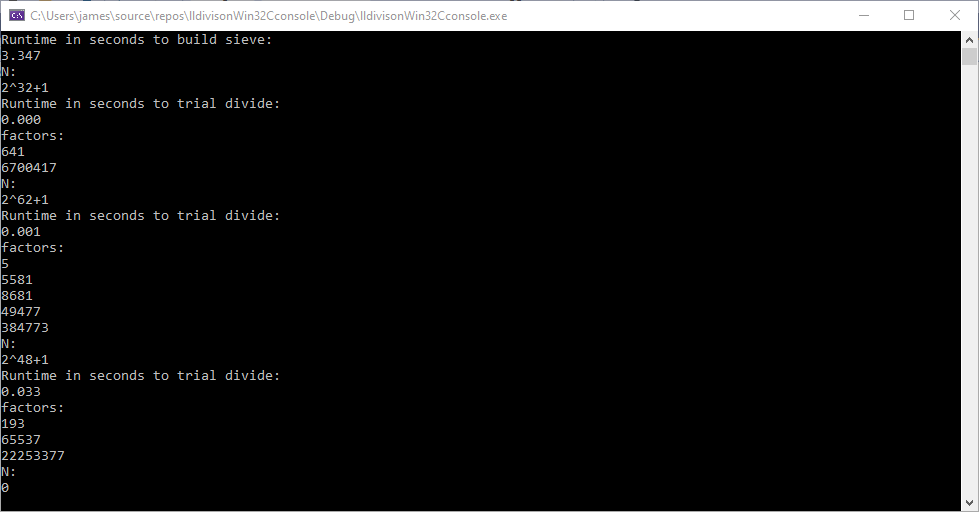
Blog Entry Monday, July 8, 2024, (c) James Pate Williams, Jr. Relatively Fast 64-bit Trial Division Using Henri Cohen’s Algorithm
The sieve of Eratosthenes handles primes up to an upper bound of 100,000,000. The number of primes is 5,761,455. Below are a few examples runs of the app. I have also created C source code for trial division and other factoring algorithms that use Professor Emeritus Arjen K. Lenstra’s Free Large Integer Package also known as lip.

 Numerical Explorations