Yet Another Revisitation of Reproducing Ordnance Pamphlet 770 by James Pate Williams, Jr.

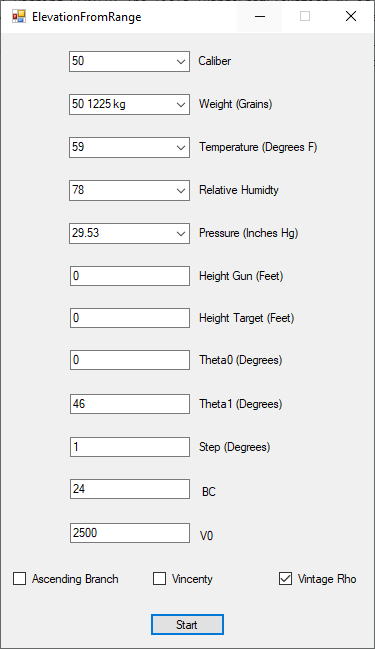
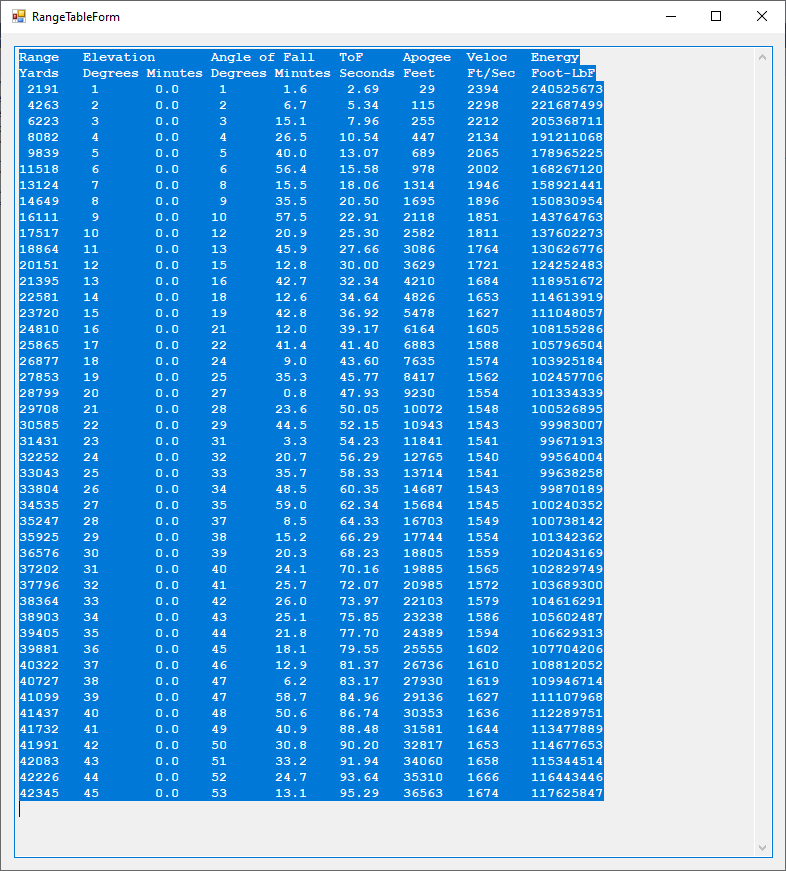
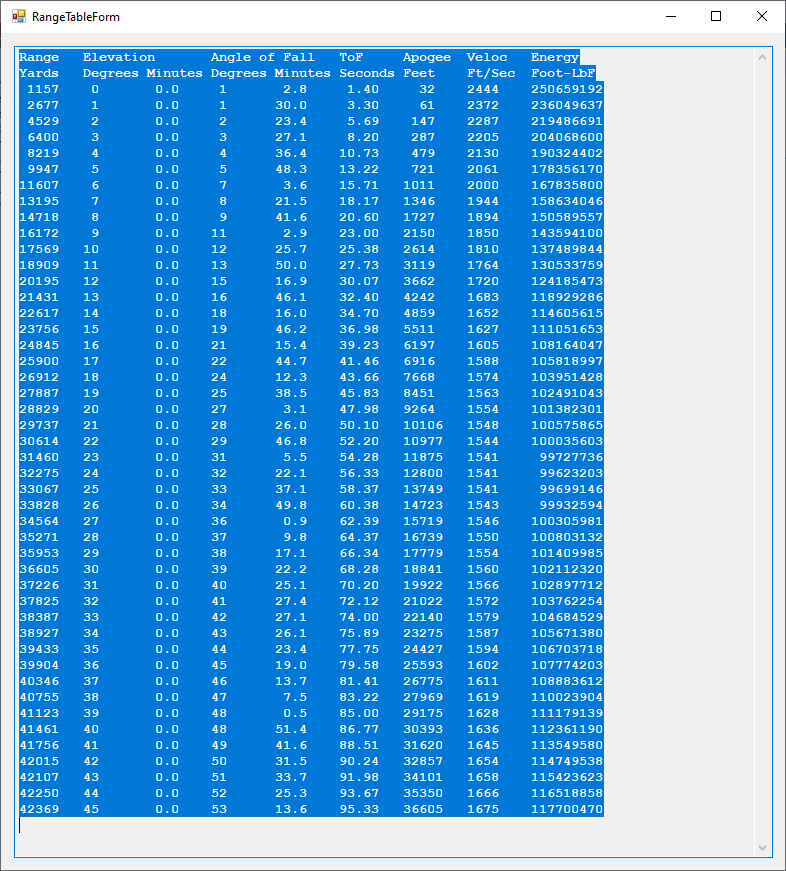
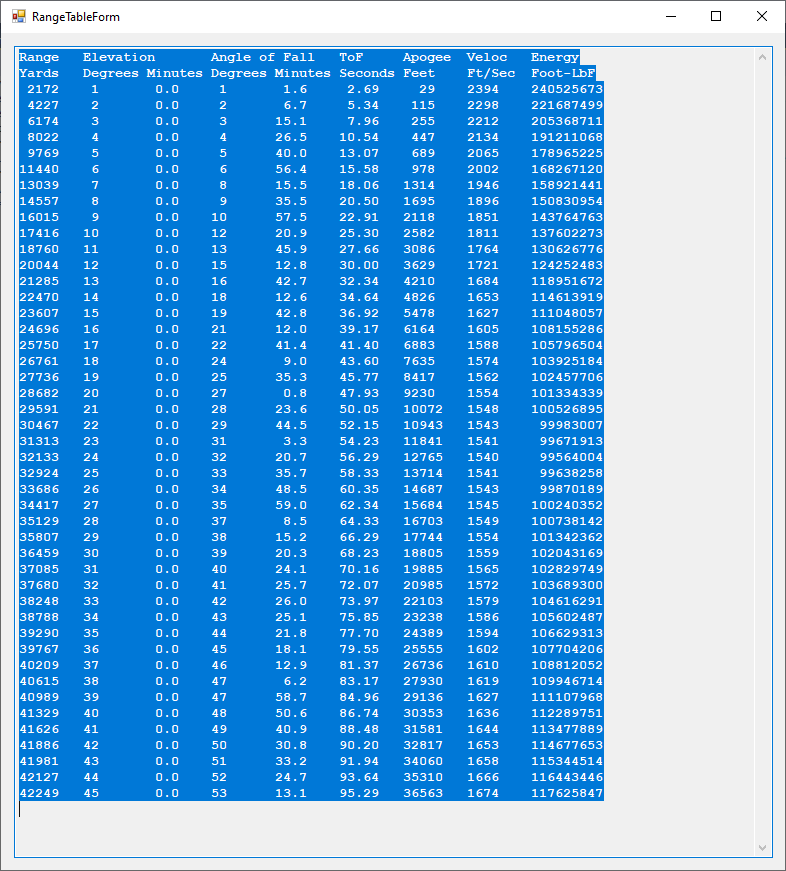
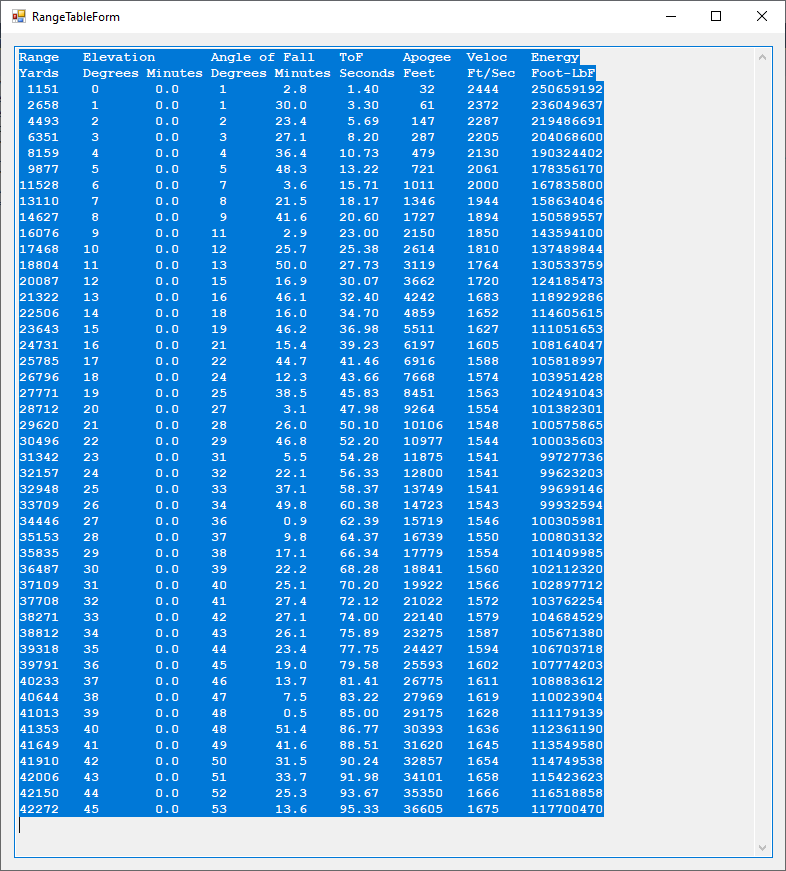
This is another attempt to reproduce the United States Navy’s Ordnance Pamphlet 770: https://eugeneleeslover.com/USN-GUNS-AND-RANGE-TABLES/OP-770-1.html which contains ballistic tables for the battleship USS Iowa (BB-61) artillery (16-inch/50 caliber) and is dated October 1941. My C# Windows desktop application is capable of calculating the elevation from range table which has the columns range in yards, angle of elevation in degrees and minutes, positive angle of fall in degrees and minutes, time of flight in seconds, apogee also called summit in feet, striking velocity in feet per second, and energy in foot pound force. Three corrections can be applied to the trajectory: trunnion height in feet, acceleration of gravity correction, and the curvature of the Earth correction (Vincenty calculation). The first image below is the ballistic settings interface. The second image is the uncorrected table. The third image is the application of a trunnion height of 32 feet. The fourth image is the curvature of the Earth correction. The fifth image is the trunnion height of 32 feet and Vincenty corrections. It is to be noticed that the striking velocity and kinetic energy are the only non-monotonically increasing or decreasing data fields.

Siacci’s Method by James Pate Williams, Jr. BA, BS, MSwE, PhD

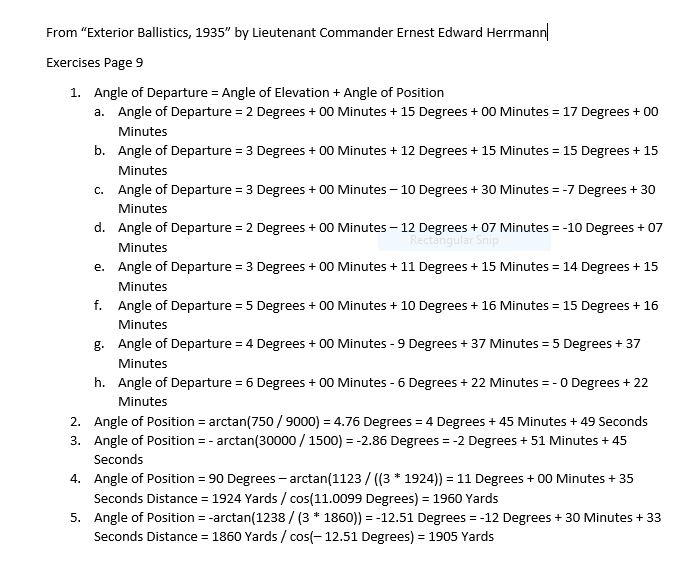
Siacci’s Method Chapter 5 and Appendix A of “Exterior Ballistics, 1935” by Lieutenant Commander Ernest Edward Herrmann of the United States Naval Academy. This is an approximate technique for solving exterior ballistics trajectories with between 12 to 15 degrees of elevation. The artillery is the 16 inch / 50 caliber rifled guns of the Iowa class of fast battleships (BB-61 USS Iowa, BB-62 USS New Jersey, BB-63 USS Missouri, and BB-64 USS Wisconsin).

Range Table 0Range Table 2Range Table 1ExteriorBallisticsRK5 Main Form


My Near-Term Agenda by James Pate Williams, Jr. BA, BS, MSwE, PhD

Merry Christmas to all you devout Christians. I am not one of you. I am about to embark on a mission to carefully annotate with open source C# computer code my copy of “Exterior Ballistics, 1935” by Professor Ernest Edward Herrmann of then the United States Naval Academy at Annapolis, Maryland. This book set the standard for naval gunnery in World War II. Of course, our navy and especially our battle-wagons had the largest rifled artillery of any United States service. The 105 mm = 105 mm / 25.4 mm / inch = 4.13 inches, 120 mm / 25.4 mm / inch = 4.72 inches, and 155 mm / 25.4 mm / inch = 6.10 inch of our excellent United States Army and United States Marine Corps (semper fidelis) are puny in comparison to the mighty 8, 10, 12, 14, and finally 16 inch mostly rifled artillery of our incredible navy’s cruisers, dreadnoughts, and battleships of the World War I and World War II era ships. Even a destroyer of the USN Fletcher class had 5-inch (127 mm) / 38 caliber rifled artillery which had a 5 inch * 38 = 190-inch barrel length. Our mightiest naval artillery was, of course, my favorite the mighty 16 inch (406.4 mm) / 50 caliber rifles that had a barrel length of 16 * 50 inches = 800 inches = 66.6 feet!

Thanks,

James Pate Williams, Jr.

Bachelor of Arts Chemistry LaGrange College 1979

Bachelor of Science Computer Science LaGrange College 1994

Master of Software Engineering Auburn University 2000

Doctor of Philosophy Computer Science Auburn University 2005

Gratis Open Source Computer Software Developer Since Summer 1978

1980 – 1983 Graduate Work in Chemistry and Mathematics at Georgia Tech

A Current Website I developed for my friends Wesley “Wes” and Missy Cochran:

http://thecochrancollection.com/Home
Selected Exercises for the Feynman Lectures on Physics by Richard Feynman, Et Al. Chapter 4 Kinematics – Detailed Work by James Pate Williams, Jr. BA, BS, MSwE, PhD

Exercises 4.1 to 4.7:

Feynman Exercises Chapter 04

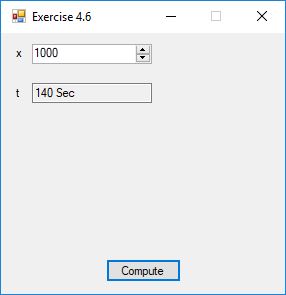
Computer solution output of Exercise 4.6:

Exercise 4.6

C# source code for the computer solution of Exercise 4.6, sorry about the naming confusion in the file:

Exercise 4.6

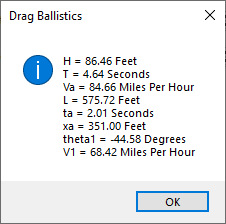
Computer solution of Exercise 4.7 using a velocity square drag function (velocity retardation function is the term used in exterior ballistics). I wrote a baseball ballistics program based on my numeric work (Runge-Kutta Fifth Order) and analytic solutions found in the paper:

Click to access 04-LAJPE-782_Chudinov.pdf

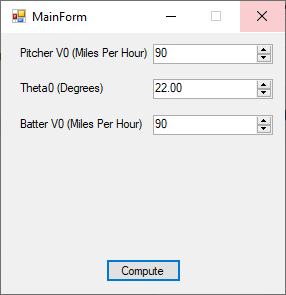
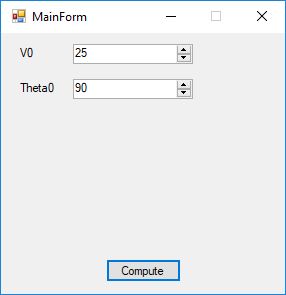
The first picture is the main form interface for the program with the parameters initial velocity in meters per second and the initial angle which is in degrees. We use a velocity of 25 meters per second which is approximately 56 miles per hour and the angle is 90 degrees to the horizontal which is throwing the ball straight up into the air.

BB Main Exercise 4.7

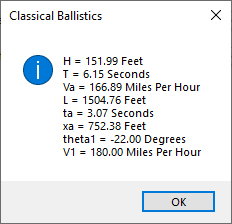
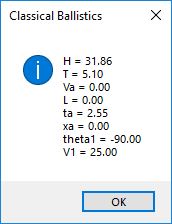
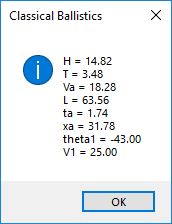
First we show the classical ballistics without atmospheric drag:

BB CB Exercise 4.7

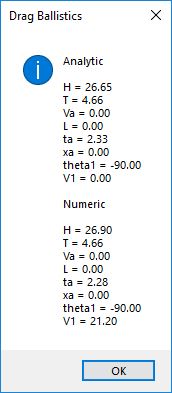
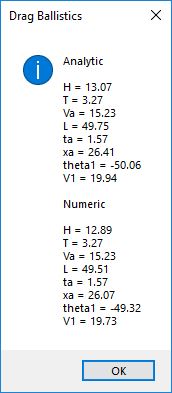
Next we show the invalid (due to a singularity in one of the equations) analytic and numeric solutions:

BB AN Exercise 4.7

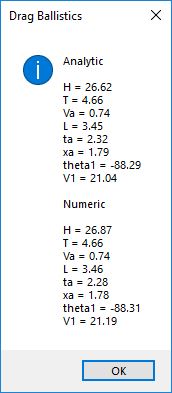
The analytic solution is not valid for theta0 = 90 degrees. The numeric solution shows a time to apogee of 2.28 seconds and time of flight 4.66 seconds. The difference is 4.66 – 2.28 seconds = 2.38 seconds so the time to return from apogee is greater than the time to reach apogee. The analytic solution becomes valid at 88 degrees of inclination.

BB AN 88 Exercise 4.7

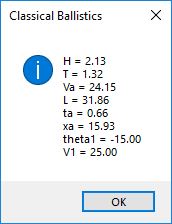
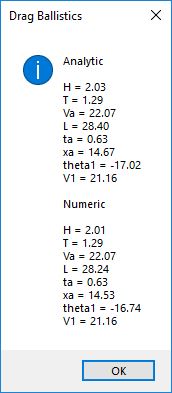
Next we move onto an inclination of 15 degrees:

BB CB 15 Exercise 4.7

BB AN 15 Exercise 4.7

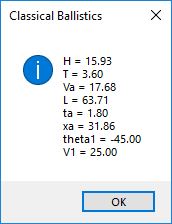
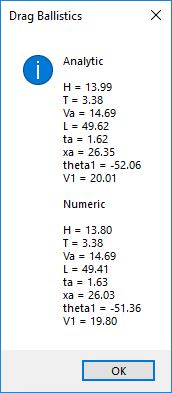
Finally for the maximum distance traveled by the ball classically we select 45 degrees:

BB CB 45 Exercise 4.7

BB AN 45 Exercise 4.7

We find that with drag the maximum distance traveled (range) is achieved around 43 degrees:

BB CB 43 Exercise 4.7

BB AN 43 Exercise 4.7


A Modern Reincarnation of Ordnance Pamphlet 770 October 1941 by James Pate Williams, Jr. BA, BS, MSwE, PhD

Ordnance Pamphlet 770 by the United States Navy is concerned with testing and calibrating the 16 inch/50 caliber guns of the Iowa class of fast battleships. I use modern digital computer methods to attempt to reproduce the analog computations of the ordnance pamphlet. Recall that digital computers did not exist in 1941, but analog computers using cams, differentials, gears, and levers did exist.

Pamphlet Paper