Category: Hydrogen Atom
Blog Entry © Monday, August 11, 2025, by James Pate Williams, Jr. Van der Waals Interaction Between Two Hydrogen Atoms
Blog Entry © Tuesday, July 29, 2025, Double and Triple Monte Carlo Integration by James Pate Williams, Jr.
#include <math.h>
#include <stdio.h>
#include <stdlib.h>

static double randomRange(double lo, double hi)
{
	return (hi - lo) * (double)rand() / RAND_MAX + lo;
}

static double integrand(double r, double w)
{
	return pow(r, 4.0) * (2.0 - r) * w * w * exp(-r);
}

static double StarkEffectIntegral(double E, int N)
{
	double sum = 0.0;

	for (int i = 0; i <= N; i++)
	{
		double r = randomRange(0.0, 100.0);
		double w = randomRange(-1.0, 1.0);

		sum += integrand(r, w);
	}

	return 100.0 * 2.0 * E * sum / (16.0 * (N - 1));
}

static void firstOrderStarkEffect(double E)
{
	double exact = -3.0 * E;
	int N[9] = {
		1000000, 2000000, 3000000, 4000000,
		5000000, 6000000, 7000000, 8000000,
		9000000 };

	for (int n = 0; n < 9; n++)
	{
		int iN = N[n];
		double integ = StarkEffectIntegral(E, iN);
		double error = 100.0 * fabs(integ - exact) / fabs(exact);

		printf("N = %4ld\tintegral = %13.10lf\t%% error = %13.10lf\n",
			iN, integ, error);
	}

	printf("exact value = %13.10lf\n", exact);
}

static double ee1(int N, double R, double Z)
{
	double pi = 4.0 * atan(1.0);
	double sum = 0.0;

	for (int i = 0; i <= N; i++)
	{
		double r1 = randomRange(1.0e-25, R);
		double r2 = randomRange(0.0, r1);

		sum += R * r1 * r1 * exp(-2.0 * Z * (r1 + r2)) * r2 * r2;
	}

	return 16.0 * pi * pi * sum / (N - 1);
}

static double ee2(int N, double R, double Z)
{
	double pi = 4.0 * atan(1.0);
	double sum = 0.0;

	for (int i = 0; i <= N; i++)
	{
		double r1 = randomRange(1.0e-25, R);
		double r2 = randomRange(r1, R);

		sum += R * (R - r2) * r2 * exp(-2.0 * Z * (r1 + r2)) * r1 * r1;
	}

	return 16.0 * pi * pi * sum / (N - 1);
}

static void firstOrderHelium(double Z)
{
	double pi = 4.0 * atan(1.0), R = 25.0;
	double exact = 5.0 * pi * pi / (8.0 * pow(Z, 5.0));

	int N[9] = {
		1000000, 2000000, 3000000, 4000000,
		5000000, 6000000, 7000000, 8000000,
		9000000 };

	for (int n = 0; n < 9; n++)
	{
		int iN = N[n];
		double integ = ee1(iN, R, Z) + ee2(iN, R, Z);
		double error = 100.0 * fabs(integ - exact) / fabs(exact);

		printf("N = %4ld\tintegral = %13.10lf\t%% error = %13.10lf\n",
			iN, integ, error);
	}

	printf("exact value = %13.10lf\n", exact);
}

int main(void)
{
	firstOrderStarkEffect(2.0);
	firstOrderHelium(2.0);
	return 0;
}
#include <math.h>
#include <stdio.h>
#include <stdlib.h>

static double randomRange(double lo, double hi)
{
	return (hi - lo) * (double)rand() / RAND_MAX + lo;
}

static double f(double x, double y, double z)
{
	return pow(sin(x), 2.0) + y * sin(z);
}

static double g(double x, double y, double z)
{
	return x + y * z * z;
}

static double integral(
	double x0, double x1,
	double y0, double y1,
	double z0, double z1,
	double (*f)(double, double, double),
	int N)
{
	double sum = 0.0;

	for (int n = 0; n <= N; n++)
	{
		double x = randomRange(x0, x1);
		double y = randomRange(y0, y1);
		double z = randomRange(z0, z1);

		sum += f(x, y, z);
	}

	return (x1 - x0) * (y1 - y0) * (z1 - z0) *
		sum / (N - 1);
}

int main(void)
{
	double pi = 4.0 * atan(1.0);
	double x0 = 0.0, x1 = pi;
	double y0 = 0.0, y1 = 1.0;
	double z0 = 0.0, z1 = pi;
	double exact = 0.5 * pi * (2.0 + pi);
	int N[9] = {
		1000000, 2000000, 3000000, 4000000,
		5000000, 6000000, 7000000, 8000000,
		9000000 };

	printf("integrand pow(sin(x), 2.0) + y * sin(z)\n");
	printf("x = 0 to pi, y = 0 to 1, z = 0 to pi\n");

	for (int n = 0; n < 9; n++)
	{
		int iN = N[n];
		double integ = integral(
			x0, x1, y0, y1, z0, z1, f, iN);
		double error = 100.0 * fabs(integ - exact) / fabs(exact);

		printf("N = %4ld\tintegral = %13.10lf\t%% error = %13.10lf\n",
			iN, integ, error);
	}

	printf("exact value = %13.10lf\n", exact);

	x0 = -1.0;
	x1 = 5.0;
	y0 = 2.0;
	y1 = 4.0;
	z0 = 0.0;
	z1 = 1.0;
	exact = 36.0;

	printf("integrand x + y * z * z\n");
	printf("x = -1 to 5, y = 2 to 4, z = 0 to 1\n");

	for (int n = 0; n < 9; n++)
	{
		int iN = N[n];
		double integ = integral(
			x0, x1, y0, y1, z0, z1, g, iN);
		double error = 100.0 * fabs(integ - exact) / fabs(exact);

		printf("N = %4ld\tintegral = %13.10lf\t%% error = %13.10lf\n",
			iN, integ, error);
	}

	printf("exact value = %13.10lf\n", exact);
	return 0.0;
}
Approximation of the Ground-State Total Energy of a Beryllium Atom © Sunday, March 30 to Tuesday April 1, 2025, by James Pate Williams, Jr., BA, BS, Master of Software Engineering, PhD Computer Science
Blog Entry © Sunday, March 29, 2025, by James Pate Williams, Jr., BA, BS, Master of Software Engineering, PhD Slater Determinant Coefficients for Z = 2 to 4
Enter the atomic number Z (2 to 6 or 0 to quit): 2
2       1       1       +       a(1)b(2)
1       0       0       -       a(2)b(1)
# Even Permutations = 1
Enter the atomic number Z (2 to 6 or 0 to quit): 3
6       3       1       +       a(1)b(2)c(3)
5       2       0       -       a(1)b(3)c(2)
4       2       0       -       a(2)b(1)c(3)
3       1       1       +       a(2)b(3)c(1)
2       1       1       +       a(3)b(1)c(2)
1       0       0       -       a(3)b(2)c(1)
# Even Permutations = 3
Enter the atomic number Z (2 to 6 or 0 to quit): 4
24      12      0       +       a(1)b(2)c(3)d(4)
23      11      1       -       a(1)b(2)c(4)d(3)
22      11      1       -       a(1)b(3)c(2)d(4)
21      10      0       +       a(1)b(3)c(4)d(2)
20      10      0       +       a(1)b(4)c(2)d(3)
19      9       1       -       a(1)b(4)c(3)d(2)
18      9       1       -       a(2)b(1)c(3)d(4)
17      8       0       +       a(2)b(1)c(4)d(3)
16      8       0       +       a(2)b(3)c(1)d(4)
15      7       1       -       a(2)b(3)c(4)d(1)
14      7       1       -       a(2)b(4)c(1)d(3)
13      6       0       +       a(2)b(4)c(3)d(1)
12      6       0       +       a(3)b(1)c(2)d(4)
11      5       1       -       a(3)b(1)c(4)d(2)
10      5       1       -       a(3)b(2)c(1)d(4)
9       4       0       +       a(3)b(2)c(4)d(1)
8       4       0       +       a(3)b(4)c(1)d(2)
7       3       1       -       a(3)b(4)c(2)d(1)
6       3       1       -       a(4)b(1)c(2)d(3)
5       2       0       +       a(4)b(1)c(3)d(2)
4       2       0       +       a(4)b(2)c(1)d(3)
3       1       1       -       a(4)b(2)c(3)d(1)
2       1       1       -       a(4)b(3)c(1)d(2)
1       0       0       +       a(4)b(3)c(2)d(1)
# Even Permutations = 12
Enter the atomic number Z (2 to 6 or 0 to quit):
// AOPermutations.cpp : This file contains the 'main' function.
// Program execution begins and ends there.
// Copyright (c) Saturday, March 29, 2025
// by James Pate Williams, Jr., BA, BS, MSwE, PhD
// Signs of the atomic orbitals in a Slater Determinant

#include <algorithm>
#include <iostream>
#include <string>
#include <vector>

int main()
{
    char alpha[] = { 'a', 'b', 'c', 'd', 'e', 'f' }, line[128] = {};
    int factorial[7] = { 1, 1, 2, 6, 24, 120, 720 };

    while (true)
    {
        int col = 0, counter = 0, row = 0, sign = 1, t = 0, Z = 0, zfact = 0;
        int numberEven = 0;
        std::cout << "Enter the atomic number Z (2 to 6 or 0 to quit): ";
        std::cin.getline(line, 127);
        std::string str(line);
        Z = std::stoi(str);

        if (Z == 0)
        {
            break;
        }

        if (Z < 2 || Z > 6)
        {
            std::cout << "Illegal Z, please try again" << std::endl;
            continue;
        }

        zfact = factorial[Z];

        std::vector<char> orb(Z);
        std::vector<int> tmp(Z), vec(Z);

        for (int i = 0; i < Z; i++)
        {
            orb[i] = alpha[i];
            vec[i] = i + 1;
        }

        do
        {
            for (int i = 0; i < (int)vec.size(); i++)
            {
                tmp[i] = vec[i];
            }

            t = 0;

            do
            {
                t++;
            } while (std::next_permutation(tmp.begin(), tmp.end()));

            std::cout << t << '\t' << t / 2 << '\t';
            std::cout << (t / 2 & 1) << '\t';

            if (Z == 2 || Z == 3)
            {
                if ((t / 2 & 1) == 0)
                {
                    std::cout << "-\t";
                }

                else
                {
                    std::cout << "+\t";
                    numberEven++;
                }
            }

            else
            {
                if ((t / 2 & 1) == 1)
                {
                    std::cout << "-\t";
                }

                else
                {
                    std::cout << "+\t";
                    numberEven++;
                }
            }

            for (int i = 0; i < Z; i++)
            {
                std::cout << orb[i] << '(' << vec[i] << ')';
            }

            row++;
            std::cout << std::endl;

            if (zfact != 2 && row == zfact)
            {
                std::cout << std::endl;
                break;
            }

            row %= Z;
        } while (std::next_permutation(vec.begin(), vec.end()));

        std::cout << "# Even Permutations = ";
        std::cout << numberEven << std::endl;
    }

    return 0;
}
Blog Entry © Thursday, March 27, 2025, by James Pate Williams, Jr., BA, BS, Master of Software Engineering, PhD Lithium (Li, Z = 3) Total Ground-State Energy Numerical Experiments
Blog Entry © Tuesday, March 25, 2025, by James Pate Williams, Jr. Hydrogen Radial Wavefunctions and Related Functions
Revised Helium Ground-State Total Energy Computation (c) Sunday, March 23, 2025, by James Pate Williams, Jr.
Blog Entry © Saturday, November 30, 2024, by James Pate Williams, Jr. Partial Solution of the Schrödinger Equation for Hydrogen in Parabolic Coordinates
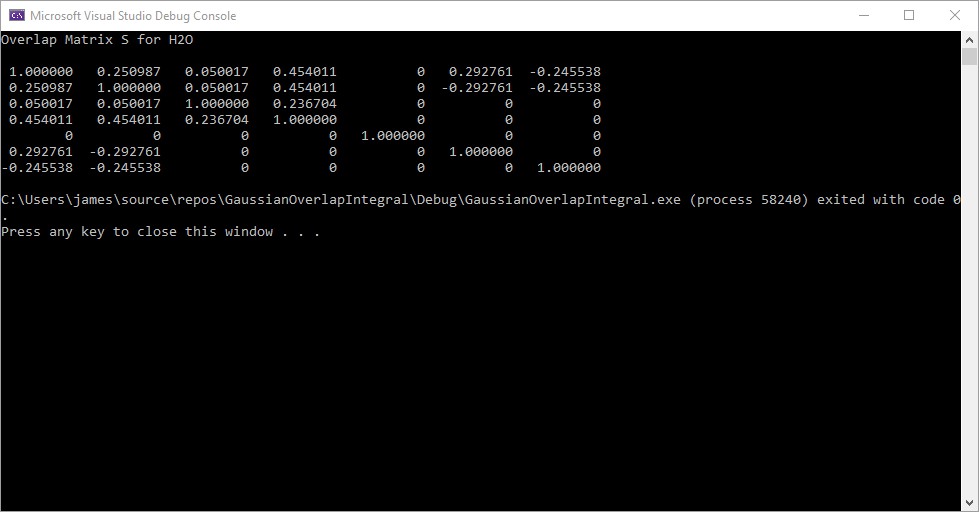
Blog Entry © Friday, November 1, 2024, by James Pate Williams, Jr. Calculation of the Overlap Matrix for the Water Molecule (H2O) Using a Contracted Set of Gaussian Orbitals
Reference: https://content.wolfram.com/sites/19/2012/02/Ho.pdf
I reproduced most of the computations in the MATHMATICA reference. The water molecule is a planar molecule that lies in the YZ-plane.