Category: Memoirs of James Pate Williams Jr
Recent Email that I Wrote on May 23, 2024
Does the following thought experiment make sense?
Suppose we have a positively charged quantum mechanical particle in a finite potential energy well. Also suppose there is a free negatively charged quantum mechanical particle outside the potential energy well. There is a measurable probability that the positively charged particle will tunnel through the potential energy well and perhaps be attracted to the negatively charged particle. Likewise, the negatively charged particle has a finite probability of penetrating the potential energy well and hooking up with the positively charged particle should it still be trapped in the well. There is no “spooky action at a distance” to use Albert Einstein’s 1930s definition of quantum entanglement in this example since this electromagnetic attraction is a local phenomenon (?). The positively charged particle cannot exert an attractive force until it tunnels through the energy barrier or otherwise the negatively charged particle winds up breaking into the well. I don’t know exactly how quantum electrodynamics would explain this example. Perhaps the positively charged particle is a positron (antimatter lepton) and the negatively charged particle is a plain vanilla electron. We know that the local result of the interaction of our two matter-antimatter particles is an annihilation event whereby two energetic photons are created, or other products are generated.
https://en.wikipedia.org/wiki/Annihilation#/media/File:Electron_Positron_Annihilation.png
Quantum Mechanical Angular Momentum Ladder Operators by James Pate Williams, Jr. Copyright Thursday, May 23, 2024, All Applicable Rights Reserved


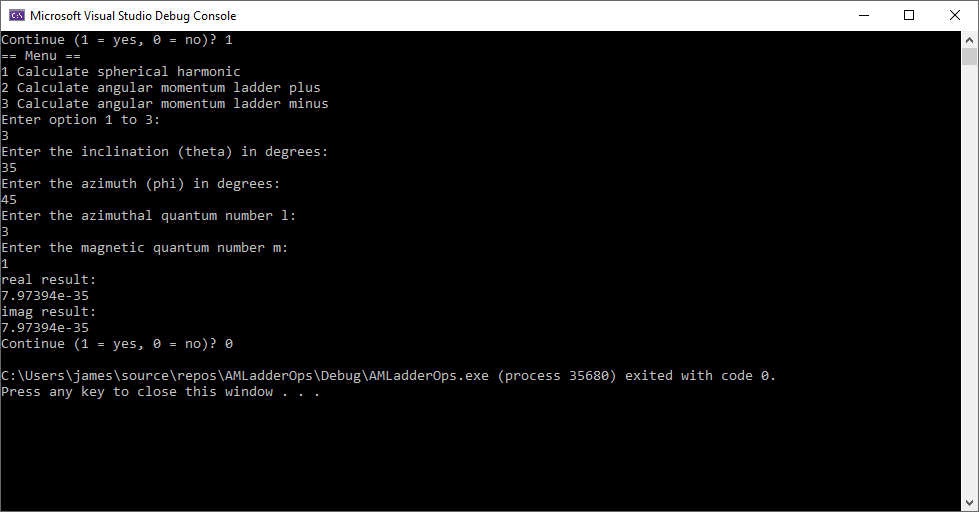

Several Problems from Schiff Chapter 7 (c) May 19-24, 2024, by James Pate Williams, Jr.
A Few Problems from Schiff Chapter 6 (c) May 19-20, 2024, by James Pate Williams, Jr.
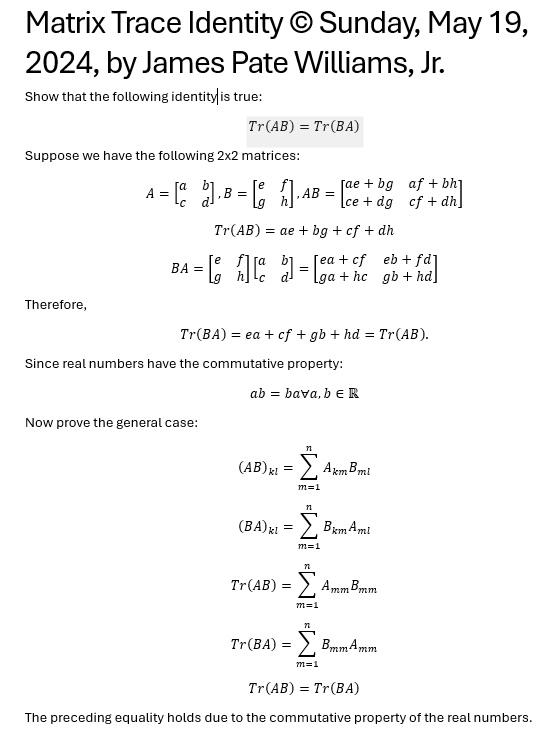
A Matrix Identity
Sikorsky MH-60R SEAHAWK Helicopter © Friday, May 17, 2024, by James Pate Williams, Jr.
My USS New Jersey, BB-62 (1982 version), Revell plastic model has two Sikorsky (now Lockheed Martin) MH-60R SEAHAWK miniature model helicopters. Each of the helicopters consists of two fuselage parts, a tail, a tail rotor, and main rotor. Also, you have six very small decals to attach. I did not have much luck with the decals. The real helicopter is an anti-submarine, maritime spotting, and search and rescue vehicle. I have clumsy fingers.
Some Elementary Quantum Mechaincs (c) Thursday, May 16, 2024, by James Pate Williams, Jr.
Plastic Models I Have Built Spanning the Late 1950s to Today Blog Entry (c) Tuesday May 14, 2024, James Pate Williams, Jr.
Most of the models are either Aurora, Monogram, and/or Revell and are listed in no particular order. First list consists of aircraft.
- NASA North American X-15 experimental rocket
- North American XB-70 Valkyrie experimental high velocity heavy bomber
- Lockheed YF-12A Blackbird (Blackbird family A-12, SR-71, and YF-12A)
- Lockheed SR-71 the pride of Clarence “Kelly” Johnson USAF-CIA spyplane
- Lockheed U-2 Dragon Lady high-altitude reconnaissance
- Lockheed P-38 Lightening
- Republic P-47D bubble canopy Thunderbolt
- North American P-51D bubble canopy Mustang fast long-range fighter
- Boeing B-17 Flying Fortress heavy bomber
- Douglas A-1 Sky Raider attack close air support
- Grumman F4F Wildcat Marine/Navy fighter
- Grumman F6F Hellcat Marine/Navy fighter
- Vought F4U Corsair Marine/Navy fighter
- Vought OS2U Kingfisher sometimes a battleship spotting aircraft
- Mishibishu Zero agile, very maneuverer fighter without self-sealing fuel tanks
- Grumman TBF Avenger torpedo bomber deceased ex-President George Herbert Walker Bush flew this type of aircraft
- Curtiss SB2C Helldiver dive bomber
- Douglas SBD Dauntless dive bomber
- Junkers Ju-87 Stuka dive bomber
- Messerschmidt Bf 109 many, many of these fighters were built and deployed
- Messerschmitt Bf 110 night fighter fitted with advanced radar
- Messerschmitt Me 163 Komet high-speed very short-ranged rocket plane
- Messerschmitt Me 262 Swallow first ever jet fighter
- Focke-Wulf Fw 190 Shrike high-speed fighter
- Focke-Wulf Fw 200 Condor long-range maritime heavy bomber
- Lockheed F-104 Starfighter supersonic jet fighter
- Republic F-105 Thunderchief high-speed jet fighter
- General Dynamics F-111 Aardvark swing-wind high-speed jet fighter
- Convair B-58 Hustler supersonic medium bomber nuclear bomb delivery system
- Boeing F/A-18E Super Hornet all weather fighter-bomber
- Fairchild Republic A-10 Thunderbolt II close air support and tank killer
- Northrop P-61 Black Widow exceptional night-fighter with advanced radar (radio detection and ranging)
Next comes the ships:
- CSS Alabama Confederate commerce raider whose captain was Raphael Semmes
- HMS Hood heavy battlecruiser that was sunk by the Kriegsmarine battleship Bismarck on May 24, 1941, in the Battle of the Denmark Strait
- USS Arizona BB-39 sunk at Pearl in the early morning of Sunday, December 7, 1941, a day Franklin Delano Roosevelt stated “Yesterday, December 7, 1941—a date which will live in infamy—the United States of America was suddenly and deliberately attacked by naval and air forces of the Empire of Japan”
- Kriegsmarine Bismarck victorious in the Battle of the Denmark Strait then sunk by Royal Navy in the morning of May 27, 1941
- Kriegsmarine Tirpitz Bismarck class heavy battleship sunk by the British while she was hiding out in a Norwegian fjord
- U-boat model
- USS Nautilus nuclear powered submarine
- Other ships that I can’t recall
- USS New Jersey BB-62 Iowa class fast battleship a work in progress today
Tanks:
- Panzerkampfwagen V Panther medium tank 75 mm main gun
- Tiger I heavy tank 88 mm main artillery
- Other US and Japanese tanks and personnel carriers
I have built other miscellaneous models including a number of automobiles. I used to utilize cans of spray paint on some models. The spray painting was usually done on the rock patio of 601 Hill Street, LaGrange, GA, 30241, my former abode from the early 1960s to 2013.
Strange Pictorial Instructions Blog Entry May 13, 2024, (c) James Pate Williams, Jr.
Revell has some strange hieroglyphics in the instruction manual for their USS New Jersey (Platinum Edition) model. Pictures show the modeler clipping part of a plastic frame and heating the clipped part over a candle and drawing the plastic to a new length of 32 mm (1.26 inches) in a few cases. This reminds me of glass blowing where molten glass is drawn to a new length. I am making some progress on painting and assembling parts of my Revell New Jersey model.
 Numerical Explorations
