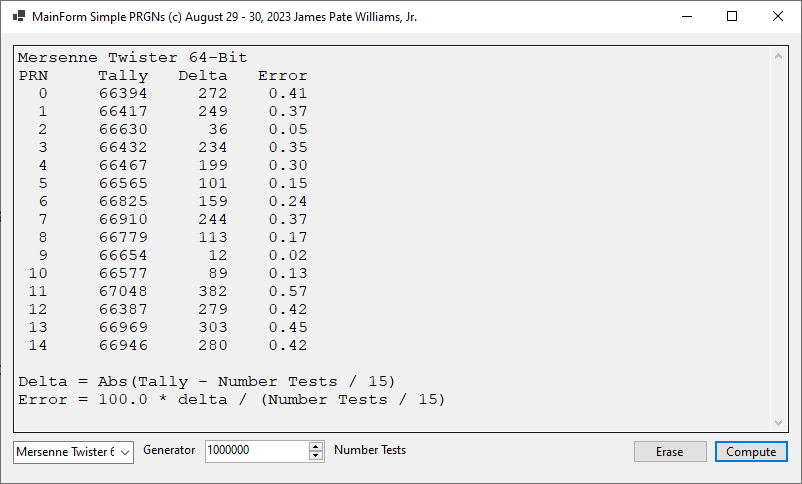
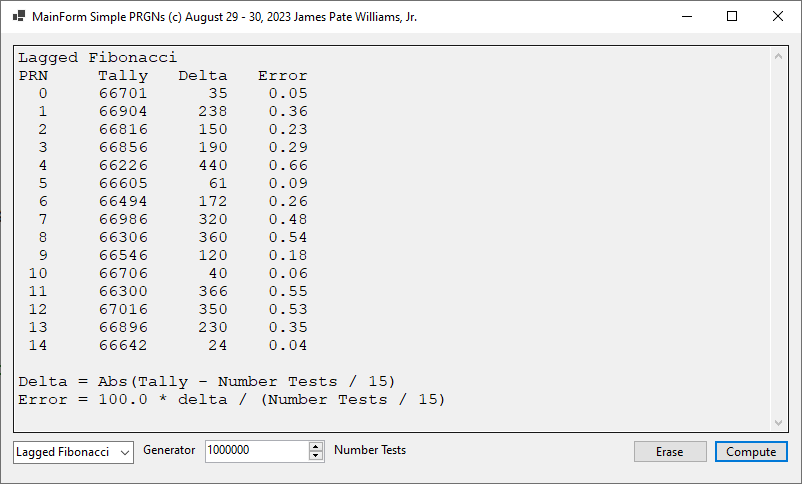
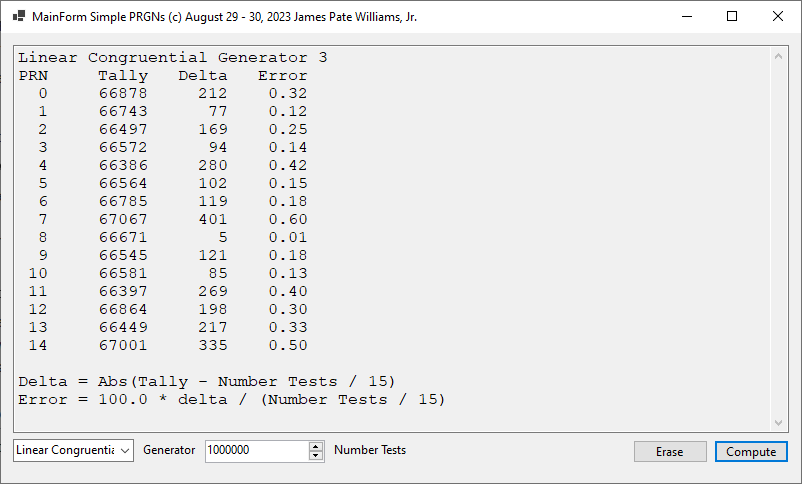
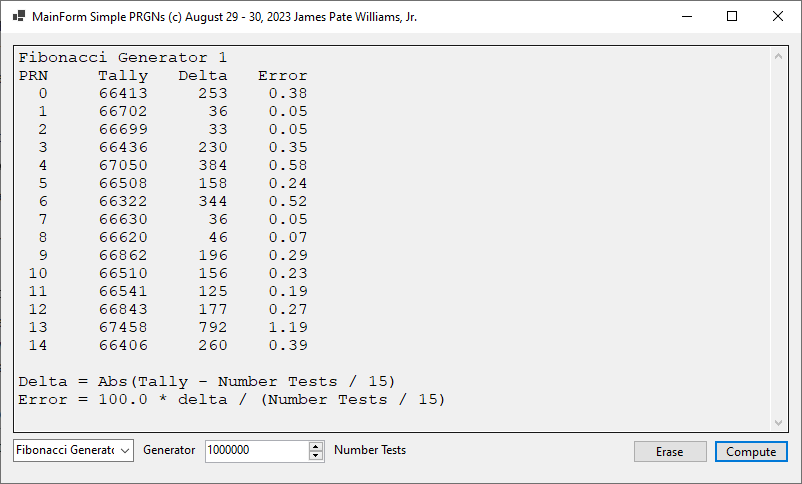
Added the Pseudo-Random Number Generators: Mersenne Twister and Lagged Fibonacci to My C# Application by James Pate Wiliams, Jr. with the Help of the Internet

// "Numerical Computation 2: Methods, Software,
// and Analysis" by Christoph W. Ueberhuber
// Chapter 17 Random Numbers
// "The Art of Computer Programming Volume 2"
// "Seminumerical Algorithms Second Edition"
// "Chapter 3 RANDOM NUMBERS" by Donald E. Knuth
// https://en.wikipedia.org/wiki/Mersenne_Twister

using System.Collections.Generic;

namespace SimplePRNGs
{
    class PRNGs
    {
        private long AMxn1, AMxn;
        private long AMyn1, AMyn;
        private long AMk;
        private long AMm = 34359738368;
        private long LCG0z0, LCG0z1;
        private long LCG1z0, LCG1z1;
        private long LCG2z0, LCG2z1, LCG2z2;
        private long MFG0z0, MFG0z1;
        private readonly long LCG0m = 4294967296;
        private readonly long LCG2m = 2147483647;
        private readonly List<long> AMV = new();
        private long MTindex;
        private long[] MT;
        private LaggedFibRng fibRng;

        public void SetSeedLCG0(long z0)
        {
            LCG0z0 = z0;
        }

        public void SetSeedLCG1(long z0)
        {
            LCG1z0 = z0;
        }

        public void SetSeedLCG2(long z0, long z1)
        {
            LCG2z0 = z0;
            LCG2z1 = z1;
        }

        public long LCG0()
        {
            LCG0z1 = (69069 * LCG0z0) % LCG0m;
            LCG0z0 = LCG0z1;
            return LCG0z1;
        }

        public long LCG1()
        {
            LCG1z1 = (69069 * LCG1z0 + 1) % LCG0m;
            LCG1z0 = LCG1z1;
            return LCG1z1;
        }

        public long LCG2()
        {
            LCG2z2 = (1999 * LCG2z1 + 4444 * LCG2z0) % LCG2m;
            LCG2z0 = LCG2z1;
            LCG2z1 = LCG2z2;
            return LCG2z2;
        }

        public void SetSeedMFG0(long z0, long z1)
        {
            MFG0z0 = z0;
            MFG0z1 = z1;
        }

        public long MFG0()
        {
            long MFG0z2 = (MFG0z1 + MFG0z0) % LCG0m;
            MFG0z0 = MFG0z1;
            MFG0z1 = MFG0z2;
            return MFG0z2;
        }

        public void ComputeNextXY()
        {
            AMxn1 = (3141592653 * AMxn + 2718281829) % AMm;

            if (AMxn1 < 0)
                AMxn1 += AMm;

            AMyn1 = (2718281829 * AMyn + 3141592653) % AMm;

            if (AMyn1 < 0)
                AMyn1 += AMm;
        }

        public void AMSeed(long k, long x0, long y0)
        {
            long AMTxn1, AMTxn = x0;

            AMxn = x0;
            AMyn = y0;
            AMk = k;

            for (int i = 0; i < k; i++)
            {
                AMTxn1 = (3141592653 * AMTxn + 2718281829) % AMm;

                if (AMTxn1 < 0)
                    AMTxn1 += AMm;

                AMTxn = AMTxn1;
                AMV.Add(AMTxn1);
            }
        }

        public long AlgorithmM()
        {
            ComputeNextXY();
            AMxn = AMxn1;
            AMyn = AMyn1;

            long j = (AMk * AMyn1) / AMm;
            long r = AMV[(int)j];
            
            AMV[(int)j] = AMxn1;

            if (r < 0)
                r += AMm;

            return r;
        }

        public void MTInitialization(long seed)
        {
            long f = 6364136223846793005;
            long n = 312, w = 64;

            MTindex = n;
            MT = new long[n];
            MT[0] = seed;

            for (int i = 1; i < n; i++)
                MT[i] = f * (MT[i - 1] ^ (MT[i - 1] >> (int)(w - 2))) + i;
        }

        public long MTExtractNumber()
        {
            unchecked
            {
                long n = 312;
                long c = (long)0xFFF7EEE000000000;
                long b = 0x71D67FFFEDA60000;
                long d = 0x5555555555555555;
                long u = 29, s = 17, t = 27, l = 43;

                if (MTindex == n)
                    MTTwist();

                long y = MT[MTindex];

                y ^= ((y >> (int)u) & d);
                y ^= ((y << (int)s) & b);
                y ^= ((y << (int)t) & c);
                y ^= (y >> (int)l);
                MTindex++;
                return y;
            }
        }

        public void MTTwist()
        { 
            unchecked
            {
                long n = 312, m = 156, r = 31;
                long a = (long)0xB5026F5AA96619E9;
                MTindex = n + 1;
                long lower_mask = (1 << (int)r) - 1;
                long upper_mask = ~lower_mask;

                for (int i = 0; i < n; i++)
                {
                    long x = (MT[i] & upper_mask) |
                       (MT[(i + 1) % n] & lower_mask);
                    long xA = x >> 1;

                    if (x % 2 != 0)
                        xA ^= a;

                    MT[i] = MT[(i + m) % n] ^ xA;
                }
            }

            MTindex = 0;
        }

        public void LaggedFibRngSeed(int seed)
        {
            fibRng = new LaggedFibRng(seed);
        }

        public long LaggedFibonacci(long modulus)
        {
            long lo = fibRng.Next();
            long hi = fibRng.Next();
            long rs = ((hi << 31) | lo) % modulus;

            return rs;
        }
    }
}
//https://learn.microsoft.com/en-us/archive/msdn-magazine/2016/august/test-run-lightweight-random-number-generation
// modified by current author James Pate Williams, Jr. on August 30, 2023

using System.Collections.Generic;

namespace SimplePRNGs
{
    public class LaggedFibRng
    {
        private const int k = 606; // Largest magnitude"-index"
        private const int j = 273; // Other "-index"
        private const long m = 4294967296;  // 2^32
        private readonly List<long> vals = null;
        private long seed;
        public LaggedFibRng(int seed)
        {
            vals = new List<long>();
            for (int i = 0; i < k + 1; ++i)
                vals.Add(i);
            if (seed % 2 == 0) vals[0] = 11;
            // Burn some values away
            for (int ct = 0; ct < 1000; ++ct)
            {
                long dummy = Next();
            }
        }  // ctor
        public long Next()
        {
            // (a + b) mod n = [(a mod n) + (b mod n)] mod n
            long left = vals[0] % m;    // [x-big]
            long right = vals[k - j] % m; // [x-other]
            long sum = (left + right) % m;  // prevent overflow
            if (sum < 0)
                seed = sum + m;
            else
                seed = sum;
            vals.Insert(k + 1, seed);  // Add new val at end
            vals.RemoveAt(0);  // Delete now irrelevant [0] val
            return seed;
        }
    }
}

Simple Pseudo-Random Number Generators in C# Implemented by James Pate Williams, Jr.

// "Numerical Computation 2: Methods, Software,
// and Analysis" by Christoph W. Ueberhuber
// Chapter 17 Random Numbers
// "The Art of Computer Programming Volume 2"
// "Seminumerical Algorithms Second Edition"
// "Chapter 3 RANDOM NUMBERS" by Donald E. Knuth

using System.Collections.Generic;

namespace SimplePRNGs
{
    class PRNGs
    {
        private long AMxn1, AMxn;
        private long AMyn1, AMyn;
        private long AMk;
        private long AMm = 34359738368;
        private long LCG0z0, LCG0z1;
        private long LCG1z0, LCG1z1;
        private long LCG2z0, LCG2z1, LCG2z2;
        private long MFG0z0, MFG0z1;
        private readonly long LCG0m = 4294967296;
        private readonly long LCG2m = 2147483647;
        private readonly List<long> AMV = new();

        public void SetSeedLCG0(long z0)
        {
            LCG0z0 = z0;
        }

        public void SetSeedLCG1(long z0)
        {
            LCG1z0 = z0;
        }

        public void SetSeedLCG2(long z0, long z1)
        {
            LCG2z0 = z0;
            LCG2z1 = z1;
        }

        public long LCG0()
        {
            LCG0z1 = (69069 * LCG0z0) % LCG0m;
            LCG0z0 = LCG0z1;
            return LCG0z1;
        }

        public long LCG1()
        {
            LCG1z1 = (69069 * LCG1z0 + 1) % LCG0m;
            LCG1z0 = LCG1z1;
            return LCG1z1;
        }

        public long LCG2()
        {
            LCG2z2 = (1999 * LCG2z1 + 4444 * LCG2z0) % LCG2m;
            LCG2z0 = LCG2z1;
            LCG2z1 = LCG2z2;
            return LCG2z2;
        }

        public void SetSeedMFG0(long z0, long z1)
        {
            MFG0z0 = z0;
            MFG0z1 = z1;
        }

        public long MFG0()
        {
            long MFG0z2 = (MFG0z1 + MFG0z0) % LCG0m;
            MFG0z0 = MFG0z1;
            MFG0z1 = MFG0z2;
            return MFG0z2;
        }

        public void ComputeNextXY()
        {
            AMxn1 = (3141592653 * AMxn + 2718281829) % AMm;

            if (AMxn1 < 0)
                AMxn1 += AMm;

            AMyn1 = (2718281829 * AMyn + 3141592653) % AMm;

            if (AMyn1 < 0)
                AMyn1 += AMm;
        }

        public void AMSeed(long k, long x0, long y0)
        {
            long AMTxn1, AMTxn = x0;

            AMxn = x0;
            AMyn = y0;
            AMk = k;

            for (int i = 0; i < k; i++)
            {
                AMTxn1 = (3141592653 * AMTxn + 2718281829) % AMm;

                if (AMTxn1 < 0)
                    AMTxn1 += AMm;

                AMTxn = AMTxn1;
                AMV.Add(AMTxn1);
            }
        }

        public long AlgorithmM()
        {
            ComputeNextXY();
            AMxn = AMxn1;
            AMyn = AMyn1;

            long j = (AMk * AMyn1) / AMm;
            long r = AMV[(int)j];
            
            AMV[(int)j] = AMxn1;

            if (r < 0)
                r += AMm;

            return r;
        }
    }
}

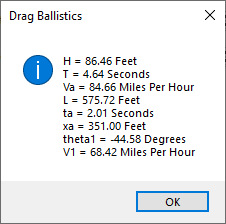
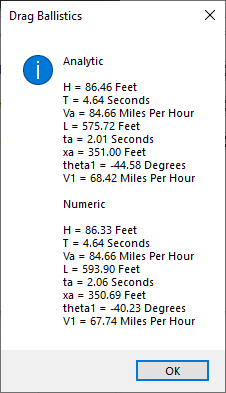
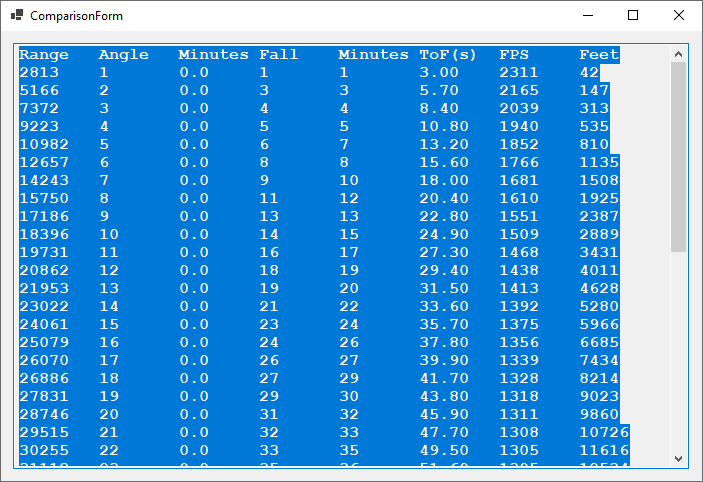
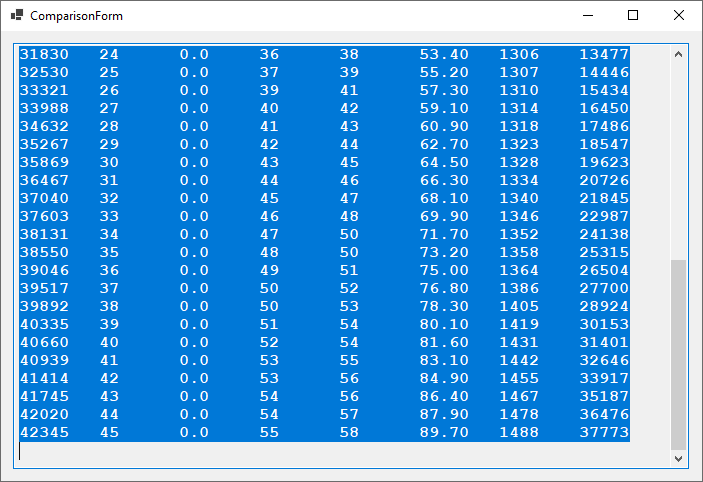
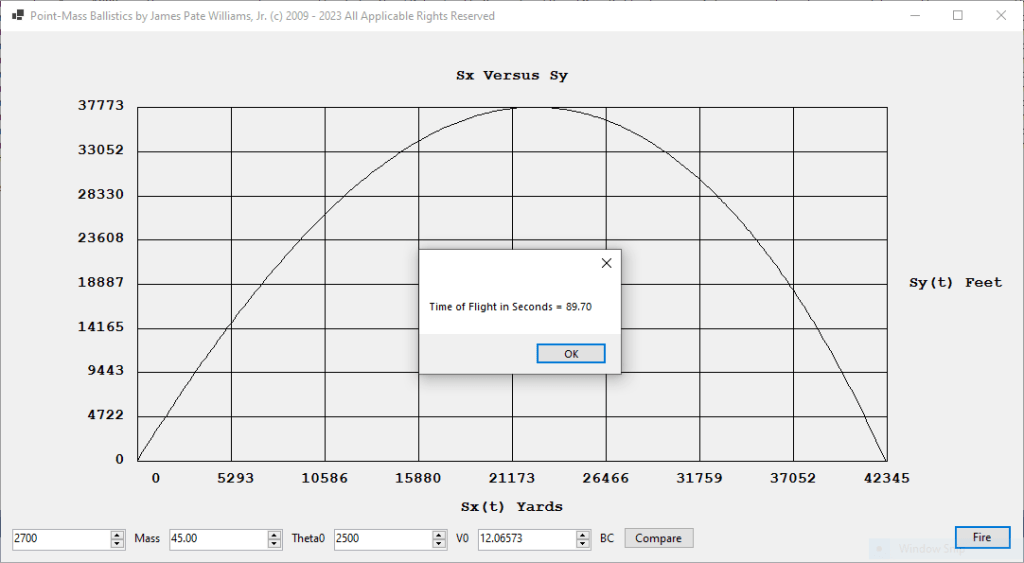
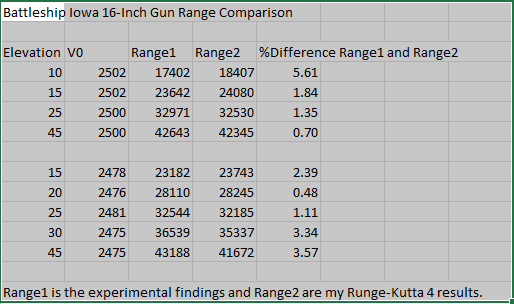
Another Point-Mass Ballistics Application Battleship Iowa 16-Inch Guns in Particular

by James Pate Williams, Jr.

namespace PointMassBallistics
{
    public class TableEntry : IComparable<TableEntry>
    {
        public double range, elevationDegrees, elevationMinutes,
            angleFallDegrees, angleFallMinutes, timeOfFlight,
            strikingVelocity, maximumOrdinate;
        public int CompareTo(TableEntry other)
        {
            if (elevationDegrees < other.elevationDegrees &&
                elevationMinutes < other.elevationMinutes)
                return -1;
            if (elevationDegrees > other.elevationDegrees &&
                elevationMinutes > other.elevationMinutes)
                return +1;
            return 0;
        }
    }
}
// Solves the following system of first order
// ordinary differential equations. Formulas
// are from "Elementary Numerical Analysis:
// An Algorithmic Approach 3rd Edition" by S.
// D. Conte & Carl de Boor (c) 1980 8.12 page 398.
// Extended from two to four equations.
// See https://apps.dtic.mil/dtic/tr/fulltext/u2/a439796.pdf
// Also view https://eugeneleeslover.com/USN-GUNS-AND-RANGE-TABLES/OP-770-1.html

using System;
using System.Collections.Generic;

namespace PointMassBallistics
{
    class RungeKutta4
	{
		private double BC;
		private readonly double g = 32.17405;
		private readonly double[] GarveN = {
			2, 3, 5, 3, 2, 1.7, 1.55 };
		private readonly double[] log10K = {
			5.66989 - 10, 2.77344 - 10, 6.80187 - 20,
			2.98090 - 10, 6.11926 - 10, 7.09620 - 10, 7.60905 - 10 };
		private readonly double[] K = new double[7];
		private int zone;

		static private double Density(double y)
		{
			return Math.Pow(10, -0.00001372 * y);
		}

		static private int ComputeIndex(double v)
		{
			int index;

			if (v > 3600)
				index = 6;

			else if (v > 2600 && v <= 3600)
				index = 5;

			else if (v > 1800 && v <= 2600)
				index = 4;

			else if (v > 1370 && v <= 1800)
				index = 3;

			else if (v > 1230 && v <= 1370)
				index = 2;

			else if (v > 790 && v <= 1230)
				index = 1;

			else
				index = 0;

			return index;
		}

		public double MayevskiRetardation(double v, int zone)
		{
			// See Exterior Ballistics 1935 by Ernest Edward Herrmann
			// Garve function

			return K[zone] * Math.Pow(v, GarveN[zone]);
		}

		private double Vx(double syn, double vxn, double vyn)
		{ 
			double v = Math.Sqrt(vxn * vxn + vyn * vyn);
			zone = ComputeIndex(v);
			double E = Density(syn) * MayevskiRetardation(v, zone) / BC;
			return -E * vxn / v;
        }

		private double Vy(double syn, double vxn, double vyn)
		{
			double v = Math.Sqrt(vxn * vxn + vyn * vyn);
			zone = ComputeIndex(v);
			double E = Density(syn) * MayevskiRetardation(v, zone) / BC;
			return -E * vyn / v - g;
		}

		static private double Sx(double vxn)
        {
			return vxn;
        }

		static private double Sy(double vyn)
		{
			return vyn;
		}

		public void Solve(
			double t0, double t1,
			double vx0, double vy0,
			double sx0, double sy0,
			double BC, int nSteps, ref List<double> lt,
			ref List<double> lvx, ref List<double> lvy,
			ref List<double> lsx, ref List<double> lsy)
		{ 
			double k1, k2, k3, k4;
			double l1, l2, l3, l4;
			double m1, m2, m3, m4;
			double n1, n2, n3, n4;
			double h = (t1 - t0) / nSteps, tn = t0;
			double vxn = vx0, vyn = vy0, sxn = sx0, syn = sy0;
			int n = 1;

			for (int i = 0; i < log10K.Length; i++)
				K[i] = Math.Pow(10, log10K[i]);

			this.BC = BC;

			lt.Add(tn);
			lvx.Add(vxn);
			lvy.Add(vyn);
			lsx.Add(sxn / 3);
			lsy.Add(syn);

			while (true)
			{
				tn = t0 + n * h;
				k1 = h * Vx(syn, vxn, vyn);
				l1 = h * Vy(syn, vxn, vyn);
				m1 = h * Sx(vxn);
				n1 = h * Sy(vyn);

				k2 = h * Vx(syn + 0.5 * n1, vxn + 0.5 * k1, vyn + 0.5 * l1);
				l2 = h * Vy(syn + 0.5 * n1, vxn + 0.5 * k1, vyn + 0.5 * l1);
				m2 = h * Sx(vxn + 0.5 * m1);
				n2 = h * Sy(vyn + 0.5 * n1);

				k3 = h * Vx(syn + 0.5 * n2, vxn + 0.5 * k2, vyn + 0.5 * l2);
				l3 = h * Vy(syn + 0.5 * n2, vxn + 0.5 * k2, vyn + 0.5 * l2);
				m3 = h * Sx(vxn + 0.5 * m2);
				n3 = h * Sy(vyn + 0.5 * n2);

				k4 = h * Vx(syn + n3, vxn + k3, vyn + l3);
				l4 = h * Vy(syn + n3, vxn + k3, vyn + l3);
				m4 = h * Sx(vxn + m3);
				n4 = h * Sy(vyn + n3);

				vxn = vx0 + (k1 + 2 * k2 + 2 * k3 + k4) / 6.0;
				vyn = vy0 + (l1 + 2 * l2 + 2 * l3 + l4) / 6.0;
				sxn = sx0 + (m1 + 2 * m2 + 2 * m3 + m4) / 6.0;
				syn = sy0 + (n1 + 2 * n2 + 2 * n3 + n4) / 6.0;

				vx0 = vxn;
				vy0 = vyn;
				sx0 = sxn;
				sy0 = syn;
				
				n++;

				lt.Add(tn);
				lvx.Add(vxn);
				lvy.Add(vyn);
				lsx.Add(sxn / 3);
				lsy.Add(syn);
				
				if (syn <= 1.0e-2)
					break;
			}
		}
	}
}

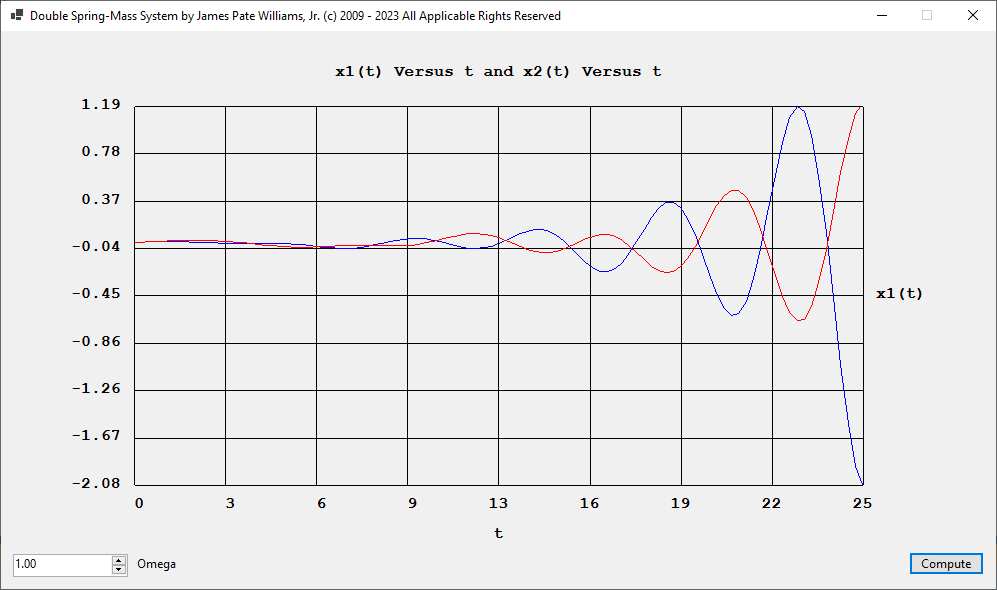
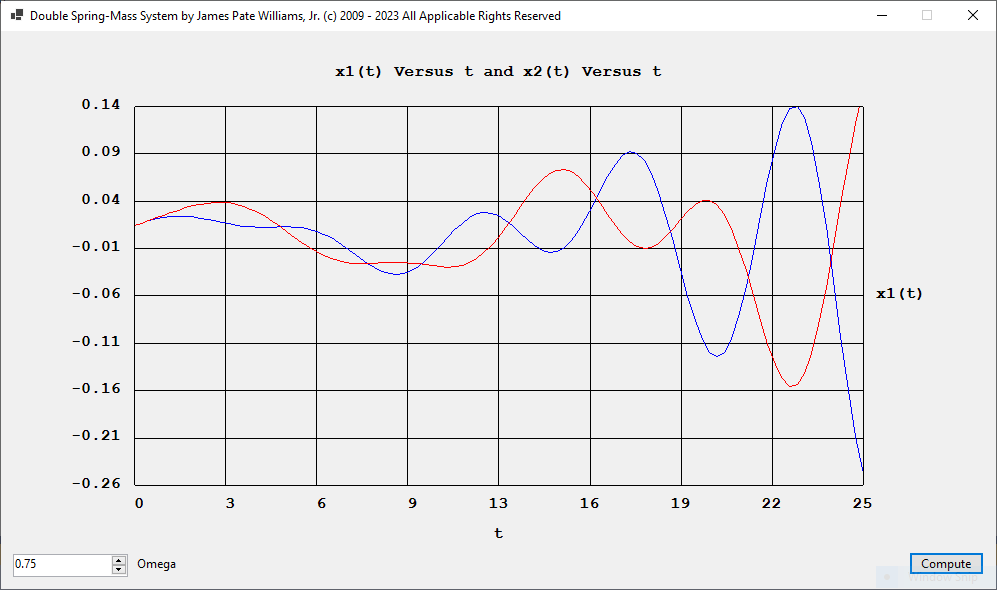
Double Spring-Mass System

// Solves the following system of first order
// ordinary differential equations. Formulas
// are from "Elementary Numerical Analysis:
// An Algorithmic Approach 3rd Edition" by S.
// D. Conte & Carl de Boor (c) 1980 8.12 page 398.
// Extended from two to four equations.
// See "Ordinary Differential Equations
// from Calculus to Dynamical Systems"
// by Virginia W. Noonburg for the exact
// solution, view pages 167 - 170.

using System.Collections.Generic;

namespace DoubleSpring
{
	class RungeKutta4
	{
		private double omega2;

		static private double Dx1(double x3)
        {
			return x3;
        }

		static private double Dx2(double x4)
		{
			return x4;
		}

		private double Dx3(double x1, double x2)
		{
			return -2 * omega2 * x1 + omega2 * x2;
		}

		private double Dx4(double x1, double x2)
		{
			return omega2 * x1 - omega2 * x2;
		}

		public void Solve(
			double t0, double t1,
			double x10, double x20,
			double x30, double x40,
			double omega, int nSteps, ref List<double> lt,
			ref List<double> lx1, ref List<double> lx2,
			ref List<double> lx3, ref List<double> lx4)
		{
			double k1, k2, k3, k4;
			double l1, l2, l3, l4;
			double m1, m2, m3, m4;
			double n1, n2, n3, n4;
			double h = (t1 - t0) / nSteps, tn = t0;
			double x1n = x10, x2n = x20, x3n = x30, x4n = x40;
			int n = 1;

			omega2 = omega * omega;

			lt.Add(tn);
			lx1.Add(x1n);
			lx2.Add(x2n);
			lx3.Add(x3n);
			lx4.Add(x4n);

			while (tn <= t1)
			{
				tn = t0 + n * h;
				k1 = h * Dx1(x3n);
				l1 = h * Dx2(x4n);
				m1 = h * Dx3(x1n, x2n);
				n1 = h * Dx4(x1n, x2n);

				k2 = h * Dx1(x3n + 0.5 * k1);
				l2 = h * Dx2(x4n + 0.5 * l1);
				m2 = h * Dx3(x1n + 0.5 * m1, x2n + 0.5 * n1);
				n2 = h * Dx4(x1n + 0.5 * m1, x2n + 0.5 * n1);

				k3 = h * Dx1(x3n + 0.5 * k2);
				l3 = h * Dx2(x4n + 0.5 * l2);
				m3 = h * Dx3(x1n + 0.5 * m2, x2n + 0.5 * n2);
				n3 = h * Dx4(x1n + 0.5 * m2, x2n + 0.5 * n2);

				k4 = h * Dx1(x3n + k3);
				l4 = h * Dx2(x4n + l3);
				m4 = h * Dx3(x1n + m3, x2n + n3);
				n4 = h * Dx4(x1n + m3, x2n + n3);

				x1n = x10 + (k1 + 2 * k2 + 2 * k3 + k4) / 6.0;
				x2n = x20 + (l1 + 2 * l2 + 2 * l3 + l4) / 6.0;
				x3n = x30 + (m1 + 2 * m2 + 2 * m3 + m4) / 6.0;
				x4n = x40 + (n1 + 2 * n2 + 2 * n3 + n4) / 6.0;

				x10 = x1n;
				x20 = x2n;
				x30 = x3n;
				x40 = x4n;

				n++;

				lt.Add(tn);
				lx1.Add(x1n);
				lx2.Add(x2n);
				lx3.Add(x3n);
				lx4.Add(x4n);
			}
		}
	}
}

Two-Tank Mixing Problem C++ Implementation Using Runge-Kutta 4 for a System of Two Ordinary Differential Equations Implementation by James Pate Williams, Jr.

// Two-tank Mixing Problem
// x'(t) = f(t, x, y)
// y'(t) = g(t, x, y)
// x(0) = 5, y(0) = 1
// See “Ordinary Differential Equations
// from Calculus to Dynamical Systems”
// by Virginia W. Noonburg for the exact
// solution, view pages 165 – 167. Also
// see “Elementary Numerical Analysis:
// An Algorithmic Approach Third
// Edition” by S. D. Conte and Carl de
// Boor pages 398 – 491 for the Runge-
// Kutta-4 equations.

#include "RK4System.h"

void RK4System::Solve(
	real t0, real t1,
	real x0, real  z0,
	real(*f)(real, real, real),
	real(*g)(real, real, real),
	int nSteps, vector<real>& tv,
	vector<real>& xv, vector<real>& yv)
{
	real k1, k2, k3, k4, l1, l2, l3, l4;
	real h, tn, xn, yn, xn1, yn1;
	
	h = (t1 - t0) / nSteps;
	tn = t0;
	xn = x0;
	yn = z0;
	tv.push_back(tn);
	xv.push_back(xn);
	yv.push_back(yn);

	for (unsigned int n = 1; n <= nSteps; n++)
	{
		tn = t0 + n * h;
		k1 = h * f(tn, xn, yn);
		l1 = h * g(tn, xn, yn);
		k2 = h * f(tn + 0.5 * h, xn + 0.5 * k1, yn + 0.5 * l1);
		l2 = h * g(tn + 0.5 * h, xn + 0.5 * k1, yn + 0.5 * l1);
		k3 = h * f(tn + 0.5 * h, xn + 0.5 * k2, yn + 0.5 * l2);
		l3 = h * g(tn + 0.5 * h, xn + 0.5 * k2, yn + 0.5 * l2);
		k4 = h * f(tn + h, xn + k3, yn + l3);
		l4 = h * g(tn + h, xn + k3, yn + l3);
		xn1 = xn + (k1 + 2 * k2 + 2 * k3 + k4) / 6.0;
		yn1 = yn + (l1 + 2 * l2 + 2 * l3 + l4) / 6.0;
		xn = xn1;
		yn = yn1;
		tv.push_back(tn);
		xv.push_back(xn);
		yv.push_back(yn);
	}
}
#pragma once
// Solves the following system of first order
// ordinary differential equations. Formulas
// are from "Elementary Numerical Analysis:
// An Algorithmic Approach" by S. D. Conte &
// Carl de Boor (c) 1980 8.12 page 398.
// x' = f(t, x, y)
// y' = g(t, x, y)

#include <vector>
using namespace std;

typedef long double real;

class RK4System
{
public:
	static void Solve(
		real t0, real t1,
		real x0, real  y0,
		real(*f)(real, real, real),
		real(*g)(real, real, real),
		int nSteps, vector<real>& tv,
		vector<real>& xv, vector<real>& yv);
};

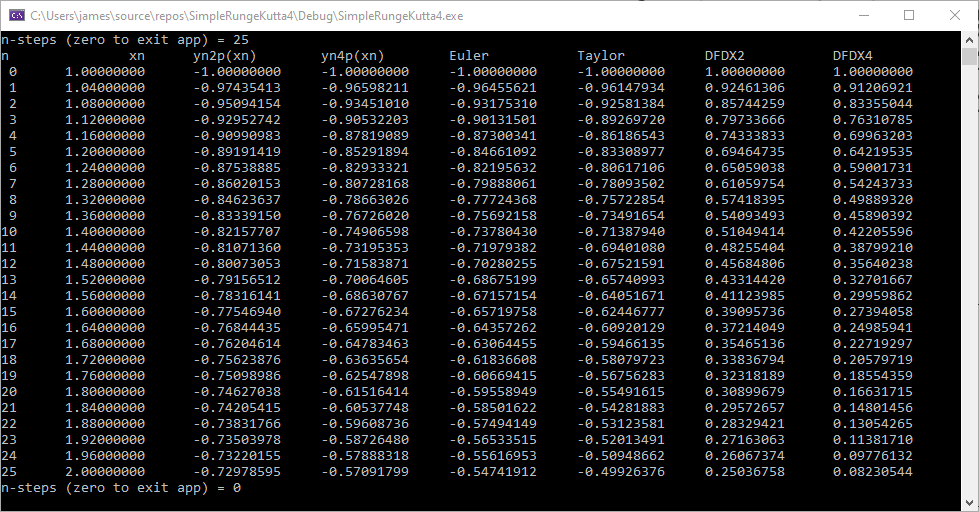
Comparison of Euler Method, Runge-Kutta 2, Runge-Kutta 4, and Taylor Series Solutions of a Single Ordinary Differential Equation

#include "RungeKutta4.h"
#include <iomanip>
#include <iostream>
using namespace std;

int main()
{
	int nSteps;
	vector<Point> solution1, solution2;
	vector<Point> solution3, solution4;

	while (true)
	{
		cout << "n-steps (zero to exit app) = ";
		cin >> nSteps;

		if (nSteps == 0)
			break;

		cout << "n\t\txn\tyn2p(xn)\tyn4p(xn)\tEuler\t\tTaylor\t\tDFDX2\t\tDFDX4\r\n";
		RungeKutta4::ComputeEuler(nSteps, 1, 2, -1, solution1);
		RungeKutta4::ComputeRK2(nSteps, 1, 2, -1, solution2);
		RungeKutta4::ComputeRK4(nSteps, 1, 2, -1, solution3);
		RungeKutta4::ComputeTaylor(nSteps, 1, 2, -1, solution4);

		for (int i = 0; i <= nSteps; i++)
		{
			POINT pt1 = solution1[i];
			POINT pt2 = solution2[i];
			POINT pt3 = solution3[i];
			POINT pt4 = solution4[i];
			cout << setw(2) << pt1.n << "\t";
			cout << setprecision(8) << fixed << pt1.x << "\t";
			cout << setprecision(8) << fixed << pt3.y << "\t";
			cout << setprecision(8) << fixed << pt4.y << "\t";
			cout << setprecision(8) << fixed << pt1.y << "\t";
			cout << setprecision(8) << fixed << pt2.y << "\t";
			cout << setprecision(8) << fixed << pt2.derivative << "\t";
			cout << setprecision(8) << fixed << pt3.derivative << "\r\n";
		}
	}
}
#pragma once
#include <vector>
using namespace std;

typedef struct Point
{
	int n;
	long double derivative, x, y;
} POINT, *PPOINT;

class RungeKutta4
{
private:
	static long double FX(
		long double x,
		long double y);
	static long double DFDX(
		long double x,
		long double y,
		long double yp);
public:
	static void ComputeEuler(
		int nSteps,
		long double x0,
		long double x1,
		long double y0,
		vector<Point>& pts);
	static void ComputeRK2(
		int nSteps,
		long double x0,
		long double x1,
		long double y0,
		vector<Point>& pts);
	static void ComputeRK4(
		int nSteps,
		long double x0,
		long double x1,
		long double y0,
		vector<Point>& pts);
	static void ComputeTaylor(
		int nSteps,
		long double x0,
		long double x1,
		long double y0,
		vector<Point>& pts);
};
// Translated from FORTRAN 77 source code found
// in "Elementary Numerical Analysis:
// An Algorithmic Approach" by S. D. Conte and Carl de
// Boor. Translator: James Pate Williams, Jr. (c)
// August 20, 2023

#include "RungeKutta4.h"

long double RungeKutta4::FX(
	long double x, long double y)
{
	long double x2 = x * x;
	long double term1 = 1.0 / x2;
	long double term2 = -y / x;
	long double term3 = -y * y;
	return term1 + term2 + term3;
}

long double RungeKutta4::DFDX(
	long double x,
	long double y,
	long double yp)
{
	long double x3 = x * x * x;
	long double term1 = -2.0 / x3;
	long double term2 = -yp / x;
	long double term3 = y / x / x;
	long double term4 = -2.0 * y * yp;
	return term1 + term2 + term3 + term4;
}

void RungeKutta4::ComputeEuler(
	int nSteps,
	long double x0,
	long double x1,
	long double y0,
	vector<Point>& pts)
{
	Point pt0 = {};
	pt0.n = 0;
	pt0.x = x0;
	pt0.y = y0;
	double derivative = FX(x0, y0);
	pt0.derivative = derivative;
	pts.push_back(pt0);

	if (nSteps == 1)
		return;

	long double h = (x1 - x0) / nSteps;
	long double xn = x0;
	long double yn = y0;

	for (int n = 1; n <= nSteps; n++)
	{
		xn = x0 + n * h;
		long double yn = y0 + h * FX(xn, y0);
		derivative = FX(xn, y0);
		pt0.n = n;
		pt0.derivative = derivative;
		pt0.x = xn;
		pt0.y = yn;
		pts.push_back(pt0);
		y0 = yn;
	}
}

void RungeKutta4::ComputeRK2(
	int nSteps,
	long double x0,
	long double x1,
	long double y0,
	vector<Point>& pts)
{
	Point pt0 = {};
	pt0.n = 0;
	pt0.x = x0;
	pt0.y = y0;
	double derivative = FX(x0, y0);
	pt0.derivative = derivative;
	pts.push_back(pt0);

	if (nSteps == 1)
		return;

	long double h = (x1 - x0) / nSteps;
	long double xn = x0;
	long double yn = y0;

	for (int n = 1; n <= nSteps; n++)
	{
		long double k1 = h * FX(xn, yn);
		long double k2 = h * FX(xn + h, yn + k1);
		yn += 0.5 * (k1 + k2);
		xn = x0 + n * h;
		derivative = FX(xn, yn);
		pt0.n = n;
		pt0.derivative = derivative;
		pt0.x = xn;
		pt0.y = yn;
		pts.push_back(pt0);
	}
}

void RungeKutta4::ComputeRK4(
	int nSteps,
	long double x0,
	long double x1,
	long double y0,
	vector<Point>& pts)
{
	Point pt0 = {};
	pt0.n = 0;
	pt0.x = x0;
	pt0.y = y0;
	double derivative = FX(x0, y0);
	pt0.derivative = derivative;
	pts.push_back(pt0);

	if (nSteps == 1)
		return;

	long double h = (x1 - x0) / nSteps;
	long double xn = x0;
	long double yn = y0;

	for (int n = 1; n <= nSteps; n++)
	{
		long double k1 = h * FX(xn, yn);
		long double k2 = h * FX(xn + h / 2, yn + k1 / 2);
		long double k3 = h * FX(xn + h / 2, yn + k2 / 2);
		long double k4 = h * FX(xn + h, yn + k3);
		xn = x0 + n * h;
		yn = yn + (k1 + k2 + k3 + k4) / 6.0;
		derivative = FX(xn, yn);
		pt0.n = n;
		pt0.derivative = derivative;
		pt0.x = xn;
		pt0.y = yn;
		pts.push_back(pt0);
	}
}

void RungeKutta4::ComputeTaylor(
	int nSteps,
	long double x0,
	long double x1,
	long double y0,
	vector<Point>& pts)
{
	Point pt0 = {};
	pt0.n = 0;
	pt0.x = x0;
	pt0.y = y0;
	double derivative = FX(x0, y0);
	pt0.derivative = derivative;
	pts.push_back(pt0);

	if (nSteps == 1)
		return;

	long double h = (x1 - x0) / nSteps;
	long double xn = x0;
	long double yn = y0;
	long double yp = FX(x0, y0);

	for (int n = 1; n <= nSteps; n++)
	{
		xn = x0 + n * h;
		yp = FX(xn, y0);
		long double yn = y0 + h * (FX(xn, y0) + h * DFDX(xn, y0, yp) / 2);
		derivative = FX(xn, y0);
		pt0.n = n;
		pt0.derivative = derivative;
		pt0.x = xn;
		pt0.y = yn;
		pts.push_back(pt0);
		y0 = yn;
	}
}

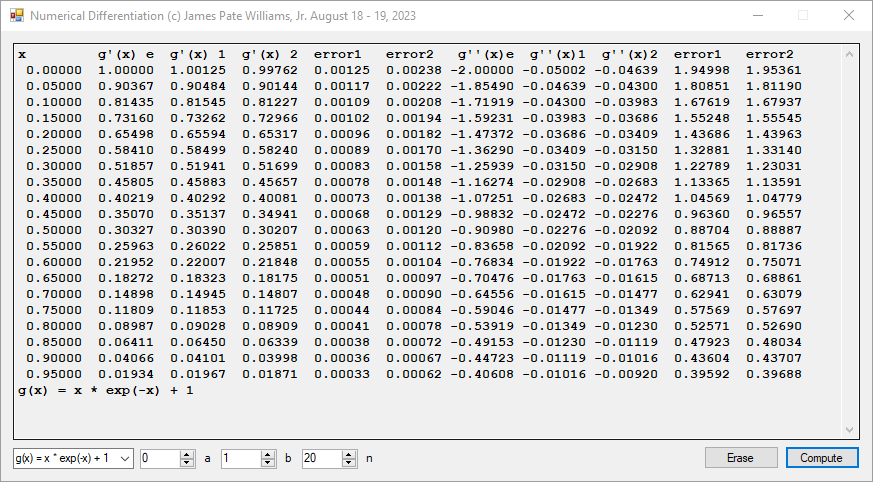
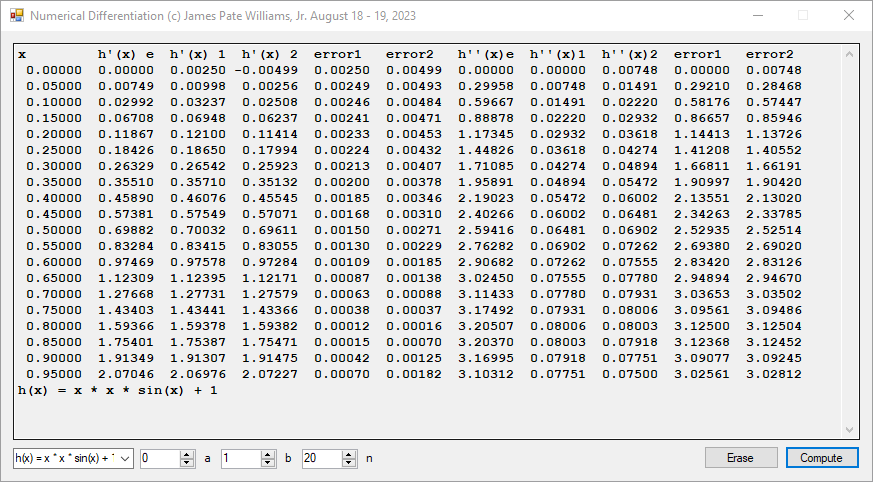
Numerical Differentiation in C# by James Pate Williams, Jr. Translated from FORTRAN 77 Formulas

using System;
using System.Windows.Forms;

namespace NumericalDifferentiation
{
    public partial class Form1 : Form
    {
        public Form1()
        {
            InitializeComponent();
            comboBox1.SelectedIndex = 0;
        }

        private double F1(double x)
        {
            return x * (x * (x - 2) + 4) - 1;
        }

        private double F2(double x)
        {
            return x * Math.Exp(-x) + 1;
        }

        private double F3(double x)
        {
            return x * x * Math.Sin(x) + 1;
        }

        private double DF1(double x)
        {
            return 3 * x * x - 4 * x + 4; 
        }

        private double DF2(double x)
        {
            return Math.Exp(-x) - x * Math.Exp(-x);
        }

        private double DF3(double x)
        {
            return 2 * x * Math.Sin(x) + x * x * Math.Cos(x);
        }

        private double DDF1(double x)
        {
            return 6 * x - 4;
        }

        private double DDF2(double x)
        {
            return -2 * Math.Exp(-x) + x * Math.Exp(-x);
        }

        private double DDF3(double x)
        {
            return
                2 * Math.Sin(x) + 2 * x * Math.Cos(x) +
                2 * x * Math.Cos(x) - x * x * Math.Sin(x);
        }

        private void button1_Click(object sender, EventArgs e)
        {
            double a = (double)numericUpDown1.Value;
            double b = (double)numericUpDown2.Value;
            int n = (int)numericUpDown3.Value;
            double deriv1c, deriv1f;
            double deriv2c, deriv2f;
            double x = a, y, u, v;
            double error1c, error1f, error2c, error2f;
            double h = (b - a) / n;

            if (comboBox1.SelectedIndex == 0)
                textBox1.Text += "x\t  f'(x) e  f'(x) 1  f'(x) 2  " +
                    "error1   error2   f''(x)e  f''(x)1  f''(x)2  " +
                    "error1   error2\r\n";
            else if (comboBox1.SelectedIndex == 1)
                textBox1.Text += "x\t  g'(x) e  g'(x) 1  g'(x) 2  " +
                    "error1   error2   g''(x)e  g''(x)1  g''(x)2  " +
                    "error1   error2\r\n";
            else if (comboBox1.SelectedIndex == 2)
                textBox1.Text += "x\t  h'(x) e  h'(x) 1  h'(x) 2  " +
                    "error1   error2   h''(x)e  h''(x)1  h''(x)2  " +
                    "error1   error2\r\n";

            while (x <= b)
            {
                switch (comboBox1.SelectedIndex)
                {
                    case 0:
                        y = F1(x);
                        u = DF1(x);
                        v = DDF1(x);
                        deriv1c = Differentiation.Derivative1sc(x, h, F1);
                        deriv1f = Differentiation.Derivative1sf(x, h, F1);
                        deriv2c = Differentiation.Derivative2sc(x, h, F1);
                        deriv2f = Differentiation.Derivative2sf(x, h, F1);
                        error1c = Math.Abs(deriv1c - u);
                        error1f = Math.Abs(deriv1f - u);
                        error2c = Math.Abs(deriv2c - v);
                        error2f = Math.Abs(deriv2f - v);
                        textBox1.Text +=
                            x.ToString("F5").PadLeft(8) + " " +
                            u.ToString("F5").PadLeft(8) + " " +
                            deriv1c.ToString("F5").PadLeft(8) + " " +
                            deriv1f.ToString("F5").PadLeft(8) + " " +
                            error1c.ToString("F5").PadLeft(8) + " " +
                            error1f.ToString("F5").PadLeft(8) + " " +
                            v.ToString("F5").PadLeft(8) + " " +
                            deriv2c.ToString("F5").PadLeft(8) + " " +
                            deriv2f.ToString("F5").PadLeft(8) + " " +
                            error2c.ToString("F5").PadLeft(8) + " " +
                            error2f.ToString("F5").PadLeft(8) + "\r\n";
                        break;
                    case 1:
                        y = F2(x);
                        u = DF2(x);
                        v = DDF2(x);
                        deriv1c = Differentiation.Derivative1sc(x, h, F2);
                        deriv1f = Differentiation.Derivative1sf(x, h, F2);
                        deriv2c = Differentiation.Derivative2sc(x, h, F2);
                        deriv2f = Differentiation.Derivative2sf(x, h, F2);
                        error1c = Math.Abs(deriv1c - u);
                        error1f = Math.Abs(deriv1f - u);
                        error2c = Math.Abs(deriv2c - v);
                        error2f = Math.Abs(deriv2f - v);
                        textBox1.Text +=
                            x.ToString("F5").PadLeft(8) + " " +
                            u.ToString("F5").PadLeft(8) + " " +
                            deriv1c.ToString("F5").PadLeft(8) + " " +
                            deriv1f.ToString("F5").PadLeft(8) + " " +
                            error1c.ToString("F5").PadLeft(8) + " " +
                            error1f.ToString("F5").PadLeft(8) + " " +
                            v.ToString("F5").PadLeft(8) + " " +
                            deriv2c.ToString("F5").PadLeft(8) + " " +
                            deriv2f.ToString("F5").PadLeft(8) + " " +
                            error2c.ToString("F5").PadLeft(8) + " " +
                            error2f.ToString("F5").PadLeft(8) + "\r\n";
                        break;
                    case 2:
                        y = F3(x);
                        u = DF3(x);
                        v = DDF3(x);
                        deriv1c = Differentiation.Derivative1sc(x, h, F3);
                        deriv1f = Differentiation.Derivative1sf(x, h, F3);
                        deriv2c = Differentiation.Derivative2sc(x, h, F3);
                        deriv2f = Differentiation.Derivative2sf(x, h, F3);
                        error1c = Math.Abs(deriv1c - u);
                        error1f = Math.Abs(deriv1f - u);
                        error2c = Math.Abs(deriv2c - v);
                        error2f = Math.Abs(deriv2f - v);
                        textBox1.Text +=
                            x.ToString("F5").PadLeft(8) + " " +
                            u.ToString("F5").PadLeft(8) + " " +
                            deriv1c.ToString("F5").PadLeft(8) + " " +
                            deriv1f.ToString("F5").PadLeft(8) + " " +
                            error1c.ToString("F5").PadLeft(8) + " " +
                            error1f.ToString("F5").PadLeft(8) + " " +
                            v.ToString("F5").PadLeft(8) + " " +
                            deriv2c.ToString("F5").PadLeft(8) + " " +
                            deriv2f.ToString("F5").PadLeft(8) + " " +
                            error2c.ToString("F5").PadLeft(8) + " " +
                            error2f.ToString("F5").PadLeft(8) + "\r\n";                   
                        break;
                    default:
                        break;
                }

                x += h;
            }

            textBox1.Text += comboBox1.SelectedItem;
        }

        private void button2_Click(object sender, EventArgs e)
        {
            textBox1.Text = string.Empty;
        }
    }
}
// Derivative formulas translated from FORTRAN 77
// source code found in "Elementary Numerical Analysis:
// An Algorithmic Approach" by S. D. Conte and Carl de
// Boor. Translator: James Pate Williams, Jr. (c)
// August 18 - 19, 2023

using System;

namespace NumericalDifferentiation
{
    // Numerically compute first and second
    // ordinary derivatives
    class Differentiation
    {
        static public double Derivative1sc(
            double a, double h, Func<double, double> f)
        {
            return (f(a + h) - f(a - h)) / (h + h);
        }

        static public double Derivative1sf(
            double a, double h, Func<double, double> f)
        {
            return (-3.0 * f(a) + 4.0 * f(a + h) - f(a + h + h)) / (h + h);
        }

        static public double Derivative2sc(
            double a, double h, Func<double, double> f)
        {
            return (f(a - h) - 2.0 * f(a) + f(a + h)) / (h + h);
        }

        static public double Derivative2sf(
            double a, double h, Func<double, double> f)
        {
            return (f(a) - 2.0 * f(a + h) + f(a + h + h)) / (h + h);
        }
    }
}

Adams-Moulton Predictor Corrector Method to Solve a One-Dimensional Ordinary Differential Equation Translated from FORTRAN 77 Code by James Pate Williams, Jr.

using System;
using System.Collections.Generic;
using System.ComponentModel;
using System.Data;
using System.Drawing;
using System.Linq;
using System.Text;
using System.Threading.Tasks;
using System.Windows.Forms;

namespace AdamsMoultonMethod1
{
    public partial class Form1 : Form
    {
        public Form1()
        {
            InitializeComponent();
        }

        private double Solution(double x)
        {
            return Math.Exp(x) - 1.0 - x;
        }
        private void button1_Click(object sender, EventArgs e)
        {
            int numberSteps = (int)numericUpDown1.Value;
            AdamsMoulton.AdamsMoultonMethod(
                numberSteps, Solution, textBox1);
        }

        private void button2_Click(object sender, EventArgs e)
        {
            textBox1.Text = string.Empty;
        }
    }
}
// Adams-Moulton Method translated from FORTRAN 77
// source code found in "Elementary Numerical Analysis:
// An Algorithmic Approach" by S. D. Conte and Carl de
// Boor. Translator: James Pate Williams, Jr. (c)
// August 18, 2023

using System;
using System.Windows.Forms;

namespace AdamsMoultonMethod1
{
    public struct Point
    {
        public double x, y;
    }
    class AdamsMoulton
    {
        static private string FormatNumber(double x)
        {
            return x.ToString("E11").PadLeft(12);
        }
        static private string FormatLine(
            int n, double x, double y, double delta, double error)
        {
            return
                n.ToString("D2") + " " +
                FormatNumber(x) + " " +
                FormatNumber(y) + " " +
                FormatNumber(delta) + " " +
                FormatNumber(error) + "\r\n";
        }
        static public void AdamsMoultonMethod(
            int numberSteps, Func<double, double> solution,
            TextBox textBox)
        {
            double h = 1.0 / numberSteps;
            double xn = 0.0, yn = 0.0, yofxn;
            double xBegin = 0.0, yBegin = 0.0;
            double fnPredict, ynPredict;
            double delta = 0.0, error = 0.0;
            double[] f = new double[numberSteps];
            int n = 0;

            textBox.Text += "n\txn\tyn\tdelta\terror\r\n";
            textBox.Text += FormatLine(n, xn, yn, delta, error);
            f[1] = xBegin + yBegin;

            for (n = 1; n <= 3; n++)
            {
                xn = xBegin + n * h;
                yn = solution(xn);
                f[n + 1] = xn + yn;
                textBox.Text += FormatLine(n, xn, yn, delta, error);
            }

            for (n = 4; n <= numberSteps; n++)
            {
                ynPredict =
                    yn + h / 24.0 * (55.0 * f[4] - 59.0 * f[3] +
                    37.0 * f[2] - 9.0 * f[1]);
                xn = xBegin + n * h;
                fnPredict = xn + ynPredict;
                yn += h / 24.0 * (9.0 * fnPredict + 19.0 * f[4]
                    - 5.0 * f[3] + f[2]);
                delta = (yn - ynPredict) / 14.0;
                f[1] = f[2];
                f[2] = f[3];
                f[3] = f[4];
                f[4] = xn + yn;
                yofxn = solution(xn);
                error = yn - yofxn;
                textBox.Text += FormatLine(n, xn, yn, delta, error);
            }
        }
    }
}

Determinant Calculations: Bareiss Algorithm and Gaussian Elimination by James Pate Williams, Jr.

Below are three screenshots of two methods of calculating the determinant of a matrix, namely the Bareiss Algorithm and Gaussian Elimination:

using System;
using System.Diagnostics;
using System.Windows.Forms;

namespace MatrixInverseComparison
{
    public partial class MainForm : Form
    {
        public MainForm()
        {
            InitializeComponent();
        }
        static private string FormatNumber(double x)
        {
            string result = string.Empty;

            if (x > 0)
                result += x.ToString("F5").PadLeft(10);
            else
                result += x.ToString("F5").PadLeft(10);

            return result;
        }

        private void MultiplyPrintMatricies(
            double[,] A, double[,] B, int n)
        {
            double[,] I = new double[n, n];

            textBox1.Text += "Matrix Product:\r\n";

            for (int i = 0; i < n; i++)
            {
                for (int j = 0; j < n; j++)
                {
                    double sum = 0.0;

                    for (int k = 0; k < n; k++)
                        sum += A[i, k] * B[k, j];

                    I[i, j] = sum;
                }
            }

            for (int i = 0; i < n; i++)
            {
                for (int j = 0; j < n; j++)
                {
                    textBox1.Text += FormatNumber(I[i, j]) + " ";
                }

                textBox1.Text += "\r\n";
            }
        }

        private void PrintMatrix(string title, double[,] A, int n)
        {
            textBox1.Text += title + "\r\n";

            for (int i = 0; i < n; i++)
            {
                for (int j = 0; j < n; j++)
                {
                    textBox1.Text += FormatNumber(A[i, j]) + " ";
                }

                textBox1.Text += "\r\n";
            }
        }

        private void Compute(double[,] MI, int n)
        {
            double determinantGE = 1;
            double[] b = new double[n];
            double[] x = new double[n];
            double[,] MB1 = new double[n, n];
            double[,] MB2 = new double[n, n];
            double[,] MG = new double[n, n];
            double[,] MS = new double[n, n];
            double[,] IG = new double[n, n];
            double[,] IS = new double[n, n];
            int[] pivot = new int[n];
            Stopwatch sw = new();
            for (int i = 0; i < n; i++)
            {
                for (int j = 0; j < n; j++)
                    MB1[i, j] = MB2[i, j] = MG[i, j] = MS[i, j] = MI[i, j];
            }
            PrintMatrix("Initial Matrix: ", MI, n);
            sw.Start();
            int flag = DirectMethods.Factor(MG, n, pivot);
            if (flag != 0)
            {
                for (int i = 0; i < n; i++)
                    determinantGE *= MG[i, i];
                determinantGE *= flag;
            }
            sw.Stop();
            PrintMatrix("Gaussian Elimination Final:", MG, n);
            for (int i = 0; i < n; i++)
                b[i] = 0;
            for (int i = 0; i < n; i++)
            {
                for (int j = 0; j < n; j++)
                {
                    b[j] = 1.0;
                    DirectMethods.Substitute(MG, b, x, n, pivot);
                    for (int k = 0; k < n; k++)
                        IG[k, j] = x[k];
                    b[j] = 0.0;
                }
            }
            PrintMatrix("Gaussian Elimination Inverse:", IG, n);
            textBox1.Text += "Determinant: " +
                FormatNumber(determinantGE) + "\r\n";
            MultiplyPrintMatricies(IG, MI, n);
            textBox1.Text += "Runtime (MS) = " +
                sw.ElapsedMilliseconds + "\r\n";
            sw.Start();
            double determinant1 = BareissAlgorithm.Determinant1(MB1, n);
            sw.Stop();
            PrintMatrix("Bareiss Algorithm Final 1:", MB1, n);
            textBox1.Text += "Determinant: " +
                FormatNumber(determinant1) + "\r\n";
            textBox1.Text += "Runtime (MS) = " +
                sw.ElapsedMilliseconds + "\r\n";
            sw.Start();
            double determinant2 = BareissAlgorithm.Determinant2(MB2, n);
            sw.Stop();
            PrintMatrix("Bareiss Algorithm Final 2:", MB2, n);
            textBox1.Text += "Determinant: " +
                FormatNumber(determinant2) + "\r\n";
            textBox1.Text += "Runtime (MS) = " +
                sw.ElapsedMilliseconds + "\r\n";
        }
        private void button1_Click(object sender, EventArgs e)
        {
            int n = (int)numericUpDown1.Value;
            int seed = (int)numericUpDown2.Value;
            double[,] A = new double[n, n];
            Random random = new Random(seed);

            for (int i = 0; i < n; i++)
            {
                for (int j = 0; j < n; j++)
                {
                    double q = n * random.NextDouble();

                    while (q == 0.0)
                        q = n * random.NextDouble();

                    A[i, j] = q;
                }
            }
            
            Compute(A, n);
        }

        private void button2_Click(object sender, EventArgs e)
        {
            textBox1.Text = string.Empty;
        }
    }
}
using System;

namespace MatrixInverseComparison
{
    public class DirectMethods
    {
        // Substitute and Factor translated from FORTRAN 77
        // source code found in "Elementary Numerical Analysis:
        // An Algorithmic Approach" by S. D. Conte and Carl de
        // Boor. Translator: James Pate Williams, Jr. (c)
        // August 14 - 17, 2023
        static public void Substitute(
            double[,] w,
            double[] b,
            double[] x,
            int n,
            int[] pivot)
        {
            double sum;
            int i, j, n1 = n - 1;

            if (n == 1)
            {
                x[0] = b[0] / w[0, 0];
                return;
            }

            // forward substitution
            x[0] = b[pivot[0]];

            for (i = 0; i < n; i++)
            {
                for (j = 0, sum = 0.0; j < i; j++)
                    sum += w[i, j] * x[j];
                x[i] = b[pivot[i]] - sum;
            }

            // backward substitution
            x[n1] /= w[n1, n1];

            for (i = n - 2; i >= 0; i--)
            {
                for (j = i + 1, sum = 0.0; j < n; j++)
                    sum += w[i, j] * x[j];
                x[i] = (x[i] - sum) / w[i, i];
            }
        }

        // Factor returns +1 if an even number of exchanges
        // Factor returns -1 if an odd  number of exchanges
        // Factor retrurn 0  if matrix is singular
        static public int Factor(
            double[,] w, int n, int[] pivot)
        // returns 0 if matrix is singular
        {
            double awikod, col_max, ratio, row_max, temp;
            double[] d = new double[n];
            int flag = 1, i, i_star, j, k;

            for (i = 0; i < n; i++)
            {
                pivot[i] = i;
                row_max = 0;
                for (j = 0; j < n; j++)
                    row_max = Math.Max(row_max, Math.Abs(w[i, j]));
                if (row_max == 0)
                {
                    flag = 0;
                    row_max = 1;
                }
                d[i] = row_max;
            }
            if (n <= 1)
                return flag;
            // factorization
            for (k = 0; k < n - 1; k++)
            {
                // determine pivot row the row i_star
                col_max = Math.Abs(w[k, k]) / d[k];
                i_star = k;
                for (i = k + 1; i < n; i++)
                {
                    awikod = Math.Abs(w[i, k]) / d[i];
                    if (awikod > col_max)
                    {
                        col_max = awikod;
                        i_star = i;
                    }
                }
                if (col_max == 0)
                    flag = 0;
                else
                {
                    if (i_star > k)
                    {
                        // make k the pivot row by
                        // interchanging with i_star
                        flag *= -1;
                        i = pivot[i_star];
                        pivot[i_star] = pivot[k];
                        pivot[k] = i;
                        temp = d[i_star];
                        d[i_star] = d[k];
                        d[k] = temp;
                        for (j = 0; j < n; j++)
                        {
                            temp = w[i_star, j];
                            w[i_star, j] = w[k, j];
                            w[k, j] = temp;
                        }
                    }
                    // eliminate x[k]
                    for (i = k + 1; i < n; i++)
                    {
                        w[i, k] /= w[k, k];
                        ratio = w[i, k];
                        for (j = k + 1; j < n; j++)
                            w[i, j] -= ratio * w[k, j];
                    }
                }
            }

            if (w[n - 1, n - 1] == 0)
                flag = 0;

            return flag;
        }
    }
}
namespace MatrixInverseComparison
{
    // One implementation is based on https://en.wikipedia.org/wiki/Bareiss_algorithm
    // Another perhaps better implementation is found on the following webpage
    // https://cs.stackexchange.com/questions/124759/determinant-calculation-bareiss-vs-gauss-algorithm
    class BareissAlgorithm
    {
        static public double Determinant1(double[,] M, int n)
        {
            double M00;

            for (int k = 0; k < n; k++)
            {
                if (k - 1 == -1)
                    M00 = 1;
                else
                    M00 = M[k - 1, k - 1];

                for (int i = k + 1; i < n; i++)
                {
                    for (int j = k + 1; j < n; j++)
                    {
                        M[i, j] = (
                            M[i, j] * M[k, k] -
                            M[i, k] * M[k, j]) / M00;
                    }
                }
            }

            return M[n - 1, n - 1];
        }

        static public double Determinant2(double[,] A, int dim)
        {
            if (dim <= 0)
            {
                return 0;
            }

            double sign = 1;

            for (int k = 0; k < dim - 1; k++)
            {
                //Pivot - row swap needed
                if (A[k, k] == 0)
                {
                    int m;
                    for (m = k + 1; m < dim; m++)
                    {
                        if (A[m, k] != 0)
                        {
                            double[] tempRow = new double[dim];

                            for (int i = 0; i < dim; i++)
                                tempRow[i] = A[m, i];
                            for (int i = 0; i < dim; i++)
                                A[m, i] = A[k, i];
                            for (int i = 0; i < dim; i++)
                                A[k, i] = tempRow[i];
                            sign = -sign;
                            break;
                        }
                    }
                    //No entries != 0 found in column k -> det = 0
                    if (m == dim)
                    {
                        return 0;
                    }
                }
                //Apply formula
                for (int i = k + 1; i < dim; i++)
                {
                    for (int j = k + 1; j < dim; j++)
                    {
                        A[i, j] = A[k, k] * A[i, j] - A[i, k] * A[k, j];

                        if (k >= 1)
                        {
                            A[i, j] /= A[k - 1, k - 1];
                        }
                    }
                }
            }

            return sign * A[dim - 1, dim - 1];
        }
    }
}
Blast from the Past 1997 Image of a Matrix by James Pate Williams, Jr.

/*
  Author:  Pate Williams (c) 1997

  "Algorithm 2.3.2 (Image of a Matrix). Given an
  m by n matrix M = (m[i][i]) with 1 <= i <= m and
  1 <= j <= n having coefficients in the field K,
  this algorithm outputs a basis of the image of
  M, i. e. vector space spanned by the columns of
  M." -Henri Cohen- See "A Course in Computational
  Algebraic Number Theory" by Henri Cohen pages
  58-59. We specialize the code to the field Zp.
*/

#include <stdio.h>
#include <stdlib.h>

long** create_matrix(long m, long n)
{
    long i, ** matrix = (long**)calloc(m, sizeof(long*));

    if (!matrix) {
        fprintf(stderr, "fatal error\ninsufficient memory\n");
        fprintf(stderr, "from create_matrix\n");
        exit(1);
    }
    for (i = 0; i < m; i++) {
        matrix[i] = (long*)calloc(n, sizeof(long));
        if (!matrix[i]) {
            fprintf(stderr, "fatal error\ninsufficient memory\n");
            fprintf(stderr, "from create_matrix\n");
            exit(1);
        }
    }
    return matrix;
}

void delete_matrix(long m, long** matrix)
{
    long i;

    for (i = 0; i < m; i++) free(matrix[i]);
    free(matrix);
}

void Euclid_extended(long a, long b, long* u,
    long* v, long* d)
{
    long q, t1, t3, v1, v3;

    *u = 1, * d = a;
    if (b == 0) {
        *v = 0;
        return;
    }
    v1 = 0, v3 = b;
#ifdef DEBUG
    printf("----------------------------------\n");
    printf(" q    t3   *u   *d   t1   v1   v3\n");
    printf("----------------------------------\n");
#endif
    while (v3 != 0) {
        q = *d / v3;
        t3 = *d - q * v3;
        t1 = *u - q * v1;
        *u = v1, * d = v3;
#ifdef DEBUG
        printf("%4ld %4ld %4ld ", q, t3, *u);
        printf("%4ld %4ld %4ld %4ld\n", *d, t1, v1, v3);
#endif
        v1 = t1, v3 = t3;
    }
    *v = (*d - a * *u) / b;
#ifdef DEBUG
    printf("----------------------------------\n");
#endif
}

long inv(long number, long modulus)
{
    long d, u, v;

    Euclid_extended(number, modulus, &u, &v, &d);
    if (d == 1) return u;
    return 0;
}

void image(long m, long n, long p,
    long** M, long** X, long* r)
{
    int found;
    long D, i, j, k, s;
    long* c = (long*)calloc(m, sizeof(long));
    long* d = (long*)calloc(n, sizeof(long));
    long** N = create_matrix(m, n);

    if (!c || !d) {
        fprintf(stderr, "fatal error\ninsufficient memory\n");
        fprintf(stderr, "from kernel\n");
        exit(1);
    }
    for (i = 0; i < m; i++) {
        c[i] = -1;
        for (j = 0; j < n; j++) N[i][j] = M[i][j];
    }
    *r = 0;
    for (k = 0; k < n; k++) {
        found = 0, j = 0;
        while (!found && j < m) {
            found = M[j][k] != 0 && c[j] == -1;
            if (!found) j++;
        }
        if (found) {
            D = p - inv(M[j][k], p);
            M[j][k] = p - 1;
            for (s = k + 1; s < n; s++)
                M[j][s] = (D * M[j][s]) % p;
            for (i = 0; i < m; i++) {
                if (i != j) {
                    D = M[i][k];
                    M[i][k] = 0;
                    for (s = k + 1; s < n; s++) {
                        M[i][s] = (M[i][s] + D * M[j][s]) % p;
                        if (M[i][s] < 0) M[i][s] += p;
                    }
                }
            }
            c[j] = k;
            d[k] = j;
        }
        else {
            *r = *r + 1;
            d[k] = -1;
        }
    }
    for (j = 0; j < m; j++) {
        if (c[j] != -1) {
            for (i = 0; i < n; i++) {
                if (i < m) X[i][j] = N[i][c[j]];
                else X[i][j] = 0;
            }
        }
    }
    delete_matrix(m, N);
    free(c);
    free(d);
}

void print_matrix(long m, long n, long** a)
{
    long i, j;

    for (i = 0; i < m; i++) {
        for (j = 0; j < n; j++)
            printf("%2ld ", a[i][j]);
        printf("\n");
    }
}

int main(void)
{
    long i, j, m = 8, n = 8, p = 13, r;
    long a[8][8] = { {0,  0,  0,  0,  0,  0,  0,  0},
                    {2,  0,  7, 11, 10, 12,  5, 11},
                    {3,  6,  3,  3,  0,  4,  7,  2},
                    {4,  3,  6,  4,  1,  6,  2,  3},
                    {2, 11,  8,  8,  2,  1,  3, 11},
                    {6, 11,  8,  6,  2,  6, 10,  9},
                    {5, 11,  7, 10,  0, 11,  6, 12},
                    {3,  3, 12,  5,  0, 11,  9, 11} };
    long** M = create_matrix(m, n);
    long** X = create_matrix(n, n);

    for (i = 0; i < m; i++)
        for (j = 0; j < n; j++)
            M[i][j] = a[j][i];
    printf("the original matrix is as follows:\n");
    print_matrix(m, n, M);
    image(m, n, p, M, X, &r);
    printf("the image of the matrix is as follows:\n");
    print_matrix(n, n - r, X);
    printf("the rank of the matrix is: %ld\n", n - r);
    delete_matrix(m, M);
    delete_matrix(n, X);
    return 0;
}