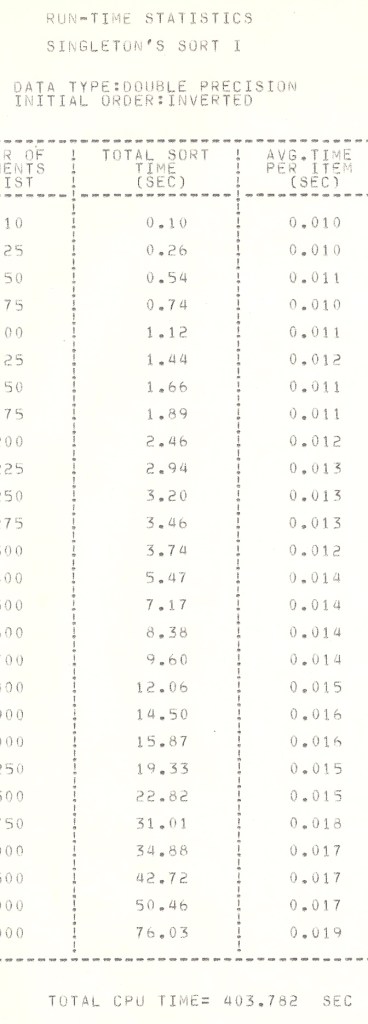
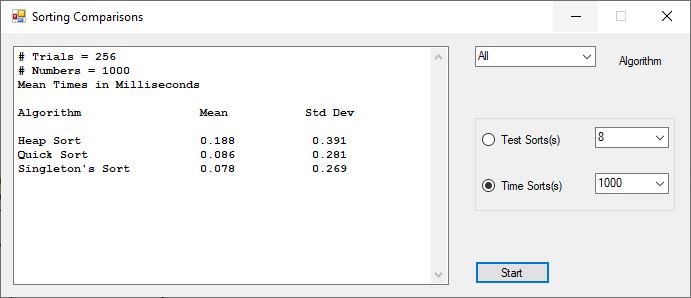
#include "SampleStatistics.h"
#include "Sorting.h"
#include <stdlib.h>
#include <iostream>
#include <iomanip>
#include <vector>
#include <chrono>
using namespace std::chrono;
using namespace std;

// https://www.geeksforgeeks.org/measure-execution-time-function-cpp/

char GetSubOption(char title[])
{
	char line[128];
	cout << title << endl;
	cout << "1 Insertion Sort" << endl;
	cout << "2 Selection Sort" << endl;
	cout << "3 Heap Sort" << endl;
	cout << "4 Quick Sort" << endl;
	cout << "5 Singleton's Sort" << endl;
	cout << "6 Tree Sort 3" << endl;
	cout << "7 Exit Submenu" << endl;
	cout << "8 Exit Program" << endl;
	cout << "Suboption Number: ";
	cin.getline(line, 128);
	return line[0];
}

char DoSort(char option) {
	char subOption, line[128];
	char title[128] = { 0 };
	char name[6][64] = { { 0 } };
	strcpy_s(name[0], 64, "Insertion Sort");
	strcat_s(name[1], 64, "Selection Sort");
	strcat_s(name[2], 64, "Heap Sort");
	strcat_s(name[3], 64, "Quick Sort");
	strcat_s(name[4], 64, "Singleton's Sort");
	strcat_s(name[5], 64, "Tree Sort 3");
	vector<double> runtime;
	if (option == '1')
	{
		strcpy_s(title, 128, "Single Sorting Tests Submenu");
	}
	else {
		strcpy_s(title, 128, "Statistical Sorting Tests Submenu");
	}
	subOption = GetSubOption(title);
	if (subOption < '1' || subOption > '8') {
		cout << "Illegal Suboption Exiting Application!" << endl;
		exit(-1);
	}
	if (subOption == '7' || subOption == '8') {
		return subOption;
	}
	int index = (int)(subOption - '1');
	cout << name[index] << endl;
	cout << "PRNG Seed             = ";
	cin.getline(line, 128);
	int seed = atoi(line);
	cout << "Number of Samples     = ";
	cin.getline(line, 128);
	int n = atoi(line);
	cout << "Maximum Sample Value  = ";
	cin.getline(line, 128);
	int maximum = atoi(line);
	srand(seed);
	int number;
	if (option == '2') {
		cout << "Number of Experiments = ";
		cin.getline(line, 128);
		number = atoi(line);
	}
	else {
		number = 1;
	}
	double* sample = new double[n];
	double* shadow = new double[n];
	for (int i = 0; i < number; i++) {
		for (int j = 0; j < n; j++) {
			sample[j] = rand() % maximum;
			if (option == '1') {
				shadow[j] = sample[j];
			}
		}
		auto start = high_resolution_clock::now();
		switch (subOption) {
		case '1':
			Sorting::InsertionSort(sample, n);
			break;
		case '2':
			Sorting::SelectionSort(sample, n);
			break;
		case '3':
			Sorting::HeapSort(sample, n);
			break;
		case '4':
			Sorting::QuickSort(sample, n);
			break;
		case '5':
			Sorting::SingletonsSort(sample, n);
			break;
		case '6':
			Sorting::TreeSort3(sample, n);
			break;
		default:
			cout << "Unknown Suboption" << endl;
			break;
		}
		auto stop = high_resolution_clock::now();
		auto duration = duration_cast<microseconds>(stop - start);
		double rt = (double)duration.count();
		runtime.push_back(rt);
	}
	if (option == '1') {
		for (int i = 0; i < n; i++) {
			cout << setw(2) << shadow[i] << ' ';
			cout << setw(2) << sample[i] << endl;
		}
	}
	else if (option == '2') {
		cout << "Runtimes in Microseconds" << endl;
		cout << "Minimum Runtime       = "
			<< setw(4) << fixed << setprecision(0)
			<< SampleStatistics::Min(runtime) << endl;
		cout << "Maximum Runtime       = "
			<< setw(4) << fixed << setprecision(0)
			<< SampleStatistics::Max(runtime) << endl;
		cout << "Mean Runtime          = "
			<< setw(4) << fixed << setprecision(0)
			<< SampleStatistics::Mean(runtime) << endl;
		cout << "Median Runtime        = "
			<< setw(4) << fixed << setprecision(0) <<
			SampleStatistics::Median(runtime) << endl;
	}
	delete[] sample;
	delete[] shadow;
	return subOption;
}

int main() {
	while (true) {
		char line[128];
		cout << "Menu" << endl;
		cout << "1 Single Sortimg Tests" << endl;
		cout << "2 Statistical Tests" << endl;
		cout << "3 Exit" << endl;;
		cout << "Option number: ";
		cin.getline(line, 128);
		if (line[0] == '3')
			break;
		if (line[0] == '1' || line[0] == '2') {
			while (true)
			{
				char doSort = DoSort(line[0]);
				if (doSort == '7')
					break;
				else if (doSort == '8')
					exit(1);
			}
		}
	}
	return 0;
}
#pragma once
#include <limits.h>
#include <vector>
using namespace std;

class SampleStatistics {
public:
	inline static double Mean(vector<double> x) {
		double sum = 0;

		for (int i = 0; i < (int)x.size(); i++)
			sum += (double)x[i];

		return sum / (int)x.size();
	};
	inline static double Max(vector<double> x)
	{
		double max = DBL_MIN;

		for (int i = 0; i < (int)x.size(); i++)
			if (x[i] > max)
				max = x[i];

		return max;
	};
	inline static double Min(vector<double> x)
	{
		double min = DBL_MAX;

		for (int i = 0; i < (int)x.size(); i++)
			if (x[i] < min)
				min = x[i];

		return min;
	};
	inline static double Median(vector<double> x)
	{
		int n = x.size(), n2 = n / 2 - 1;

		if (n % 2 == 1)
			return x[(n + 1) / 2 - 1];

		return 0.5 * (x[n2] + x[n2 + 1]);
	};
	inline static double Variance(vector<double> x)
	{
		double mean = Mean(x), sumSq = 0;
		int n = x.size();
		int n1 = n - 1;

		for (int i = 0; i < n; i++)
		{
			double delta = x[i] - mean;

			sumSq += delta * delta;
		}

		return sumSq / n1;
	};
};
#pragma once
// Insertion sort, heap sort, and quick sort algorithms
// From "Algortihms" by Thomas H. Cormen, et. al.
// Selection sort, Singleton's sort, and Tree Sort 3
// From "Sorting and Sort Systems" by Harold Lorin
class Sorting {
public:
	static void InsertionSort(double a[], int n);
	static void SelectionSort(double a[], int n);
	static void HeapSort(double a[], int n);
	static void QuickSort(double a[], int n);
	static void SingletonsSort(double a[], int n);
	static void TreeSort3(double a[], int n);
private:
	// five helper methods for Heap Sort
	static int Parent(int i);
	static int Left(int i);
	static int Right(int i);
	static void BuildHeap(double a[], int n, int& heapSize);
	static void Heapify(double a[], int i, int n, int& heapSize);
	// helper methods for Quick Sort
	static int Partition(double a[], int n, int lo, int hi);
	static void DoQuickSort(double a[], int n, int p, int r);
	// helper function for Singleton's sort
	static void DoSingletonsSort(double a[], int ii, int jj);
	// helper function for TreeSort3
	static void SiftUp(double a[], int i, int n);
};
#include "Sorting.h"

void Sorting::InsertionSort(double a[], int n) {
    for (int j = 1; j < n; j++)
    {
        double key = a[j];
        int i = j - 1;

        while (i >= 0 && a[i] > key)
        {
            a[i + 1] = a[i];
            i--;
        }

        a[i + 1] = key;
    }
}

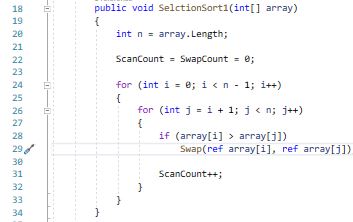
void Sorting::SelectionSort(double a[], int n) {
    for (int i = 0; i < n - 1; i++)
    {
        for (int j = i + 1; j < n; j++)
        {
            if (a[i] > a[j])
            {
                double t = a[i];

                a[i] = a[j];
                a[j] = t;
            }
        }
    }
}

int Sorting::Parent(int i) {
    return i / 2;
}

int Sorting::Left(int i) {
    return 2 * i;
}

int Sorting::Right(int i) {
    return 2 * i + 1;
}

void Sorting::Heapify(double a[], int i, int n, int& heapSize) {
    int l = Left(i);
    int r = Right(i);
    int largest = -1;

    if (l < heapSize && a[l] > a[i])
        largest = l;
    else
        largest = i;

    if (r < heapSize && a[r] > a[largest])
        largest = r;

    if (largest != i)
    {
        double t = a[i];

        a[i] = a[largest];
        a[largest] = t;

        Heapify(a, largest, n, heapSize);
    }
}

void Sorting::BuildHeap(double a[], int n, int& heapSize) {
    for (int i = n / 2; i >= 0; i--)
        Heapify(a, i, n, heapSize);
}

void Sorting::HeapSort(double a[], int n) {
    int heapSize = n;

    BuildHeap(a, n, heapSize);

    for (int i = n - 1; i >= 0; i--)
    {
        double t = a[0];

        a[0] = a[i];
        a[i] = t;

        heapSize--;

        Heapify(a, 0, n, heapSize);
    }
}

int Sorting::Partition(double a[], int n, int lo, int hi) {
    int pivotIndex = lo + (hi - lo) / 2;
    double x = a[pivotIndex];
    double t = x;

    a[pivotIndex] = a[hi];
    a[hi] = t;

    int storeIndex = lo;

    for (int i = lo; i < hi; i++)
    {
        if (a[i] < x)
        {
            t = a[i];
            a[i] = a[storeIndex];
            a[storeIndex++] = t;
        }
    }

    t = a[storeIndex];
    a[storeIndex] = a[hi];
    a[hi] = t;

    return storeIndex;
}

void Sorting::DoQuickSort(double a[], int n, int p, int r) {
    if (p < r)
    {
        int q = Partition(a, n, p, r);

        DoQuickSort(a, n, p, q - 1);
        DoQuickSort(a, n, q + 1, r);
    }
}

void Sorting::QuickSort(double a[], int n) {
    DoQuickSort(a, n, 0, n - 1);
}

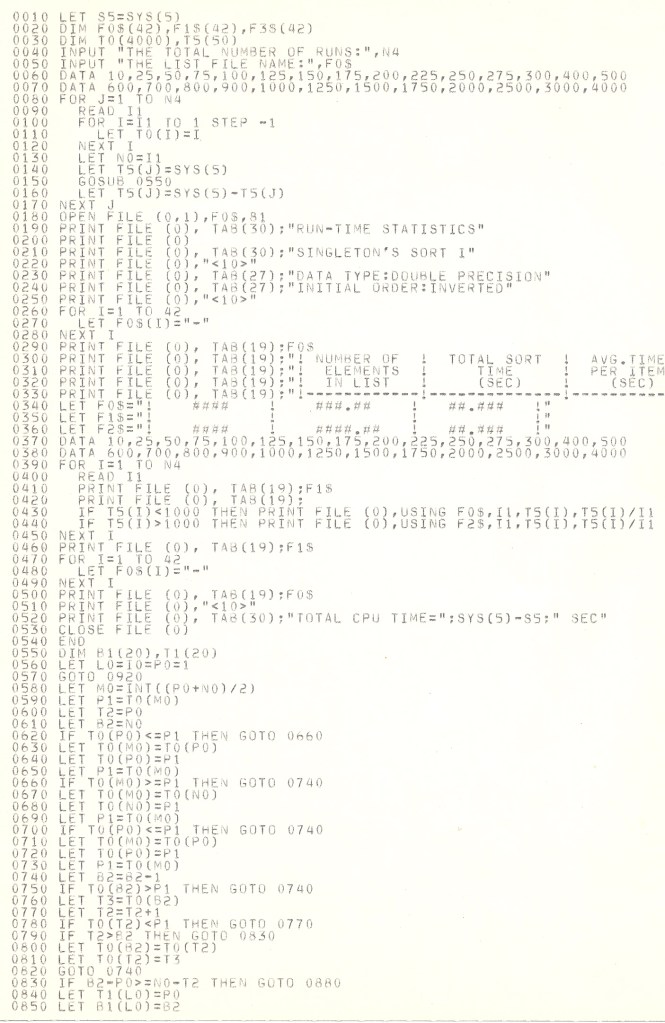
void Sorting::DoSingletonsSort(double a[], int ii, int jj) {
    int m = 0;
    int i = ii;
    int j = jj;
    int iu[50] = { 0 };
    int il[50] = { 0 };
    int ij = 0, l = 1, k = 0;
    double t = 0.0, tt = 0.0;
    Label1:
        if (i >= j)
            goto Label8;
        goto Label2;
    Label2:
        k = i;
        ij = (j + i) / 2;
        t = a[ij];
        if (a[i] <= t)
            goto Label3;
        a[ij] = a[i];
        a[i] = t;
        t = a[ij];
        goto Label3;
    Label3:
        l = j;
        if (a[j] >= t)
            goto Label5;
        a[ij] = a[j];
        a[j] = t;
        t = a[ij];
        if (a[i] <= t)
            goto Label5;
        a[ij] = a[i];
        a[i] = t;
        t = a[ij];
        goto Label5;
    Label4:
        a[l] = a[k];
        a[k] = tt;
        goto Label5;
    Label5:
        l--;
        if (a[l] > t)
            goto Label5;
        tt = a[l];
        goto Label6;
    Label6:
        k++;
        if (a[k] < t)
            goto Label6;
        if (k <= l)
            goto Label4;
        if (l - i <= j - k)
            goto Label7;
        il[m] = i;
        iu[m] = l;
        i = k;
        m++;
        goto Label9;
    Label7:
        il[m] = k;
        iu[m] = j;
        j = l;
        m++;
        goto Label9;
    Label8:
        m--;
        if (m == -1)
            return;
        i = il[m];
        j = iu[m];
        goto Label9;
    Label9:
        if (j - i > 10)
            goto Label2;
        if (i == ii)
            goto Label1;
        i--;
        goto Label10;
    Label10:
        i++;
        if (i == j)
            goto Label8;
        t = a[i + 1];
        if (a[i] <= t)
            goto Label10;
        k = i;
        goto Label11;
    Label11:
        a[k + 1] = a[k];
        k--;
        if (t < a[k])
            goto Label11;
        a[k + 1] = t;
        goto Label10;
}

void Sorting::SingletonsSort(double a[], int n) {
    DoSingletonsSort(a, 0, n - 1);
}

void Sorting::SiftUp(double a[], int i, int n) {
    double copy = a[i];
    int j;

    while (true)
    {
        j = i + i;

        if (j <= n)
        {
            if (j < n)
            {
                if (a[j + 1] > a[j])
                    j++;
            }

            if (a[j] > copy)
            {
                a[i] = a[j];
                i = j;
                continue;
            }
        }

        break;
    }

    a[i] = copy;
}

void Sorting::TreeSort3(double a[], int n)
{
    for (int i = n / 2; i >= 1; i--)
        SiftUp(a, i, n - 1);

    for (int i = n - 1; i >= 1; i--)
    {
        SiftUp(a, 0, i);

        double t = a[0];

        a[0] = a[i];
        a[i] = t;
    }
}