All of the following computations were performed on a late 2015 Dell XPS 8900 personal computer with a 64-bit Intel Core I7 processor @ 4.0GHz with 16GB of DDR2 RAM.

Factorization of Six Fibonacci Sequence Numbers:


Fibonacci 500

# digits 105

5 ^ 2 p # digits 1

15 c # digits 2

101 p # digits 3

401 p # digits 3

1661 c # digits 4

3001 p # digits 4

10291 c # digits 5

570601 p # digits 6

112128001 p # digits 9

1353439001 p # digits 10

28143378001 p # digits 11

5465167948001 p # digits 13

84817574770589638001 p # digits 20

158414167964045700001 p # digits 21

Runtime (s) = 1.206000


Fibonacci 505

# digits 106

5 p # digits 1

743519377 p # digits 9

44614641121 p # digits 11

770857978613 p # digits 12

960700389041 p # digits 12

12588421794766514566269164716286291055826556238643852856601641 p # digits 62

Runtime (s) = 1.959000


Fibonacci 510

# digits 107

2 ^ 3 p # digits 1

11 p # digits 2

61 p # digits 2

1021 p # digits 4

1597 p # digits 4

3469 p # digits 4

3571 p # digits 4

9521 p # digits 4

53551 p # digits 5

95881 p # digits 5

142445 c # digits 6

1158551 p # digits 7

3415914041 p # digits 10

20778644396941 p # digits 14

20862774425341 p # digits 14

81358225616651 c # digits 14

162716451241291 p # digits 15

Runtime (s) = 2.682000


Fibonacci 515

# digits 108

5 p # digits 1

519121 p # digits 6

5644193 p # digits 7

512119709 p # digits 9

84388938382141 p # digits 14

300367026458796424297447559250634818495937628065437243817852436228914621 p # digits 72

Runtime (s) = 7.861000


Fibonacci 520

# digits 109

131 p # digits 3

451 c # digits 3

521 p # digits 3

2081 p # digits 4

2161 p # digits 4

3121 p # digits 4

24571 p # digits 5

90481 p # digits 5

2519895 c # digits 7

21183761 p # digits 8

57089761 p # digits 8

102193207 p # digits 9

1932300241 p # digits 10

14736206161 p # digits 11

5836312049326721 p # digits 16

42426476041450801 p # digits 17

Runtime (s) = 5.155000


Fibonacci 525

# digits 110

2 p # digits 1

5 p # digits 1

421 p # digits 3

701 p # digits 3

3001 p # digits 4

3965 c # digits 4

4201 p # digits 4

141961 p # digits 6

2553601 p # digits 7

230686501 p # digits 9

8288823481 p # digits 10

82061511001 p # digits 11

19072991752501 c # digits 14

8481116649425701 p # digits 16

17231203730201189308301 p # digits 23

Runtime (s) = 2.026000

Factorization of Six Lucas Sequence Numbers


Lucas 340

113709744839525149336680459091826532688903186653162057995534262332121127

# digits 72

7 p # digits 1

2161 p # digits 4

5441 p # digits 4

897601 p # digits 6

23230657239121 p # digits 14

17276792316211992881 p # digits 20

3834936832404134644974961 p # digits 25

Runtime (s) = 109.103000


Lucas 345

# digits 73

2 ^ 2 p # digits 1

31 p # digits 2

461 p # digits 3

1151 p # digits 4

1529 c # digits 4

324301 p # digits 6

686551 p # digits 6

1485571 p # digits 7

4641631 p # digits 7

19965899801 c # digits 11

117169733521 p # digits 12

3490125311294161 p # digits 16

Runtime (s) = 0.032000


Lucas 350

13985374084677485786380981408251904922622980674054858121032362563653278123

# digits 74

3 p # digits 1

401 p # digits 3

2801 p # digits 4

11521 c # digits 5

28001 p # digits 5

570601 p # digits 6

12317523121 p # digits 11

248773766357061401 p # digits 18

7358192362316341243805801 p # digits 25

Runtime (s) = 21.047000


Lucas 355

69362907070206748494476200566565775354902428015845969798000696945226974645

# digits 74

5 p # digits 1

4261 p # digits 4

6673 p # digits 4

75309701 p # digits 8

309273161 p # digits 9

46165371073 p # digits 11

9207609261398081 p # digits 16

49279722643391864192801 p # digits 23

Runtime (s) = 40.726000


Lucas 360

769246427201094785080787978422393713094534885688979999504447628313150135520

# digits 75

2 ^ 5 p # digits 1

3 ^ 2 p # digits 1

23 p # digits 2

41 p # digits 2

105 c # digits 3

107 p # digits 3

241 p # digits 3

2161 p # digits 4

2521 p # digits 4

3439 c # digits 4

8641 p # digits 4

20641 p # digits 5

103681 p # digits 6

109441 p # digits 6

191306797 c # digits 9

10783342081 p # digits 11

13373763765986881 p # digits 17

Runtime (s) = 0.032000


Lucas 365

19076060504701386559675231910437330047906343529583769121365013189782992678011

# digits 77

11 p # digits 2

151549 p # digits 6

514651 p # digits 6

7015301 p # digits 7

8942501 p # digits 7

9157663121 p # digits 10

11899937029 p # digits 11

3252336525249736694804553589211 p # digits 31

The following two numbers were first factorized by J. M. Pollard on an 8-bit Phillips P2012 personal computer with 64 KB RAM and two 640 KB disc drives. The times required by Pollard were 41 and 47 hours.

2^144-3
22300745198530623141535718272648361505980413

# digits 44

492729991333 p # digits 12

45259565260477899162010980272761 p # digits 32

Runtime (s) = 0.086000

2^153+3
11417981541647679048466287755595961091061972995

# digits 47

5 p # digits 1

11 p # digits 2

600696432006490087537 p # digits 21

345598297796034189382757 p # digits 24

Runtime (s) = 0.676000

Partial factorization of the Twelfth Fermat Number 2^4096+1
# digits 1234

114689 p # digits 6

26017793 p # digits 8

63766529 p # digits 8

190274191361 p # digits 12

Runtime (s) = 1532.878000
Category: Uncategorized
My Exploration of the Computer-Generated Random Song Space (c) January 19, 2024, by James Pate Williams, Jr.
I have been interested in creating “music” using computers since I read an article by Martin Gardner in “Scientific American” way back in the 1970s. Gardner mentioned three types of noise found in nature: Brownian, Fractal, and White noises. My first feeble attempts at computer generated music happened in the early 1980s when I used LaGrange College’s Personal Computers (generic not IBM PCs). Later after my father bought me a Commodore Amiga 2000 on Saturday, April 30, 1988, I explored the sound producing space of that brand of Personal Computers and the Amiga BASIC computer language which was created by Microsoft. I designed and implemented a keyboard emulator program and a stochastic “music” generating program that used Brownian, Fractal, and White noise.
Skip forward to the early 2000s. While I was a graduate student in software engineering and computer science in the period 2000 to 2005, I translated Sun Java’s MIDI (Musical Instrument Digital Interface) sequencer to the Apple and PC C languages. I also created a MIDI language assembler and compiler. MIDI is well-known as a gestural music language. Sometime in the late 2000s, I designed and implemented an application in C# to create a random song from either musical chords or scales. Nowadays I still reuse a lot of my decade’s old software.
User interface of my “Random Song from Scale” C# application:

After creating a random song, I upload (import) the MIDI file to my SONAR Platinum Digital Audio Workstation then use a synthesizer to create a sound (audio) track to export as a wave, MP3, etc. file.
On January 17, 2024, I purchased two bargain basement Universal Audio VST plug-ins: a Moog Mini-Moog synthesizer emulator and a Waterfall Hammond B3 emulator complete with a software Type 147 amplifier with Doppler effect Lesley rotating speaker. Each plug-in cost me a cool $49.00 USD. Now the prices have jumped to $199.00. The real 1970s analog Mini-Moog is available for approximately $3,500 to $24,000 USD. I know an individual with a Voyager Moog synthesizer that was hand signed by the inventor Robert Moog.
The Lockheed Blackbirds by James Pate Williams, Jr.
My 1988 Commodore Amiga 2000 Is Still Functioning by James Pate Williams, Jr.
On Friday September 8, 2023, I setup my thirty-five-year-old personal computer which is a Commodore Amiga 2000. My father bought the computer for me on Saturday, April 30, 1988. It still works although the Commodore 1084 RGB color display has a non-functional power button. My remedy for the problem was to Scotch tape the power button in the “On” position. I have an Amiga BASIC by Microsoft manual and software, a Modula-2 compiler, Motorola MC68000 macro-assembly language software, and a Pecan UCSD Pascal compiler. The Amiga was the first multimedia personal computer. In May 1988 I created two Amiga BASIC programs: a keyboard emulator and a primitive computer-generated music program that used three types of noise namely Brownian, fractal, and white noise. I used the computer extensively in the years 1988 to 1994. In December 1994 my mother and older sister purchased a mom-and-pop store Microsoft-Intel personal computer.

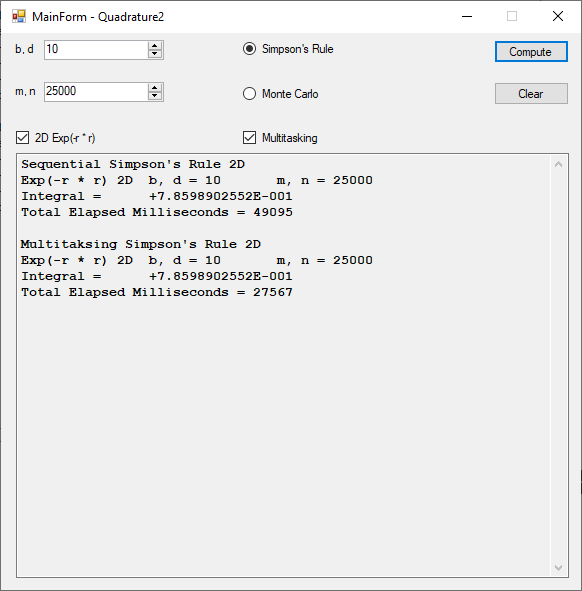
Numerical Two-Dimensional Quadrature (Integration) by James Pate Williams, Jr.
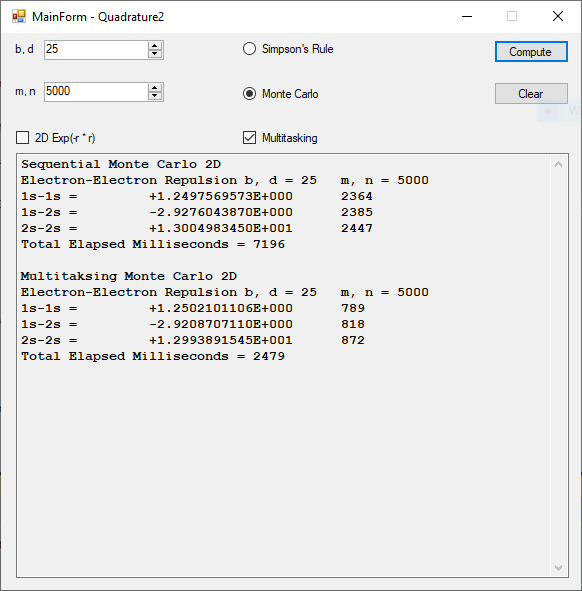
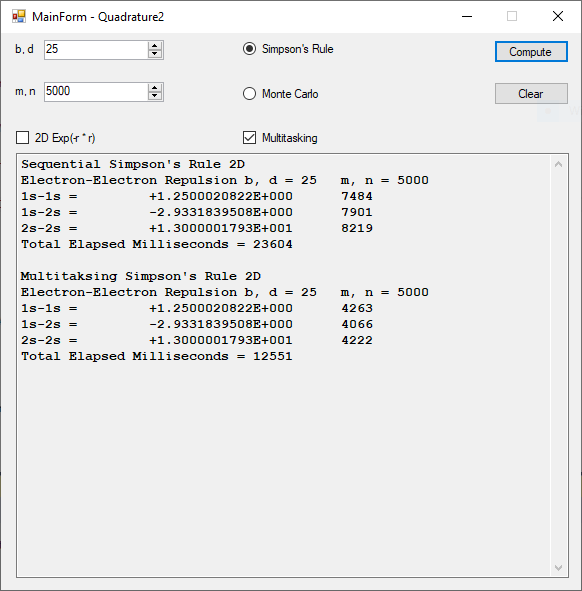
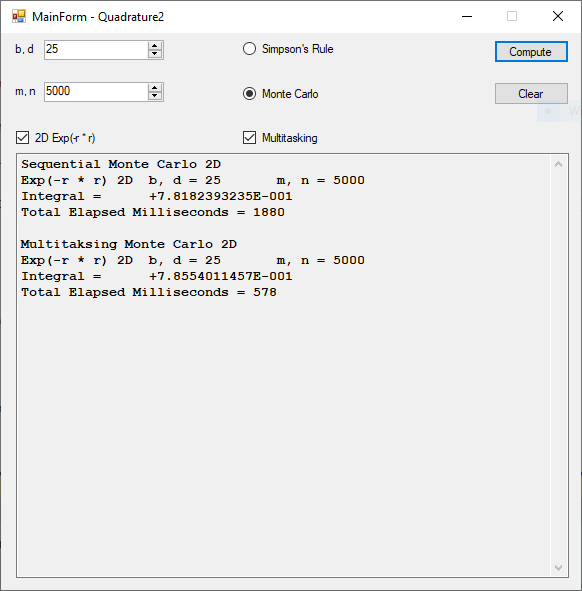
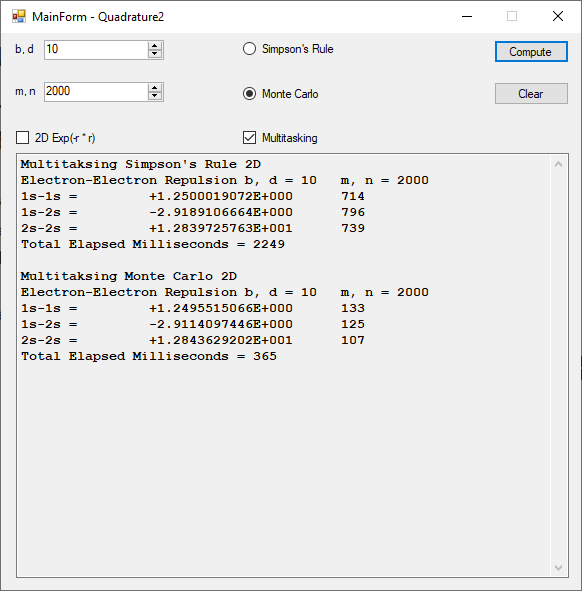
Back in 2022 I performed some numerical experiments using the two-dimensional quadrature methods: Simpson’s Rule and Monte Carlo. I implemented both sequential and multitasking techniques. The integration algorithms were applied to electron-electron repulsion integrals and a two-dimensional exponential function. The two-dimensional exponential function has an exact value of pi divided by 4. The multitasking speed-up is about two-fold in the Simpson’s Rule case and almost three-fold in the Monte Carlo case.


Scale Model Construction Suggestions by James Pate Williams, Jr.
- After opening the box and making sure all pieces are on their numbered tree (sprue), read and study all the instructions.
- I like to paint the pieces while the part is on its tree.
- Make notes by grouping the pieces by color.
- I like to use acrylic paints nowadays (way back when I used enamel and enamel aerosol spray cans). Acrylic paint is easy to clean up and cures (completely dries) faster than enamel paint.
- Do subassemblies according to the instructions. Sometimes it is good to look ahead and make sure the assembly is facile.
- Do not wait until the model is finished to apply decals.
- Not everyone will have the artistic talent to create a museum worthy model. Be satisfied with your current modeling ability. Happy scale modeling!
I took up plastic scale modeling again in about 2017 at the age of around 64. Here is a list of my models and some notes about their construction. All of my relatively modern models are by Revell:
- USS Arizona – To accurately build the hull tape off the armor belt and apply black paint. This model was painted with Testors enamel paint.
- USAAF B-17G Flying Fortress heavy bomber 1:48 scale. Use rubber bands and clothes pins to make sure the fuselage halves seal nicely.
- USN or USMC Vought F4U Corsair 1:48 scale. Be careful with the undercarriage. The landing gear is especially tricky to get correct.
- USAF Fairchild Republic A-10 Thunderbolt II “Warthog” 1:48 scale. I have not applied the plethora of decals. Please counterweights in the nose so the tricycle landing gear is accurate.
- McDonnell Douglas USMC or USN F/A-18 Hornet. Tricky landing gear assembly.
- Kriegsmarine Bismarck 1:350 scale. Many very small parts.
- Lockheed SR-71 Blackbird 1:48 scale. Lots of rather small decals. You can build different “Articles” (CIA lingo for the A-12 Archangel [Oxcart, Cygnus] and SR-71). The red no step decals are especially tricky to apply. Uses a lot of black paint.
- Apollo 11 Saturn V with the command module and lunar excursion module (LEM) 1:144 scale. Comes with three to scale engineers.
- USAAF Northup P-61 Black Widow 1:48 scale. The model comes in black plastic, so I did not paint the exterior. The radar in the nose is hard to get correctly seated.
- North American B-25J Mitchell medium bomber 1:48 scale. I am still working on this model.
If you have plenty of cash and patience, you can use spray paint. I prefer the somewhat inexpensive brush painting.
Old Habits Die Slowly


Actually, I can name two changes that were game changers: I quit my use of illegal drugs in the mid-1980s, and I quit smoking cigarettes on June 1, 1994.
Battle of Thermopylae by James Pate Williams, Jr.
Battle of Thermopylae – World History Encyclopedia
“The Greek forces included 300 Spartans and their helots with 2,120 Arcadians, 1,000 Lokrians, 1,000 Phokians, 700 Thespians, 400 Corinthians, 400 Thebans, 200 men from Phleious, and 80 Mycenaeans.” The Persians led by Xerxes I were myriad.
There have been at least two large scale motion pictures made about the battle namely “The 300 Spartans (1962)” and the “300 (2006)”. I have seen both movies, but I prefer the 1962 version due to attempted adherence to Herodotus’ version of the history. The ending of the 1962 movie has a small remaining contingent of Spartans led by King Leonidas I dropping their shields in a mass suicide by a barrage of Persian arrows (“the sky was black with arrows”). “Oh stranger, tell the Spartans that we lie here obedient to their word.” The mantra of the Spartans was to come home to Sparta carrying their shields or to come home being carried dead on their shields. The 300 Spartans – Wikipedia
Latest Revell Model Build by James Pate Williams, Jr.
A few days ago, I finished my Revell 1:144 scale Apollo 11 and Saturn V plastic model. The kit had 82 parts and I used every one of the pieces. I deviated from the original paint scheme since the original black and white pattern is too reminiscent of Wehner von Braun’s World War II terror weapon, the V-2 also known as Retaliation Weapon 2. The V-2 was the first liquid propelled ballistic missile. It used ethanol as the fuel and liquid oxygen as the oxidizing agent.
https://en.wikipedia.org/wiki/V-2_rocket
The Saturn V used high-grade kerosene as the propellant and liquid oxygen as the oxidizing chemical.
https://en.wikipedia.org/wiki/Apollo_11
Here are some temporary photographs of my build.
Education
LaGrange College (1971 – 1972, 1976 – 79, BA Chemistry, GPA 3.08)
LaGrange College (1990 – 1994, BS Computer Science, GPA 4.00)
Georgia Institute of Technology (1980 – 1983, No Degree, GPA 2.79)
Auburn University (1998 – 2000, Master of Software Engineering, GPA 3.880)
Auburn University (2000 – 2005, Doctor of Philosophy, Computer Science, GPA 3.871)

