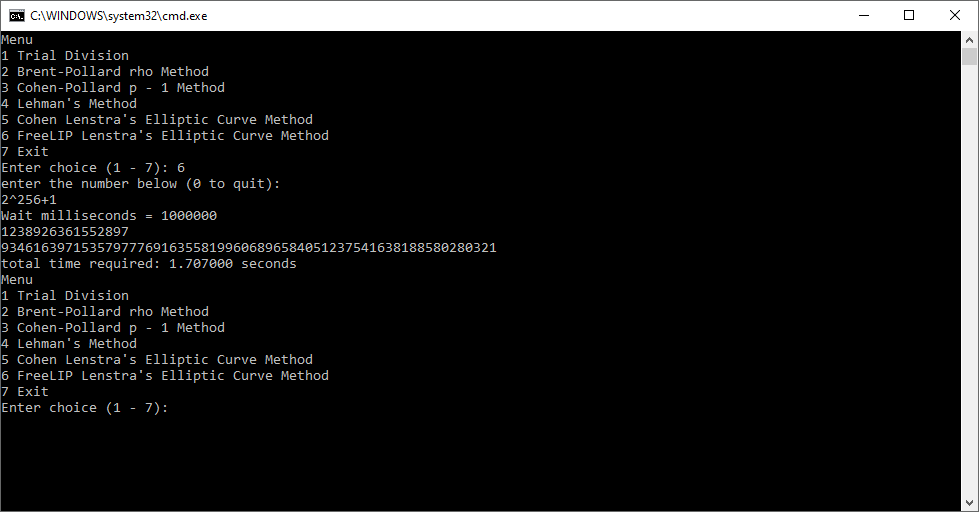
This C code uses singly linked lists as the key data structure. The factoring methods are trial division, Brent’s modification of the well-known Pollard rho method, Cohen-Pollard p – 1 algorithm first stage, Lehman’s method, Cohen’s algorithm for the Lenstra’s elliptic curve method, and the Free LIP elliptic curve method. I include a couple of sample factorizations by the Free LIP built-in Lenstra elliptic curve method. These include the seventh Fermat number 2^128+1 and the eighth Fermat number 2^256+1.
#include "LIP_data_structures.h"

/* complete factor comparison */

int factor_z_compare_c(FACTOR lt, FACTOR rt)
{
	verylong zlt, zrt;

	zcopy(lt.zfactor, &zlt);
	zcopy(rt.zfactor, &zrt);
	int zc = zcompare(zlt, zrt);

	if (zc > 0)
		return +1;
	if (zc < 0)
		return -1;
	if (lt.exponent < rt.exponent)
		return -1;
	if (lt.exponent > rt.exponent)
		return -1;

	return 0;
}

/* shallow factor comparison */

int factor_z_compare_s(FACTOR lt, FACTOR rt)
{
	verylong zlt = 0, zrt = 0;

	zcopy(lt.zfactor, &zlt);
	zcopy(rt.zfactor, &zrt);
	int zc = zcompare(zlt, zrt);

	if (zc > 0)
		return +1;
	if (zc < 0)
		return -1;

	return 0;
}

/* complete factor_node comparison */

int factor_node_z_compare_c(FACTORNODE lt, FACTORNODE rt)
{
	verylong zlt, zrt;

	zcopy(lt.factor.zfactor, &zlt);
	zcopy(rt.factor.zfactor, &zrt);
	int zc = zcompare(zlt, zrt);

	if (zc > 0)
		return +1;
	if (zc < 0)
		return -1;
	if (lt.factor.exponent < rt.factor.exponent)
		return -1;
	if (lt.factor.exponent > rt.factor.exponent)
		return -1;

	return 0;
}

/* shallow factor node comparison */

int factor_node_z_compare_s(FACTORNODE lt, FACTORNODE rt)
{
	verylong zlt, zrt;

	zcopy(lt.factor.zfactor, &zlt);
	zcopy(rt.factor.zfactor, &zrt);
	int zc = zcompare(zlt, zrt);

	if (zc > 0)
		return +1;
	if (zc < 0)
		return -1;

	return 0;
}

/* returns the first factor node */

PFACTORNODE insert_first_factor_node(verylong zf, int exponent)
{
	PFACTORNODE first = (PFACTORNODE) malloc(sizeof(FACTORNODE));

	memset(first, 0, sizeof(FACTORNODE));
	zcopy(zf, &first->factor.zfactor);
	first->factor.exponent = exponent;
	first->next = NULL;
	return first;
}

/* insert a factor node in order */

PFACTORNODE insert_factor_node(PFACTORNODE first, FACTOR factor)
{
	if (first == NULL)
		return NULL;

	PFACTORNODE next = (PFACTORNODE)malloc(sizeof(FACTORNODE));

	memset(next, 0, sizeof(FACTORNODE));
	next->factor.exponent = factor.exponent;
	zcopy(factor.zfactor, &next->factor.zfactor);
	next->next = first;
	return next;
}

PFACTORNODE delete_factor_node(PFACTORNODE first)
{
	if (first == NULL)
		return NULL;

	PFACTORNODE toDelete = first;

	first = first->next;

	zfree(&toDelete->factor.zfactor);
	free(toDelete);
	return first;
}

PFACTORNODE linear_search_factor_c(PFACTORNODE first, FACTOR factor)
{
	int found = 0;
	PFACTORNODE ptr = first;

	if (ptr == NULL)
		return NULL;

	do
	{
		found = factor_z_compare_c(ptr->factor, factor);

		if (found == 0)
			return ptr;
		else
			ptr = ptr->next;

	} while (ptr != NULL);

	return NULL;
}

void reverse(PFACTORNODE* first_ref)
{
	PFACTORNODE prev = NULL;
	PFACTORNODE current = *first_ref;
	PFACTORNODE next;

	while (current != NULL) {
		next = current->next;
		current->next = prev;
		prev = current;
		current = next;
	}

	*first_ref = prev;
}


PFACTORNODE linear_search_factor_s(PFACTORNODE first, FACTOR factor)
{
	int found = 0;
	PFACTORNODE ptr = first;

	if (ptr == NULL)
		return NULL;

	do
	{
		found = factor_z_compare_s(ptr->factor, factor);

		if (found == 0)
			return ptr;
		else
			ptr = ptr->next;

	} while (ptr != NULL);

	return NULL;
}

PFACTORNODE partition(PFACTORNODE first, PFACTORNODE last)
{
	if (first == last || first == NULL || last == NULL)
		return first;

	PFACTORNODE pivot = first;
	PFACTORNODE front = first;
	FACTOR temp;

	while (front != NULL && front != last)
	{
		if (zcompare(
			front->factor.zfactor, last->factor.zfactor) < 0) {
			pivot = first;
			temp = first->factor;
			first->factor = front->factor;
			front->factor = temp;

			first = first->next;
		}

		front = front->next;
	}

	temp = first->factor;
	first->factor = last->factor;
	last->factor = temp;
	return pivot;
}

PFACTORNODE find_last(PFACTORNODE first)
{
	while (first->next != NULL)
	{
		first = first->next;
	}

	return first;
}

void quick_sort(PFACTORNODE first, PFACTORNODE last)
{
	if (first == last) {
		return;
	}

	PFACTORNODE pivot = partition(first, last);

	if (pivot != NULL && pivot->next != NULL) {
		quick_sort(pivot->next, last);
	}

	if (pivot != NULL && first != pivot) {
		quick_sort(first, pivot);
	}
}

PFACTORNODE do_Brent_Pollard(verylong *zN, PFACTORNODE first, int *count)
{
	int e, one, pr;
	long c, i, k, l;
	verylong zP = 0, za = 0, zb = 0, zg = 0, zn = 0;
	verylong zx = 0, zx1 = 0, zy = 0;
	FACTOR factor;
	PFACTORNODE current = NULL;

	zcopy(*zN, &zn);

	do {
		c = 0, k = l = 1;
		zone(&zP);
		zintoz(2l, &zy);
		zintoz(2l, &zx);
		zintoz(2l, &zx1);
	L2:
		zsq(zx, &za);
		zsadd(za, 1l, &zb);
		zmod(zb, zn, &zx);
		zsub(zx1, zx, &za);
		zmulmod(za, zP, zn, &zb);
		zcopy(zb, &zP);

		if (++c == 20) {
			zgcd(zP, zn, &zg);

			if (zscompare(zg, 1l) > 0)
				goto L4;

			zcopy(zx, &zy);
			c = 0;
		}

		if (--k != 0)
			goto L2;

		zgcd(zP, zn, &zg);

		if (zscompare(zg, 1l) > 0)
			goto L4;

		zcopy(zx, &zx1);
		k = l, l *= 2;

		for (i = 0; i < k; i++)
		{
			zsq(zx, &za);
			zsadd(za, 1l, &zb);
			zmod(zb, zn, &zx);
		}

		zcopy(zx, &zy);
		c = 0;

		goto L2;
	L4:
		do {
			zsq(zy, &za);
			zsadd(za, 1l, &zb);
			zmod(zb, zn, &zy);
			zsub(zx1, zy, &za);
			zgcd(za, zn, &zg);
		} while (zscompare(zg, 1l) == 0);

		if (zcompare(zg, zn) == 0)
		{
			fprintf(stderr, "fatal error\nBrent's method failed\n");
			exit(1);
		}

		if (!zprobprime(zg, 20l))
		{
			zcopy(zg, &za);

			if ((current = trial_division(&zg, first, count)) == NULL) {
				fprintf(stderr, "fatal error\ncould not trial divide\n");
				exit(1);
			}

			first = current;
			zcopy(za, &zg);
			zdiv(zn, zg, &za, &zb);
			zcopy(za, &zn);
		}

		else
		{
			e = 0;

			do {
				zdiv(zn, zg, &za, &zb);
				zcopy(za, &zn);
				zmod(zn, zg, &za);
				e++;
			} while (zscompare(za, 0l) == 0);

			if (first != NULL)
			{
				factor.exponent = e;
				factor.zfactor = 0;
				zcopy(zg, &factor.zfactor);
				current = insert_factor_node(first, factor);
				first = current;
				*count = *count + 1;
			}
		}

		one = zscompare(zn, 1l) == 0;

		if (!one)
		{
			pr = zprobprime(zn, 20l);

			if (pr)
			{
				factor.exponent = 1;
				factor.zfactor = 0;
				zcopy(zn, &factor.zfactor);
				current = insert_factor_node(first, factor);
				first = current;
				break;
			}
		}
	} while (!one);

	zfree(&zP);
	zfree(&za);
	zfree(&zb);
	zfree(&zg);
	zfree(&zn);
	zfree(&zx);
	zfree(&zx1);
	zfree(&zy);
	return first;
}

PFACTORNODE Brent_Pollard_Method(
	verylong *zN,
	PFACTORNODE first,
	int *count)
{
	verylong zq = 0, zr = 0;
	FACTOR factor;
	PFACTORNODE current = NULL, ptr;

	*count = 0;

	while (1)
	{
		current = do_Brent_Pollard(zN, first, count);
		first = current;
		ptr = first;

		while (ptr != NULL)
		{
			zdiv(*zN, ptr->factor.zfactor, &zq, &zr);

			while (zscompare(zr, 0l))
			{
				zdiv(zq, ptr->factor.zfactor, &zq, &zr);
			}

			if (zscompare(zq, 1l))
				goto out_loop;

			if (zprobprime(zq, 20l))
				goto out_loop;

			ptr = ptr->next;
		}

		if (zscompare(*zN, 1l) == 0)
			return first;

		if (zprobprime(*zN, 20l) > 0)
			break;
	}
out_loop:
	zfree(&zq);
	zfree(&zr);
	factor.exponent = 1;
	factor.zfactor = 0;
	zcopy(*zN, &factor.zfactor);
	current = insert_factor_node(first, factor);
	first = current;
	return first;
}

PFACTORNODE first_stage(long k, verylong *zN, long x0, long *p,
	verylong *zx, PFACTORNODE first, int *count)
{
	long c = 0, i = -1, j = i, l, q, q1;
	static verylong zg = 0, zq1 = 0, zt = 0, zx1 = 0, zy = 0;
	FACTOR factor;
	PFACTORNODE current = NULL;

	*count = 0;
	zzero(&zg);
	zsadd(zg, x0, zx);
	zcopy(*zx, &zy);
L2:
	i++;
	if (i > k) {
		zsadd(*zx, -1l, &zx1);
		zgcd(zx1, *zN, &zg);
		if (zscompare(zg, 1l) == 0) return NULL;
		else {
			i = j;
			zcopy(zy, zx);
			goto L5;
		}
	}
	else {
		q = p[i];
		q1 = q;
		l = my_B / q;
	}

	while (q1 <= l) q1 *= q;
	zzero(&zt);
	zsadd(zt, q1, &zq1);
	zcopy(*zx, &zt);
	zexpmod(zt, zq1, *zN, zx);
	if (++c < 20) goto L2;
	zsadd(*zx, -1l, &zx1);
	zgcd(zx1, *zN, &zg);
	if (zscompare(zg, 1l) == 0) {
		c = 0;
		j = i;
		zcopy(*zx, &zy);
		goto L2;
	}
	else {
		i = j;
		zcopy(zy, zx);
	}
L5:
	i++;
	q = p[i];
	q1 = q;
L6:
	zzero(&zt);
	zsadd(zt, q, &zq1);
	zcopy(*zx, &zt);
	zexpmod(zt, zq1, *zN, zx);
	zsadd(*zx, -1l, &zx1);
	zgcd(zx1, *zN, &zg);
	if (zscompare(zg, 1l) == 0) {
		q1 *= q;
		if (q1 <= my_B) goto L6; else goto L5;
	}
	else
	{
		if (zcompare(zg, *zN) < 0) {
			factor.exponent = 1;
			factor.zfactor = 0;
			zcopy(zg, &factor.zfactor);
			current = insert_factor_node(first, factor);
			first = current;
			*count = *count + 1;
			zcopy(*zN, &zq1);
			zdiv(zq1, zg, zN, &zx1);
			return first;
		}

		if (zcompare(zg, *zN) == 0)
		{
			first = NULL;
		}
	}

	zfree(&zg);
	zfree(&zq1);
	zfree(&zt);
	zfree(&zx1);
	zfree(&zy);
	return first;
}

PFACTORNODE Cohen_Pollard_Method(
	verylong *zN,
	PFACTORNODE first,
	int *count)
{
	long cnt, i, *p = (long *)malloc(my_NUMBER_PRIMES * sizeof(long));
	verylong zx = 0;
	PFACTORNODE current = NULL;

	zpstart2();

	for (i = 0; i < my_NUMBER_PRIMES; i++)
		p[i] = zpnext();

	i = 0;

	int j = p[0];

	do {
		while ((current = first_stage(my_NUMBER_PRIMES, zN,
			j, p, &zx, first, &cnt)) != NULL && i < my_NUMBER_PRIMES)
		{
			i++;
			j = p[i];
			first = current;
			count += cnt;
		}
		j = p[++i];
	} while (
		!zscompare(*zN, 1l) &&
		!zprobprime(*zN, 20) &&
		i < my_NUMBER_PRIMES);

	FACTOR factor;

	factor.exponent = 1;
	factor.zfactor = *zN;
	current = insert_factor_node(first, factor);
	first = current;
	free(p);
	return first;
}

int square_test(verylong zn, verylong *zq)
{
	int square = 1;
	long q11[11], q63[63], q64[64], q65[65];
	long k, r, t;
	verylong zd = 0;

	for (k = 0; k < 11; k++) q11[k] = 0;
	for (k = 0; k < 6; k++) q11[(k * k) % 11] = 1;
	for (k = 0; k < 63; k++) q63[k] = 0;
	for (k = 0; k < 32; k++) q63[(k * k) % 63] = 1;
	for (k = 0; k < 64; k++) q64[k] = 0;
	for (k = 0; k < 32; k++) q64[(k * k) % 64] = 1;
	for (k = 0; k < 65; k++) q65[k] = 0;
	for (k = 0; k < 33; k++) q65[(k * k) % 65] = 1;
	t = zsmod(zn, 64l);
	r = zsmod(zn, 45045);
	if (q64[t] == 0) square = 0;
	if (square && q63[r % 63] == 0) square = 0;
	if (square && q65[r % 65] == 0) square = 0;
	if (square && q11[r % 11] == 0) square = 0;
	if (square) {
		zsqrt(zn, zq, &zd);
		if (zscompare(zd, 0l) != 0) square = 0;
	}

	zfree(&zd);
	return square;
}

int trial_division_1(long B, verylong *zN, verylong *zf)
{
	int e = 0;
	long p;
	verylong za = 0, zb = 0;

	zcopy(*zN, &za);
	zpstart2();
	do {
		p = zpnext();
		if (zsmod(za, p) == 0) {
			do {
				zsdiv(za, p, &zb);
				zcopy(zb, &za);
				e++;
			} while (zsmod(za, p) == 0);
			zintoz(p, zf);
			zcopy(za, zN);
		}
	} while (!e && p <= B);

	zfree(&za);
	zfree(&zb);
	return e;
}

int do_Lehman(verylong *zN, verylong *zf)
{
	long B = pow(zdoub(*zN), 1.0 / 3.0), a, k = 0, m, r;
	int e = trial_division_1(B, zN, zf);
	verylong za = 0, zb = 0, zc = 0, zh = 0, zl = 0;
	verylong zr = 0, zs = 0;

	if (!e) {
	L2:
		k++;
		if (k > B) goto L4;
		if (!(k & 1)) {
			zone(&zr);
			m = 2;
		}
		else {
			zsadd(*zN, k, &zr);
			m = 4;
		}
		zsmul(*zN, k, &za);
		zlshift(za, 2l, &zl);
		zintoz(B, &zh);
		zsq(zh, &zb);
		zadd(zl, zb, &zh);
		zsqrt(zl, &za, &zb);
		zsq(za, &zs);
		while (zcompare(zs, zl) < 0) {
			zsadd(za, 1l, &zb);
			zcopy(zb, &za);
			zsq(za, &zs);
		}
		r = zsmod(zr, m);
		while (!e && zcompare(zs, zh) <= 0) {
			a = zsmod(za, m);
			if (a == r) {
				zsub(zs, zl, &zc);
				if (zscompare(zc, 0l) == 0 || square_test(zc, &zb)) {
					zadd(za, zb, &zc);
					zgcd(zc, *zN, zf);
					do {
						zdiv(*zN, *zf, &za, &zb);
						zcopy(za, zN);
						zmod(za, *zf, &zb);
						e++;
					} while (zscompare(zb, 0l) == 0);
				}
			}
			if (!e) {
				zsadd(za, 1l, &zb);
				zcopy(zb, &za);
				zsq(za, &zs);
			}
		}
		if (!e) goto L2;
	}
L4:
	zfree(&za);
	zfree(&zb);
	zfree(&zc);
	zfree(&zh);
	zfree(&zl);
	zfree(&zr);
	zfree(&zs);
	return e;
}

PFACTORNODE Lehman(
	verylong *zN,
	PFACTORNODE first,
	int *count)
{
	int e = 0;
	verylong zf = 0;
	FACTOR factor;
	PFACTORNODE current = NULL;

	while (1)
	{
		e = do_Lehman(zN, &zf);

		if (e)
		{
			factor.exponent = e;
			factor.zfactor = 0;
			zcopy(zf, &factor.zfactor);
			current = insert_factor_node(first, factor);
			first = current;
			*count = *count + 1;
		}

		else if (zprobprime(*zN, 20l))
		{
			factor.exponent = 1;
			factor.zfactor = 0;
			zcopy(*zN, &factor.zfactor);
			current = insert_factor_node(first, factor);
			first = current;
			*count = *count + 1;
			break;
		}

		else
			break;
	}

	zfree(&zf);
	return first;
}

PFACTORNODE trial_division(
	verylong *zN,
	PFACTORNODE first,
	int *count)
{
	int e, one = 0, pr = 0;
	long B, p;
	verylong za = 0, zb = 0, zl = 0, zo = 0, zp = 0;
	FACTOR factor;
	PFACTORNODE current = NULL;

	zsqrt(*zN, &za, &zb);
	zone(&zo);
	zcopy(*zN, &zl);

	if (zscompare(za, my_BOUND) > 0)
		B = my_BOUND;

	else
		B = ztoint(za);

	zcopy(*zN, &za);
	zpstart2();

	do {
		p = zpnext();

		if (zsmod(za, p) == 0)
		{
			e = 0;

			do {
				zsdiv(za, p, &zb);
				zcopy(zb, &za);
				e++;
			} while (zsmod(za, p) == 0);

			zintoz(p, &zp);
			factor.exponent = e;
			factor.zfactor = 0;
			zcopy(zp, &factor.zfactor);
			current = insert_factor_node(first, factor);
			first = current;
			*count = *count + 1;
			zcopy(za, zN);
			one = zscompare(*zN, 1l) == 0;
			pr = zprobprime(*zN, 20l);

			if (!one && pr)
			{
				factor.exponent = 1;
				zcopy(*zN, &factor.zfactor);
				current = insert_factor_node(first, factor);
				first = current;
				*count = *count + 1;
				break;
			}

			else
			{
				factor.exponent = 1;
				factor.zfactor = 0;
				zcopy(*zN, &factor.zfactor);
				current = insert_factor_node(first, factor);
				first = current;
				*count = *count + 1;
			}
		}
	} while (!one && p <= B);

	PFACTORNODE last = (PFACTORNODE)malloc(sizeof(FACTORNODE));

	last->factor.exponent = 1;
	last->factor.zfactor = 0;
	zcopy(zl, &last->factor.zfactor);
	current = insert_factor_node(first, last->factor);
	first = current;
	*count = *count + 1;

	zfree(&za);
	zfree(&zb);
	zfree(&zl);
	zfree(&zo);
	zfree(&zp);
	return first;
}

int partial_addition(verylong za,
	verylong zn,
	ECPOINT P,
	ECPOINT Q,
	PECPOINT R,
	verylong *zd)

	/* returns 0 if sum is found or 1 if divisor is found */

{
	int result = -1, value = 0;
	verylong zb = 0, zc = 0, zl = 0, zs = 0;
	verylong zt = 0, zx = 0, zy = 0, zy2 = 0;

	if (zcompare(P.zx, Q.zx) == 0 &&
		zscompare(P.zy, 0l) == 0 &&
		zscompare(Q.zy, 0l) == 0) {
		zzero(&R->zx);
		zone(&R->zy);
		return 0;
	}

	zsub(zn, Q.zy, &zb);

	if (zcompare(P.zx, Q.zx) == 0 &&
		zcompare(P.zy, zb) == 0) {
		zzero(&R->zx);
		zone(&R->zy);
		return 0;
	}

	if (zscompare(P.zx, 0l) == 0 &&
		zscompare(P.zy, 1l) == 0 &&
		zscompare(P.zz, 0l) == 0) {

		/* O + Q = Q */

		zcopy(Q.zx, &R->zx);
		zcopy(Q.zy, &R->zy);
		zcopy(Q.zz, &R->zz);
		value = 0;
	}

	else if (zscompare(Q.zx, 0l) == 0 &&
		zscompare(Q.zy, 1l) == 0 &&
		zscompare(Q.zz, 0l) == 0) {

		/* P + O = P */

		zcopy(P.zx, &R->zx);
		zcopy(P.zy, &R->zy);
		zcopy(P.zz, &R->zz);
		value = 0;
	}

	else {

		/* P != O and Q != O */

		zcopy(Q.zy, &zy2);
		znegate(&zy2);
		if (zcompare(P.zx, Q.zx) == 0 &&
			zcompare(P.zy, zy2) == 0) {
			zzero(&R->zx);
			zone(&R->zy);
			zzero(&R->zz);
		}

		else {
			if (zcompare(P.zx, Q.zx) != 0) {
				zsubmod(P.zx, Q.zx, zn, &zx);
				zexteucl(zx, &zs, zn, &zt, zd);
				if (zscompare(*zd, 1l) != 0) goto L1;
				zsubmod(P.zy, Q.zy, zn, &zy);
				zmulmod(zs, zy, zn, &zl);
			}

			else {
				zaddmod(P.zy, Q.zy, zn, &zy);
				zexteucl(zy, &zs, zn, &zt, zd);
				if (zscompare(*zd, 1l) != 0) goto L1;
				zmulmod(P.zx, P.zx, zn, &zb);
				zsmulmod(zb, 3l, zn, &zc);
				zaddmod(zc, za, zn, &zb);
				zmulmod(zs, zb, zn, &zl);
			}

			zmulmod(zl, zl, zn, &zb);
			zaddmod(P.zx, Q.zx, zn, &zc);
			zsubmod(zb, zc, zn, &zx);
			zcopy(zx, &R->zx);
			zsubmod(zx, P.zx, zn, &zb);
			zmulmod(zl, zb, zn, &zc);
			zaddmod(zc, P.zy, zn, &zy);
			znegate(&zy);
			zcopy(zy, &R->zy);
			zone(&R->zz);
			goto L2;
		L1:
			value = 1;
		L2:
			;
		}
	}

	zfree(&zb);
	zfree(&zc);
	zfree(&zl);
	zfree(&zs);
	zfree(&zt);
	zfree(&zx);
	zfree(&zy);
	zfree(&zy2);
	return value;
}

int multiply(long k,
	verylong za,
	verylong zn,
	ECPOINT P,
	PECPOINT R,
	verylong *zd)
{
	int value = 0;
	ECPOINT A = { 0, 0, 0 };
	ECPOINT S = { 0, 0, 0 };
	ECPOINT T = { 0, 0, 0 };

	zone(&A.zx);
	zone(&A.zy);
	zone(&A.zz);
	zone(&S.zx);
	zone(&S.zy);
	zone(&S.zz);
	zone(&T.zx);
	zone(&T.zy);
	zone(&T.zz);

	R = (PECPOINT)malloc(sizeof(ECPOINT));

	if (R == NULL)
		exit(0);

	memset(R, 0, sizeof(ECPOINT));

	zzero(&R->zx);
	zone(&R->zy);
	zzero(&R->zz);
	zcopy(P.zx, &S.zx);
	zcopy(P.zy, &S.zy);
	zcopy(P.zz, &S.zz);

	while (!value && k != 0) {
		if (k & 1) {
			value = partial_addition(za, zn, *R, S, &A, zd);
			zcopy(A.zx, &R->zx);
			zcopy(A.zy, &R->zy);
			zcopy(A.zz, &R->zz);
		}

		k >>= 1;

		if (!value && k != 0) {
			value = partial_addition(za, zn, S, S, &T, zd);
			zcopy(T.zx, &S.zx);
			zcopy(T.zy, &S.zy);
			zcopy(T.zz, &S.zz);
		}
	}

	if (zscompare(R->zy, 0l) < 0) {
		zadd(R->zy, zn, &A.zy);
		zcopy(A.zy, &R->zy);
	}

	zfree(&A.zx);
	zfree(&A.zy);
	zfree(&A.zz);
	zfree(&S.zx);
	zfree(&S.zy);
	zfree(&S.zz);
	zfree(&T.zx);
	zfree(&T.zy);
	zfree(&T.zz);
	return value;
}

/* the following definition limits the L3 loop */

int LenstrasECM(verylong *zN, verylong *zg)
{
	int expon = 0, found;
	long B = 100000000l, i, j, k = 0, l, *p, q, q1;
	long giveUp = z2log(*zN);
	ECPOINT x, y;
	verylong za[CURVES], zb = 0, zd = 0;

	for (i = 0; i < CURVES; i++)
		za[i] = 0;

	x.zx = x.zy = x.zz = y.zx = y.zy = y.zz = 0;

	zpstart2();

	do {
		q = zpnext();
		k++;
	} while (q < B);

	p = calloc(k, sizeof(long));

	if (!p) {
		expon = -1;
		goto L4;
	}

	zpstart2();

	for (i = 0; i < k; i++)
		p[i] = zpnext();

	for (i = 0; i < CURVES; i++)
		zrandomb(*zN, &za[i]);

L2:

	zone(&x.zx);
	zone(&x.zy);
	zzero(&x.zz);
	i = -1;

L3:

	i++;

	if (i == giveUp) {
		expon = 0;
		goto L4;
	}

	if (i == k) {

		for (i = 0; i < CURVES; i++)
			zrandomb(*zN, &za[i]);

		goto L2;
	}

	q = p[i];
	q1 = q;
	l = B / q;

	while (q1 <= l)
		q1 *= q;

	found = 0;

	for (j = 0; !found && j < CURVES; j++)
		found = multiply(q1, za[j], *zN, x, &y, &zd);

	if (!found)
		goto L3;

	zcopy(y.zx, &x.zx);
	zcopy(y.zy, &x.zy);
	zcopy(y.zz, &x.zz);
	zgcd(zd, *zN, zg);

	if (zcompare(*zg, *zN) == 0) {
		for (j = 0; j < CURVES; j++)
			zrandomb(*zN, &za[j]);

		goto L2;
	}

	if (!zprobprime(*zg, 5l))
		goto L4;

	expon = 0;

	do {
		zdiv(*zN, *zg, &zb, &zd);
		zcopy(zb, zN);
		zmod(*zN, *zg, &zd);
		expon++;
	} while (zscompare(zd, 0l) == 0);

L4:

	for (i = 0; i < CURVES; i++)
		zfree(&za[i]);

	zfree(&zb);
	zfree(&zd);
	zfree(&x.zx);
	zfree(&x.zy);
	zfree(&x.zz);
	zfree(&y.zx);
	zfree(&y.zy);
	zfree(&y.zz);
	return expon;
}

PFACTORNODE CohenEllipticCurveMethod(
	char *numStr, int base, int iExpon, int addend)
{
	PFACTORNODE current, first;
	FACTOR factor;
	int result;
	int cant, expon, one, pri;
	verylong zn = 0, zN = 0, zd = 0, zg = 0;

	if (strlen(numStr) != 0)
		zstrtoz(numStr, &zN);

	else
	{
		static verylong zb = 0, zp = 0;

		zintoz(base, &zb);

		zsexp(zb, iExpon, &zp);
		zsadd(zp, addend, &zN);
	}

	zcopy(zN, &zn);

	first = insert_first_factor_node(zN, 1);

	cant = pri = 0;

	do {

		expon = LenstrasECM(&zN, &zg);

		if (expon == -1)
		{
			result = -1;
			goto L1;
		}

		if (zprobprime(zg, 20l))
		{
			factor.exponent = expon;
			factor.zfactor = zg;
			current = insert_factor_node(first, factor);
			first = current;
		}

		one = zscompare(zN, 1l) == 0;

		if (zprobprime(zN, 20l))
		{
			factor.exponent = 1;
			factor.zfactor = zN;
			current = insert_factor_node(first, factor);
			first = current;
			break;
		}

	} while (!one);

L1:

	zfree(&zn);
	zfree(&zN);
	zfree(&zd);
	zfree(&zg);

	return first;
}

PFACTORNODE LenstraEllipticCurveMethod(
	verylong *zN, PFACTORNODE first, int *count)
{
	long curvebnd = 1024, e = 0, exp = 0, phase1bnd = 64;
	long grow = 16, info = 2, nbtests = 20, s = 1;
	verylong zf = 0, zn = 0, zq = 0, zr = 0;
	FACTOR factor;
	PFACTORNODE current = NULL;

	zcopy(*zN, &zn);

	while (exp != -1)
	{
		exp = zfecm(zn, &zf, s, &curvebnd, &phase1bnd,
			grow, nbtests, info, (FILE *)NULL);

		if (exp == 1 || exp == -1)
		{
			if (zscompare(zf, 1) != 0)
			{
				*count = *count + 1;
				e = 0;
				zdiv(zn, zf, &zq, &zr);

				while (zscompare(zr, 0l) == 0)
				{
					e++;
					zcopy(zq, &zn);
					zdiv(zn, zf, &zq, &zr);
				}

				factor.exponent = e;
				factor.zfactor = zf;
				current = insert_factor_node(first, factor);
				first = current;
			}

			else
			{
				if (zprobprime(zn, 20))
				{
					factor.exponent = 1;
					factor.zfactor = zn;
					current = insert_factor_node(first, factor);
					first = current;
				}
			}
		}

		else
			break;
	}

	zfree(&zf);
	zfree(&zn);
	zfree(&zq);
	zfree(&zr);
	return first;
}