This morning as I was leaving the gym at about 2:00 AM a fellow gym member made the following remark to me: “I hear you are a scientist” and I responded “yes, a computer scientist and computer or software engineer”. Later as I was headed towards my car, this same other gym member pointed towards a planet or star in the early morning sky and asked, “what is the object in the sky he was pointing towards was?”. I did note answer his question on the spot and now I offer the following theories. Well, if we had a high-resolution telescope and/or a spectroscope we could differentiate a planet from a star due to the chemical composition of the object. There is a theory posed by Alpher, Bethe, and Gamov which states the lightest elements in the universe, namely hydrogen and helium were formed during the Big Bang and the other 115 elements were either made by humans in nuclear physics laboratories (breeder nuclear reactors or other means) or the rest of the chemical elements were synthesized in the stars. Stars are classified by the Alpher, Bethe, and Gamov scheme:
Blog Entry Thursday March 31, 2022
Blog Entry Tuesday March 29, 2022
This application’s code was translated from vanilla C to C#. The C code is from the treatise “A Numerical Library for Scientists and Engineers” by H. T. Lau “Chapter 5: Analytic Problems – Runge-Kutta 5th order no derivatives in the right hand side”. The first test case is from the preceding tome.


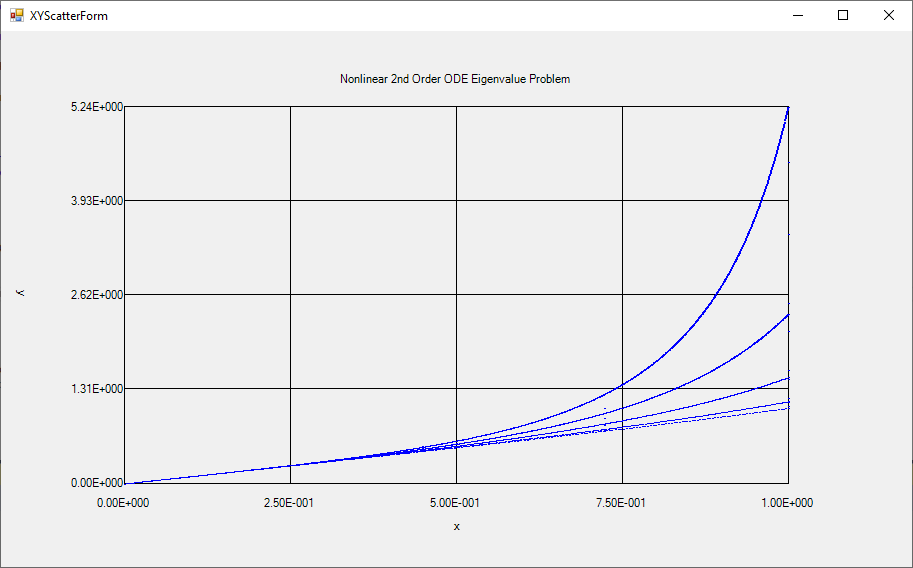
I found an interesting differential second order nonlinear initial value equation on Michael Penn’s voluminous YouTube website: Michael Penn – YouTube. The equation is y”(x) = -exp(y). The solution is illustrated in the following table and graph:

Blog Entry, Saturday March 26, 2022

Blog Entry, Friday, March 25, 2022 One Minute Improvisation
Blog Entry, Thursday, March 24, 2022
Blog Entry, Wednesday, March 23, 2022
Blog Entry Tuesday, March 22, 2022
Blog Entry Monday, March 21, 2022
Blog Entry of Saturday, March 19, 2022 – Derivation of the Classical Kinetic Energy from Einstein’s Famous Equation