Five Stream Ciphers Created from Five Pseudorandom Number Generators Built Using the Tests of FIPS 140-1 by James Pate Williams, BA, BS, MSwE, PhD

The five pseudorandom number generators are:

  1. Triple-AES based ANSI X9.17 PRNG
  2. Triple-DES based ANSI x9.17 PRNG
  3. RSA based PRNG
  4. Micali-Schnorr PRNG
  5. Blum-Blum-Shub PRNG

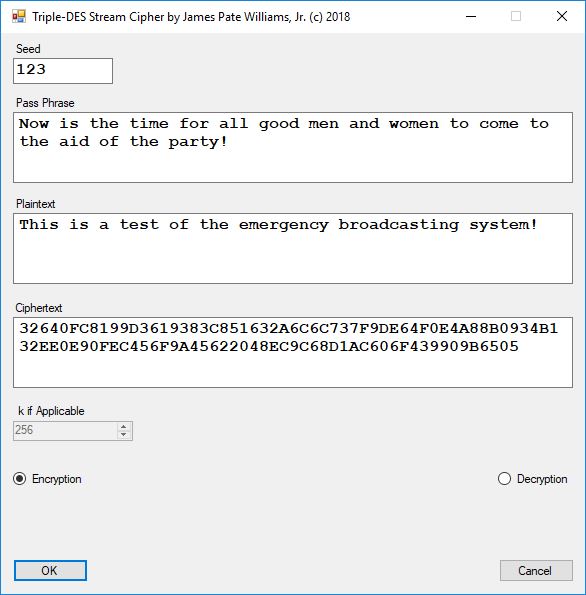
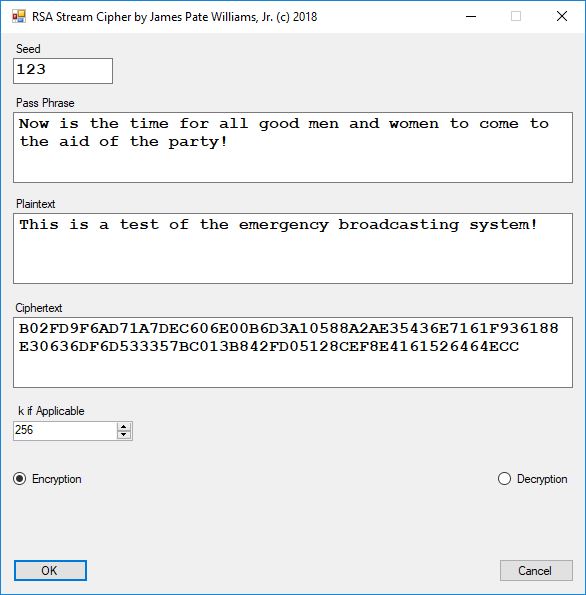
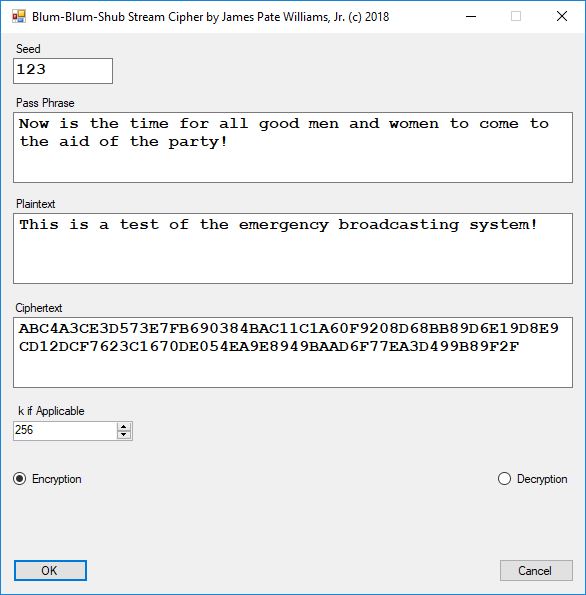
Five stream ciphers were created using 1 to 5. Screenshots of the C# application follow:

sc aessc dessc rsasc mssc bbs

The pass phrase optimally should consist of 147 ASCII characters. If the number of pass phrase ASCII characters is less than 147 then more random ASCII characters are added using the standard C# pseudorandom number generator seeded with the parameter named Seed. The user defined parameter k is used by RSA, Micali-Schnorr, and Blum-Blum-Shub pseudorandom number generators. It is the approximate bit length of the large composite number composed of two large probable prime numbers. The real key lengths of all the stream ciphers is about 1024-bits for 1, 3, 4, and 5 and 296-bits for 2. I’d strongly suggest using 1 and/or 5.
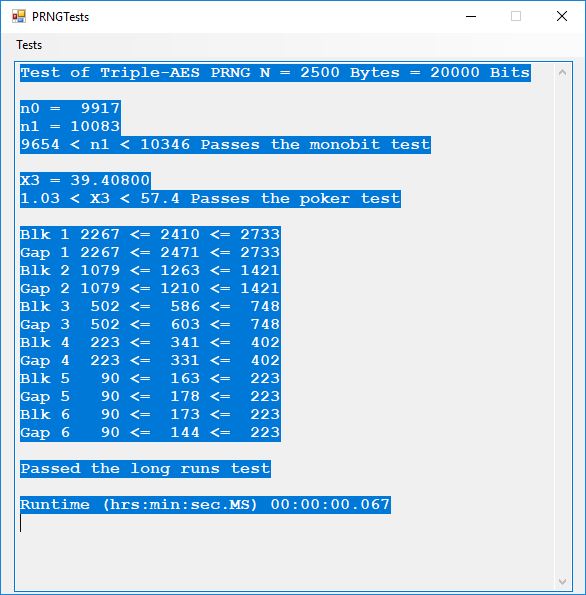
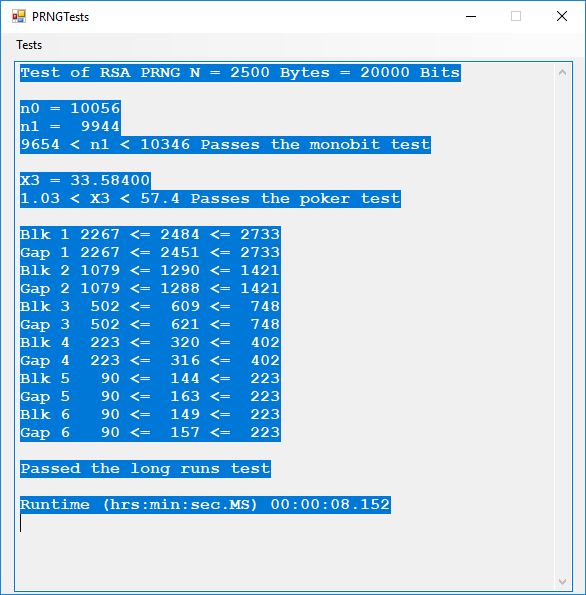
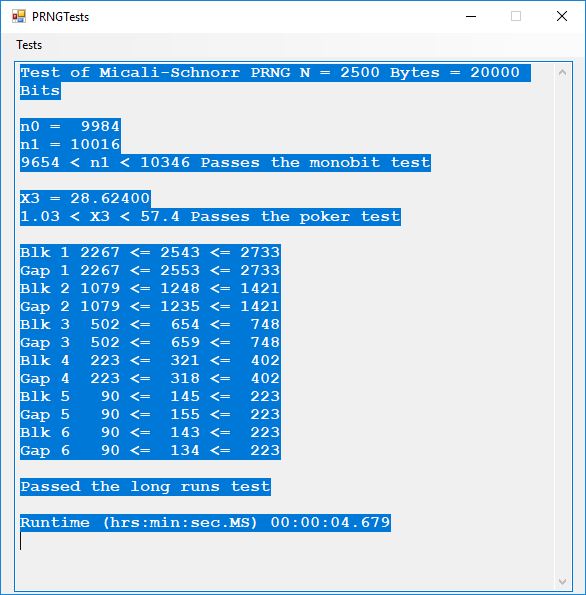
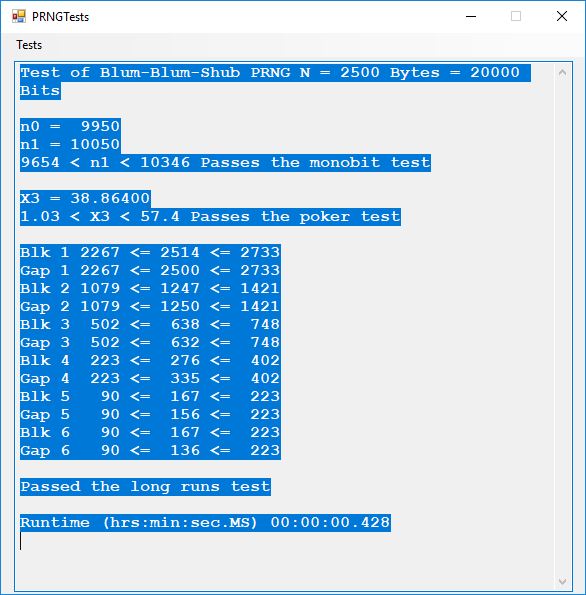
Tests of Six Pseudorandom Number Generators (PRNGs) Using the Now Superseded FIPS 140-1 by James Pate Williams, Jr. BA, BS, MSwE, PhD

This blog explores six pseudorandom number generators which are enumerated as follows:

  1. Standard C# PRNG
  2. Triple-AES PRNG
  3. Triple-DES PRNG
  4. RSA Based PRNG
  5. Micali-Schnorr PRNG
  6. Blum-Blum-Shub PRNG

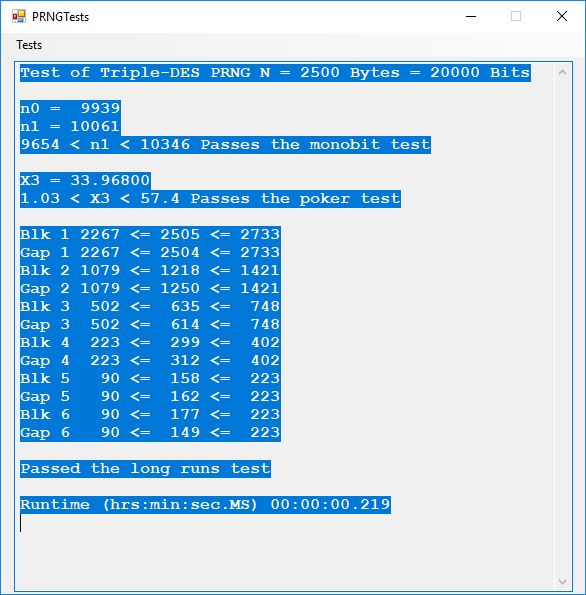
PT 00PT 01PT 02PT 03PT 04PT 05

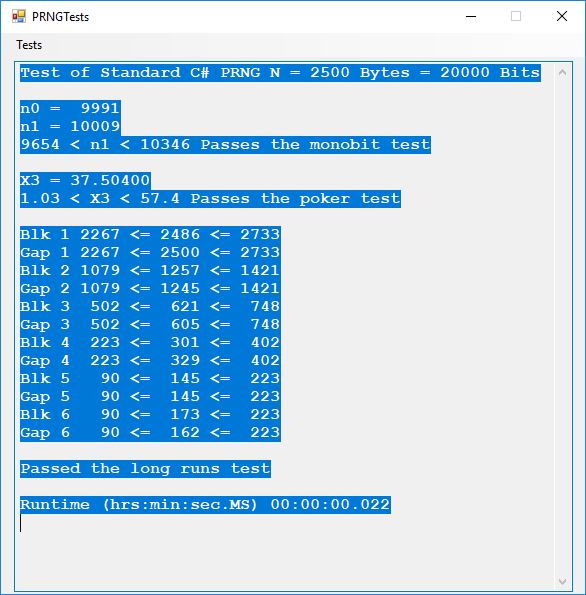
Here is the order in terms of run-times from the fastest to the slowest: 1, 2, 3, 6, 5, 4.


Another Matrix Cipher by James Pate Williams, Jr. BA, BS, MSwE, PhD

This is perhaps an improvement on the matrix cipher of a previous blog post of mine. In that post I introduced a matrix cipher whose keys were generated by selection of a seed such that 1 <= seed <= 2147483647, a number N such that 2 <= N <= 1000, and plaintext of length n such that 1 <= n <= N -1.

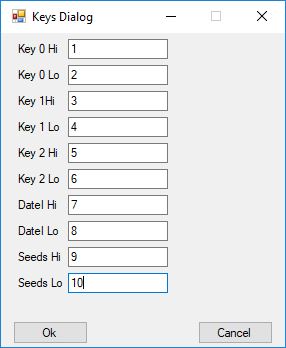
This matrix cipher relies on the ANSI X9.17 pseudorandom number generator (PRNG) of 5.11 Algorithm of the Handbook of Applied Cryptography by Alfred J. Menezes, et al. The PRNG uses triple-DES with a potential 168-bit (56 * 3 = 168) key space using E-D-E (Encryption key 1 – Decryption key 2 – Encryption key 3). Also, a 64-bit date related number and a 64-bit random seed are needed to initialize the PRNG.

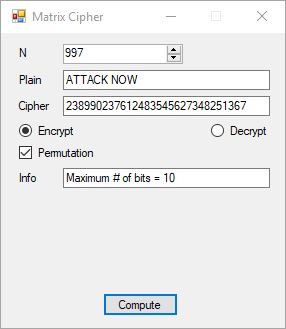
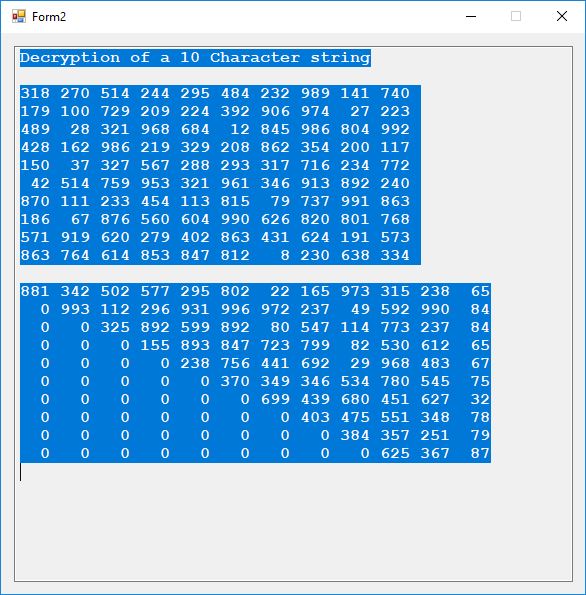
The key space for the algorithm is (168 + 128) bits which is 296 bits. Here is the encryption and decryption of the ASCII ten characters string “ATTACK NOW”.

New Matrix Cipher 0

New Matrix Cipher 1

New Matrix Cipher 2

New Matrix Cipher 3

New Matrix Cipher 4

The first step in the cryptanalysis of this cipher would be to determine the modulus of the matrix and vector calculations N. I don’t know how many ciphertexts would be necessary to perform this task. From the preceding known ciphertext we find that N is at least 991. From traffic analysis we may have determined that the maximum value of N is 1000. That means would we only need to try 10 values of N.