References: “Introduction to Statistical Thermodynamics” (c) 1960 by Terrell L. Hill 8.14.2: Properties of Nobel Gases – Chemistry LibreTexts
First, we approximate the hard sphere second virial coefficient for the Noble Gases using Monte Carlo integration. Analytic integration yields:
B2(T) = 2 * pi * a ^ 3 / 3
Where a is the diameter of the atom. The volume utilized was V = X ^ 3 where X = 25.0 * 100.0 * a. Then we compute four cluster integrals.
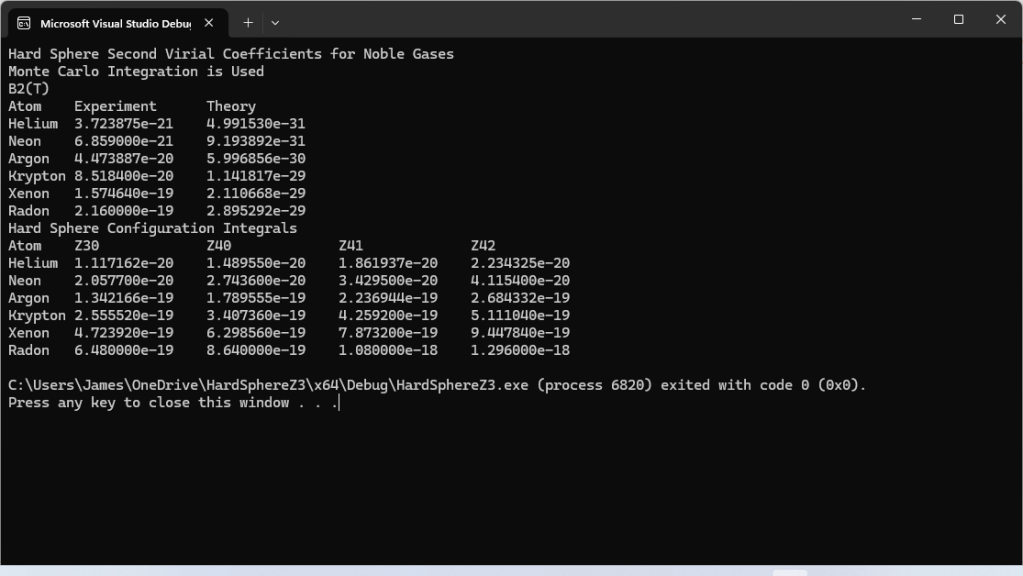
// HardSphereZ3.cpp : This file contains the 'main' function.
// Program execution begins and ends there.
// Copyright (c) Sunday, November 1, 2026
// by James Pate Williams, Jr., BA, BS, MSwE, PhD
// all potential energy is for a hard sphere

#include <cmath>
#include <iomanip>
#include <iostream>
#include <string>

// second virial coefficient
static double B2(double X, double a, int N)
{
    double I = 0.0, V = X * X * X;

    for (int n = 0; n < N; n++)
    {
        double x1 = (X * rand()) / RAND_MAX;
        double x2 = (X * rand()) / RAND_MAX;
        double y1 = (X * rand()) / RAND_MAX;
        double y2 = (X * rand()) / RAND_MAX;
        double z1 = (X * rand()) / RAND_MAX;
        double z2 = (X * rand()) / RAND_MAX;
        double r12 = std::sqrt(
            std::pow(x1 - x2, 2.0) +
            std::pow(y1 - y2, 2.0) +
            std::pow(z1 - z2, 2.0));

        if (r12 >= a)
            I += 1.0;
    }

    return V * I / N;
}

// three particle cluster integral
static double Z30(double X, double a, int N)
{
    double I = 0.0, V = X * X * X;

    for (int n = 0; n < N; n++)
    {
        double x1 = (X * rand()) / RAND_MAX;
        double x2 = (X * rand()) / RAND_MAX;
        double x3 = (X * rand()) / RAND_MAX;
        double y1 = (X * rand()) / RAND_MAX;
        double y2 = (X * rand()) / RAND_MAX;
        double y3 = (X * rand()) / RAND_MAX;
        double z1 = (X * rand()) / RAND_MAX;
        double z2 = (X * rand()) / RAND_MAX;
        double z3 = (X * rand()) / RAND_MAX;
        double r12 = std::sqrt(
            std::pow(x1 - x2, 2.0) +
            std::pow(y1 - y2, 2.0) +
            std::pow(z1 - z2, 2.0));
        double r13 = std::sqrt(
            std::pow(x1 - x3, 2.0) +
            std::pow(y1 - y3, 2.0) +
            std::pow(z1 - z3, 2.0));
        double r23 = std::sqrt(
            std::pow(x2 - x3, 2.0) +
            std::pow(y2 - y3, 2.0) +
            std::pow(z2 - z3, 2.0));
        double u = 0.0;

        if (r12 >= a)
            u += 1.0;
        if (r13 >= a)
            u += 1.0;
        if (r23 >= a)
            u += 1.0;

        if (u > 0.0)
            I += u;
    }

    return V * I / N;
}

// four particle cluster integral
static double Z40(double X, double a, int N)
{
    double I = 0.0, V = X * X * X;

    for (int n = 0; n < N; n++)
    {
        double x1 = (X * rand()) / RAND_MAX;
        double x2 = (X * rand()) / RAND_MAX;
        double x3 = (X * rand()) / RAND_MAX;
        double x4 = (X * rand()) / RAND_MAX;
        double y1 = (X * rand()) / RAND_MAX;
        double y2 = (X * rand()) / RAND_MAX;
        double y3 = (X * rand()) / RAND_MAX;
        double y4 = (X * rand()) / RAND_MAX;
        double z1 = (X * rand()) / RAND_MAX;
        double z2 = (X * rand()) / RAND_MAX;
        double z3 = (X * rand()) / RAND_MAX;
        double z4 = (X * rand()) / RAND_MAX;
        double r12 = std::sqrt(
            std::pow(x1 - x2, 2.0) +
            std::pow(y1 - y2, 2.0) +
            std::pow(z1 - z2, 2.0));
        double r23 = std::sqrt(
            std::pow(x2 - x3, 2.0) +
            std::pow(y2 - y3, 2.0) +
            std::pow(z2 - z3, 2.0));
        double r34 = std::sqrt(
            std::pow(x3 - x4, 2.0) +
            std::pow(y3 - y4, 2.0) +
            std::pow(z3 - z4, 2.0));
        double r41 = std::sqrt(
            std::pow(x4 - x1, 2.0) +
            std::pow(y4 - y1, 2.0) +
            std::pow(z4 - z1, 2.0));
        double u = 0.0;

        if (r12 >= a)
            u += 1.0;
        if (r23 >= a)
            u += 1.0;
        if (r34 >= a)
            u += 1.0;
        if (r41 >= a)
            u += 1.0;

        if (u > 0.0)
            I += u;
    }

    return V * I / N;
}

static double Z41(double X, double a, int N)
{
    double I = 0.0, V = X * X * X;

    for (int n = 0; n < N; n++)
    {
        double x1 = (X * rand()) / RAND_MAX;
        double x2 = (X * rand()) / RAND_MAX;
        double x3 = (X * rand()) / RAND_MAX;
        double x4 = (X * rand()) / RAND_MAX;
        double y1 = (X * rand()) / RAND_MAX;
        double y2 = (X * rand()) / RAND_MAX;
        double y3 = (X * rand()) / RAND_MAX;
        double y4 = (X * rand()) / RAND_MAX;
        double z1 = (X * rand()) / RAND_MAX;
        double z2 = (X * rand()) / RAND_MAX;
        double z3 = (X * rand()) / RAND_MAX;
        double z4 = (X * rand()) / RAND_MAX;
        double r12 = std::sqrt(
            std::pow(x1 - x2, 2.0) +
            std::pow(y1 - y2, 2.0) +
            std::pow(z1 - z2, 2.0));
        double r23 = std::sqrt(
            std::pow(x2 - x3, 2.0) +
            std::pow(y2 - y3, 2.0) +
            std::pow(z2 - z3, 2.0));
        double r34 = std::sqrt(
            std::pow(x3 - x4, 2.0) +
            std::pow(y3 - y4, 2.0) +
            std::pow(z3 - z4, 2.0));
        double r41 = std::sqrt(
            std::pow(x4 - x1, 2.0) +
            std::pow(y4 - y1, 2.0) +
            std::pow(z4 - z1, 2.0));
        double r24 = std::sqrt(
            std::pow(x2 - x4, 2.0) +
            std::pow(y2 - y4, 2.0) +
            std::pow(z2 - z4, 2.0));
        double u = 0.0;

        if (r12 >= a)
            u += 1.0;
        if (r23 >= a)
            u += 1.0;
        if (r34 >= a)
            u += 1.0;
        if (r41 >= a)
            u += 1.0;
        if (r24 >= a)
            u += 1.0;

        if (u > 0.0)
            I += u;
    }

    return V * I / N;
}

static double Z42(double X, double a, int N)
{
    double I = 0.0, V = X * X * X;

    for (int n = 0; n < N; n++)
    {
        double x1 = (X * rand()) / RAND_MAX;
        double x2 = (X * rand()) / RAND_MAX;
        double x3 = (X * rand()) / RAND_MAX;
        double x4 = (X * rand()) / RAND_MAX;
        double y1 = (X * rand()) / RAND_MAX;
        double y2 = (X * rand()) / RAND_MAX;
        double y3 = (X * rand()) / RAND_MAX;
        double y4 = (X * rand()) / RAND_MAX;
        double z1 = (X * rand()) / RAND_MAX;
        double z2 = (X * rand()) / RAND_MAX;
        double z3 = (X * rand()) / RAND_MAX;
        double z4 = (X * rand()) / RAND_MAX;
        double r12 = std::sqrt(
            std::pow(x1 - x2, 2.0) +
            std::pow(y1 - y2, 2.0) +
            std::pow(z1 - z2, 2.0));
        double r23 = std::sqrt(
            std::pow(x2 - x3, 2.0) +
            std::pow(y2 - y3, 2.0) +
            std::pow(z2 - z3, 2.0));
        double r34 = std::sqrt(
            std::pow(x3 - x4, 2.0) +
            std::pow(y3 - y4, 2.0) +
            std::pow(z3 - z4, 2.0));
        double r41 = std::sqrt(
            std::pow(x4 - x1, 2.0) +
            std::pow(y4 - y1, 2.0) +
            std::pow(z4 - z1, 2.0));
        double r24 = std::sqrt(
            std::pow(x2 - x4, 2.0) +
            std::pow(y2 - y4, 2.0) +
            std::pow(z2 - z4, 2.0));
        double r31 = std::sqrt(
            std::pow(x3 - x1, 2.0) +
            std::pow(y3 - y1, 2.0) +
            std::pow(z3 - z1, 2.0));
        double u = 0.0;

        if (r12 >= a)
            u += 1.0;
        if (r23 >= a)
            u += 1.0;
        if (r34 >= a)
            u += 1.0;
        if (r41 >= a)
            u += 1.0;
        if (r24 >= a)
            u += 1.0;
        if (r31 >= a)
            u += 1.0;

        if (u > 0.0)
            I += u;
    }

    return V * I / N;
}

int main()
{
    double pi = 4.0 * atan(1.0);
    // radii of Noble Gases in picometers (10^-12 m)
    const double Radii[6] = { 31, 38, 71, 88, 108, 120 };
    // spherically symmetric atom's name
    const std::string Names[6] = {
        "Helium", "Neon", "Argon", "Krypton", "Xenon", "Radon" };
    std::cout << "Hard Sphere Second Virial Coefficients for Noble Gases";
    std::cout << std::endl;
    std::cout << "Monte Carlo Integration is Used";
    std::cout << std::endl;
    std::cout << "B2(T)" << std::endl;
    std::cout << "Atom\tExperiment\tTheory" << std::endl;
    srand(1);

    for (int i = 0; i < 6; i++)
    {
        double a = 2.0 * Radii[i] * 1.0e-12;
        double X = 25.0 * 100.0 * a;
        double b2 = B2(X, a, 1000000);
        double bt = 2.0 * pi * std::pow(a, 3.0) / 3.0;

        std::cout << Names[i] << "\t";
        std::cout << std::scientific;
        std::cout << std::setprecision(6);
        std::cout << std::right;
        std::cout << b2 << '\t';
        std::cout << bt << std::endl;
    }

    std::cout << "Hard Sphere Configuration Integrals";
    std::cout << std::endl;
    std::cout << "Atom\tZ30\t\tZ40\t\tZ41\t\tZ42";
    std::cout << std::endl;

    for (int i = 0; i < 6; i++)
    {
        double a = 2.0 * Radii[i] * 1.0e-12;
        double X = 25.0 * 100.0 * a;
        double z30 = Z30(X, a, 1000000);
        double z40 = Z40(X, a, 1000000);
        double z41 = Z41(X, a, 1000000);
        double z42 = Z42(X, a, 1000000);

        std::cout << Names[i] << '\t';
        std::cout << std::scientific;
        std::cout << std::setprecision(6);
        std::cout << std::right;
        std::cout << z30 << '\t';
        std::cout << z40 << '\t';
        std::cout << z41 << '\t';
        std::cout << z42 << '\t';
        std::cout << std::endl;
    }

    return 0;
}


