Category: Chapter 9 Hash Functions and Data Integrity
Blog Entry © Friday, August 21, 2026, by James Pate Williams, Jr. NIST FIPS 203 C/C++Implementations
Blog Entry © Thursday, August 20, 2026, by James Pate Williams, Jr. A Tale of Two SecureHashing Algorithms (SHA-1 and SHA-3)
Blog Entry (c) Sunday, February 22, 2026, by James Pate Williams, Jr. A Little Test C Program Source Code and Results
Back in February 2016 I created a C# program to test my bit-orientated implementation of SHA-3 using the algorithms in NIST FIPS 202. Today I finished my C implementation, and I created a Win32 64-bit test application. Reference: https://nvlpubs.nist.gov/nistpubs/FIPS/NIST.FIPS.202.pdf
See Algorithm 10 of FIPS 202:
Enter a hex string
a32e
Enter n
14
H = 10 3 2 14
S = 1 1 0 0 0 1 0 1 0 1 1 1 0 1
D:\FIPS202Algorithm10\x64\Release\FIPS202Algorithm10.exe (process 38932) exited with code 0 (0x0).
Press any key to close this window . . .
// FIPS202Algorithm10.c
// James Pate Williams, Jr.
// Copyright Sunday, February
// 22, 2026 See FIPS 202
// Algorithm 10

#include <stdbool.h>
#include <stdio.h>
#include <string.h>
#include <stdlib.h>

char gHexStr[2048];
int gBinaryStr[8];
int gH[2048], gh[1024];
int gT[8 * 1024 + 7];
int gTruncN[1024];
int gS[1024];

static void ToBinary(int hex)
{
    int count = 0;

    while (hex > 0)
    {
        gBinaryStr[count++] = hex & 1;
        hex >>= 1;
    }

    for (int i = count; i < 8; i++)
        gBinaryStr[i] = 0;
}

static void Trunc(int X[], int n)
{
    for (int i = 0; i < n; i++)
        gTruncN[i] = X[i];
}

static void Algorithm10(int m, int n)
{
    for (int i = 0; i < m; i++)
    {
        gh[i] = 16 * gH[2 * i] + gH[2 * i + 1];
    }

    for (int i = 0; i < m; i++)
    {
        ToBinary(gh[i]);

        for (int j = 0; j < 8; j++)
            gT[8 * i + j] = gBinaryStr[j];
    }

    Trunc(gT, n);

    for (int i = 0; i < n; i++)
        gS[i] = gTruncN[i];
}

static void HexToBinary(int m, int n)
{
    int m2 = m + m;

    printf_s("H = ");

    for (int i = 0; i < m2; i++)
    {
        int digit = 0;

        if (gHexStr[i] >= '0' && gHexStr[i] <= '9')
            digit = gHexStr[i] - '0';
        else if (gHexStr[i] >= 'a' && gHexStr[i] <= 'f')
            digit = gHexStr[i] - 'a' + 10;
        else if (gHexStr[i] >= 'A' && gHexStr[i] <= 'F')
            digit = gHexStr[i] - 'A' + 10;

        gH[i] = digit;

        printf_s("% d ", gH[i]);
    }

    printf_s("\r\n");
    Algorithm10(m, n);
}

int main()
{
    int n = 0;
    printf_s("Enter a hex string\r\n");
    scanf_s("%s", gHexStr, 128);
    printf_s("Enter n\r\n");
    scanf_s("%d", &n);
    int m = (int)strlen(gHexStr);

    HexToBinary(m / 2, n);

    printf_s("S = ");

    for (int i = 0; i < n; i++)
        printf_s("%d ", gS[i]);

    printf_s("\r\n");
    return 0;
}
Chapter 9 of the Handbook of Applied Cryptography by Alfred J. Menezes, Paul C. van Oorschot, and Scott A. Vanstone Highlights Unkeyed Hash Functions by James Pate Williams, Jr. BA, BS, MSwE, PhD
In this first installment of Chapter 9 Hash Functions and Data Integrity of the Handbook, we concentrate on the unkeyed hash functions mentioned in the Chapter which are:
- Matyas-Meyer-Oseas Hash 9.41 Algorithm page 341
- Davies-Meyer Hash 9.42 Algorithm page 341
- Miyaguchi-Preneel Hash 9.43 Algorithm page 341
- MDC-2 (DES Based) 9.46 Algorithm page 342
- MDC-4 (DES Based) 9.47 Algorithm page 343
- MD4 9.49 Algorithm page 346
- MD5 9.51 Algorithm page 347
- SHA-1 (Secure Hash Algorithm 1) 9.53 Algorithm page 348-349
- RIPMD-160 9.55 Algorithm pages 350-351
The first five algorithms are based on the IBM-NIST-NSA encryption algorithm DES (Data Encryption Standard).
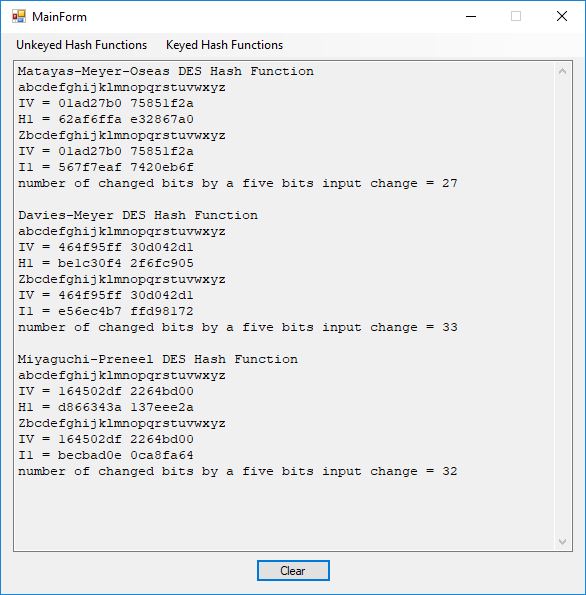
Matyas-Meyer-Oseas DES Hash Function
abcdefghijklmnopqrstuvwxyz
IV = 01ad27b0 75851f2a
H1 = 62af6ffa e32867a0
Zbcdefghijklmnopqrstuvwxyz
IV = 01ad27b0 75851f2a
I1 = 567f7eaf 7420eb6f
number of changed bits by a five bits input change = 27

Davies-Meyer DES Hash Function
abcdefghijklmnopqrstuvwxyz
IV = 464f95ff 30d042d1
H1 = be1c30f4 2f6fc905
Zbcdefghijklmnopqrstuvwxyz
IV = 464f95ff 30d042d1
I1 = e56ec4b7 ffd98172
number of changed bits by a five bits input change = 33

Miyaguchi-Preneel DES Hash Function
abcdefghijklmnopqrstuvwxyz
IV = 164502df 2264bd00
H1 = d866343a 137eee2a
Zbcdefghijklmnopqrstuvwxyz
IV = 164502df 2264bd00
I1 = becbad0e 0ca8fa64
number of changed bits by a five bits input change = 32
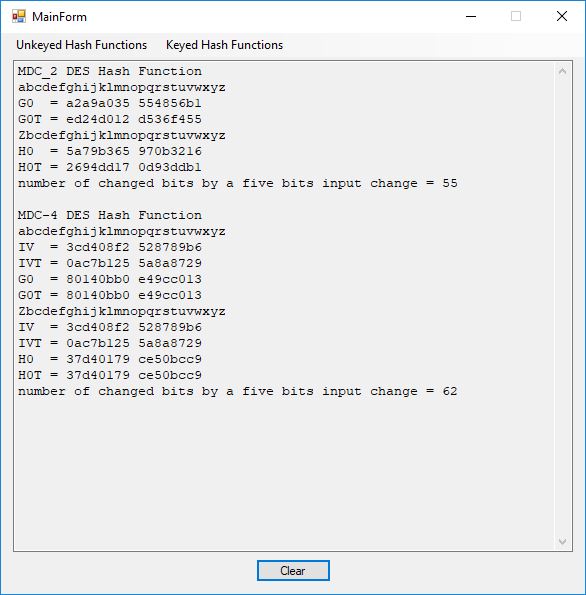
MDC_2 DES Hash Function
abcdefghijklmnopqrstuvwxyz
G0 = a2a9a035 554856b1
G0T = ed24d012 d536f455
Zbcdefghijklmnopqrstuvwxyz
H0 = 5a79b365 970b3216
H0T = 2694dd17 0d93ddb1
number of changed bits by a five bits input change = 55

MDC-4 DES Hash Function
abcdefghijklmnopqrstuvwxyz
IV = 3cd408f2 528789b6
IVT = 0ac7b125 5a8a8729
G0 = 80140bb0 e49cc013
G0T = 80140bb0 e49cc013
Zbcdefghijklmnopqrstuvwxyz
IV = 3cd408f2 528789b6
IVT = 0ac7b125 5a8a8729
H0 = 37d40179 ce50bcc9
H0T = 37d40179 ce50bcc9
number of changed bits by a five bits input change = 62
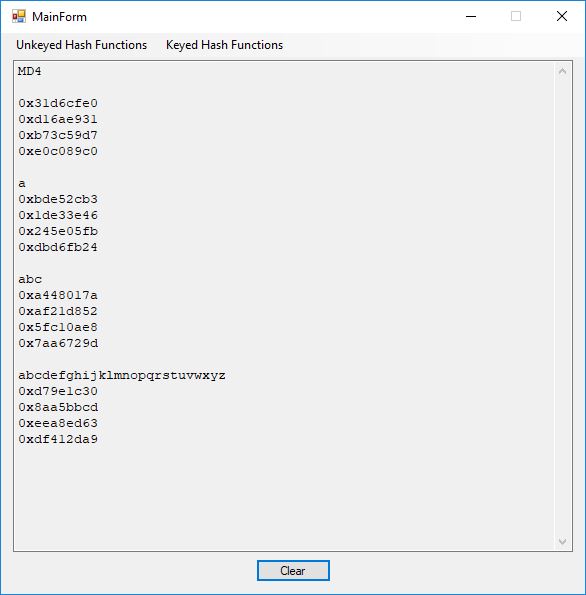
MD4

0x31d6cfe0
0xd16ae931
0xb73c59d7
0xe0c089c0

a
0xbde52cb3
0x1de33e46
0x245e05fb
0xdbd6fb24

abc
0xa448017a
0xaf21d852
0x5fc10ae8
0x7aa6729d

abcdefghijklmnopqrstuvwxyz
0xd79e1c30
0x8aa5bbcd
0xeea8ed63
0xdf412da9
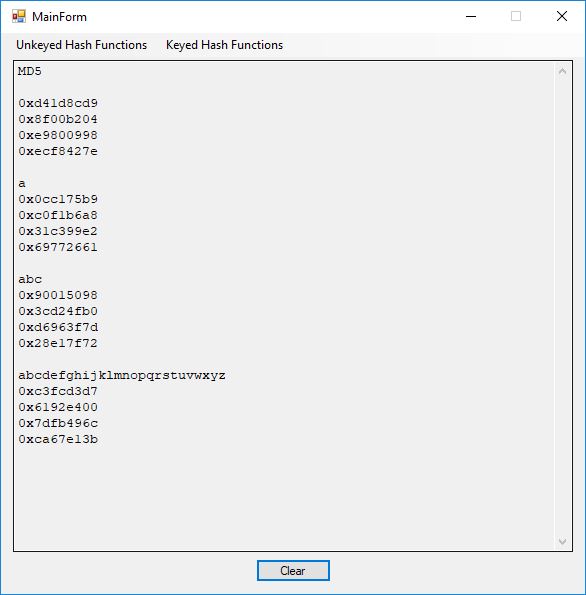
MD5

0xd41d8cd9
0x8f00b204
0xe9800998
0xecf8427e

a
0x0cc175b9
0xc0f1b6a8
0x31c399e2
0x69772661

abc
0x90015098
0x3cd24fb0
0xd6963f7d
0x28e17f72

abcdefghijklmnopqrstuvwxyz
0xc3fcd3d7
0x6192e400
0x7dfb496c
0xca67e13b
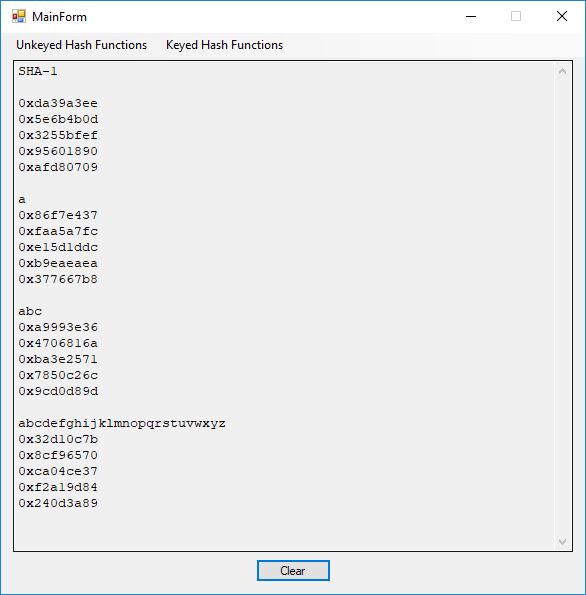
SHA-1

0xda39a3ee
0x5e6b4b0d
0x3255bfef
0x95601890
0xafd80709

a
0x86f7e437
0xfaa5a7fc
0xe15d1ddc
0xb9eaeaea
0x377667b8

abc
0xa9993e36
0x4706816a
0xba3e2571
0x7850c26c
0x9cd0d89d

abcdefghijklmnopqrstuvwxyz
0x32d10c7b
0x8cf96570
0xca04ce37
0xf2a19d84
0x240d3a89
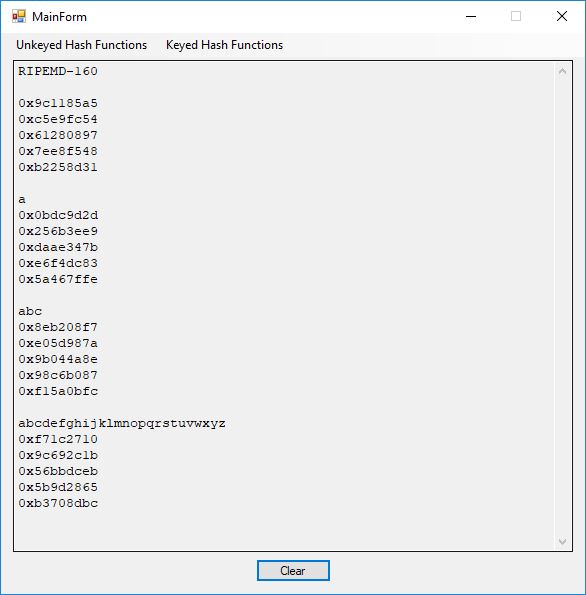
RIPEMD-160

0x9c1185a5
0xc5e9fc54
0x61280897
0x7ee8f548
0xb2258d31

a
0x0bdc9d2d
0x256b3ee9
0xdaae347b
0xe6f4dc83
0x5a467ffe

abc
0x8eb208f7
0xe05d987a
0x9b044a8e
0x98c6b087
0xf15a0bfc

abcdefghijklmnopqrstuvwxyz
0xf71c2710
0x9c692c1b
0x56bbdceb
0x5b9d2865
0xb3708dbc
Test vectors for MD4, MD5, SHA-1, and RIPEMD-160 can be found in Table 9.6 of the Handbook on page 345.

