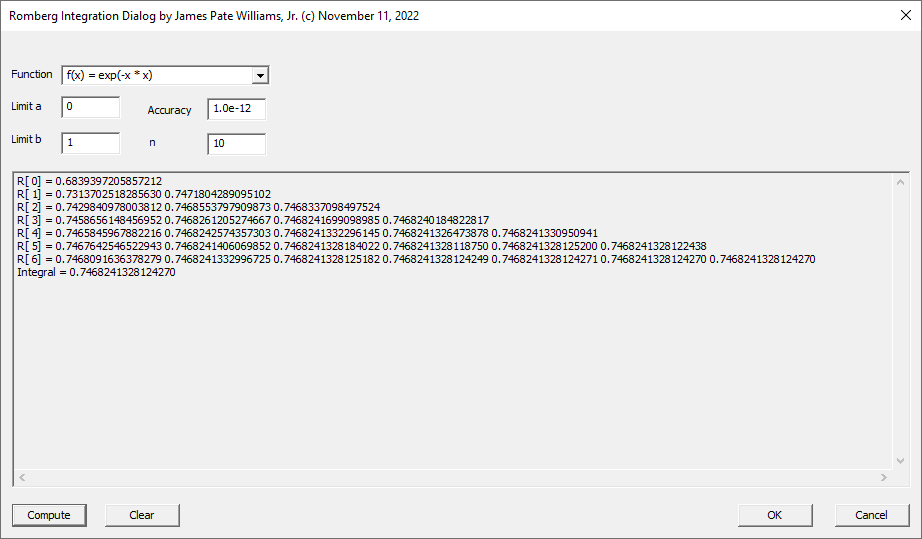
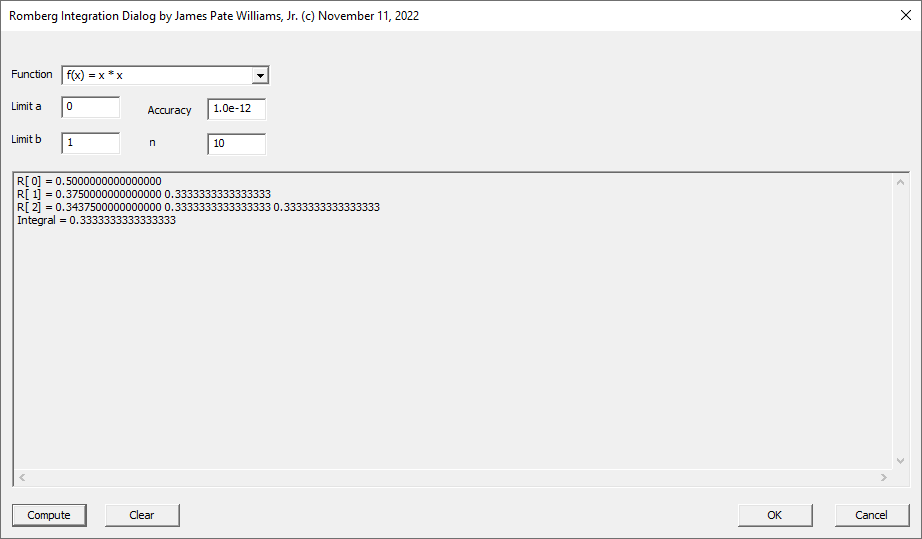
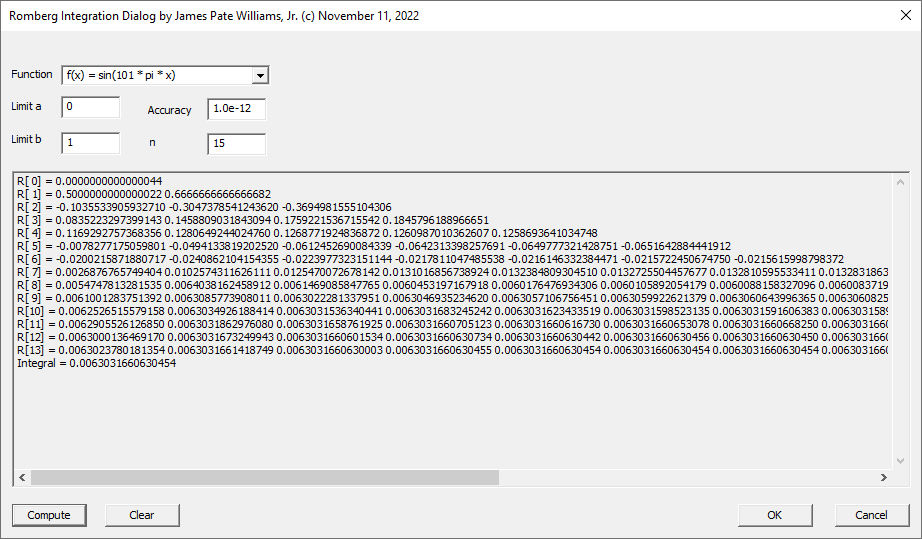
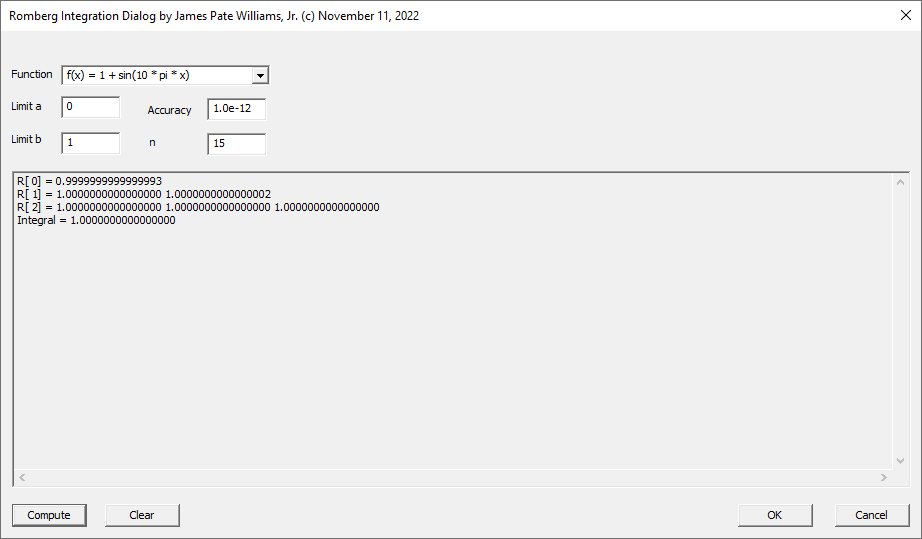
// Romberg.cpp : Defines the entry point for the application.
// https://learn.microsoft.com/en-us/windows/win32/controls/create-a-simple-combo-box

#include "stdafx.h"
#include <CommCtrl.h>
#include <math.h>
#include <stdio.h>
#include "Romberg.h"

#define MAX_LOADSTRING 100

// Global Variables:
HINSTANCE hInst;                                // current instance
WCHAR szTitle[MAX_LOADSTRING];                  // The title bar text
WCHAR szWindowClass[MAX_LOADSTRING];            // the main window class name

// Forward declarations of functions included in this code module:
ATOM                MyRegisterClass(HINSTANCE hInstance);
BOOL                InitInstance(HINSTANCE, int);
LRESULT CALLBACK    WndProc(HWND, UINT, WPARAM, LPARAM);
INT_PTR CALLBACK    About(HWND, UINT, WPARAM, LPARAM);
INT_PTR CALLBACK    RombergDialog(HWND, UINT, WPARAM, LPARAM);

int APIENTRY wWinMain(_In_ HINSTANCE hInstance,
                     _In_opt_ HINSTANCE hPrevInstance,
                     _In_ LPWSTR    lpCmdLine,
                     _In_ int       nCmdShow)
{
    UNREFERENCED_PARAMETER(hPrevInstance);
    UNREFERENCED_PARAMETER(lpCmdLine);

    // TODO: Place code here.

    // Initialize global strings
    LoadStringW(hInstance, IDS_APP_TITLE, szTitle, MAX_LOADSTRING);
    LoadStringW(hInstance, IDC_ROMBERG, szWindowClass, MAX_LOADSTRING);
    MyRegisterClass(hInstance);

    // Perform application initialization:
    if (!InitInstance (hInstance, nCmdShow))
    {
        return FALSE;
    }

    HACCEL hAccelTable = LoadAccelerators(hInstance, MAKEINTRESOURCE(IDC_ROMBERG));

    MSG msg;

    // Main message loop:
    while (GetMessage(&msg, NULL, 0, 0))
    {
        if (!TranslateAccelerator(msg.hwnd, hAccelTable, &msg))
        {
            TranslateMessage(&msg);
            DispatchMessage(&msg);
        }
    }

    return (int) msg.wParam;
}

//
//  FUNCTION: MyRegisterClass()
//
//  PURPOSE: Registers the window class.
//
ATOM MyRegisterClass(HINSTANCE hInstance)
{
    WNDCLASSEXW wcex;

    wcex.cbSize = sizeof(WNDCLASSEX);

    wcex.style          = CS_HREDRAW | CS_VREDRAW;
    wcex.lpfnWndProc    = WndProc;
    wcex.cbClsExtra     = 0;
    wcex.cbWndExtra     = 0;
    wcex.hInstance      = hInstance;
    wcex.hIcon          = LoadIcon(hInstance, MAKEINTRESOURCE(IDI_ROMBERG));
    wcex.hCursor        = LoadCursor(NULL, IDC_ARROW);
    wcex.hbrBackground  = (HBRUSH)(COLOR_WINDOW+1);
    wcex.lpszMenuName   = MAKEINTRESOURCEW(IDC_ROMBERG);
    wcex.lpszClassName  = szWindowClass;
    wcex.hIconSm        = LoadIcon(wcex.hInstance, MAKEINTRESOURCE(IDI_SMALL));

    return RegisterClassExW(&wcex);
}

//
//   FUNCTION: InitInstance(HINSTANCE, int)
//
//   PURPOSE: Saves instance handle and creates main window
//
//   COMMENTS:
//
//        In this function, we save the instance handle in a global variable and
//        create and display the main program window.
//
BOOL InitInstance(HINSTANCE hInstance, int nCmdShow)
{
   hInst = hInstance; // Store instance handle in our global variable

   HWND hWnd = CreateWindowW(szWindowClass, szTitle, WS_OVERLAPPEDWINDOW,
      CW_USEDEFAULT, 0, CW_USEDEFAULT, 0, NULL, NULL, hInstance, NULL);

   if (!hWnd)
   {
      return FALSE;
   }

   ShowWindow(hWnd, nCmdShow);
   UpdateWindow(hWnd);

   return TRUE;
}

//
//  FUNCTION: WndProc(HWND, UINT, WPARAM, LPARAM)
//
//  PURPOSE:  Processes messages for the main window.
//
//  WM_COMMAND  - process the application menu
//  WM_PAINT    - Paint the main window
//  WM_DESTROY  - post a quit message and return
//
//
LRESULT CALLBACK WndProc(HWND hWnd, UINT message, WPARAM wParam, LPARAM lParam)
{
    switch (message)
    {
    case WM_COMMAND:
        {
            int wmId = LOWORD(wParam);
            // Parse the menu selections:
            switch (wmId)
            {
            case IDM_ABOUT:
                DialogBox(hInst, MAKEINTRESOURCE(IDD_ABOUTBOX), hWnd, About);
                break;
			case ID_OPTION_ROMBERGINTEGRATION:
				DialogBox(hInst, MAKEINTRESOURCE(IDD_DIALOG1), hWnd, RombergDialog);
				break;
            case IDM_EXIT:
                DestroyWindow(hWnd);
                break;
            default:
                return DefWindowProc(hWnd, message, wParam, lParam);
            }
        }
        break;
    case WM_PAINT:
        {
            PAINTSTRUCT ps;
            HDC hdc = BeginPaint(hWnd, &ps);
            // TODO: Add any drawing code that uses hdc here...
            EndPaint(hWnd, &ps);
        }
        break;
    case WM_DESTROY:
        PostQuitMessage(0);
        break;
    default:
        return DefWindowProc(hWnd, message, wParam, lParam);
    }
    return 0;
}

// Message handler for about box.
INT_PTR CALLBACK About(HWND hDlg, UINT message, WPARAM wParam, LPARAM lParam)
{
    UNREFERENCED_PARAMETER(lParam);
    switch (message)
    {
    case WM_INITDIALOG:
        return (INT_PTR)TRUE;

    case WM_COMMAND:
        if (LOWORD(wParam) == IDOK || LOWORD(wParam) == IDCANCEL)
        {
            EndDialog(hDlg, LOWORD(wParam));
            return (INT_PTR)TRUE;
        }
        break;
    }
    return (INT_PTR)FALSE;
}

double f0(double x)
{
	return exp(-x * x);
}

double f1(double x)
{
	return x * x;
}

double f2(double x)
{
	double pi = 4.0 * atan(1.0);
	return sin(101.0 * pi * x);
}

double f3(double x)
{
	double pi = 4.0 * atan(1.0);
	return 1.0 + sin(10.0 * pi * x);
}

double f4(double x)
{
	return fabs(x - 1.0 / 3.0);
}

double f5(double x)
{
	return sqrt(x);
}

double f6(double x)
{
	double result = 1.0;

	if (x != 0.0)
		result = sin(x) / x;

	return result;
}

/* https://en.wikipedia.org/wiki/Romberg%27s_method#Implementation */

char table[8192];
double R1[2048], R2[2048];

void print_row(size_t i, double* R)
{
	char buffer[128];
	sprintf_s(buffer, 128, "R[%2zu] = ", i);
	strcat_s(table, 8192, buffer);

	for (size_t j = 0; j <= i; ++j)
	{
		sprintf_s(buffer, 128, "%.*lf ", 16, R[j]);
		strcat_s(table, 8192, buffer);
	}

	strcat_s(table, 8192, "\r\n");
}

double RombergExtrapolation(
	double(*f)(double),
	double a, double b,
	size_t max_steps,
	double acc)
{
	double *Rp = &R1[0], *Rc = &R2[0];
	double h = (b - a);
	Rp[0] = (f(a) + f(b))*h*.5;

	print_row(0, Rp);

	for (size_t i = 1; i < max_steps; ++i)
	{
		h /= 2.;
		double c = 0;
		size_t ep = 1 << (i - 1);

		for (size_t j = 1; j <= ep; ++j)
		{
			c += f(a + (2 * j - 1)*h);
		}

		Rc[0] = h*c + .5*Rp[0];

		for (size_t j = 1; j <= i; ++j)
		{
			double n_k = pow(4, j);
			Rc[j] = (n_k*Rc[j - 1] - Rp[j - 1]) / (n_k - 1);
		}

		print_row(i, Rc);

		if (i > 1 && fabs(Rp[i - 1] - Rc[i]) < acc)
		{
			return Rc[i];
		}

		double *rt = Rp;
		Rp = Rc;
		Rc = rt;
	}

	return Rp[max_steps - 1];
}

INT_PTR CALLBACK RombergDialog(HWND hDlg, UINT message, WPARAM wParam, LPARAM lParam)
{
	UNREFERENCED_PARAMETER(lParam);
	WORD word = LOWORD(wParam);
	static TCHAR functions[7][128] =
	{
		TEXT("f(x) = exp(-x * x)"),
		TEXT("f(x) = x * x"),
		TEXT("f(x) = sin(101 * pi * x)"),
		TEXT("f(x) = 1 + sin(10 * pi * x)"),
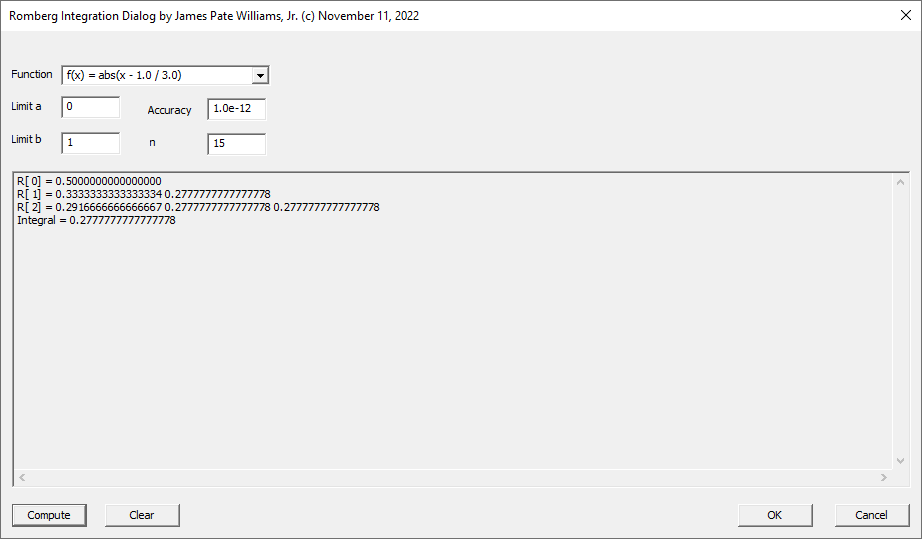
		TEXT("f(x) = abs(x - 1.0 / 3.0)"),
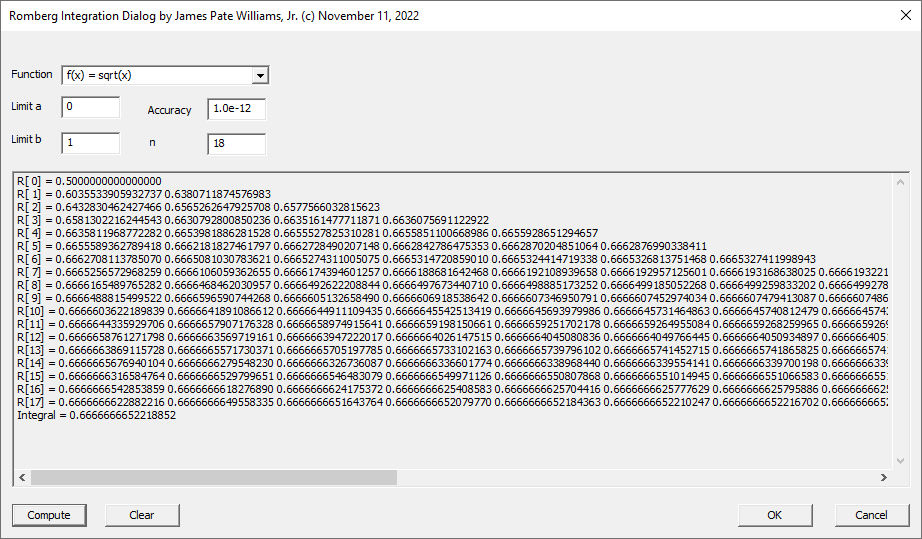
		TEXT("f(x) = sqrt(x)"),
		TEXT("f(x) = sin(x) / x or 1 if x = 0")
	};
	static TCHAR A[1024];
	static HWND cbWindow;
	static int k = 0;
	static int itemIndex;

	switch (message)
	{
	case WM_INITDIALOG:
		cbWindow = GetDlgItem(hDlg, IDC_COMBO1);
		memset(&A, 0, sizeof(A));
		for (k = 0; k < 6; k++)
		{
			// Add string to combobox.
			SendMessage(cbWindow, CB_ADDSTRING, (WPARAM)k, (LPARAM)functions[k]);
		}
		// Send the CB_SETCURSEL message to display an initial item
		// in the selection field
		SendMessage(cbWindow, CB_SETCURSEL, (WPARAM)0, (LPARAM)0);
		return (INT_PTR)TRUE;
	case WM_COMMAND:
		if (word == IDOK || word == IDCANCEL)
		{
			EndDialog(hDlg, word);
			return (INT_PTR)TRUE;
		}
		if (HIWORD(wParam) == CBN_SELCHANGE)
			// If the user makes a selection from the list:
			//   Send CB_GETCURSEL message to get the index of the selected list item.
			//   Send CB_GETLBTEXT message to get the item.
			//   Display the item in a messagebox.
		{
			itemIndex = SendMessage((HWND)lParam, (UINT)CB_GETCURSEL,
				(WPARAM)0, (LPARAM)0);
			TCHAR listItem[256];
			(TCHAR)SendMessage((HWND)lParam, (UINT)CB_GETLBTEXT,
				(WPARAM)itemIndex, (LPARAM)listItem);
		}
		else if (word == IDC_BUTTON1)
		{
			char buffer[128];
			GetDlgItemTextA(hDlg, IDC_EDIT1, buffer, 128);
			double a = atof(buffer);
			GetDlgItemTextA(hDlg, IDC_EDIT2, buffer, 128);
			double b = atof(buffer);
			double integral = 0.0;
			GetDlgItemTextA(hDlg, IDC_EDIT4, buffer, 128);
			double acc = atof(buffer);
			int max_steps = GetDlgItemInt(hDlg, IDC_EDIT5, FALSE, FALSE);

			switch (itemIndex)
			{
			case 0:
				integral = RombergExtrapolation(f0, a, b, max_steps, acc);
				break;
			case 1:
				integral = RombergExtrapolation(f1, a, b, max_steps, acc);
				break;
			case 2:
				integral = RombergExtrapolation(f2, a, b, max_steps, acc);
				break;
			case 3:
				integral = RombergExtrapolation(f3, a, b, max_steps, acc);
				break;
			case 4:
				integral = RombergExtrapolation(f4, a, b, max_steps, acc);
				break;
			case 5:
				integral = RombergExtrapolation(f5, a, b, max_steps, acc);
				break;
			case 6:
				integral = RombergExtrapolation(f6, a, b, max_steps, acc);
				break;
			}

			sprintf_s(buffer, 128, "Integral = %.*lf\r\n", 16, integral);
			strcat_s(table, 8192, buffer);
			SetDlgItemTextA(hDlg, IDC_EDIT7, table);
		}

		else if (word == IDC_BUTTON3)
		{
			table[0] = '\0';
			SetDlgItemTextA(hDlg, IDC_EDIT7, table);
		}
	}
	return (INT_PTR)FALSE;
}