Category: Elementary Physics
Estimated Babe Ruth 1921 Homerun Parameters by James Pate Williams, Jr.
“Babe Ruth is generally considered the owner of the record for the longest home run in MLB history with a 575-foot bomb launched at Navin Field in Detroit in 1921.” – https://www.msn.com/en-us/sports/mlb/what-is-the-longest-home-run-in-mlb-history/ar-AA1dGwlZ
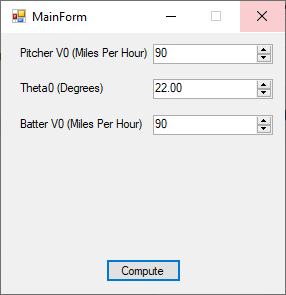
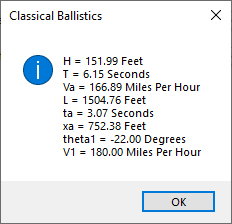
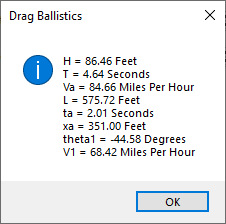
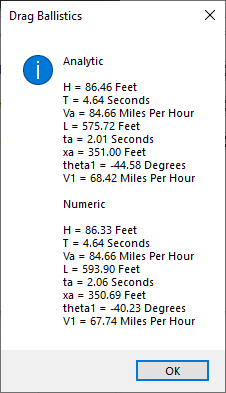
As you can see, I estimated the pitch velocity at 90 miles per hour and Babe Ruth’s (Sultan of Swing) at 90 miles per hour also. My analytic calculations yield a range of the baseball’s trajectory as about 576 feet.
Another Point-Mass Ballistics Application Battleship Iowa 16-Inch Guns in Particular
by James Pate Williams, Jr.


namespace PointMassBallistics
{
public class TableEntry : IComparable<TableEntry>
{
public double range, elevationDegrees, elevationMinutes,
angleFallDegrees, angleFallMinutes, timeOfFlight,
strikingVelocity, maximumOrdinate;
public int CompareTo(TableEntry other)
{
if (elevationDegrees < other.elevationDegrees &&
elevationMinutes < other.elevationMinutes)
return -1;
if (elevationDegrees > other.elevationDegrees &&
elevationMinutes > other.elevationMinutes)
return +1;
return 0;
}
}
}
// Solves the following system of first order
// ordinary differential equations. Formulas
// are from "Elementary Numerical Analysis:
// An Algorithmic Approach 3rd Edition" by S.
// D. Conte & Carl de Boor (c) 1980 8.12 page 398.
// Extended from two to four equations.
// See https://apps.dtic.mil/dtic/tr/fulltext/u2/a439796.pdf
// Also view https://eugeneleeslover.com/USN-GUNS-AND-RANGE-TABLES/OP-770-1.html
using System;
using System.Collections.Generic;
namespace PointMassBallistics
{
class RungeKutta4
{
private double BC;
private readonly double g = 32.17405;
private readonly double[] GarveN = {
2, 3, 5, 3, 2, 1.7, 1.55 };
private readonly double[] log10K = {
5.66989 - 10, 2.77344 - 10, 6.80187 - 20,
2.98090 - 10, 6.11926 - 10, 7.09620 - 10, 7.60905 - 10 };
private readonly double[] K = new double[7];
private int zone;
static private double Density(double y)
{
return Math.Pow(10, -0.00001372 * y);
}
static private int ComputeIndex(double v)
{
int index;
if (v > 3600)
index = 6;
else if (v > 2600 && v <= 3600)
index = 5;
else if (v > 1800 && v <= 2600)
index = 4;
else if (v > 1370 && v <= 1800)
index = 3;
else if (v > 1230 && v <= 1370)
index = 2;
else if (v > 790 && v <= 1230)
index = 1;
else
index = 0;
return index;
}
public double MayevskiRetardation(double v, int zone)
{
// See Exterior Ballistics 1935 by Ernest Edward Herrmann
// Garve function
return K[zone] * Math.Pow(v, GarveN[zone]);
}
private double Vx(double syn, double vxn, double vyn)
{
double v = Math.Sqrt(vxn * vxn + vyn * vyn);
zone = ComputeIndex(v);
double E = Density(syn) * MayevskiRetardation(v, zone) / BC;
return -E * vxn / v;
}
private double Vy(double syn, double vxn, double vyn)
{
double v = Math.Sqrt(vxn * vxn + vyn * vyn);
zone = ComputeIndex(v);
double E = Density(syn) * MayevskiRetardation(v, zone) / BC;
return -E * vyn / v - g;
}
static private double Sx(double vxn)
{
return vxn;
}
static private double Sy(double vyn)
{
return vyn;
}
public void Solve(
double t0, double t1,
double vx0, double vy0,
double sx0, double sy0,
double BC, int nSteps, ref List<double> lt,
ref List<double> lvx, ref List<double> lvy,
ref List<double> lsx, ref List<double> lsy)
{
double k1, k2, k3, k4;
double l1, l2, l3, l4;
double m1, m2, m3, m4;
double n1, n2, n3, n4;
double h = (t1 - t0) / nSteps, tn = t0;
double vxn = vx0, vyn = vy0, sxn = sx0, syn = sy0;
int n = 1;
for (int i = 0; i < log10K.Length; i++)
K[i] = Math.Pow(10, log10K[i]);
this.BC = BC;
lt.Add(tn);
lvx.Add(vxn);
lvy.Add(vyn);
lsx.Add(sxn / 3);
lsy.Add(syn);
while (true)
{
tn = t0 + n * h;
k1 = h * Vx(syn, vxn, vyn);
l1 = h * Vy(syn, vxn, vyn);
m1 = h * Sx(vxn);
n1 = h * Sy(vyn);
k2 = h * Vx(syn + 0.5 * n1, vxn + 0.5 * k1, vyn + 0.5 * l1);
l2 = h * Vy(syn + 0.5 * n1, vxn + 0.5 * k1, vyn + 0.5 * l1);
m2 = h * Sx(vxn + 0.5 * m1);
n2 = h * Sy(vyn + 0.5 * n1);
k3 = h * Vx(syn + 0.5 * n2, vxn + 0.5 * k2, vyn + 0.5 * l2);
l3 = h * Vy(syn + 0.5 * n2, vxn + 0.5 * k2, vyn + 0.5 * l2);
m3 = h * Sx(vxn + 0.5 * m2);
n3 = h * Sy(vyn + 0.5 * n2);
k4 = h * Vx(syn + n3, vxn + k3, vyn + l3);
l4 = h * Vy(syn + n3, vxn + k3, vyn + l3);
m4 = h * Sx(vxn + m3);
n4 = h * Sy(vyn + n3);
vxn = vx0 + (k1 + 2 * k2 + 2 * k3 + k4) / 6.0;
vyn = vy0 + (l1 + 2 * l2 + 2 * l3 + l4) / 6.0;
sxn = sx0 + (m1 + 2 * m2 + 2 * m3 + m4) / 6.0;
syn = sy0 + (n1 + 2 * n2 + 2 * n3 + n4) / 6.0;
vx0 = vxn;
vy0 = vyn;
sx0 = sxn;
sy0 = syn;
n++;
lt.Add(tn);
lvx.Add(vxn);
lvy.Add(vyn);
lsx.Add(sxn / 3);
lsy.Add(syn);
if (syn <= 1.0e-2)
break;
}
}
}
}

The Laplace Equation in Various Orthogonal Rectilinear Coordinate Systems James Pate Williams, Jr. BA, BS, MSwE, PhD
Solve the Laplace equation in the following orthogonal rectilinear coordinate systems:
- Cartesian coordinates
- Cylindrical coordinates
- Spherical polar coordinates
- Parabolic cylindrical coordinates
Solution PDF:
Selected Exercises for the Feynman Lectures on Physics by Richard Feynman, Et Al. Chapter 27 Quantum Behavior: Waves, Particles, and Photons – Detailed Work by James Pate Williams, Jr. BA, BS, MSwE, PhD
Computerized solutions to Exercises 27.3 to 27.6:


Partial source code for the preceding C# application:
Detailed solutions to Exercises 27.3 to 27.7 in a Portable Document File (PDF):
Selected Exercises for the Feynman Lectures on Physics by Richard Feynman, Et Al. Chapter 4 Kinematics – Detailed Work by James Pate Williams, Jr. BA, BS, MSwE, PhD
Exercises 4.1 to 4.7:
Computer solution output of Exercise 4.6:

C# source code for the computer solution of Exercise 4.6, sorry about the naming confusion in the file:
Computer solution of Exercise 4.7 using a velocity square drag function (velocity retardation function is the term used in exterior ballistics). I wrote a baseball ballistics program based on my numeric work (Runge-Kutta Fifth Order) and analytic solutions found in the paper:
Click to access 04-LAJPE-782_Chudinov.pdf
The first picture is the main form interface for the program with the parameters initial velocity in meters per second and the initial angle which is in degrees. We use a velocity of 25 meters per second which is approximately 56 miles per hour and the angle is 90 degrees to the horizontal which is throwing the ball straight up into the air.

First we show the classical ballistics without atmospheric drag:

Next we show the invalid (due to a singularity in one of the equations) analytic and numeric solutions:

The analytic solution is not valid for theta0 = 90 degrees. The numeric solution shows a time to apogee of 2.28 seconds and time of flight 4.66 seconds. The difference is 4.66 – 2.28 seconds = 2.38 seconds so the time to return from apogee is greater than the time to reach apogee. The analytic solution becomes valid at 88 degrees of inclination.

Next we move onto an inclination of 15 degrees:


Finally for the maximum distance traveled by the ball classically we select 45 degrees:


We find that with drag the maximum distance traveled (range) is achieved around 43 degrees:


Exercises for the Feynman Lectures on Physics by Richard Feynman, Et Al. Chapter 18 Algebra – Detailed Work by James Pate Williams, Jr. BA, BS, MSwE, PhD
Exercises for the Feynman Lectures on Physics by Richard Feynman, Et Al. Chapter 38 Differential Calculus of Vector Fields – Detailed Work by James Pate Williams, Jr. BA, BS, MSwE, PhD
Exercises for the Feynman Lectures on Physics by Richard Feynman, Et Al. Chapter 36 Fourier Analysis of Waves– Detailed Work by James Pate Williams, Jr. BA, BS, MSwE, PhD
Exercises for the Feynman Lectures on Physics by Richard Feynman, Et Al. Chapter 36 Fourier Analysis of Waves– Detailed Computer Work by James Pate Williams, Jr. BA, BS, MSwE, PhD