Author: jamespatewilliamsjr
My whole legal name is James Pate Williams, Jr. I was born in LaGrange, Georgia approximately 70 years ago. I barely graduated from LaGrange High School with low marks in June 1971. Later in June 1979, I graduated from LaGrange College with a Bachelor of Arts in Chemistry with a little over a 3 out 4 Grade Point Average (GPA). In the Spring Quarter of 1978, I taught myself how to program a Texas Instruments desktop programmable calculator and in the Summer Quarter of 1978 I taught myself Dayton BASIC (Beginner's All-purpose Symbolic Instruction Code) on LaGrange College's Data General Eclipse minicomputer. I took courses in BASIC in the Fall Quarter of 1978 and FORTRAN IV (Formula Translator IV) in the Winter Quarter of 1979. Professor Kenneth Cooper, a genius poly-scientist taught me a course in the Intel 8085 microprocessor architecture and assembly and machine language. We would hand assemble our programs and insert the resulting machine code into our crude wooden box computer which was designed and built by Professor Cooper. From 1990 to 1994 I earned a Bachelor of Science in Computer Science from LaGrange College. I had a 4 out of 4 GPA in the period 1990 to 1994. I took courses in C, COBOL, and Pascal during my BS work. After graduating from LaGrange College a second time in May 1994, I taught myself C++. In December 1995, I started using the Internet and taught myself client-server programming. I created a website in 1997 which had C and C# implementations of algorithms from the "Handbook of Applied Cryptography" by Alfred J. Menezes, et. al., and some other cryptography and number theory textbooks and treatises.
Blog Entry (c) Tuesday September 3, 2024, by James Pate Williams, Jr.
Blog Entry (c) Monday September 2, 2024, by James Pate Williams, Jr. Corrected Online Integral Problem
Blog Entry (c) Sunday September 1, 2024, by James Pate Williams, Jr. An Online Integral Evaluation
Blog Entry (c) Saturday August 31, 2024, by James Pate Williams, Jr. Software Development About Two Decades Ago

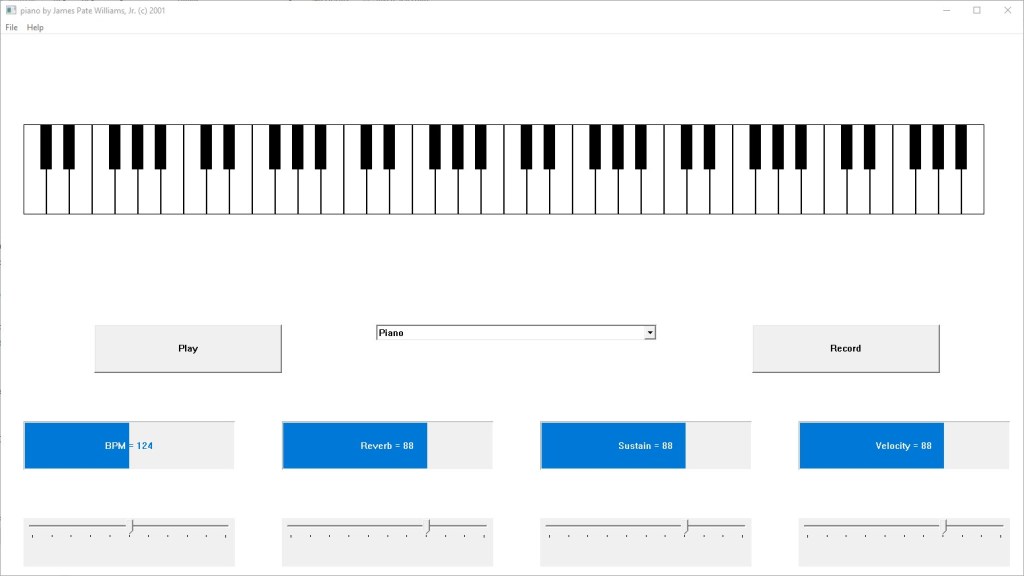

Unfortunately, I can only find the preceding executable applications and no source code. These programs date back to 2001 and 2002 while I was a graduate student in software engineering and computer science at Auburn University. I seem to recall that these apps were created using Win32 C or C++.
Blog Entry (c) Saturday August 31, 2024, by James Pate Williams, Jr. An Elementary School Problem Found Online
Solve for a real root of the equation
f(x)=log6l(5+x)+log6l(x)=0
First we test our log6l(x) function
log6l(12) = 1.386853
log6l(36) = 2.000000
x = 0.1925824036
f = 0.0000000000
Blog Entry (c) Friday August 30, 2024, by James Pate Williams, Jr. Another Simple Math Problem
We use an evolutionary hill-climber and the solution of the quadratic equation to solve the easy problem below:

Solution of f(a,x)=sin(sqrt(ax-x^2))=0
Subject to the constraint x+y=100
Where x and y are the two roots of
g(a,x)=ax-x^2-n*n*pi*pi=0
and n=15
a = 100.347888933988
x = 32.947113268776
y = 67.400775665213
g =  0.000000000000
s = 100.347888933988
runtime in seconds = 43.730000
Blog Entry (c) Wednesday August 28, 2024, by James Pate Williams, Jr.
Blog Entry (c) Tuesday, August 27, 2024, Two More Online Mathematics Problems by James Pate Williams, Jr.
Solution of f(t) = cos(2t) + cos(3t)
t    =  0.628318530718
f(t) =  1.11022302e-16
Solution of f(x) = sqrt(1 + sqrt(1 + x)) - x^1/3
x    =  8.000000000000
f(x) =  0.00000000e+00
Solution of f(x) = 9^x + 12^x - 16^x
x    =  -16.387968065352
f(x) =    2.32137533e-16
Solution of f(x) = 8^x-2^x - 2(6^x-3^x)
x    =  1.000000000000
f(x) =  0.00000000e+00
Blog Entry (c) Tuesday, August 27, 2024, Graphing New Goldwasser-Kilian Primality Test Results by James Pate Williams, Jr.
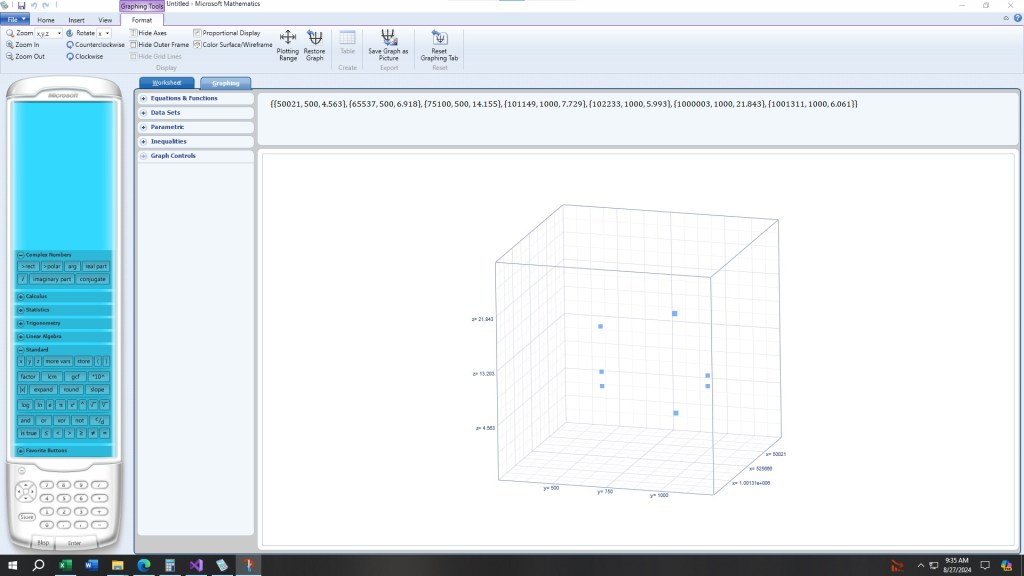
The x -axis is the number to be tested, the y-axis is prime number bound for factoring, and the z-axis is the runtime in seconds.
 Numerical Explorations