My whole legal name is James Pate Williams, Jr. I was born in LaGrange, Georgia approximately 70 years ago. I barely graduated from LaGrange High School with low marks in June 1971. Later in June 1979, I graduated from LaGrange College with a Bachelor of Arts in Chemistry with a little over a 3 out 4 Grade Point Average (GPA). In the Spring Quarter of 1978, I taught myself how to program a Texas Instruments desktop programmable calculator and in the Summer Quarter of 1978 I taught myself Dayton BASIC (Beginner's All-purpose Symbolic Instruction Code) on LaGrange College's Data General Eclipse minicomputer. I took courses in BASIC in the Fall Quarter of 1978 and FORTRAN IV (Formula Translator IV) in the Winter Quarter of 1979. Professor Kenneth Cooper, a genius poly-scientist taught me a course in the Intel 8085 microprocessor architecture and assembly and machine language. We would hand assemble our programs and insert the resulting machine code into our crude wooden box computer which was designed and built by Professor Cooper. From 1990 to 1994 I earned a Bachelor of Science in Computer Science from LaGrange College. I had a 4 out of 4 GPA in the period 1990 to 1994. I took courses in C, COBOL, and Pascal during my BS work. After graduating from LaGrange College a second time in May 1994, I taught myself C++. In December 1995, I started using the Internet and taught myself client-server programming. I created a website in 1997 which had C and C# implementations of algorithms from the "Handbook of Applied Cryptography" by Alfred J. Menezes, et. al., and some other cryptography and number theory textbooks and treatises.
The merge-sort I used was from “A Numerical Library in C for Scientists and Engineers” by H. T. Lau Translated from ALGOL NUMAL. The quick-sort algorithm was from “Introduction to Algorithms” by Thomas H. Cormen, Charles E. Leiserson, and Ronald L. Rivest.
== Menu ==

1 Side-by-Side Tests

2 Timing Comparisons

3 Exit

Enter an option: 2

Enter a PRNG Seed >= 1: 1

mergesort mean runtime = 0.358999

QuickSort mean runtime = 0.290000

mergesort std dev = 0.005610

QuickSort std dev = 0.004532

== Menu ==

1 Side-by-Side Tests

2 Timing Comparisons

3 Exit

Enter an option:
Note: For comparison with a paper on matrix operations, we use column major order also known as column major echelon order. Column major order is used in Fortran and row major order is utilized in C computations.
void ColMajorSlowMatMul(double** a, double** b, double** c, int n)
{
    for (int j = 1; j <= n; j++)
        for (int k = 1; k <= n; k++)
            c[j][k] = 0.0;

    for (int j = 1; j <= n; j++)
    {
        for (int i = 1; i <= n; i++)
        {
            double t = 0;

            for (int k = 1; k <= n; k++)
                t += a[i][k] * b[k][j];

            c[i][j] = t;
        }
    }
}
And now we present the allegedly fast multiplication code:
void ColMajorFastMatMul(double** a, double** b, double** c, int n)
{
    for (int j = 1; j <= n; j++)
        for (int k = 1; k <= n; k++)
            c[j][k] = 0.0;

    for (int j = 1; j <= n; j++)
    {
        for (int k = 1; k <= n; k++)
        {
            double t = b[k][j];

            for (int i = 1; i <= n; i++)
                c[i][j] += a[i][k] * t;
        }
    }
}
Finally, we have another algorithm for matrix multiplication:
void ColMajorSemiMatMul(double** a, double** b, double** c, int n)
{
    for (int j = 1; j <= n; j++)
        for (int k = 1; k <= n; k++)
            c[j][k] = 0.0;

    for (int j = 1; j <= n; j++)
    {
        for (int i = 1; i <= n; i++)
        {
            for (int k = 1; k <= n; k++)
                c[i][j] += a[i][k] * b[k][j];
        }
    }
}
We performed the following experiments.
slow runtime in microseconds: 2736

semi runtime in microseconds: 4001

fast runtime in microseconds: 5293

n * n = 10000

equal = 10000

n * n = 10000

equal = 10000

slow runtime in microseconds: 21962

semi runtime in microseconds: 29585

fast runtime in microseconds: 28701

n * n = 40000

equal = 40000

n * n = 40000

equal = 40000

slow runtime in microseconds: 67256

semi runtime in microseconds: 101554

fast runtime in microseconds: 107969

n * n = 90000

equal = 90000

n * n = 90000

equal = 90000

slow runtime in microseconds: 183839

semi runtime in microseconds: 268616

fast runtime in microseconds: 244832

n * n = 160000

equal = 160000

n * n = 160000

equal = 160000

slow runtime in microseconds: 428263

semi runtime in microseconds: 638721

fast runtime in microseconds: 650535

n * n = 250000

equal = 250000

n * n = 250000

equal = 250000


C:\Users\james\source\repos\FastMatrixMultiplication\Debug\FastMatrixMultiplication.exe (process 29552) exited with code 0.

Press any key to close this window . . .
// FastMatrixMultiplication.cpp : This file contains the 'main' function. Program execution begins and ends there.
// https://www-users.york.ac.uk/~mijp1/teaching/grad_HPC_for_MatSci/Lecture4.pdf
// https://stackoverflow.com/questions/25483620/how-to-measure-running-time-of-specific-function-in-c-very-accurate

#include <stdlib.h>
#include <chrono>
#include <iostream>
using namespace std;

typedef chrono::high_resolution_clock Clock;

void ColMajorFastMatMul(double** a, double** b, double** c, int n)
{
    for (int j = 1; j <= n; j++)
        for (int k = 1; k <= n; k++)
            c[j][k] = 0.0;

    for (int j = 1; j <= n; j++)
    {
        for (int k = 1; k <= n; k++)
        {
            double t = b[k][j];

            for (int i = 1; i <= n; i++)
                c[i][j] += a[i][k] * t;
        }
    }
}

void ColMajorSemiMatMul(double** a, double** b, double** c, int n)
{
    for (int j = 1; j <= n; j++)
        for (int k = 1; k <= n; k++)
            c[j][k] = 0.0;

    for (int j = 1; j <= n; j++)
    {
        for (int i = 1; i <= n; i++)
        {
            for (int k = 1; k <= n; k++)
                c[i][j] += a[i][k] * b[k][j];
        }
    }
}

void ColMajorSlowMatMul(double** a, double** b, double** c, int n)
{
    for (int j = 1; j <= n; j++)
        for (int k = 1; k <= n; k++)
            c[j][k] = 0.0;

    for (int j = 1; j <= n; j++)
    {
        for (int i = 1; i <= n; i++)
        {
            double t = 0;

            for (int k = 1; k <= n; k++)
                t += a[i][k] * b[k][j];

            c[i][j] = t;
        }
    }
}

void GenerateMatrix(double** a, int n, int seed)
{
    srand(seed);

    for (int j = 1; j <= n; j++)
    {
        for (int k = 1; k <= n; k++)
        {
            a[j][k] = (double)rand() / RAND_MAX;
        }
    }
}

int main()
{
    for (int n = 100; n <= 500; n += 100)
    {
        double** a = new double* [n + 1];
        double** b = new double* [n + 1];
        double** c = new double* [n + 1];
        double** d = new double* [n + 1];
        double** e = new double* [n + 1];

        for (int j = 0; j < n + 1; j++)
        {
            a[j] = new double[n + 1];
            b[j] = new double[n + 1];
            c[j] = new double[n + 1];
            d[j] = new double[n + 1];
            e[j] = new double[n + 1];
        }

        GenerateMatrix(a, n, 1);
        GenerateMatrix(b, n, 2);

        auto clock1 = Clock::now();
        ColMajorSlowMatMul(a, b, c, n);
        auto clock2 = Clock::now();
        long long microseconds1 = chrono::duration_cast<chrono::microseconds>
            (clock2 - clock1).count();

        auto clock3 = Clock::now();
        ColMajorSemiMatMul(a, b, d, n);
        auto clock4 = Clock::now();
        long long microseconds2 = chrono::duration_cast<chrono::microseconds>
            (clock4 - clock3).count();

        auto clock5 = Clock::now();
        ColMajorFastMatMul(a, b, e, n);
        auto clock6 = Clock::now();
        long long microseconds3 = chrono::duration_cast<chrono::microseconds>
            (clock6 - clock5).count();

        cout << "slow runtime in microseconds: " << microseconds1 << endl;
        cout << "semi runtime in microseconds: " << microseconds2 << endl;
        cout << "fast runtime in microseconds: " << microseconds3 << endl;

        long long equal = 0;

        for (int j = 1; j <= n; j++)
            for (int k = 1; k <= n; k++)
                if (c[j][k] == d[j][k])
                    equal++;

        cout << "n * n = " << n * n << endl;
        cout << "equal = " << equal << endl;

        equal = 0;

        for (int j = 1; j <= n; j++)
            for (int k = 1; k <= n; k++)
                if (c[j][k] == e[j][k])
                    equal++;

        cout << "n * n = " << n * n << endl;
        cout << "equal = " << equal << endl;

        for (int j = 0; j < n + 1; j++)
        {
            delete[] a[j];
            delete[] b[j];
            delete[] c[j];
            delete[] d[j];
            delete[] e[j];
        }

        delete[] a;
        delete[] b;
        delete[] c;
        delete[] d;
        delete[] e;
    }
}
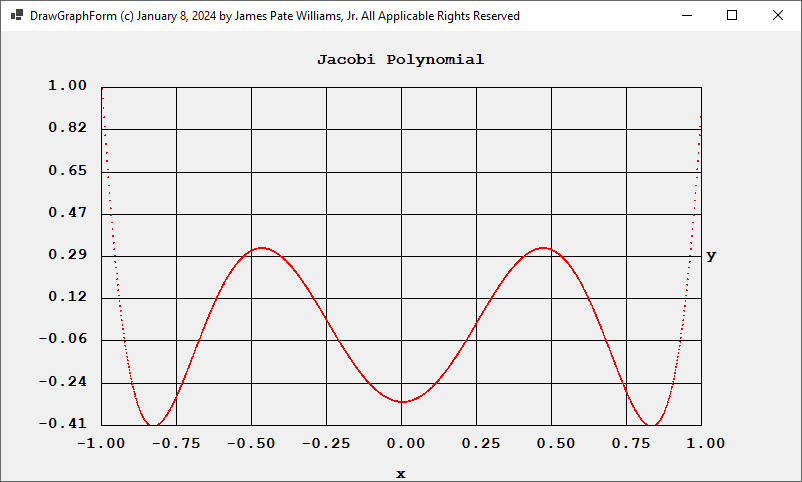
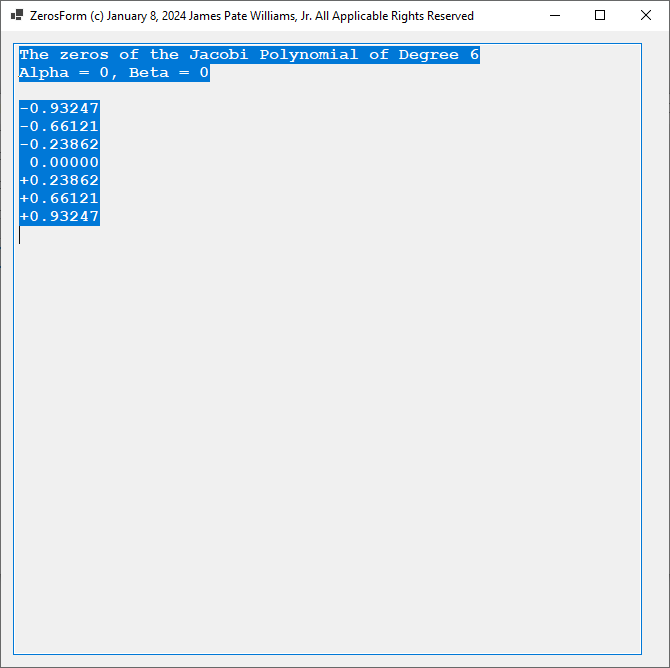
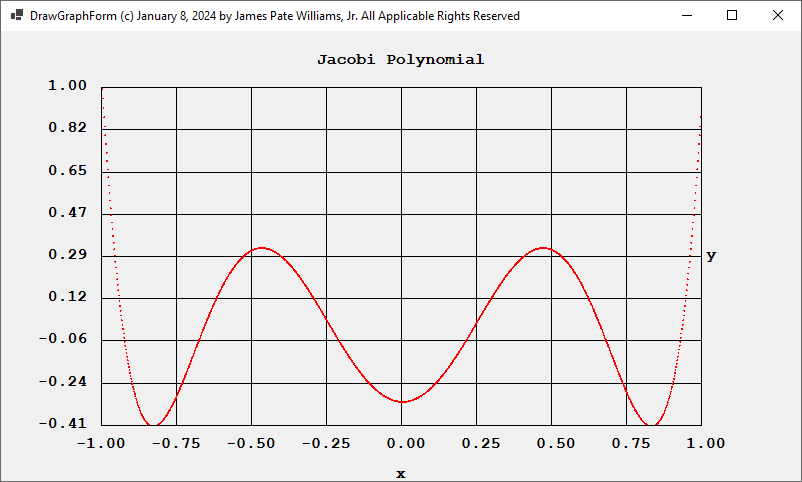
The two primary references used to create my application were: “A Numerical Library in C for Scientists and Engineers” by H. T. Lau and the following website: https://en.wikipedia.org/wiki/Jacobi_polynomials.
Using the Jacobi parameters alpha = 0 and beta = 0, we have the Legendre polynomials for degrees 4 and 6 and their associated roots:
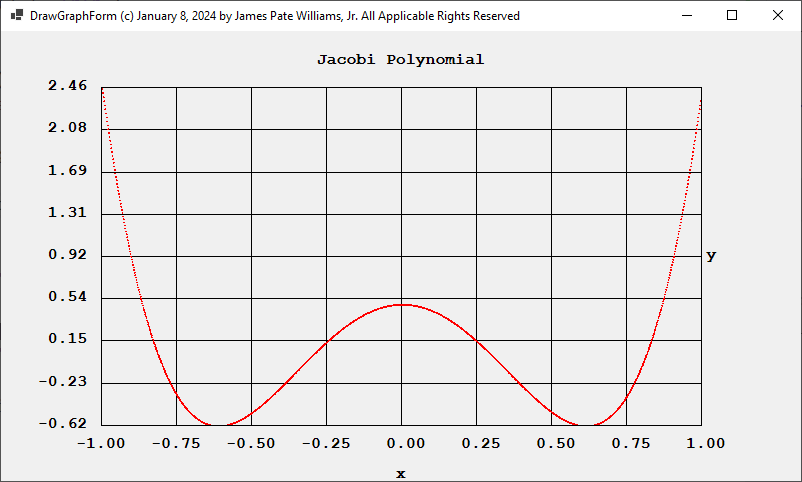
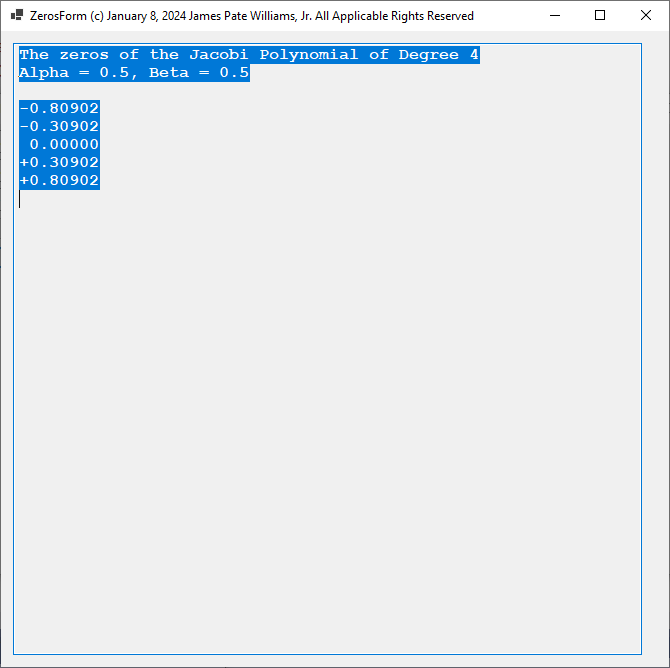
Using alpha = 0.5 and beta= 0.5 we obtain for degrees 4 and 6:
Some modern physical models of our universe require more than Einstein’s four dimensions: three spatial dimensions and one time dimension. Why do people worry about introducing more dimensions into our understanding of chemistry and physics? When Erwin Schrödinger introduced his famous quantum mechanical two-body solution of the time independent hydrogen-like atom wave equation he went four dimensions to three spatial dimensions. Later, Wolfgang Pauli espoused his famous Pauli Exclusion Principle that simply stated no two electrons (fermions) in an atomic orbital can have the same quantum spin number. Atoms live in a four-dimensional quantum number space augmented by three spatial dimensions and one time dimension.