Category: C Applications
Blog Entry (c) Saturday August 31, 2024, by James Pate Williams, Jr. An Elementary School Problem Found Online
Solve for a real root of the equation
f(x)=log6l(5+x)+log6l(x)=0
First we test our log6l(x) function
log6l(12) = 1.386853
log6l(36) = 2.000000
x = 0.1925824036
f = 0.0000000000
Blog Entry (c) Friday August 30, 2024, by James Pate Williams, Jr. Another Simple Math Problem
We use an evolutionary hill-climber and the solution of the quadratic equation to solve the easy problem below:

Solution of f(a,x)=sin(sqrt(ax-x^2))=0
Subject to the constraint x+y=100
Where x and y are the two roots of
g(a,x)=ax-x^2-n*n*pi*pi=0
and n=15
a = 100.347888933988
x = 32.947113268776
y = 67.400775665213
g =  0.000000000000
s = 100.347888933988
runtime in seconds = 43.730000
Blog Entry (c) Wednesday August 28, 2024, by James Pate Williams, Jr.
Blog Entry (c) Tuesday, August 27, 2024, Graphing New Goldwasser-Kilian Primality Test Results by James Pate Williams, Jr.
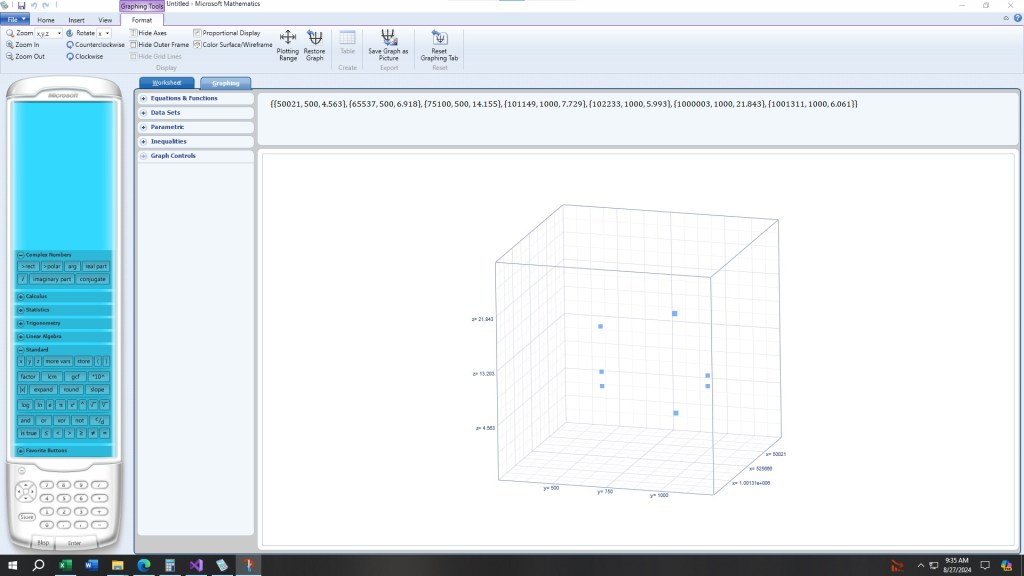
The x -axis is the number to be tested, the y-axis is prime number bound for factoring, and the z-axis is the runtime in seconds.
Blog Entry (c) Wednesday, August 21, 2024, by James Pate Williams, Jr. New and Improved Version of the Goldwasser-Kilian Primality Test
I corrected my powering modulo a prime routine. I added Pollard’s p – 1 factoring method and Shanks-Mestre elliptic curve point counting algorithm.

number to be tested or 0 to quit:
10000019
number of primes in factor base:
10000
Prime sieving time = 3.220000
N[0] = 10000019
a = 7838973
b = 2449531
m = 9995356
q = 356977
P = (9786147, 3226544)
P1 = (0, 1)
P2 = (5887862, 8051455)
N[1] = 356977
a = 45561
b = 178451
m = 357946
q = 178973
P = (80627, 163299)
P1 = (0, 1)
P2 = (52101, 282559)
N[2] = 178973
a = 135281
b = 76426
m = 178996
q = 73
P = (10238, 98035)
P1 = (0, 1)
P2 = (46702, 94326)
number is proven prime
runtime in seconds = 35.471000

number to be tested or 0 to quit:
10015969
number of primes in factor base:
10000
Prime sieving time = 3.424000
N[0] = 10015969
a = 6613193
b = 3951715
m = 10013908
q = 2503477
P = (998314, 8329764)
P1 = (0, 1)
P2 = (6944357, 1053776)
N[1] = 2503477
a = 1175442
b = 379813
m = 2505736
q = 293
P = (646462, 1631861)
P1 = (0, 1)
P2 = (1477980, 88719)
number is proven prime
runtime in seconds = 5.612000

number to be tested or 0 to quit:
99997981
number of primes in factor base:
10000
Prime sieving time = 4.152000
N[0] = 99997981
a = 34129462
b = 80482974
m = 100001414
q = 181
P = (19305995, 40493835)
P1 = (0, 1)
P2 = (33828245, 72969559)
number is proven prime
runtime in seconds = 11.500000

number to be tested or 0 to quit:
100001819
number of primes in factor base:
100000
Prime sieving time = 3.218000
N[0] = 100001819
a = 2694060
b = 17329746
m = 100008102
q = 5569
P = (124594, 14596756)
P1 = (0, 1)
P2 = (32514144, 56926555)
number is proven prime
runtime in seconds = 76.301000

number to be tested or 0 to quit:
100005317
number of primes in factor base:
100000
Prime sieving time = 3.269000
N[0] = 100005317
a = 45478318
b = 328034
m = 99988256
q = 3124633
P = (62548529, 30179124)
P1 = (0, 1)
P2 = (70379514, 76899689)
N[1] = 3124633
a = 2605576
b = 1809212
m = 3127654
q = 503
P = (1236288, 2081401)
P1 = (0, 1)
P2 = (2264479, 2583693)
number is proven prime
runtime in seconds = 459.979000

number to be tested or 0 to quit:
100000007
number of primes in factor base:
100000
Prime sieving time = 3.209000
N[0] = 100000007
a = 50593669
b = 72502607
m = 100005736
q = 2053
P = (72365335, 69885097)
P1 = (0, 1)
P2 = (55023241, 20078454)
number is proven prime
runtime in seconds = 163.705000

number to be tested or 0 to quit:
100014437
number of primes in factor base:
100000
Prime sieving time = 3.919000
N[0] = 100014437
a = 49955472
b = 45482796
m = 100024160
q = 263
P = (41650735, 8652103)
P1 = (0, 1)
P2 = (53790105, 37282431)
number is proven prime
runtime in seconds = 12.915000
Blog Entry (c) Wednesday, August 21, 2024, by James Pate Williams, Jr. Single Precision (64-Bit) Version of Pollard’s P-1 Factoring Method
prime number sieve creation
time in seconds = 3.483000
number to be factored or 0 to quit:
2111222333
1       11      1       p
2       17      1       p
3       11289959        1       p
factoring time in seconds = 0.063000
number to be factored or 0 to quit:
1234567890
1       2       1       p
2       3       2       p
3       5       1       p
4       3607    1       p
5       3803    1       p
factoring time in seconds = 0.133000
number to be factored or 0 to quit:
2^30+0
prime powers are not allowed
number to be factored or 0 to quit:
0
Blog Entry (c) Tuesday, August 20, 2024, by James Pate Williams, Jr. More Goldwasser-Kilian Primality Results (64-Bit Version which I call Single Precision)
Blog Entry Wednesday, August 14, 2024 (c) James Pate Williams, Jr. Goldwasser-Kilian Primality Test
The Goldwasser-Kilian Primality proving algorithm was the first method to utilize elliptic curves to generate primality proving certificates. What follows is a file of two certificates and the single precision C source code.
 Numerical Explorations