Category: C++ Computer Applications
New and Corrected Ground State Energy Numerical Computation for the Helium Like Atom (Atomic Number 2) by James Pate Williams, Jr.
A New Calculus of Variations Solution of the Schrödinger Equation for the Lithium Like Atom’s Ground State Energy
This computation took a lot longer time to reach a much better solution than my previously published result.
A Calculus of Variations Solution to the Quantum Mechanical Schrödinger Wave Equation for the Lithium Like Atom (Atomic Number Z = 3) by James Pate Williams, Jr.
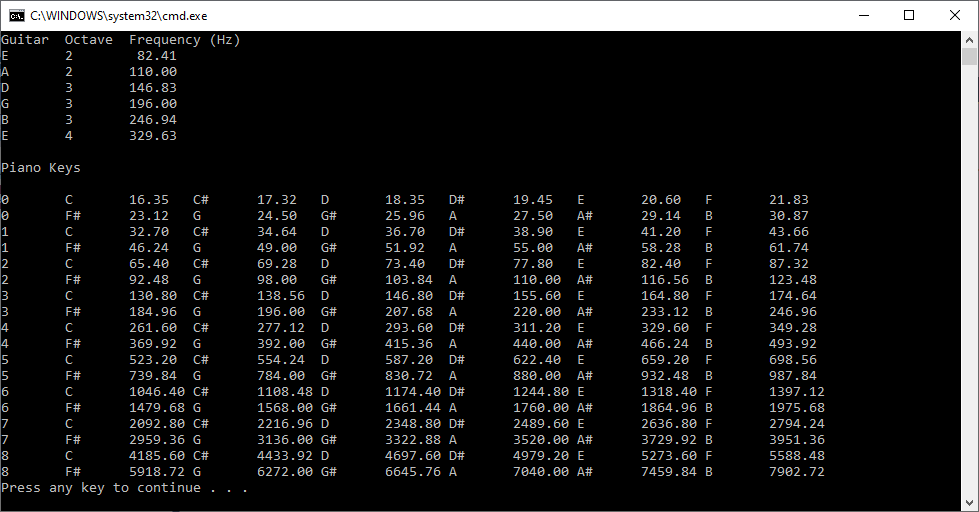
Guitar String and Piano Key Frequencies by James Pate Williams, Jr.
// FrequencyKey.cpp : Defines the entry point for the console application.
// James Pate Willims, Jr. (c) All Applicable Rights Reserved

#include "stdafx.h"
#include <math.h>
#include <iomanip>
#include <iostream>
#include <string>
#include <vector>
using namespace std;

vector<string> pnote;
double a = pow(2.0, 1.0 / 12.0);
double f0 = 440.0, gStrF[6];
double e2, a2, d3, g3, b3, e4;
double pfreq[9 * 12];
int offset = 0;

double fn(int n)
{
	return f0 * pow(a, n);
}

void printFrequency(char note, int octave, double frequency)
{
	cout << note << "\t" << octave << "\t";
	cout << setw(6) << fixed << setprecision(2);
	cout << frequency << endl;
}

int main()
{
	for (int octave = 0; octave <= 8; octave++)
	{
		pnote.push_back("C");
		pnote.push_back("C#");
		pnote.push_back("D");
		pnote.push_back("D#");
		pnote.push_back("E");
		pnote.push_back("F");
		pnote.push_back("F#");
		pnote.push_back("G");
		pnote.push_back("G#");
		pnote.push_back("A");
		pnote.push_back("A#");
		pnote.push_back("B");
	}

	pfreq[0] = 16.35;
	pfreq[1] = 17.32;
	pfreq[2] = 18.35;
	pfreq[3] = 19.45;
	pfreq[4] = 20.6;
	pfreq[5] = 21.83;
	pfreq[6] = 23.12;
	pfreq[7] = 24.5;
	pfreq[8] = 25.96;
	pfreq[9] = 27.5;
	pfreq[10] = 29.14;
	pfreq[11] = 30.87;

	for (int octave = 1; octave <= 8; octave++)
	{
		for (int i = 0; i < 12; i++)
		{
			pfreq[octave * 12 + i] = 2.0 * pfreq[(octave - 1) * 12 + i];
		}
	}

	gStrF[0] = e2 = fn(offset - 29);
	gStrF[1] = a2 = fn(offset - 24);
	gStrF[2] = d3 = fn(offset - 19);
	gStrF[3] = g3 = fn(offset - 14);
	gStrF[4] = b3 = fn(offset - 10);
	gStrF[5] = e4 = fn(offset - 5);

	cout << "Guitar\tOctave\tFrequency (Hz)" << endl;

	printFrequency('E', 2, e2);
	printFrequency('A', 2, a2);
	printFrequency('D', 3, d3);
	printFrequency('G', 3, g3);
	printFrequency('B', 3, b3);
	printFrequency('E', 4, e4);

	cout << endl;
	cout << "Piano Keys" << endl << endl;

	for (int octave = 0; octave <= 8; octave++)
	{
		for (int i = 0; i < 2; i++)
		{
			cout << octave << '\t';

			for (int j = 0; j < 6; j++)
			{
				{
					cout << pnote[(12 * octave + 6 * i + j) % 12] << '\t';
					cout << pfreq[(12 * octave + 6 * i + j)] << '\t';
				}
			}

			cout << endl;
		}
	}

	return 0;
}
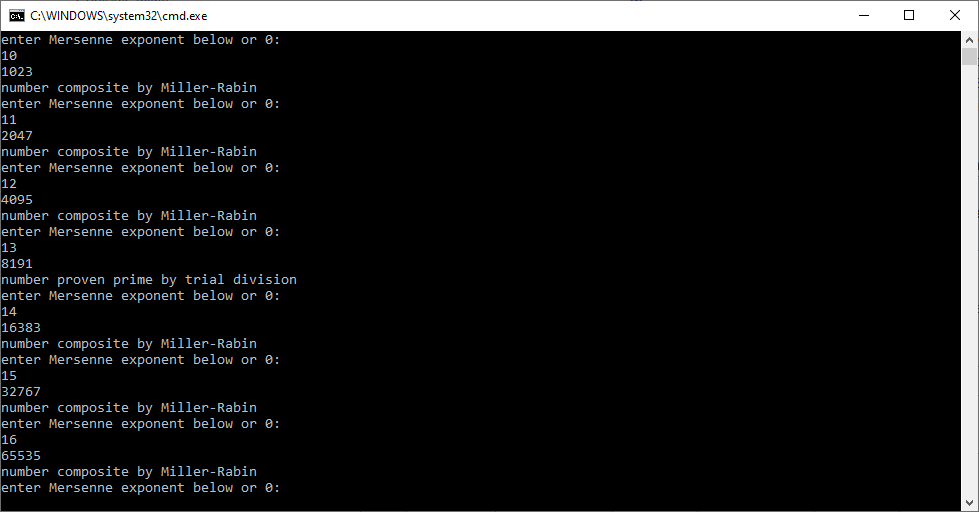
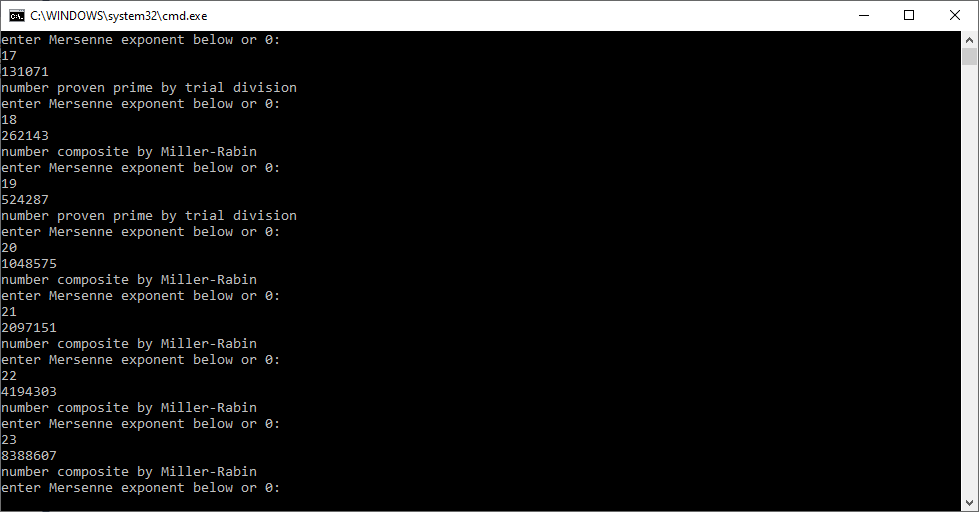
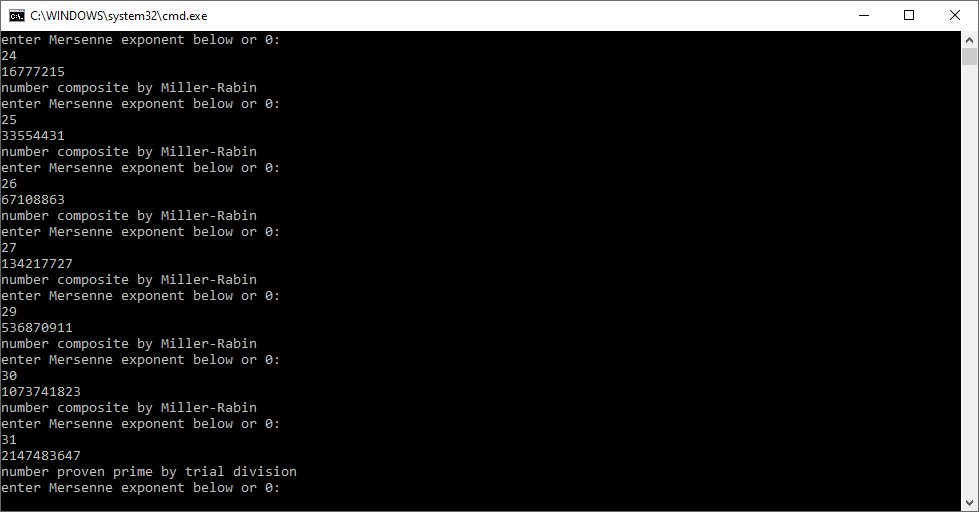
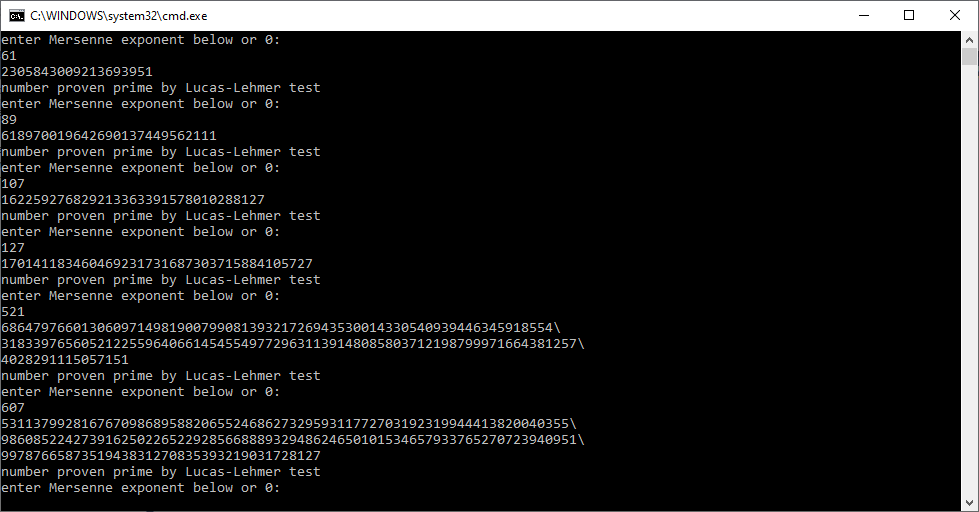
Lucas-Lehmer Primality Test in C Utilizing Arjen K. Lenstra’s FreeLIP (Free Large Integer Package) by James Pate Williams, Jr.

Comparison of Linear Systems Applications in C# and C++ by James Pate Williams, Jr.
Back in 2017 I created a C# application that implemented the direct methods: Cholesky decomposition, Gaussian elimination with partial pivoting, LU decomposition, and simple Gaussian elimination. The classical iterative methods Gauss-Seidel, Jacobi, Successive Overrelaxation, and gradient descent were also implemented along with the modern iterative methods: conjugate gradient descent and Modified Richardson’s method. Recently I translated the C# code to C++. I used the following test matrices: Cauchy, Lehmer, Pascal, and other. Below are some results. As is apparent the C++ runtimes are faster than the C# execution times.
Euler’s Method and Runge-Kutta 4 Algorithm for Numerically Solving an Ordinary Differential Equation by James Pate Williams, Jr.
I added the Runge-Kutta 4 algorithm found in Numerical Analysis: An Algorithmic Approach Third Edition by S. D. Conte and Carl de Boor. I also added a multistep method, the Adams-Bashforth Method.


Two-Tank Mixing Problem C++ Implementation Using Runge-Kutta 4 for a System of Two Ordinary Differential Equations Implementation by James Pate Williams, Jr.
// Two-tank Mixing Problem
// x'(t) = f(t, x, y)
// y'(t) = g(t, x, y)
// x(0) = 5, y(0) = 1
// See “Ordinary Differential Equations
// from Calculus to Dynamical Systems”
// by Virginia W. Noonburg for the exact
// solution, view pages 165 – 167. Also
// see “Elementary Numerical Analysis:
// An Algorithmic Approach Third
// Edition” by S. D. Conte and Carl de
// Boor pages 398 – 491 for the Runge-
// Kutta-4 equations.

#include "RK4System.h"

void RK4System::Solve(
	real t0, real t1,
	real x0, real  z0,
	real(*f)(real, real, real),
	real(*g)(real, real, real),
	int nSteps, vector<real>& tv,
	vector<real>& xv, vector<real>& yv)
{
	real k1, k2, k3, k4, l1, l2, l3, l4;
	real h, tn, xn, yn, xn1, yn1;

	h = (t1 - t0) / nSteps;
	tn = t0;
	xn = x0;
	yn = z0;
	tv.push_back(tn);
	xv.push_back(xn);
	yv.push_back(yn);

	for (unsigned int n = 1; n <= nSteps; n++)
	{
		tn = t0 + n * h;
		k1 = h * f(tn, xn, yn);
		l1 = h * g(tn, xn, yn);
		k2 = h * f(tn + 0.5 * h, xn + 0.5 * k1, yn + 0.5 * l1);
		l2 = h * g(tn + 0.5 * h, xn + 0.5 * k1, yn + 0.5 * l1);
		k3 = h * f(tn + 0.5 * h, xn + 0.5 * k2, yn + 0.5 * l2);
		l3 = h * g(tn + 0.5 * h, xn + 0.5 * k2, yn + 0.5 * l2);
		k4 = h * f(tn + h, xn + k3, yn + l3);
		l4 = h * g(tn + h, xn + k3, yn + l3);
		xn1 = xn + (k1 + 2 * k2 + 2 * k3 + k4) / 6.0;
		yn1 = yn + (l1 + 2 * l2 + 2 * l3 + l4) / 6.0;
		xn = xn1;
		yn = yn1;
		tv.push_back(tn);
		xv.push_back(xn);
		yv.push_back(yn);
	}
}
#pragma once
// Solves the following system of first order
// ordinary differential equations. Formulas
// are from "Elementary Numerical Analysis:
// An Algorithmic Approach" by S. D. Conte &
// Carl de Boor (c) 1980 8.12 page 398.
// x' = f(t, x, y)
// y' = g(t, x, y)

#include <vector>
using namespace std;

typedef long double real;

class RK4System
{
public:
	static void Solve(
		real t0, real t1,
		real x0, real  y0,
		real(*f)(real, real, real),
		real(*g)(real, real, real),
		int nSteps, vector<real>& tv,
		vector<real>& xv, vector<real>& yv);
};
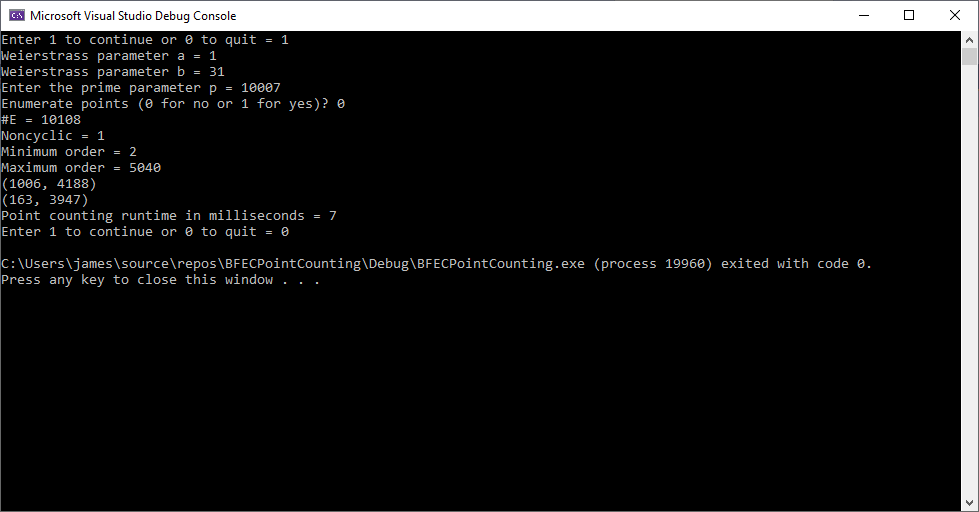
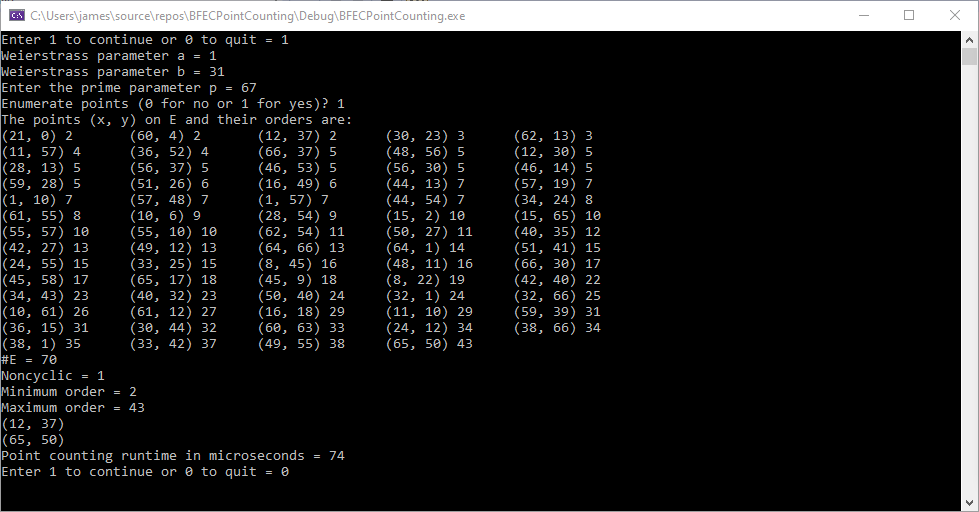
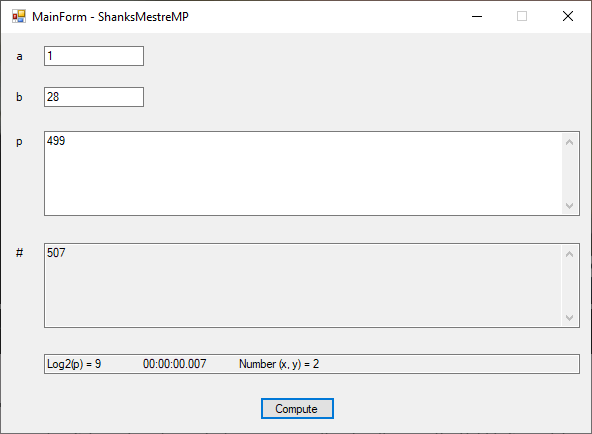
Brute Force Elliptic Curve Point Counting Algorithm Implementation by James Pate Williams, Jr.




#include <algorithm>
#include <iomanip>
#include <iostream>
#include <chrono>
#include <vector>
using namespace std;

typedef long long ll;

typedef struct ecPoint
{
	ll x, y;
} ECPOINT, *PECPOINT;

typedef struct ecPointOrder
{
	ll order;
	ECPOINT pt;
} ECPOINTORDER, * PECPOINTORDER;

int JACOBI(ll a, ll n)
{
	int e = 0, s;
	ll a1, b = a, m, n1;

	if (a == 0) return 0;
	if (a == 1) return 1;
	while ((b & 1) == 0)
	{
		b >>= 1;
		e++;
	}
	a1 = b;
	m = n % 8;
	if (!(e & 1)) s = 1;
	else if (m == 1 || m == 7) s = +1;
	else if (m == 3 || m == 5) s = -1;
	if (n % 4 == 3 && a1 % 4 == 3) s = -s;
	if (a1 != 1) n1 = n % a1; else n1 = 1;
	return s * JACOBI(n1, a1);
}

ll ExpMod(ll x, ll b, ll n)
/* returns x ^ b mod n */
{
	ll a = 1LL, s = x;

	if (b == 0)
		return 1LL;
	while (b != 0) {
		if (b & 1l) a = (a * s) % n;
		b >>= 1;
		if (b != 0) s = (s * s) % n;
	}
	if (a < 0)
		a += n;
	return a;
}

ll ExtendedEuclidean(ll b, ll n)
{
	ll b0 = b, n0 = n, t = 1, t0 = 0, temp, q, r;

	q = n0 / b0;
	r = n0 - q * b0;

	while (r > 0) {
		temp = t0 - q * t;
		if (temp >= 0) temp = temp % n;
		else temp = n - (-temp % n);
		t0 = t;
		t = temp;
		n0 = b0;
		b0 = r;
		q = n0 / b0;
		r = n0 - q * b0;
	}
	if (b0 != 1) return 0;
	else return t % n;
}

ll Weierstrass(ll a, ll b, ll x, ll p)
{
	return ((((x * x) % p) * x) % p + (a * x) % p + b) % p;
}

ll EPoints(
	bool print,
	ll a, ll b, ll p,
	vector<ECPOINT>& e)
	/* returns the number of points on the elliptic
	curve y ^ 2 = x ^ 3 + ax + b mod p */
{
	ll count = 0, m = (p + 1) / 4, x, y;
	ECPOINT pt{};

	if (p % 4 == 3) {
		for (x = 0; x < p; x++) {
			y = Weierstrass(a, b, x, p);
			if (JACOBI(y, p) != -1) {
				y = ExpMod(y, m, p);
				if (print)
				{
					cout << "(" << setw(2) << x << ", ";
					cout << y << ") " << endl;
				}
				pt.x = x;
				pt.y = y;
				e.push_back(pt);
				count++;
				y = -y % p;
				if (y < 0) y += p;
				if (y != 0)
				{
					if (print)
					{
						cout << "(" << setw(2) << x << ", ";
						cout << y << ") " << endl;
					}
					pt.x = x;
					pt.y = y;
					e.push_back(pt);
					count++;
				}
				if (print && count % 5 == 0)
					cout << endl;
			}
		}
		if (print && count % 5 != 0)
			cout << endl;
	}
	return count;
}

void Add(ll a, ll p, ECPOINT P,
	ECPOINT Q, ECPOINT& R)
	/* elliptic curve point partial addition */
{
	ll i, lambda;

	if (P.x == Q.x && P.y == 0 && Q.y == 0) {
		R.x = 0;
		R.y = 1;
		return;
	}
	if (P.x == Q.x && P.y == p - Q.y) {
		R.x = 0;
		R.y = 1;
		return;
	}
	if (P.x == 0 && P.y == 1) {
		R = Q;
		return;
	}
	if (Q.x == 0 && Q.y == 1) {
		R = P;
		return;
	}
	if (P.x != Q.x) {
		i = Q.x - P.x;
		if (i < 0) i += p;
		i = ExtendedEuclidean(i, p);
		lambda = ((Q.y - P.y) * i) % p;
	}
	else {
		i = ExtendedEuclidean((2 * P.y) % p, p);
		lambda = ((3 * P.x * P.x + a) * i) % p;
	}
	if (lambda < 0) lambda += p;
	R.x = (lambda * lambda - P.x - Q.x) % p;
	R.y = (lambda * (P.x - R.x) - P.y) % p;
	if (R.x < 0) R.x += p;
	if (R.y < 0) R.y += p;
}

void Multiply(
	ll a, ll k, ll p,
	ECPOINT P,
	ECPOINT& R)
{
	ECPOINT S;

	R.x = 0;
	R.y = 1;
	S = P;
	while (k != 0) {
		if (k & 1) Add(a, p, R, S, R);
		k >>= 1;
		if (k != 0) Add(a, p, S, S, S);
	}
}

ll Order(ll a, ll p, ECPOINT P)
{
	ll order = 1;
	ECPOINT Q = P, R{};

	do {
		order++;
		Add(a, p, P, Q, R);
		Q = R;
	} while (R.x != 0 && R.y != 1);
	return order;
}

const int PrimeSize = 10000000;
bool sieve[PrimeSize];

void PopulateSieve() {

	// sieve of Eratosthenes

	int c, inc, i, n = PrimeSize - 1;

	for (i = 0; i < n; i++)
		sieve[i] = false;

	sieve[1] = false;
	sieve[2] = true;

	for (i = 3; i <= n; i++)
		sieve[i] = (i & 1) == 1 ? true : false;

	c = 3;

	do {
		i = c * c;
		inc = c + c;

		while (i <= n) {
			sieve[i] = false;
			i += inc;
		}

		c += 2;
		while (!sieve[c])
			c++;
	} while (c * c <= n);
}

ll Partition(
	vector<ECPOINTORDER>& a, ll n, ll lo, ll hi)
{
	ll pivotIndex = lo + (hi - lo) / 2;
	ECPOINTORDER po = a[(unsigned int)pivotIndex];
	ECPOINTORDER x = po;
	ECPOINTORDER t = x;

	a[(unsigned int)pivotIndex] = a[(unsigned int)hi];
	a[(unsigned int)hi] = t;

	ll storeIndex = lo;

	for (unsigned int i = (unsigned int)lo; i < (unsigned int)hi; i++)
	{
		if (a[i].order < x.order)
		{
			t = a[i];
			a[i] = a[(unsigned int)storeIndex];
			a[(unsigned int)(storeIndex++)] = t;
		}
	}

	t = a[(unsigned int)storeIndex];
	a[(unsigned int)storeIndex] = a[(unsigned int)hi];
	a[(unsigned int)hi] = t;

	return storeIndex;
}

static void DoQuickSort(
	vector<ECPOINTORDER>& a, ll n, ll p, ll r)
{
	if (p < r)
	{
		ll q = Partition(a, n, p, r);

		DoQuickSort(a, n, p, q - 1);
		DoQuickSort(a, n, q + 1, r);
	}
}

void QuickSort(vector<ECPOINTORDER>& a, ll n)
{
	DoQuickSort(a, n, 0, n - 1);
}

int main()
{
	PopulateSieve();

	while (true)
	{
		bool noncyclic = false;
		int option;
		ll a, b, p;

		cout << "Enter 1 to continue or 0 to quit = ";
		cin >> option;

		if (option == 0)
			break;

		cout << "Weierstrass parameter a = ";
		cin >> a;
		cout << "Weierstrass parameter b = ";
		cin >> b;
		cout << "Enter the prime parameter p = ";
		cin >> p;

		if (!sieve[p])
		{
			cout << "p is not a prime number. " << endl;
			continue;
		}

		if (p % 4 != 3)
		{
			cout << "p mod 4 must be 3 for this algorithm." << endl;
			continue;
		}

		bool print = false, enumerate = false;
		vector<ECPOINT> e;
		vector<ECPOINTORDER> eOrder;

		cout << "Enumerate points (0 for no or 1 for yes)? ";
		cin >> option;

		enumerate = option == 1;
		auto time0 = chrono::high_resolution_clock::now();
		ll count = EPoints(print, a, b, p, e);
		auto time1 = chrono::high_resolution_clock::now();
		auto elapsed = time1 - time0;
		ll h = count + 1;
		ll maxOrder = 0;
		ll minOrder = h;
		ll order = -1;
		ECPOINT P{}, Q{};

		if (enumerate)
			cout << "The points (x, y) on E and their orders are:" << endl;

		for (unsigned int i = 0; i < count; i++)
		{
			ECPOINTORDER ptOrder{};

			order = Order(a, p, e[i]);
			ptOrder.order = order;
			ptOrder.pt = e[i];
			eOrder.push_back(ptOrder);

			if (order < h)
				noncyclic = true;
			if (order < minOrder) {
				P = e[i];
				minOrder = order;
			}
			if (order > maxOrder) {
				Q = e[i];
				maxOrder = order;
			}
		}
		if (enumerate)
		{
			QuickSort(eOrder, count);

			for (unsigned int i = 0; i < eOrder.size(); i++)
			{
				cout << "(" << eOrder[i].pt.x << ", ";
				cout << eOrder[i].pt.y << ") ";
				cout << eOrder[i].order << "\t";
				if ((i + 1) % 5 == 0)
					cout << endl;
			}
			if (count % 5 != 0)
				cout << endl;
		}
		cout << "#E = " << h << endl;
		cout << "Noncyclic = " << noncyclic << endl;
		cout << "Minimum order = " << minOrder << endl;
		cout << "Maximum order = " << maxOrder << endl;
		cout << "(" << P.x << ", " << P.y << ")" << endl;
		cout << "(" << Q.x << ", " << Q.y << ")" << endl;

		long long runtime = chrono::duration_cast<chrono::milliseconds>(elapsed).count();
		if (runtime != 0)
			cout << "Point counting runtime in milliseconds = " << runtime << endl;
		else
		{
			runtime = chrono::duration_cast<chrono::microseconds>(elapsed).count();
			cout << "Point counting runtime in microseconds = " << runtime << endl;
		}
	}
	return 0;
}

