My reference is Numerical Analysis: An Algorithmic Approach 3rd Edition by S. D. Conte and Carl de Boor Chapter 9.1.
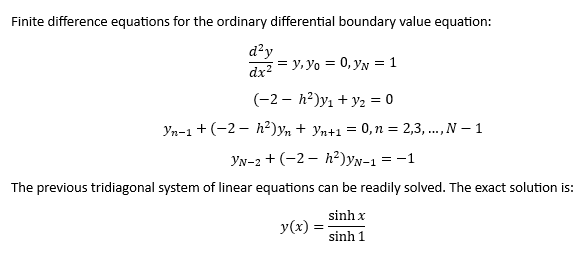
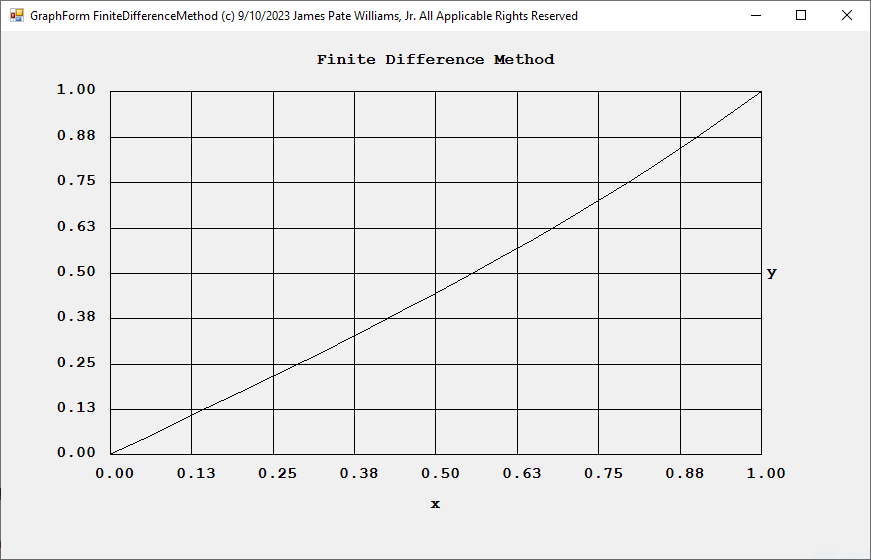


My reference is Numerical Analysis: An Algorithmic Approach 3rd Edition by S. D. Conte and Carl de Boor Chapter 9.1.
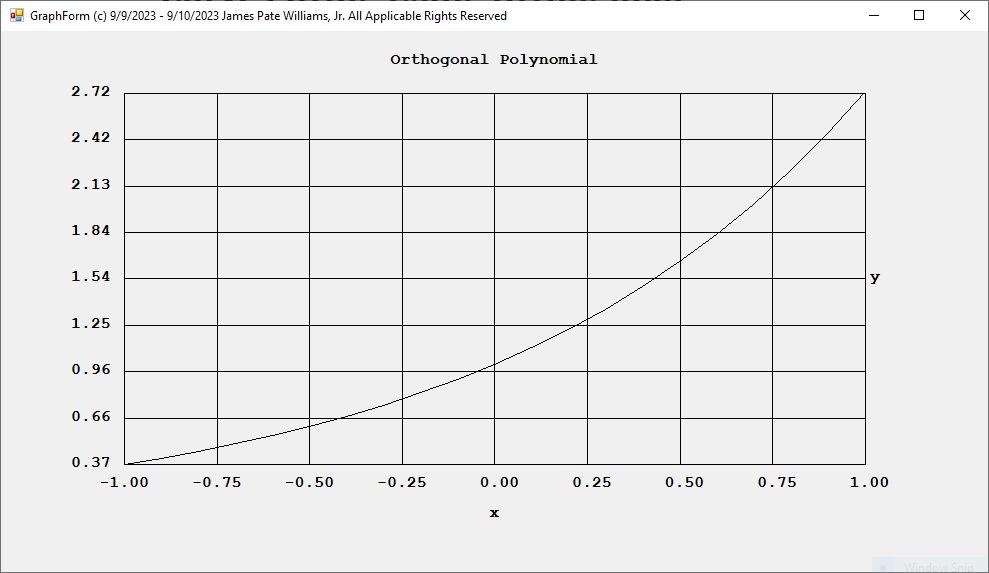
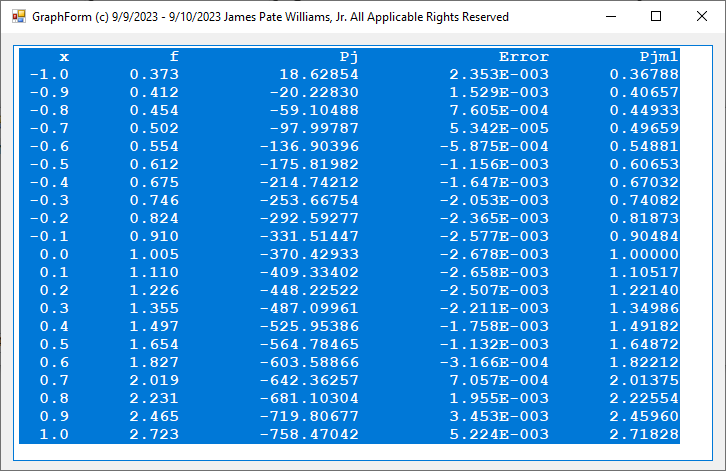
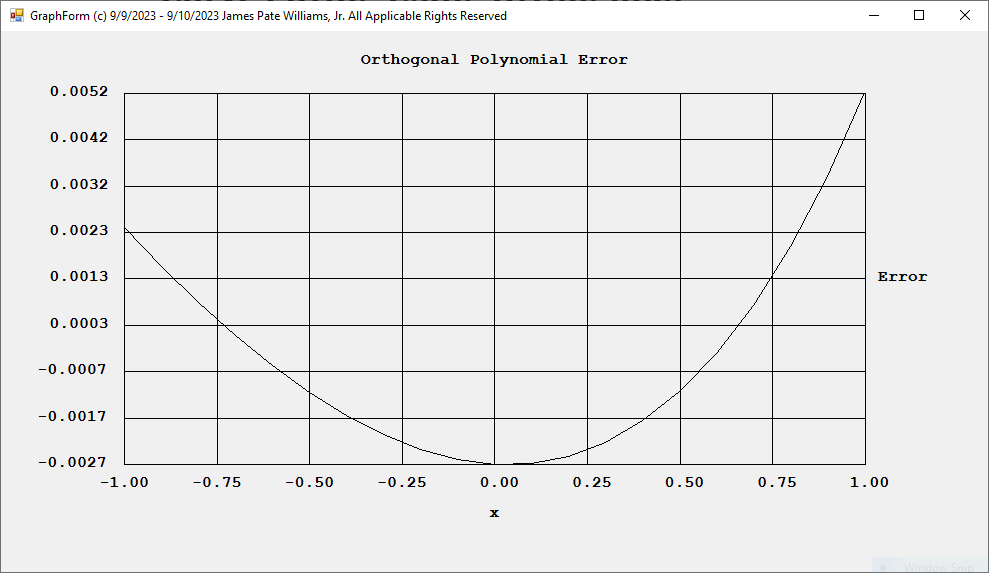
The curve in this best fit example is the function y(x) = exp(x).

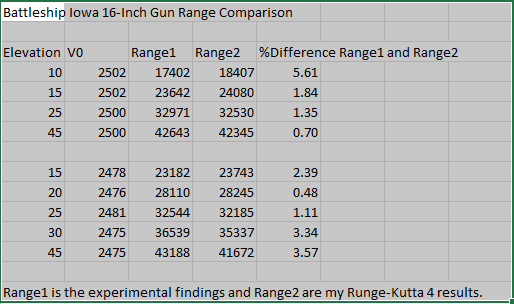
I added the Runge-Kutta 4 algorithm found in Numerical Analysis: An Algorithmic Approach Third Edition by S. D. Conte and Carl de Boor. I also added a multistep method, the Adams-Bashforth Method.


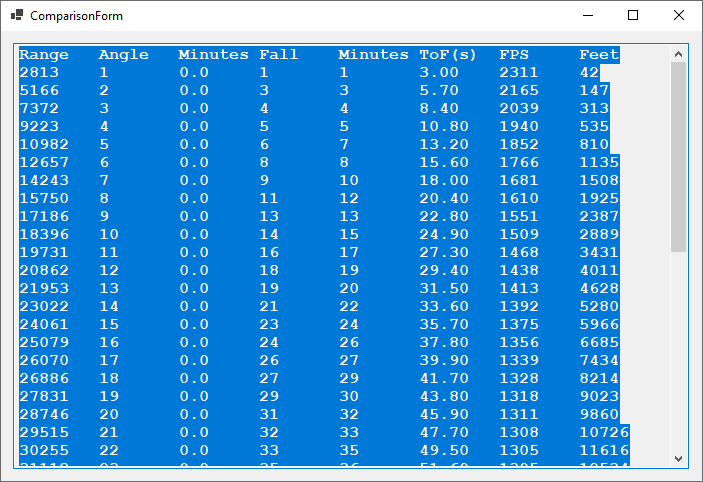
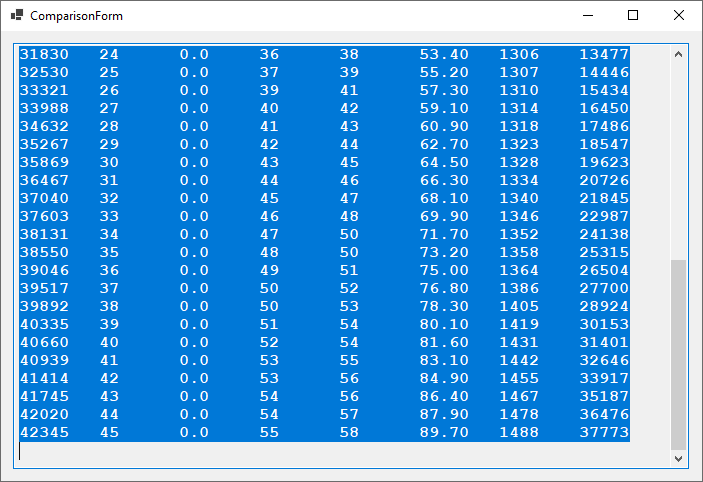
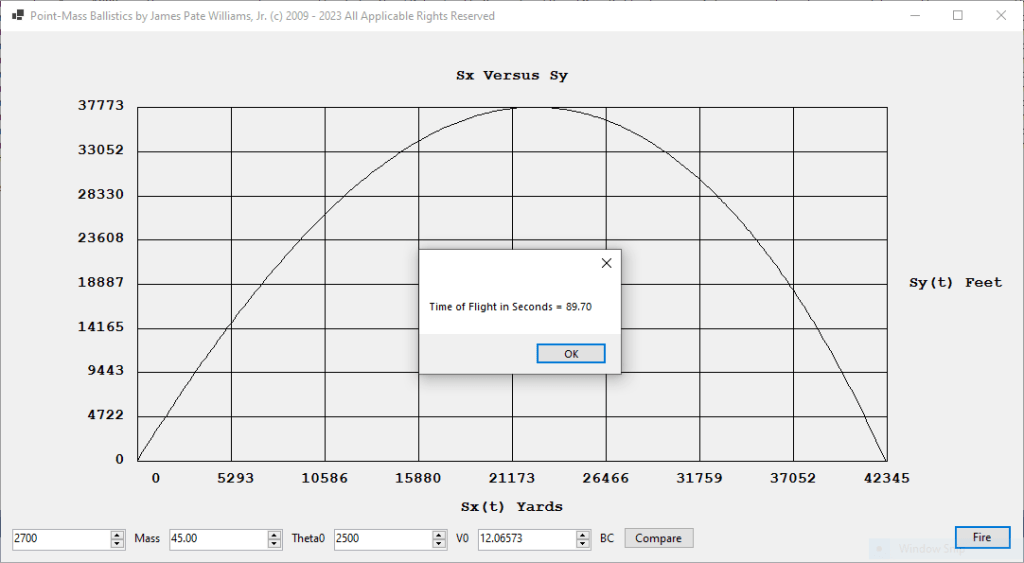
“Babe Ruth is generally considered the owner of the record for the longest home run in MLB history with a 575-foot bomb launched at Navin Field in Detroit in 1921.” – https://www.msn.com/en-us/sports/mlb/what-is-the-longest-home-run-in-mlb-history/ar-AA1dGwlZ
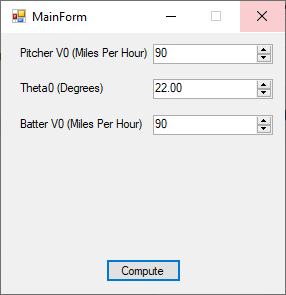
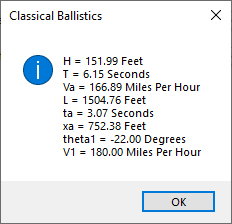
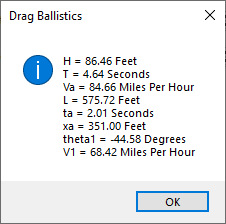
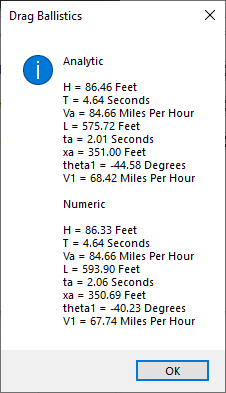
As you can see, I estimated the pitch velocity at 90 miles per hour and Babe Ruth’s (Sultan of Swing) at 90 miles per hour also. My analytic calculations yield a range of the baseball’s trajectory as about 576 feet.
// "Numerical Computation 2: Methods, Software,
// and Analysis" by Christoph W. Ueberhuber
// Chapter 17 Random Numbers
// "The Art of Computer Programming Volume 2"
// "Seminumerical Algorithms Second Edition"
// "Chapter 3 RANDOM NUMBERS" by Donald E. Knuth
// https://en.wikipedia.org/wiki/Mersenne_Twister

using System.Collections.Generic;

namespace SimplePRNGs
{
    class PRNGs
    {
        private long AMxn1, AMxn;
        private long AMyn1, AMyn;
        private long AMk;
        private long AMm = 34359738368;
        private long LCG0z0, LCG0z1;
        private long LCG1z0, LCG1z1;
        private long LCG2z0, LCG2z1, LCG2z2;
        private long MFG0z0, MFG0z1;
        private readonly long LCG0m = 4294967296;
        private readonly long LCG2m = 2147483647;
        private readonly List<long> AMV = new();
        private long MTindex;
        private long[] MT;
        private LaggedFibRng fibRng;

        public void SetSeedLCG0(long z0)
        {
            LCG0z0 = z0;
        }

        public void SetSeedLCG1(long z0)
        {
            LCG1z0 = z0;
        }

        public void SetSeedLCG2(long z0, long z1)
        {
            LCG2z0 = z0;
            LCG2z1 = z1;
        }

        public long LCG0()
        {
            LCG0z1 = (69069 * LCG0z0) % LCG0m;
            LCG0z0 = LCG0z1;
            return LCG0z1;
        }

        public long LCG1()
        {
            LCG1z1 = (69069 * LCG1z0 + 1) % LCG0m;
            LCG1z0 = LCG1z1;
            return LCG1z1;
        }

        public long LCG2()
        {
            LCG2z2 = (1999 * LCG2z1 + 4444 * LCG2z0) % LCG2m;
            LCG2z0 = LCG2z1;
            LCG2z1 = LCG2z2;
            return LCG2z2;
        }

        public void SetSeedMFG0(long z0, long z1)
        {
            MFG0z0 = z0;
            MFG0z1 = z1;
        }

        public long MFG0()
        {
            long MFG0z2 = (MFG0z1 + MFG0z0) % LCG0m;
            MFG0z0 = MFG0z1;
            MFG0z1 = MFG0z2;
            return MFG0z2;
        }

        public void ComputeNextXY()
        {
            AMxn1 = (3141592653 * AMxn + 2718281829) % AMm;

            if (AMxn1 < 0)
                AMxn1 += AMm;

            AMyn1 = (2718281829 * AMyn + 3141592653) % AMm;

            if (AMyn1 < 0)
                AMyn1 += AMm;
        }

        public void AMSeed(long k, long x0, long y0)
        {
            long AMTxn1, AMTxn = x0;

            AMxn = x0;
            AMyn = y0;
            AMk = k;

            for (int i = 0; i < k; i++)
            {
                AMTxn1 = (3141592653 * AMTxn + 2718281829) % AMm;

                if (AMTxn1 < 0)
                    AMTxn1 += AMm;

                AMTxn = AMTxn1;
                AMV.Add(AMTxn1);
            }
        }

        public long AlgorithmM()
        {
            ComputeNextXY();
            AMxn = AMxn1;
            AMyn = AMyn1;

            long j = (AMk * AMyn1) / AMm;
            long r = AMV[(int)j];

            AMV[(int)j] = AMxn1;

            if (r < 0)
                r += AMm;

            return r;
        }

        public void MTInitialization(long seed)
        {
            long f = 6364136223846793005;
            long n = 312, w = 64;

            MTindex = n;
            MT = new long[n];
            MT[0] = seed;

            for (int i = 1; i < n; i++)
                MT[i] = f * (MT[i - 1] ^ (MT[i - 1] >> (int)(w - 2))) + i;
        }

        public long MTExtractNumber()
        {
            unchecked
            {
                long n = 312;
                long c = (long)0xFFF7EEE000000000;
                long b = 0x71D67FFFEDA60000;
                long d = 0x5555555555555555;
                long u = 29, s = 17, t = 27, l = 43;

                if (MTindex == n)
                    MTTwist();

                long y = MT[MTindex];

                y ^= ((y >> (int)u) & d);
                y ^= ((y << (int)s) & b);
                y ^= ((y << (int)t) & c);
                y ^= (y >> (int)l);
                MTindex++;
                return y;
            }
        }

        public void MTTwist()
        {
            unchecked
            {
                long n = 312, m = 156, r = 31;
                long a = (long)0xB5026F5AA96619E9;
                MTindex = n + 1;
                long lower_mask = (1 << (int)r) - 1;
                long upper_mask = ~lower_mask;

                for (int i = 0; i < n; i++)
                {
                    long x = (MT[i] & upper_mask) |
                       (MT[(i + 1) % n] & lower_mask);
                    long xA = x >> 1;

                    if (x % 2 != 0)
                        xA ^= a;

                    MT[i] = MT[(i + m) % n] ^ xA;
                }
            }

            MTindex = 0;
        }

        public void LaggedFibRngSeed(int seed)
        {
            fibRng = new LaggedFibRng(seed);
        }

        public long LaggedFibonacci(long modulus)
        {
            long lo = fibRng.Next();
            long hi = fibRng.Next();
            long rs = ((hi << 31) | lo) % modulus;

            return rs;
        }
    }
}
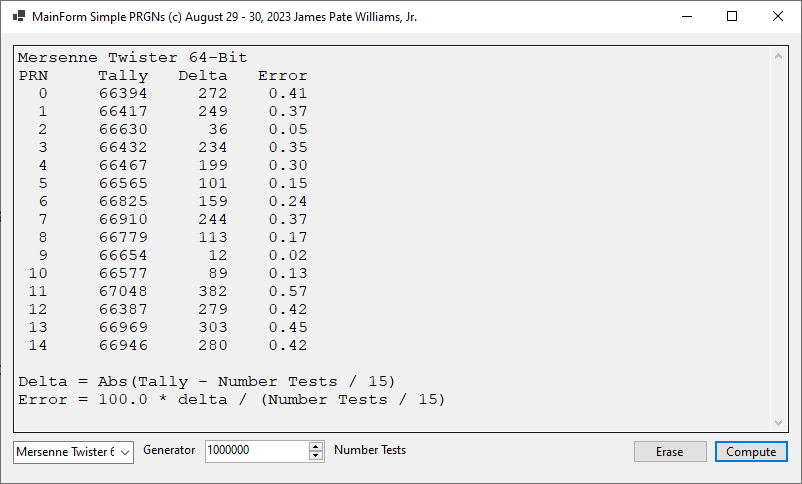
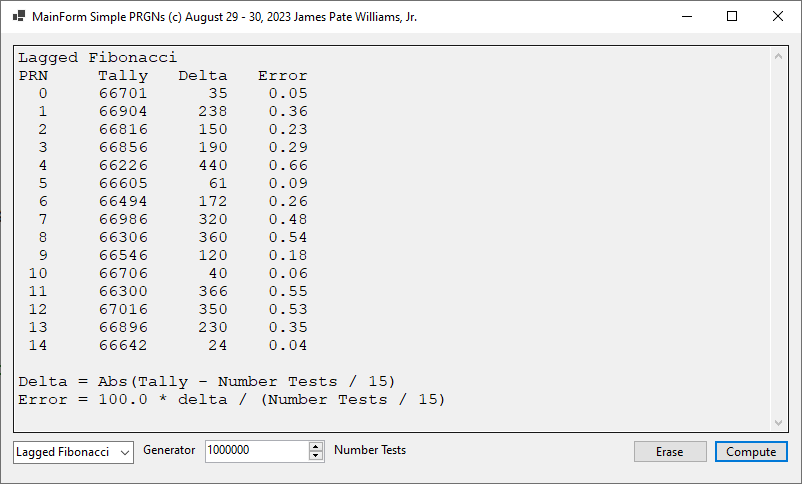
//https://learn.microsoft.com/en-us/archive/msdn-magazine/2016/august/test-run-lightweight-random-number-generation
// modified by current author James Pate Williams, Jr. on August 30, 2023

using System.Collections.Generic;

namespace SimplePRNGs
{
    public class LaggedFibRng
    {
        private const int k = 606; // Largest magnitude"-index"
        private const int j = 273; // Other "-index"
        private const long m = 4294967296;  // 2^32
        private readonly List<long> vals = null;
        private long seed;
        public LaggedFibRng(int seed)
        {
            vals = new List<long>();
            for (int i = 0; i < k + 1; ++i)
                vals.Add(i);
            if (seed % 2 == 0) vals[0] = 11;
            // Burn some values away
            for (int ct = 0; ct < 1000; ++ct)
            {
                long dummy = Next();
            }
        }  // ctor
        public long Next()
        {
            // (a + b) mod n = [(a mod n) + (b mod n)] mod n
            long left = vals[0] % m;    // [x-big]
            long right = vals[k - j] % m; // [x-other]
            long sum = (left + right) % m;  // prevent overflow
            if (sum < 0)
                seed = sum + m;
            else
                seed = sum;
            vals.Insert(k + 1, seed);  // Add new val at end
            vals.RemoveAt(0);  // Delete now irrelevant [0] val
            return seed;
        }
    }
}


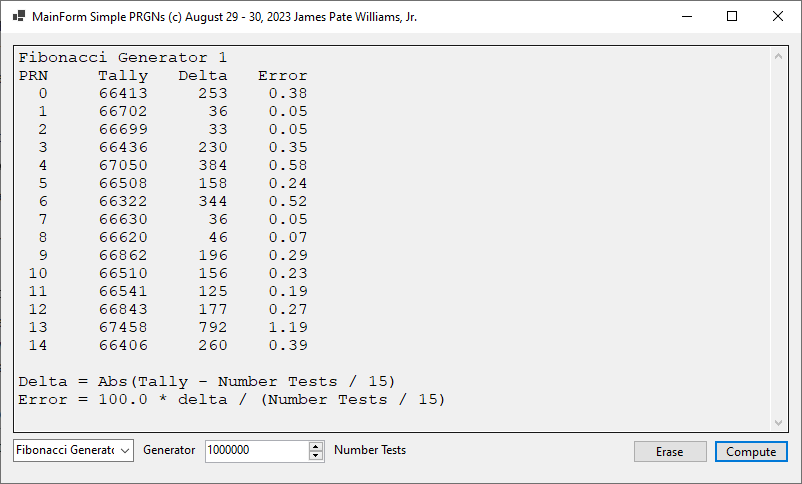

// "Numerical Computation 2: Methods, Software,
// and Analysis" by Christoph W. Ueberhuber
// Chapter 17 Random Numbers
// "The Art of Computer Programming Volume 2"
// "Seminumerical Algorithms Second Edition"
// "Chapter 3 RANDOM NUMBERS" by Donald E. Knuth

using System.Collections.Generic;

namespace SimplePRNGs
{
    class PRNGs
    {
        private long AMxn1, AMxn;
        private long AMyn1, AMyn;
        private long AMk;
        private long AMm = 34359738368;
        private long LCG0z0, LCG0z1;
        private long LCG1z0, LCG1z1;
        private long LCG2z0, LCG2z1, LCG2z2;
        private long MFG0z0, MFG0z1;
        private readonly long LCG0m = 4294967296;
        private readonly long LCG2m = 2147483647;
        private readonly List<long> AMV = new();

        public void SetSeedLCG0(long z0)
        {
            LCG0z0 = z0;
        }

        public void SetSeedLCG1(long z0)
        {
            LCG1z0 = z0;
        }

        public void SetSeedLCG2(long z0, long z1)
        {
            LCG2z0 = z0;
            LCG2z1 = z1;
        }

        public long LCG0()
        {
            LCG0z1 = (69069 * LCG0z0) % LCG0m;
            LCG0z0 = LCG0z1;
            return LCG0z1;
        }

        public long LCG1()
        {
            LCG1z1 = (69069 * LCG1z0 + 1) % LCG0m;
            LCG1z0 = LCG1z1;
            return LCG1z1;
        }

        public long LCG2()
        {
            LCG2z2 = (1999 * LCG2z1 + 4444 * LCG2z0) % LCG2m;
            LCG2z0 = LCG2z1;
            LCG2z1 = LCG2z2;
            return LCG2z2;
        }

        public void SetSeedMFG0(long z0, long z1)
        {
            MFG0z0 = z0;
            MFG0z1 = z1;
        }

        public long MFG0()
        {
            long MFG0z2 = (MFG0z1 + MFG0z0) % LCG0m;
            MFG0z0 = MFG0z1;
            MFG0z1 = MFG0z2;
            return MFG0z2;
        }

        public void ComputeNextXY()
        {
            AMxn1 = (3141592653 * AMxn + 2718281829) % AMm;

            if (AMxn1 < 0)
                AMxn1 += AMm;

            AMyn1 = (2718281829 * AMyn + 3141592653) % AMm;

            if (AMyn1 < 0)
                AMyn1 += AMm;
        }

        public void AMSeed(long k, long x0, long y0)
        {
            long AMTxn1, AMTxn = x0;

            AMxn = x0;
            AMyn = y0;
            AMk = k;

            for (int i = 0; i < k; i++)
            {
                AMTxn1 = (3141592653 * AMTxn + 2718281829) % AMm;

                if (AMTxn1 < 0)
                    AMTxn1 += AMm;

                AMTxn = AMTxn1;
                AMV.Add(AMTxn1);
            }
        }

        public long AlgorithmM()
        {
            ComputeNextXY();
            AMxn = AMxn1;
            AMyn = AMyn1;

            long j = (AMk * AMyn1) / AMm;
            long r = AMV[(int)j];

            AMV[(int)j] = AMxn1;

            if (r < 0)
                r += AMm;

            return r;
        }
    }
}
namespace PointMassBallistics
{
    public class TableEntry : IComparable<TableEntry>
    {
        public double range, elevationDegrees, elevationMinutes,
            angleFallDegrees, angleFallMinutes, timeOfFlight,
            strikingVelocity, maximumOrdinate;
        public int CompareTo(TableEntry other)
        {
            if (elevationDegrees < other.elevationDegrees &&
                elevationMinutes < other.elevationMinutes)
                return -1;
            if (elevationDegrees > other.elevationDegrees &&
                elevationMinutes > other.elevationMinutes)
                return +1;
            return 0;
        }
    }
}
// Solves the following system of first order
// ordinary differential equations. Formulas
// are from "Elementary Numerical Analysis:
// An Algorithmic Approach 3rd Edition" by S.
// D. Conte & Carl de Boor (c) 1980 8.12 page 398.
// Extended from two to four equations.
// See https://apps.dtic.mil/dtic/tr/fulltext/u2/a439796.pdf
// Also view https://eugeneleeslover.com/USN-GUNS-AND-RANGE-TABLES/OP-770-1.html

using System;
using System.Collections.Generic;

namespace PointMassBallistics
{
    class RungeKutta4
	{
		private double BC;
		private readonly double g = 32.17405;
		private readonly double[] GarveN = {
			2, 3, 5, 3, 2, 1.7, 1.55 };
		private readonly double[] log10K = {
			5.66989 - 10, 2.77344 - 10, 6.80187 - 20,
			2.98090 - 10, 6.11926 - 10, 7.09620 - 10, 7.60905 - 10 };
		private readonly double[] K = new double[7];
		private int zone;

		static private double Density(double y)
		{
			return Math.Pow(10, -0.00001372 * y);
		}

		static private int ComputeIndex(double v)
		{
			int index;

			if (v > 3600)
				index = 6;

			else if (v > 2600 && v <= 3600)
				index = 5;

			else if (v > 1800 && v <= 2600)
				index = 4;

			else if (v > 1370 && v <= 1800)
				index = 3;

			else if (v > 1230 && v <= 1370)
				index = 2;

			else if (v > 790 && v <= 1230)
				index = 1;

			else
				index = 0;

			return index;
		}

		public double MayevskiRetardation(double v, int zone)
		{
			// See Exterior Ballistics 1935 by Ernest Edward Herrmann
			// Garve function

			return K[zone] * Math.Pow(v, GarveN[zone]);
		}

		private double Vx(double syn, double vxn, double vyn)
		{
			double v = Math.Sqrt(vxn * vxn + vyn * vyn);
			zone = ComputeIndex(v);
			double E = Density(syn) * MayevskiRetardation(v, zone) / BC;
			return -E * vxn / v;
        }

		private double Vy(double syn, double vxn, double vyn)
		{
			double v = Math.Sqrt(vxn * vxn + vyn * vyn);
			zone = ComputeIndex(v);
			double E = Density(syn) * MayevskiRetardation(v, zone) / BC;
			return -E * vyn / v - g;
		}

		static private double Sx(double vxn)
        {
			return vxn;
        }

		static private double Sy(double vyn)
		{
			return vyn;
		}

		public void Solve(
			double t0, double t1,
			double vx0, double vy0,
			double sx0, double sy0,
			double BC, int nSteps, ref List<double> lt,
			ref List<double> lvx, ref List<double> lvy,
			ref List<double> lsx, ref List<double> lsy)
		{
			double k1, k2, k3, k4;
			double l1, l2, l3, l4;
			double m1, m2, m3, m4;
			double n1, n2, n3, n4;
			double h = (t1 - t0) / nSteps, tn = t0;
			double vxn = vx0, vyn = vy0, sxn = sx0, syn = sy0;
			int n = 1;

			for (int i = 0; i < log10K.Length; i++)
				K[i] = Math.Pow(10, log10K[i]);

			this.BC = BC;

			lt.Add(tn);
			lvx.Add(vxn);
			lvy.Add(vyn);
			lsx.Add(sxn / 3);
			lsy.Add(syn);

			while (true)
			{
				tn = t0 + n * h;
				k1 = h * Vx(syn, vxn, vyn);
				l1 = h * Vy(syn, vxn, vyn);
				m1 = h * Sx(vxn);
				n1 = h * Sy(vyn);

				k2 = h * Vx(syn + 0.5 * n1, vxn + 0.5 * k1, vyn + 0.5 * l1);
				l2 = h * Vy(syn + 0.5 * n1, vxn + 0.5 * k1, vyn + 0.5 * l1);
				m2 = h * Sx(vxn + 0.5 * m1);
				n2 = h * Sy(vyn + 0.5 * n1);

				k3 = h * Vx(syn + 0.5 * n2, vxn + 0.5 * k2, vyn + 0.5 * l2);
				l3 = h * Vy(syn + 0.5 * n2, vxn + 0.5 * k2, vyn + 0.5 * l2);
				m3 = h * Sx(vxn + 0.5 * m2);
				n3 = h * Sy(vyn + 0.5 * n2);

				k4 = h * Vx(syn + n3, vxn + k3, vyn + l3);
				l4 = h * Vy(syn + n3, vxn + k3, vyn + l3);
				m4 = h * Sx(vxn + m3);
				n4 = h * Sy(vyn + n3);

				vxn = vx0 + (k1 + 2 * k2 + 2 * k3 + k4) / 6.0;
				vyn = vy0 + (l1 + 2 * l2 + 2 * l3 + l4) / 6.0;
				sxn = sx0 + (m1 + 2 * m2 + 2 * m3 + m4) / 6.0;
				syn = sy0 + (n1 + 2 * n2 + 2 * n3 + n4) / 6.0;

				vx0 = vxn;
				vy0 = vyn;
				sx0 = sxn;
				sy0 = syn;

				n++;

				lt.Add(tn);
				lvx.Add(vxn);
				lvy.Add(vyn);
				lsx.Add(sxn / 3);
				lsy.Add(syn);

				if (syn <= 1.0e-2)
					break;
			}
		}
	}
}
// Solves the following system of first order
// ordinary differential equations. Formulas
// are from "Elementary Numerical Analysis:
// An Algorithmic Approach 3rd Edition" by S.
// D. Conte & Carl de Boor (c) 1980 8.12 page 398.
// Extended from two to four equations.
// See "Ordinary Differential Equations
// from Calculus to Dynamical Systems"
// by Virginia W. Noonburg for the exact
// solution, view pages 167 - 170.

using System.Collections.Generic;

namespace DoubleSpring
{
	class RungeKutta4
	{
		private double omega2;

		static private double Dx1(double x3)
        {
			return x3;
        }

		static private double Dx2(double x4)
		{
			return x4;
		}

		private double Dx3(double x1, double x2)
		{
			return -2 * omega2 * x1 + omega2 * x2;
		}

		private double Dx4(double x1, double x2)
		{
			return omega2 * x1 - omega2 * x2;
		}

		public void Solve(
			double t0, double t1,
			double x10, double x20,
			double x30, double x40,
			double omega, int nSteps, ref List<double> lt,
			ref List<double> lx1, ref List<double> lx2,
			ref List<double> lx3, ref List<double> lx4)
		{
			double k1, k2, k3, k4;
			double l1, l2, l3, l4;
			double m1, m2, m3, m4;
			double n1, n2, n3, n4;
			double h = (t1 - t0) / nSteps, tn = t0;
			double x1n = x10, x2n = x20, x3n = x30, x4n = x40;
			int n = 1;

			omega2 = omega * omega;

			lt.Add(tn);
			lx1.Add(x1n);
			lx2.Add(x2n);
			lx3.Add(x3n);
			lx4.Add(x4n);

			while (tn <= t1)
			{
				tn = t0 + n * h;
				k1 = h * Dx1(x3n);
				l1 = h * Dx2(x4n);
				m1 = h * Dx3(x1n, x2n);
				n1 = h * Dx4(x1n, x2n);

				k2 = h * Dx1(x3n + 0.5 * k1);
				l2 = h * Dx2(x4n + 0.5 * l1);
				m2 = h * Dx3(x1n + 0.5 * m1, x2n + 0.5 * n1);
				n2 = h * Dx4(x1n + 0.5 * m1, x2n + 0.5 * n1);

				k3 = h * Dx1(x3n + 0.5 * k2);
				l3 = h * Dx2(x4n + 0.5 * l2);
				m3 = h * Dx3(x1n + 0.5 * m2, x2n + 0.5 * n2);
				n3 = h * Dx4(x1n + 0.5 * m2, x2n + 0.5 * n2);

				k4 = h * Dx1(x3n + k3);
				l4 = h * Dx2(x4n + l3);
				m4 = h * Dx3(x1n + m3, x2n + n3);
				n4 = h * Dx4(x1n + m3, x2n + n3);

				x1n = x10 + (k1 + 2 * k2 + 2 * k3 + k4) / 6.0;
				x2n = x20 + (l1 + 2 * l2 + 2 * l3 + l4) / 6.0;
				x3n = x30 + (m1 + 2 * m2 + 2 * m3 + m4) / 6.0;
				x4n = x40 + (n1 + 2 * n2 + 2 * n3 + n4) / 6.0;

				x10 = x1n;
				x20 = x2n;
				x30 = x3n;
				x40 = x4n;

				n++;

				lt.Add(tn);
				lx1.Add(x1n);
				lx2.Add(x2n);
				lx3.Add(x3n);
				lx4.Add(x4n);
			}
		}
	}
}
// Two-tank Mixing Problem
// x'(t) = f(t, x, y)
// y'(t) = g(t, x, y)
// x(0) = 5, y(0) = 1
// See “Ordinary Differential Equations
// from Calculus to Dynamical Systems”
// by Virginia W. Noonburg for the exact
// solution, view pages 165 – 167. Also
// see “Elementary Numerical Analysis:
// An Algorithmic Approach Third
// Edition” by S. D. Conte and Carl de
// Boor pages 398 – 491 for the Runge-
// Kutta-4 equations.

#include "RK4System.h"

void RK4System::Solve(
	real t0, real t1,
	real x0, real  z0,
	real(*f)(real, real, real),
	real(*g)(real, real, real),
	int nSteps, vector<real>& tv,
	vector<real>& xv, vector<real>& yv)
{
	real k1, k2, k3, k4, l1, l2, l3, l4;
	real h, tn, xn, yn, xn1, yn1;

	h = (t1 - t0) / nSteps;
	tn = t0;
	xn = x0;
	yn = z0;
	tv.push_back(tn);
	xv.push_back(xn);
	yv.push_back(yn);

	for (unsigned int n = 1; n <= nSteps; n++)
	{
		tn = t0 + n * h;
		k1 = h * f(tn, xn, yn);
		l1 = h * g(tn, xn, yn);
		k2 = h * f(tn + 0.5 * h, xn + 0.5 * k1, yn + 0.5 * l1);
		l2 = h * g(tn + 0.5 * h, xn + 0.5 * k1, yn + 0.5 * l1);
		k3 = h * f(tn + 0.5 * h, xn + 0.5 * k2, yn + 0.5 * l2);
		l3 = h * g(tn + 0.5 * h, xn + 0.5 * k2, yn + 0.5 * l2);
		k4 = h * f(tn + h, xn + k3, yn + l3);
		l4 = h * g(tn + h, xn + k3, yn + l3);
		xn1 = xn + (k1 + 2 * k2 + 2 * k3 + k4) / 6.0;
		yn1 = yn + (l1 + 2 * l2 + 2 * l3 + l4) / 6.0;
		xn = xn1;
		yn = yn1;
		tv.push_back(tn);
		xv.push_back(xn);
		yv.push_back(yn);
	}
}
#pragma once
// Solves the following system of first order
// ordinary differential equations. Formulas
// are from "Elementary Numerical Analysis:
// An Algorithmic Approach" by S. D. Conte &
// Carl de Boor (c) 1980 8.12 page 398.
// x' = f(t, x, y)
// y' = g(t, x, y)

#include <vector>
using namespace std;

typedef long double real;

class RK4System
{
public:
	static void Solve(
		real t0, real t1,
		real x0, real  y0,
		real(*f)(real, real, real),
		real(*g)(real, real, real),
		int nSteps, vector<real>& tv,
		vector<real>& xv, vector<real>& yv);
};




#include <algorithm>
#include <iomanip>
#include <iostream>
#include <chrono>
#include <vector>
using namespace std;

typedef long long ll;

typedef struct ecPoint
{
	ll x, y;
} ECPOINT, *PECPOINT;

typedef struct ecPointOrder
{
	ll order;
	ECPOINT pt;
} ECPOINTORDER, * PECPOINTORDER;

int JACOBI(ll a, ll n)
{
	int e = 0, s;
	ll a1, b = a, m, n1;

	if (a == 0) return 0;
	if (a == 1) return 1;
	while ((b & 1) == 0)
	{
		b >>= 1;
		e++;
	}
	a1 = b;
	m = n % 8;
	if (!(e & 1)) s = 1;
	else if (m == 1 || m == 7) s = +1;
	else if (m == 3 || m == 5) s = -1;
	if (n % 4 == 3 && a1 % 4 == 3) s = -s;
	if (a1 != 1) n1 = n % a1; else n1 = 1;
	return s * JACOBI(n1, a1);
}

ll ExpMod(ll x, ll b, ll n)
/* returns x ^ b mod n */
{
	ll a = 1LL, s = x;

	if (b == 0)
		return 1LL;
	while (b != 0) {
		if (b & 1l) a = (a * s) % n;
		b >>= 1;
		if (b != 0) s = (s * s) % n;
	}
	if (a < 0)
		a += n;
	return a;
}

ll ExtendedEuclidean(ll b, ll n)
{
	ll b0 = b, n0 = n, t = 1, t0 = 0, temp, q, r;

	q = n0 / b0;
	r = n0 - q * b0;

	while (r > 0) {
		temp = t0 - q * t;
		if (temp >= 0) temp = temp % n;
		else temp = n - (-temp % n);
		t0 = t;
		t = temp;
		n0 = b0;
		b0 = r;
		q = n0 / b0;
		r = n0 - q * b0;
	}
	if (b0 != 1) return 0;
	else return t % n;
}

ll Weierstrass(ll a, ll b, ll x, ll p)
{
	return ((((x * x) % p) * x) % p + (a * x) % p + b) % p;
}

ll EPoints(
	bool print,
	ll a, ll b, ll p,
	vector<ECPOINT>& e)
	/* returns the number of points on the elliptic
	curve y ^ 2 = x ^ 3 + ax + b mod p */
{
	ll count = 0, m = (p + 1) / 4, x, y;
	ECPOINT pt{};

	if (p % 4 == 3) {
		for (x = 0; x < p; x++) {
			y = Weierstrass(a, b, x, p);
			if (JACOBI(y, p) != -1) {
				y = ExpMod(y, m, p);
				if (print)
				{
					cout << "(" << setw(2) << x << ", ";
					cout << y << ") " << endl;
				}
				pt.x = x;
				pt.y = y;
				e.push_back(pt);
				count++;
				y = -y % p;
				if (y < 0) y += p;
				if (y != 0)
				{
					if (print)
					{
						cout << "(" << setw(2) << x << ", ";
						cout << y << ") " << endl;
					}
					pt.x = x;
					pt.y = y;
					e.push_back(pt);
					count++;
				}
				if (print && count % 5 == 0)
					cout << endl;
			}
		}
		if (print && count % 5 != 0)
			cout << endl;
	}
	return count;
}

void Add(ll a, ll p, ECPOINT P,
	ECPOINT Q, ECPOINT& R)
	/* elliptic curve point partial addition */
{
	ll i, lambda;

	if (P.x == Q.x && P.y == 0 && Q.y == 0) {
		R.x = 0;
		R.y = 1;
		return;
	}
	if (P.x == Q.x && P.y == p - Q.y) {
		R.x = 0;
		R.y = 1;
		return;
	}
	if (P.x == 0 && P.y == 1) {
		R = Q;
		return;
	}
	if (Q.x == 0 && Q.y == 1) {
		R = P;
		return;
	}
	if (P.x != Q.x) {
		i = Q.x - P.x;
		if (i < 0) i += p;
		i = ExtendedEuclidean(i, p);
		lambda = ((Q.y - P.y) * i) % p;
	}
	else {
		i = ExtendedEuclidean((2 * P.y) % p, p);
		lambda = ((3 * P.x * P.x + a) * i) % p;
	}
	if (lambda < 0) lambda += p;
	R.x = (lambda * lambda - P.x - Q.x) % p;
	R.y = (lambda * (P.x - R.x) - P.y) % p;
	if (R.x < 0) R.x += p;
	if (R.y < 0) R.y += p;
}

void Multiply(
	ll a, ll k, ll p,
	ECPOINT P,
	ECPOINT& R)
{
	ECPOINT S;

	R.x = 0;
	R.y = 1;
	S = P;
	while (k != 0) {
		if (k & 1) Add(a, p, R, S, R);
		k >>= 1;
		if (k != 0) Add(a, p, S, S, S);
	}
}

ll Order(ll a, ll p, ECPOINT P)
{
	ll order = 1;
	ECPOINT Q = P, R{};

	do {
		order++;
		Add(a, p, P, Q, R);
		Q = R;
	} while (R.x != 0 && R.y != 1);
	return order;
}

const int PrimeSize = 10000000;
bool sieve[PrimeSize];

void PopulateSieve() {

	// sieve of Eratosthenes

	int c, inc, i, n = PrimeSize - 1;

	for (i = 0; i < n; i++)
		sieve[i] = false;

	sieve[1] = false;
	sieve[2] = true;

	for (i = 3; i <= n; i++)
		sieve[i] = (i & 1) == 1 ? true : false;

	c = 3;

	do {
		i = c * c;
		inc = c + c;

		while (i <= n) {
			sieve[i] = false;
			i += inc;
		}

		c += 2;
		while (!sieve[c])
			c++;
	} while (c * c <= n);
}

ll Partition(
	vector<ECPOINTORDER>& a, ll n, ll lo, ll hi)
{
	ll pivotIndex = lo + (hi - lo) / 2;
	ECPOINTORDER po = a[(unsigned int)pivotIndex];
	ECPOINTORDER x = po;
	ECPOINTORDER t = x;

	a[(unsigned int)pivotIndex] = a[(unsigned int)hi];
	a[(unsigned int)hi] = t;

	ll storeIndex = lo;

	for (unsigned int i = (unsigned int)lo; i < (unsigned int)hi; i++)
	{
		if (a[i].order < x.order)
		{
			t = a[i];
			a[i] = a[(unsigned int)storeIndex];
			a[(unsigned int)(storeIndex++)] = t;
		}
	}

	t = a[(unsigned int)storeIndex];
	a[(unsigned int)storeIndex] = a[(unsigned int)hi];
	a[(unsigned int)hi] = t;

	return storeIndex;
}

static void DoQuickSort(
	vector<ECPOINTORDER>& a, ll n, ll p, ll r)
{
	if (p < r)
	{
		ll q = Partition(a, n, p, r);

		DoQuickSort(a, n, p, q - 1);
		DoQuickSort(a, n, q + 1, r);
	}
}

void QuickSort(vector<ECPOINTORDER>& a, ll n)
{
	DoQuickSort(a, n, 0, n - 1);
}

int main()
{
	PopulateSieve();

	while (true)
	{
		bool noncyclic = false;
		int option;
		ll a, b, p;

		cout << "Enter 1 to continue or 0 to quit = ";
		cin >> option;

		if (option == 0)
			break;

		cout << "Weierstrass parameter a = ";
		cin >> a;
		cout << "Weierstrass parameter b = ";
		cin >> b;
		cout << "Enter the prime parameter p = ";
		cin >> p;

		if (!sieve[p])
		{
			cout << "p is not a prime number. " << endl;
			continue;
		}

		if (p % 4 != 3)
		{
			cout << "p mod 4 must be 3 for this algorithm." << endl;
			continue;
		}

		bool print = false, enumerate = false;
		vector<ECPOINT> e;
		vector<ECPOINTORDER> eOrder;

		cout << "Enumerate points (0 for no or 1 for yes)? ";
		cin >> option;

		enumerate = option == 1;
		auto time0 = chrono::high_resolution_clock::now();
		ll count = EPoints(print, a, b, p, e);
		auto time1 = chrono::high_resolution_clock::now();
		auto elapsed = time1 - time0;
		ll h = count + 1;
		ll maxOrder = 0;
		ll minOrder = h;
		ll order = -1;
		ECPOINT P{}, Q{};

		if (enumerate)
			cout << "The points (x, y) on E and their orders are:" << endl;

		for (unsigned int i = 0; i < count; i++)
		{
			ECPOINTORDER ptOrder{};

			order = Order(a, p, e[i]);
			ptOrder.order = order;
			ptOrder.pt = e[i];
			eOrder.push_back(ptOrder);

			if (order < h)
				noncyclic = true;
			if (order < minOrder) {
				P = e[i];
				minOrder = order;
			}
			if (order > maxOrder) {
				Q = e[i];
				maxOrder = order;
			}
		}
		if (enumerate)
		{
			QuickSort(eOrder, count);

			for (unsigned int i = 0; i < eOrder.size(); i++)
			{
				cout << "(" << eOrder[i].pt.x << ", ";
				cout << eOrder[i].pt.y << ") ";
				cout << eOrder[i].order << "\t";
				if ((i + 1) % 5 == 0)
					cout << endl;
			}
			if (count % 5 != 0)
				cout << endl;
		}
		cout << "#E = " << h << endl;
		cout << "Noncyclic = " << noncyclic << endl;
		cout << "Minimum order = " << minOrder << endl;
		cout << "Maximum order = " << maxOrder << endl;
		cout << "(" << P.x << ", " << P.y << ")" << endl;
		cout << "(" << Q.x << ", " << Q.y << ")" << endl;

		long long runtime = chrono::duration_cast<chrono::milliseconds>(elapsed).count();
		if (runtime != 0)
			cout << "Point counting runtime in milliseconds = " << runtime << endl;
		else
		{
			runtime = chrono::duration_cast<chrono::microseconds>(elapsed).count();
			cout << "Point counting runtime in microseconds = " << runtime << endl;
		}
	}
	return 0;
}
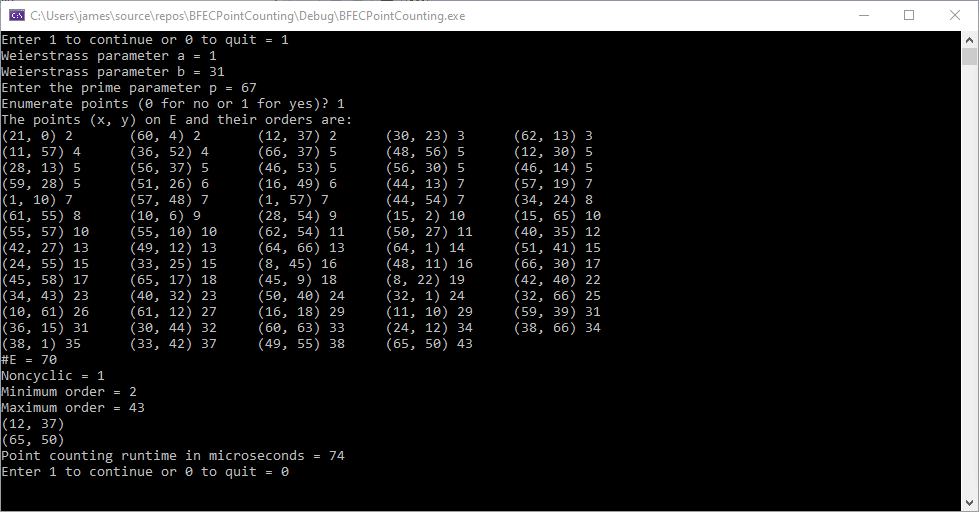
 Numerical Explorations