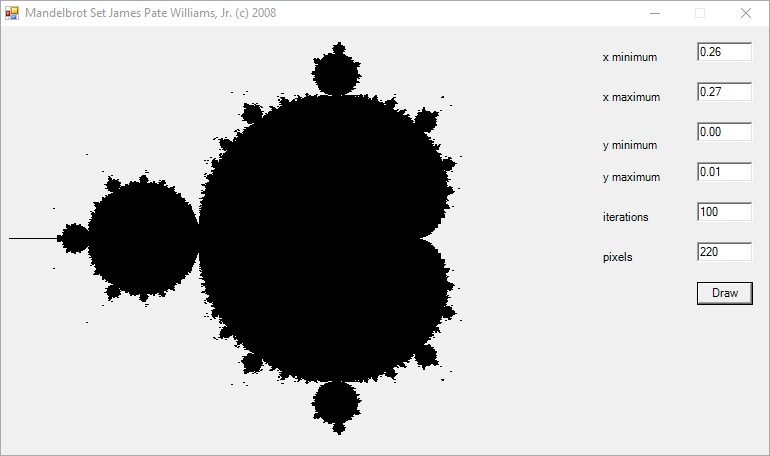
Blog Entry (c) Saturday, September 14, 2024, The Mandelbrot Set by James Pate Williams, Jr. A Simple Fractal Self-Similar Curve
Solve for a real root of the equation
f(x)=log6l(5+x)+log6l(x)=0
First we test our log6l(x) function
log6l(12) = 1.386853
log6l(36) = 2.000000
x = 0.1925824036
f = 0.0000000000
We use an evolutionary hill-climber and the solution of the quadratic equation to solve the easy problem below:

Solution of f(a,x)=sin(sqrt(ax-x^2))=0
Subject to the constraint x+y=100
Where x and y are the two roots of
g(a,x)=ax-x^2-n*n*pi*pi=0
and n=15
a = 100.347888933988
x = 32.947113268776
y = 67.400775665213
g =  0.000000000000
s = 100.347888933988
runtime in seconds = 43.730000
Solution of f(t) = cos(2t) + cos(3t)
t    =  0.628318530718
f(t) =  1.11022302e-16
Solution of f(x) = sqrt(1 + sqrt(1 + x)) - x^1/3
x    =  8.000000000000
f(x) =  0.00000000e+00
Solution of f(x) = 9^x + 12^x - 16^x
x    =  -16.387968065352
f(x) =    2.32137533e-16
Solution of f(x) = 8^x-2^x - 2(6^x-3^x)
x    =  1.000000000000
f(x) =  0.00000000e+00
The problem is to find the real root of the equation: f(x)=x^(x^8)-8=0. I use the Newton-Raphson method, a root finding algorithm. A first guess is x = 2. The solution is: x = 1.2968395547, f(x) = -2.6645353e-15. I compute the necessary derivative using central-finite differences with a step size of h = 2/10000.
 Numerical Explorations