Category: Matrix Algebra
Blog Entry (c) Friday, October 25, 2024, by James Pate Williams, Jr. Optimization Methods
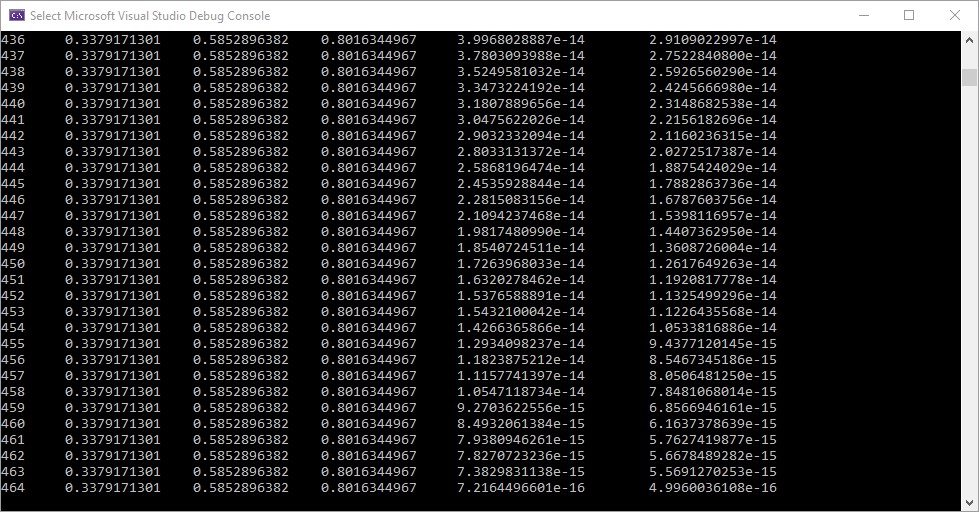
The optimization methods that were programmed are the Simplex Algorithm, the Steepest Descent method, and Newton’s Method. The Simplex Algorithm was given to me by Microsoft Copilot. The other two methods are from Elementary Numerical Analysis: An Algorithmic Approach 3rd Edition (c) 1980 by S.D. Conte and Carl de Boor.

Blog Entry (c) Saturday, October 19, 2024, New Ab Initio Calculations to Determine the Ground State Energies of the Helium-Hydrogen Cation and the Hydrogen Molecule
Using my STO-4G curve fit for N = 4 basis Gaussian type 1s orbitals I was able to get better results than found using the N = 3 basis wavefunctions in the graduate-level textbook Modern Quantum Chemistry Introduction to Advanced Electronic Structure Theory by Attila Szabo and Neil S. Ostlund. My recreation for N = 3 discovered -2.97867 atomic units ground state energy for the helium-hydrogen ion and -1.11651 atomic units for the hydrogen molecule using the textbook’s basis wavefunctions. The percentage errors were 3.98002% and 4.15928% respectively. My STO-4G basis wavefunctions found a ground state energy for the helium-hydrogen ion of -2.94937 atomic units and for the hydrogen molecule -1.14344 atomic units, which have percentage errors of 0.98349% and 2.86607% respectively.
Blog Entry (c) Friday, October 18, 2024, by James Pate Williams, Jr. Ab Initio Quantum Chemical Calculation
On Wednesday, October 16, 2024, I bought an Amazon Kindle book named “Modern Quantum Chemistry: Introduction to Advanced Electronic Structure Theory” by Attila Szabo and Neil S. Ostlund. It cost me $10.69 which is a real bargain. In Appendix B there is a listing for a FORTRAN program to perform an ab initio Hartree-Fock Self Consistent Field calculation for a two-electron heteronuclear molecule namely the helium-hydrogen cation. I successfully translated the program from FORTRAN to C++. I had to remember that FORTRAN stores matrices in column major order and C/C++ stores matrices in row major order. I took the transposes of two FORTRAN COMMON matrices to get the correct C++ storage. The authors of the book did an extensive treatment of the test calculation. The application is only 823 lines of monolithic C++ source code. I used FORTRAN like array indexing starting at 1 instead of the C initial beginning index of 0. I think I will try to get in touch with the authors to get permission to post the source code and results on my blog.
P. S. I got permission from Dover Books to publish my source code and results. I think I will reconsider posting the C++ source code. The actual ground state energy of the cation is -2.97867. My calculation and the book’s computation are in percentage errors of about 4%. The book’s value is a little closer to the exact value than my result. The book calculation was done in FORTRAN double precision on a Digital Equipment Corporation PDP-10 minicomputer. My recreation of the book’s endeavor was executed on an Intel Itanium Core 7 and Windows 10 Professional machine using Win32 C++. The C++ compiler was from Microsoft Visual Studio 2019 Community Version.
Note I added a calculation for a homonuclear molecule, namely, the hydrogen diatomic molecule.
Blog Entry © Monday, October 14, 2024, Real Eigenvalues and Eigenvectors of a 4 x 4 Tridiagonal Matrix and Solutions of a 4 x 4 System Using the Same Tridiagonal Matrix by James Pate Williams, Jr.
Two methods of solving linear systems of equations are explored in this blog. The methods are the Gauss-Seidel method and the Jacobi iteration.
 Numerical Explorations