Category: Matrix Algebra
Blog Entry © Tuesday, August 19, 2025, by James Pate Williams, Jr., Continuation of Answers to the Exercises in Chapter 1 of Modern Quantum Chemistry an Introduction to Advanced Electronic Structure Theory by Attila Szabo and Neil S. Ostlund
Note: Later on, Tuesday, August 19, 2025, I added five C++ source code files.
#include <vector>
#include <random>

class DblLinearAlgebra
{
public:
    static void DblPrintMatrix(
        int m, int n, std::vector<std::vector<double>>& A);
    static void DblAddition(
        size_t m, size_t n,
        std::vector<std::vector<double>>& A,
        std::vector<std::vector<double>>& B,
        std::vector<std::vector<double>>& C);
    static void DblSubtraction(
        size_t m, size_t n,
        std::vector<std::vector<double>>& A,
        std::vector<std::vector<double>>& B,
        std::vector<std::vector<double>>& C);
    static void DblMultiply(
        size_t m, size_t n, size_t p,
        std::vector<std::vector<double>>& A,
        std::vector<std::vector<double>>& B,
        std::vector<std::vector<double>>& C);
    static void DblAnticommutator(
        size_t n,
        std::vector<std::vector<double>>& A,
        std::vector<std::vector<double>>& B,
        std::vector<std::vector<double>>& C);
    static void DblCommutator(
        size_t n,
        std::vector<std::vector<double>>& A,
        std::vector<std::vector<double>>& B,
        std::vector<std::vector<double>>& C);
    static double DblDeterminant(
        int n, int row, int col,
        std::vector<std::vector<double>>& A);
    static bool DblGaussianElimination(
        int m, int n, std::vector<std::vector<double>>& A,
        std::vector<double>& b, std::vector<double>& x,
        std::vector<size_t>& pivot);
    static bool DblGaussianFactor(
        int n, std::vector<std::vector<double>>& M,
        std::vector<size_t>& pivot);
    static bool DblGaussianSolution(
        int n, std::vector<std::vector<double>>& M,
        std::vector<double>& b, std::vector<double>& x,
        std::vector<size_t>& pivot);
    static bool DblSubstitution(
        int n, std::vector<std::vector<double>>& M,
        std::vector<double>& b, std::vector<double>& x,
        std::vector<size_t>& pivot);
    static bool DblInverse(
        int n, std::vector<std::vector<double>>& M,
        std::vector<std::vector<double>>& A);
    static void DblCharPolyAndAdjoint(
        int n,
        std::vector<std::vector<double>>& C,
        std::vector<std::vector<double>>& I,
        std::vector<std::vector<double>>& M,
        std::vector<std::vector<double>>& adjoint,
        std::vector<double>& a);
    static void DblMatrixKernel(
        int m, int n,
        std::vector<std::vector<double>>& M,
        std::vector<std::vector<double>>& X,
        size_t& r);
    static void DblMatrixImage(
        int m, int n,
        std::vector<std::vector<double>>& M,
        std::vector<std::vector<double>>& N,
        std::vector<std::vector<double>>& X,
        int rank);
    static void DblGenerateNonSingular(
        double scale, double& determinant,
        int n, unsigned int seed,
        std::vector<std::vector<double>>& Mr);
};
#include "DblLinearAlgebra.h"
#include <iomanip>
#include <iostream>

void DblLinearAlgebra::DblPrintMatrix(
    int m, int n, std::vector<std::vector<double>>& A)
{
    for (int i = 0; i < m; i++)
    {
        for (int j = 0; j < n; j++)
        {
            std::cout << std::setprecision(6) << std::setw(9);

            if (fabs(A[i][j]) > 1.0e-12)
            {
                std::cout << A[i][j] << ' ';
            }

            else
            {
                std::cout << 0 << ' ';
            }
        }

        std::cout << std::endl;
    }
}

void DblLinearAlgebra::DblAddition(
    size_t m, size_t n,
    std::vector<std::vector<double>>& A,
    std::vector<std::vector<double>>& B,
    std::vector<std::vector<double>>& C)
{
    for (size_t i = 0; i < m; i++)
    {
        for (size_t j = 0; j < n; j++)
        {
            C[i][j] = A[i][j] + B[i][j];
        }
    }
}

void DblLinearAlgebra::DblSubtraction(
    size_t m, size_t n,
    std::vector<std::vector<double>>& A,
    std::vector<std::vector<double>>& B,
    std::vector<std::vector<double>>& C)
{
    for (size_t i = 0; i < m; i++)
    {
        for (size_t j = 0; j < n; j++)
        {
            C[i][j] = A[i][j] - B[i][j];
        }
    }
}

void DblLinearAlgebra::DblMultiply(
    size_t m, size_t n, size_t p,
    std::vector<std::vector<double>>& A,
    std::vector<std::vector<double>>& B,
    std::vector<std::vector<double>>& C)
{
    for (size_t i = 0; i < m; i++)
    {
        for (size_t j = 0; j < n; j++)
        {
            double sum = { 0 };

            for (size_t k = 0; k < p; k++)
            {
                sum += A[i][k] * B[k][j];
            }

            C[i][j] = sum;
        }
    }
}

void DblLinearAlgebra::DblAnticommutator(
    size_t n,
    std::vector<std::vector<double>>& A,
    std::vector<std::vector<double>>& B,
    std::vector<std::vector<double>>& C)
{
    std::vector<std::vector<double>> D(n,
        std::vector<double>(n));
    std::vector<std::vector<double>> E(n,
        std::vector<double>(n));

    DblMultiply(n, n, n, A, B, D);
    DblMultiply(n, n, n, B, A, E);
    DblAddition(n, n, D, E, C);
}

void DblLinearAlgebra::DblCommutator(
    size_t n,
    std::vector<std::vector<double>>& A,
    std::vector<std::vector<double>>& B,
    std::vector<std::vector<double>>& C)
{
    std::vector<std::vector<double>> D(n,
        std::vector<double>(n));
    std::vector<std::vector<double>> E(n,
        std::vector<double>(n));

    DblMultiply(n, n, n, A, B, D);
    DblMultiply(n, n, n, B, A, E);
    DblSubtraction(n, n, D, E, C);
}

// https://www.geeksforgeeks.org/dsa/determinant-of-a-matrix/

double getDet(std::vector<std::vector<double>>& mat, int n) {

    // Base case: if the matrix is 1x1
    if (n == 1) {
        return mat[0][0];
    }

    // Base case for 2x2 matrix
    if (n == 2) {
        return mat[0][0] * mat[1][1] -
            mat[0][1] * mat[1][0];
    }

    // Recursive case for larger matrices
    double  res = 0;
    for (int col = 0; col < n; ++col) {

        // Create a submatrix by removing the first
        // row and the current column
        std::vector<std::vector<double>> sub(n - 1,
            std::vector<double>(n - 1));
        for (int i = 1; i < n; ++i) {
            int subcol = 0;
            for (int j = 0; j < n; ++j) {

                // Skip the current column
                if (j == col) continue;

                // Fill the submatrix
                sub[i - 1LL][subcol++] = mat[i][j];
            }
        }

        // Cofactor expansion
        int sign = (col % 2 == 0) ? 1 : -1;
        res += sign * mat[0][col] * getDet(sub, n - 1);
    }

    return res;
}

double DblLinearAlgebra::DblDeterminant(
    int n, int row, int col,
    std::vector<std::vector<double>>& A)
{
    return getDet(A, A.size());
}

bool DblLinearAlgebra::DblGaussianElimination(
    int m, int n, std::vector<std::vector<double>>& M,
    std::vector<double>& b, std::vector<double>& x,
    std::vector<size_t>& pivot)
{
    bool failure = false;
    std::vector<double> c(m);

    b.resize(n);
    x.resize(n);

    for (size_t i = 0; i < m; i++)
        c[i] = -1;

    for (size_t j = 0; j < n; j++)
    {
        bool found = false;
        size_t i = j;

        while (i < n && !found)
        {
            if (M[i][j] != 0)
                found = true;
            else
                i++;
        }

        if (!found)
        {
            failure = true;
            break;
        }

        if (i > j)
        {
            for (size_t l = j; l < n; l++)
            {
                double t = M[i][l];
                M[i][l] = M[j][l];
                M[j][l] = t;
                t = b[i];
                b[i] = b[j];
                b[j] = t;
            }
        }

        double d = 1.0 / M[j][j];

        for (size_t k = j + 1; k < n; k++)
            c[k] = d * M[k][j];

        for (size_t k = j + 1; k < n; k++)
        {
            for (size_t l = j + 1; l < n; l++)
                M[k][l] = M[k][l] - c[k] * M[j][l];

            b[k] = b[k] - c[k] * b[j];
        }
    }

    for (long long i = (long long)n - 1; i >= 0; i--)
    {
        double sum = 0;

        for (size_t j = i + 1; j < n; j++)
            sum += M[i][j] * x[j];

        x[i] = (b[i] - sum) / M[i][i];
    }

    return failure;
}

bool DblLinearAlgebra::DblGaussianFactor(
    int n, std::vector<std::vector<double>>& M,
    std::vector<size_t>& pivot)
{
    // returns false if matrix is singular
    std::vector<double> d(n);
    double awikod, col_max, ratio, row_max, temp;
    int flag = 1;
    size_t i_star, itemp;

    for (size_t i = 0; i < n; i++)
    {
        pivot[i] = i;
        row_max = 0;

        for (size_t j = 0; j < n; j++)
            row_max = fmax(row_max, fabs(M[i][j]));

        if (row_max == 0)
        {
            flag = 0;
            row_max = 1.0;
        }

        d[i] = row_max;
    }

    if (n <= 1) return flag != 0;

    // factorization

    for (size_t k = 0; k < (size_t)(n - 1LL); k++)
    {
        // determine pivot row the row i_star

        col_max = fabs(M[k][k]) / d[k];
        i_star = k;

        for (size_t i = k + 1; i < n; i++)
        {
            awikod = fabs(M[i][k]) / d[i];

            if (awikod > col_max)
            {
                col_max = awikod;
                i_star = i;
            }
        }

        if (col_max == 0)
            flag = 0;

        else
        {
            if (i_star > k)
            {
                // make k the pivot row by
                // interchanging with i_star

                flag *= -1;
                itemp = pivot[i_star];
                pivot[i_star] = pivot[k];
                pivot[k] = itemp;
                temp = d[i_star];
                d[i_star] = d[k];
                d[k] = temp;

                for (size_t j = 0; j < n; j++)
                {
                    temp = M[i_star][j];
                    M[i_star][j] = M[k][j];
                    M[k][j] = temp;
                }
            }

            // eliminate x[k]

            for (size_t i = k + 1; i < n; i++)
            {
                M[i][k] /= M[k][k];
                ratio = M[i][k];

                for (size_t j = k + 1; j < n; j++)
                    M[i][j] -= ratio * M[k][j];
            }
        }

        if (M[n - 1LL][n - 1LL] == 0) flag = 0;
    }

    if (flag == 0)
        return false;

    return true;
}

bool DblLinearAlgebra::DblGaussianSolution(
    int n, std::vector<std::vector<double>>& M,
    std::vector<double>& b, std::vector<double>& x,
    std::vector<size_t>& pivot)
{
    if (!DblGaussianFactor(n, M, pivot))
        return false;

    return DblSubstitution(n, M, b, x, pivot);
}

bool DblLinearAlgebra::DblSubstitution(
    int n, std::vector<std::vector<double>>& M,
    std::vector<double>& b, std::vector<double>& x,
    std::vector<size_t>& pivot)
{
    double sum = 0.0;
    size_t n1 = n - 1LL;

    if (n == 1)
    {
        x[0] = b[0] / M[0][0];
        return true;
    }

    // forward substitution

    x[0] = b[pivot[0]];

    for (size_t i = 1; i < n; i++)
    {
        double sum = 0.0;

        for (size_t j = 0; j < i; j++)
            sum += M[i][j] * x[j];

        x[i] = b[pivot[i]] - sum;
    }

    // backward substitution

    x[n1] /= M[n1][n1];

    for (long long i = n - 2LL; i >= 0; i--)
    {
        double sum = 0.0;

        for (size_t j = i + 1; j < n; j++)
            sum += M[i][j] * x[j];

        x[i] = (x[i] - sum) / M[i][i];
    }

    return true;
}

bool DblLinearAlgebra::DblInverse(
    int n, std::vector<std::vector<double>>& M,
    std::vector<std::vector<double>>& Mi)
{
    std::vector<double> b(n);
    std::vector<double> x(n);
    std::vector<size_t> pivot(n);
    std::vector<std::vector<double>> Mc(n,
        std::vector<double>(n));

    for (size_t i = 0; i < n; i++)
    {
        for (size_t j = 0; j < n; j++)
        {
            Mc[i][j] = M[i][j];
        }
    }

    if (!DblGaussianFactor(n, Mc, pivot))
        return false;

    for (size_t i = 0; i < n; i++)
    {
        b[i] = 0;
    }

    for (size_t i = 0; i < n; i++)
    {
        b[i] = 1;

        if (!DblSubstitution(n, Mc, b, x, pivot))
            return false;

        b[i] = 0;

        for (size_t j = 0; j < n; j++)
            Mi[j][i] = x[j];
    }

    return true;
}

void DblLinearAlgebra::DblCharPolyAndAdjoint(
    int n,
    std::vector<std::vector<double>>& C,
    std::vector<std::vector<double>>& I,
    std::vector<std::vector<double>>& M,
    std::vector<std::vector<double>>& adjoint,
    std::vector<double>& a)
{
    C.resize(n, std::vector<double>(n));
    I.resize(n, std::vector<double>(n));

    for (size_t i = 0; i < n; i++)
    {
        for (size_t j = 0; j < n; j++)
            C[i][j] = I[i][j] = 0;
    }

    for (size_t i = 0; i < n; i++)
        C[i][i] = I[i][i] = 1;

    a[0] = 1;

    for (size_t i = 1; i < n; i++)
    {
        for (size_t j = 0; j < n; j++)
        {
            for (size_t k = 0; k < n; k++)
            {
                double sum = 0.0;

                for (size_t l = 0; l < n; l++)
                    sum += M[j][l] * C[l][k];

                C[j][k] = sum;
            }
        }

        double tr = 0.0;

        for (size_t j = 0; j < n; j++)
            tr += C[j][j];

        a[i] = -tr / i;

        for (size_t j = 0; j < n; j++)
        {
            for (size_t k = 0; k < n; k++)
                C[j][k] += a[i] * I[j][k];
        }
    }

    for (size_t i = 0; i < n; i++)
    {
        for (size_t j = 0; j < n; j++)
        {
            double sum = 0.0;

            for (size_t k = 0; k < n; k++)
                sum += M[i][k] * C[k][j];

            C[i][j] = sum;
        }
    }

    double trace = 0.0;

    for (size_t i = 0; i < n; i++)
        trace += C[i][i];

    trace /= n;
    a[n - 1LL] = -trace;

    double factor = 1.0;

    if ((n - 1) % 2 != 0)
        factor = -1.0;

    for (size_t i = 0; i < n; i++)
    {
        for (size_t j = 0; j < n; j++)
            adjoint[i][j] = factor * C[i][j];
    }
}

void DblLinearAlgebra::DblMatrixKernel(
    int m, int n,
    std::vector<std::vector<double>>& M,
    std::vector<std::vector<double>>& X,
    size_t& r)
{
    double D = 0.0;
    std::vector <int> c(m);
    std::vector <int> d(n);

    r = 0;

    for (size_t i = 0; i < m; i++)
        c[i] = -1;

    size_t j, k = 1;

Step2:

    for (j = 0; j < m; j++)
    {
        if (M[j][k] != 0 && c[j] == -1)
            break;
    }

    if (j == m)
    {
        r++;
        d[k] = 0;
        goto Step4;
    }

    D = -1.0 / M[j][k];

    M[j][k] = -1;

    for (size_t s = k + 1; s < n; s++)
    {
        M[j][s] = D * M[j][s];

        for (size_t i = 0; i < m; i++)
        {
            if (i != j)
            {
                D = M[i][k];
                M[i][k] = 0;
            }
        }
    }

    for (size_t s = k + 1; s < n; s++)
    {
        for (size_t i = 0; i < m; i++)
        {
            M[i][s] += D * M[j][s];
        }
    }

    c[j] = (int)k;
    d[k] = (int)j;

Step4:

    if (k < n - 1)
    {
        k++;
        goto Step2;
    }

    X.resize(n, std::vector<double>(n));

    if (r != 0)
    {
        for (k = 0; k < n; k++)
        {
            if (d[k] == 0)
            {
                for (size_t i = 0; i < n; i++)
                {
                    if (d[i] > 0)
                        X[k][i] = M[d[i]][k];
                    else if (i == k)
                        X[k][i] = 1;
                    else
                        X[k][i] = 0;
                }
            }
        }
    }
}

void DblLinearAlgebra::DblMatrixImage(
    int m, int n,
    std::vector<std::vector<double>>& M,
    std::vector<std::vector<double>>& N,
    std::vector<std::vector<double>>& X,
    int rank)
{
    double D = 0.0;
    size_t r = 0;
    std::vector<std::vector<double>> copyM(
        m, std::vector<double>(n));
    std::vector <int> c(m);
    std::vector <int> d(n);

    for (size_t i = 0; i < m; i++)
        c[i] = -1;

    size_t j = 0, k = 1;

    for (size_t i = 0; i < m; i++)
    {
        for (size_t j = 0; j < n; j++)
        {
            N[i][j] = copyM[i][j] = M[i][j];
        }
    }

Step2:

    for (size_t j = 0; j < m; j++)
    {
        if (copyM[j][k] != 0 && c[j] == -1)
            break;
    }

    if (j == m)
    {
        r++;
        d[k] = 0;
        goto Step4;
    }

    D = -1.0 / copyM[j][k];

    copyM[j][k] = -1;

    for (size_t s = k + 1; s < n; s++)
    {
        copyM[j][s] = D * copyM[j][s];

        for (size_t i = 0; i < m; i++)
        {
            if (i != j)
            {
                D = copyM[i][k];
                copyM[i][k] = 0;
            }
        }
    }

    for (size_t s = k + 1; s < n; s++)
    {
        for (size_t i = 0; i < m; i++)
        {
            copyM[i][s] += D * copyM[j][s];
        }
    }

    c[j] = (int)k;
    d[k] = (int)j;

Step4:

    if (k < (size_t)(n - 1LL))
    {
        k++;
        goto Step2;
    }

    rank = (int)(n - r) ;

    for (j = 0; j < m; j++)
    {
        if (c[j] != 0)
        {
            for (size_t i = 0; i < m; i++)
            {
                N[i][c[j]] = M[i][c[j]];
            }
        }
    }
}

void DblLinearAlgebra::DblGenerateNonSingular(
    double scale, double& determinant,
    int n, unsigned int seed,
    std::vector<std::vector<double>>& Mr)
{
    bool failure = false;
    std::mt19937 rng(seed);
    std::uniform_real_distribution<double> dist(0.0, 1.0);

    while (true)
    {
        for (int i = 0; i < n; i++)
        {
            for (int j = 0; j < n; j++)
            {
                Mr[i][j] = scale * dist(rng);
            }
        }

        determinant = DblDeterminant(n, 0, 0, Mr);
        failure = determinant == 0;

        if (!failure)
            return;
    }
}
#include <complex>
#include <vector>

class CmpLinearAlgebra
{
public:
    static void CmpPrintMatrix(
        int m, int n,
        std::vector<std::vector<std::complex<double>>>& Ac);
    static void CmpAddition(
        size_t m, size_t n,
        std::vector<std::vector<std::complex<double>>>& A,
        std::vector<std::vector<std::complex<double>>>& B,
        std::vector<std::vector<std::complex<double>>>& C);
    static void CmpSubtraction(
        size_t m, size_t n,
        std::vector<std::vector<std::complex<double>>>& A,
        std::vector<std::vector<std::complex<double>>>& B,
        std::vector<std::vector<std::complex<double>>>& C);
    static void CmpMultiply(
        size_t m, size_t n, size_t p,
        std::vector<std::vector<std::complex<double>>>& A,
        std::vector<std::vector<std::complex<double>>>& B,
        std::vector<std::vector<std::complex<double>>>& C);
    static void CmpAnticommutator(
        size_t n,
        std::vector<std::vector<std::complex<double>>>& A,
        std::vector<std::vector<std::complex<double>>>& B,
        std::vector<std::vector<std::complex<double>>>& C);
    static void CmpCommutator(
        size_t n,
        std::vector<std::vector<std::complex<double>>>& A,
        std::vector<std::vector<std::complex<double>>>& B,
        std::vector<std::vector<std::complex<double>>>& C);
    static std::complex<double> CmpDeterminant(
        int n,
        std::vector<std::vector<std::complex<double>>>& Ac);
    static void CmpAdjoint(
        size_t m, size_t n,
        std::vector<std::vector<std::complex<double>>>& Ac,
        std::vector<std::vector<std::complex<double>>>& Ad);
    static bool CmpGaussianElimination(
        int m, int n,
        std::vector<std::vector<std::complex<double>>>& A,
        std::vector<std::complex<double>>& b,
        std::vector<std::complex<double>>& x,
        std::vector<size_t>& pivot);
    static bool CmpGaussianFactor(
        int n, std::vector<std::vector<std::complex<double>>>& M,
        std::vector<size_t>& pivot);
    static bool CmpGaussianSolution(
        int n, std::vector<std::vector<std::complex<double>>>& M,
        std::vector<std::complex<double>>& b,
        std::vector<std::complex<double>>& x,
        std::vector<size_t>& pivot);
    static bool CmpSubstitution(
        int m, int n, std::vector<std::vector<std::complex<double>>>& M,
        std::vector<std::complex<double>>& b,
        std::vector<std::complex<double>>& x,
        std::vector<size_t>& pivot);
    static bool CmpInverse(
        int n, std::vector<std::vector<std::complex<double>>>& M,
        std::vector<std::vector<std::complex<double>>>& Mi);
    static void CmpCharPolyAndAdjoint(
        int n,
        std::vector<std::vector<std::complex<double>>>& C,
        std::vector<std::vector<std::complex<double>>>& I,
        std::vector<std::vector<std::complex<double>>>& M,
        std::vector<std::vector<std::complex<double>>>& adjoint,
        std::vector<std::complex<double>>& a);
    static void CmpMatrixKernel(
        int m, int n,
        std::vector<std::vector<std::complex<double>>>& M,
        std::vector<std::vector<std::complex<double>>>& X,
        size_t& r);
    static void CmpMatrixImage(
        int m, int n,
        std::vector<std::vector<std::complex<double>>>& M,
        std::vector<std::vector<std::complex<double>>>& N,
        std::vector<std::vector<std::complex<double>>>& X,
        int rank);
    static void CmpGenerateNonSingular(
        double scale, std::complex<double>& determinant,
        int n, unsigned int seed,
        std::vector<std::vector<std::complex<double>>>& Mc);
};
#include "CmpLinearAlgebra.h"
#include <iomanip>
#include <iostream>
#include <random>

void CmpLinearAlgebra::CmpPrintMatrix(
    int m, int n,
    std::vector<std::vector<std::complex<double>>>& Ac)
{
    for (int i = 0; i < m; i++)
    {
        for (int j = 0; j < n; j++)
        {
            if (Ac[i][j]._Val[0] >= 0)
                std::cout << '+';
            else
                std::cout << '-';

            std::cout << std::setprecision(6) << std::setw(9);

            if (fabs(Ac[i][j]._Val[0]) > 1.0e-12)
            {
                std::cout << fabs(Ac[i][j]._Val[0]) << ' ';
            }

            else
            {
                std::cout << 0 << ' ';
            }

            if (Ac[i][j]._Val[1] >= 0)
                std::cout << '+';
            else
                std::cout << '-';

            std::cout << std::setprecision(6) << std::setw(9);

            if (fabs(Ac[i][j]._Val[1]) > 1.0e-12)
            {
                std::cout << fabs(Ac[i][j]._Val[1]) << "i\t";
            }

            else
            {
                std::cout << 0 << "i\t";
            }
        }

        std::cout << std::endl;
    }
}

void CmpLinearAlgebra::CmpAddition(
    size_t m, size_t n,
    std::vector<std::vector<std::complex<double>>>& A,
    std::vector<std::vector<std::complex<double>>>& B,
    std::vector<std::vector<std::complex<double>>>& C)
{
    for (size_t i = 0; i < m; i++)
    {
        for (size_t j = 0; j < n; j++)
        {
            C[i][j] = A[i][j] + B[i][j];
        }
    }
}

void CmpLinearAlgebra::CmpSubtraction(
    size_t m, size_t n,
    std::vector<std::vector<std::complex<double>>>& A,
    std::vector<std::vector<std::complex<double>>>& B,
    std::vector<std::vector<std::complex<double>>>& C)
{
    for (size_t i = 0; i < m; i++)
    {
        for (size_t j = 0; j < n; j++)
        {
            C[i][j] = A[i][j] - B[i][j];
        }
    }
}

void CmpLinearAlgebra::CmpMultiply(
    size_t m, size_t n, size_t p,
    std::vector<std::vector<std::complex<double>>>& A,
    std::vector<std::vector<std::complex<double>>>& B,
    std::vector<std::vector<std::complex<double>>>& C)
{
    for (size_t i = 0; i < m; i++)
    {
        for (size_t j = 0; j < n; j++)
        {
            std::complex<double> sum = 0;

            for (size_t k = 0; k < p; k++)
            {
                sum += A[i][k] * B[k][j];
            }

            C[i][j] = sum;
        }
    }
}

void CmpLinearAlgebra::CmpAnticommutator(
    size_t n,
    std::vector<std::vector<std::complex<double>>>& A,
    std::vector<std::vector<std::complex<double>>>& B,
    std::vector<std::vector<std::complex<double>>>& C)
{
    std::vector<std::vector<std::complex<double>>> D(n,
        std::vector<std::complex<double>>(n));
    std::vector<std::vector<std::complex<double>>> E(n,
        std::vector<std::complex<double>>(n));

    CmpMultiply(n, n, n, A, B, D);
    CmpMultiply(n, n, n, B, A, E);
    CmpAddition(n, n, D, E, C);
}

void CmpLinearAlgebra::CmpCommutator(
    size_t n,
    std::vector<std::vector<std::complex<double>>>& A,
    std::vector<std::vector<std::complex<double>>>& B,
    std::vector<std::vector<std::complex<double>>>& C)
{
    std::vector<std::vector<std::complex<double>>> D(n,
        std::vector<std::complex<double>>(n));
    std::vector<std::vector<std::complex<double>>> E(n,
        std::vector<std::complex<double>>(n));

    CmpMultiply(n, n, n, A, B, D);
    CmpMultiply(n, n, n, B, A, E);
    CmpSubtraction(n, n, D, E, C);
}

void CmpLinearAlgebra::CmpAdjoint(
    size_t m, size_t n,
    std::vector<std::vector<std::complex<double>>>& Ac,
    std::vector<std::vector<std::complex<double>>>& Ad)
{
    for (size_t i = 0; i < m; i++)
    {
        for (size_t j = 0; j < n; j++)
        {
            Ad[j][i] = std::conj(Ac[i][j]);
        }
    }
}

// https://www.geeksforgeeks.org/dsa/determinant-of-a-matrix/

std::complex<double> getDet(
    std::vector<std::vector<std::complex<double>>>& mat, int n) {

    // Base case: if the matrix is 1x1
    if (n == 1) {
        return mat[0][0];
    }

    // Base case for 2x2 matrix
    if (n == 2) {
        return mat[0][0] * mat[1][1] -
            mat[0][1] * mat[1][0];
    }

    // Recursive case for larger matrices
    std::complex<double> res = 0;
    for (int col = 0; col < n; ++col) {

        // Create a submatrix by removing the first
        // row and the current column
        std::vector<std::vector<std::complex<double>>> sub(n - 1,
            std::vector<std::complex<double>>(n - 1));
        for (int i = 1; i < n; ++i) {
            int subcol = 0;
            for (int j = 0; j < n; ++j) {

                // Skip the current column
                if (j == col) continue;

                // Fill the submatrix
                sub[i - 1LL][subcol++] = mat[i][j];
            }
        }

        // Cofactor expansion
        int sign = (col % 2 == 0) ? 1 : -1;
        std::complex<double> csign(sign, 0.0);
        res = res + csign * mat[0][col] * getDet(sub, n - 1);
    }

    return res;
}

std::complex<double> CmpLinearAlgebra::CmpDeterminant(
    int n, std::vector<std::vector<std::complex<double>>>& A)
{
    return getDet(A, A.size());
}

bool CmpLinearAlgebra::CmpGaussianElimination(
    int m, int n,
    std::vector<std::vector<std::complex<double>>>& A,
    std::vector<std::complex<double>>& b,
    std::vector<std::complex<double>>& x,
    std::vector<size_t>& pivot)
{
    bool failure = false;
    std::vector<std::complex<double>> c(m);

    b.resize(n);
    x.resize(n);

    for (size_t i = 0; i < m; i++)
        c[i] = -1;

    for (size_t j = 0; j < n; j++)
    {
        bool found = false;
        size_t i = j;

        while (i < n && !found)
        {
            if (abs(A[i][j]) != 0)
                found = true;
            else
                i++;
        }

        if (!found)
        {
            failure = true;
            break;
        }

        if (i > j)
        {
            for (size_t l = j; l < n; l++)
            {
                std::complex<double> t = A[i][l];
                A[i][l] = A[j][l];
                A[j][l] = t;
                t = b[i];
                b[i] = b[j];
                b[j] = t;
            }
        }

        std::complex<double> d = 1.0 / A[j][j];

        for (size_t k = j + 1; k < n; k++)
            c[k] = d * A[k][j];

        for (size_t k = j + 1; k < n; k++)
        {
            for (size_t l = j + 1; l < n; l++)
                A[k][l] = A[k][l] - c[k] * A[j][l];

            b[k] = b[k] - c[k] * b[j];
        }
    }

    for (long long i = (long long)n - 1; i >= 0; i--)
    {
        std::complex<double> sum = 0;

        for (size_t j = i + 1; j < n; j++)
            sum += A[i][j] * x[j];

        x[i] = (b[i] - sum) / A[i][i];
    }

    return failure;
}

bool CmpLinearAlgebra::CmpSubstitution(
    int m, int n, std::vector<std::vector<std::complex<double>>>& M,
    std::vector<std::complex<double>>& b,
    std::vector<std::complex<double>>& x,
    std::vector<size_t>& pivot)
{
    std::complex<double> sum = 0;
    size_t n1 = n - 1LL;

    if (n == 1)
    {
        x[0] = b[0] / M[0][0];
        return true;
    }

    // forward substitution

    x[0] = b[pivot[0]];

    for (size_t i = 1; i < n; i++)
    {
        std::complex<double> sum = 0;

        for (size_t j = 0; j < i; j++)
            sum += M[i][j] * x[j];

        x[i] = b[pivot[i]] - sum;
    }

    // backward substitution

    x[n1] /= M[n1][n1];

    for (long long i = n - 2LL; i >= 0; i--)
    {
        std::complex<double> sum = 0;

        for (size_t j = i + 1; j < n; j++)
            sum += M[i][j] * x[j];

        x[i] = (x[i] - sum) / M[i][i];
    }

    return true;
}

static std::complex<double> complex_max(
    std::complex<double> a, std::complex<double> b) {
    return (std::abs(a) > std::abs(b)) ? a : b;
}

bool CmpLinearAlgebra::CmpGaussianFactor(
    int n, std::vector<std::vector<std::complex<double>>>& M,
    std::vector<size_t>& pivot)
{
    // returns false if matrix is singular
    std::vector<std::complex<double>> d(n);
    std::complex<double> awikod = 0, col_max = 0, ratio = 0, row_max = 0, temp = 0;
    int flag = 1;
    size_t i_star, itemp;

    for (size_t i = 0; i < n; i++)
    {
        pivot[i] = i;
        row_max = 0;

        for (size_t j = 0; j < n; j++)
            row_max = complex_max(row_max, abs(M[i][j]));

        if (abs(row_max) == 0)
        {
            flag = 0;
            row_max = 1;
        }

        d[i] = row_max;
    }
    if (n <= 1) return flag != 0;

    // factorization

    for (size_t k = 0; k < (size_t)n - 1LL; k++)
    {
        // determine pivot row the row i_star

        col_max = abs(M[k][k]) / d[k];
        i_star = k;

        for (size_t i = k + 1; i < n; i++)
        {
            awikod = abs(M[i][k]) / d[i];

            if (abs(awikod) > abs(col_max))
            {
                col_max = awikod;
                i_star = i;
            }
        }

        if (abs(col_max) == 0)
            flag = 0;

        else
        {
            if (i_star > k)
            {
                // make k the pivot row by
                // interchanging with i_star
                flag *= -1;
                itemp = pivot[i_star];
                pivot[i_star] = pivot[k];
                pivot[k] = itemp;
                temp = d[i_star];
                d[i_star] = d[k];
                d[k] = temp;

                for (size_t j = 0; j < n; j++)
                {
                    temp = M[i_star][j];
                    M[i_star][j] = M[k][j];
                    M[k][j] = temp;
                }
            }

            // eliminate x[k]

            for (size_t i = k + 1; i < n; i++)
            {
                M[i][k] /= M[k][k];
                ratio = M[i][k];

                for (size_t j = k + 1; j < n; j++)
                    M[i][j] -= ratio * M[k][j];
            }
        }

        if (abs(M[n - 1LL][n - 1LL]) == 0) flag = 0;
    }

    if (flag == 0)
        return false;

    return true;
}

bool CmpLinearAlgebra::CmpGaussianSolution(
    int n, std::vector<std::vector<std::complex<double>>>& M,
    std::vector<std::complex<double>>& b,
    std::vector<std::complex<double>>& x,
    std::vector<size_t>& pivot)
{
    if (!CmpGaussianFactor(n, M, pivot))
        return false;

    return CmpSubstitution(n, n, M, b, x, pivot);
}

bool CmpLinearAlgebra::CmpInverse(
    int n, std::vector<std::vector<std::complex<double>>>& M,
    std::vector<std::vector<std::complex<double>>>& Mi)
{
    std::vector<std::complex<double>> b(n);
    std::vector<std::complex<double>> x(n);
    std::vector<size_t> pivot(n);
    std::vector<std::vector<std::complex<double>>> Mc(n,
        std::vector<std::complex<double>>(n));

    for (size_t i = 0; i < n; i++)
    {
        for (size_t j = 0; j < n; j++)
        {
            Mc[i][j] = M[i][j];
        }
    }

    if (!CmpGaussianFactor(n, Mc, pivot))
        return false;

    for (size_t i = 0; i < n; i++)
    {
        b[i] = 0;
    }

    for (size_t i = 0; i < n; i++)
    {
        b[i] = 1;

        if (!CmpSubstitution(n, n, Mc, b, x, pivot))
            return false;

        b[i] = 0;

        for (size_t j = 0; j < n; j++)
            Mi[j][i] = x[j];
    }

    return true;
}

void CmpLinearAlgebra::CmpCharPolyAndAdjoint(
    int n,
    std::vector<std::vector<std::complex<double>>>& C,
    std::vector<std::vector<std::complex<double>>>& I,
    std::vector<std::vector<std::complex<double>>>& M,
    std::vector<std::vector<std::complex<double>>>& adjoint,
    std::vector<std::complex<double>>& a)
{
    C.resize(n, std::vector<std::complex<double>>(n));
    I.resize(n, std::vector<std::complex<double>>(n));

    for (size_t i = 0; i < n; i++)
    {
        for (size_t j = 0; j < n; j++)
            C[i][j] = I[i][j] = 0;
    }

    for (size_t i = 0; i < n; i++)
        C[i][i] = I[i][i] = 1;

    a[0] = 1;

    for (size_t i = 1; i < n; i++)
    {
        for (size_t j = 0; j < n; j++)
        {
            for (size_t k = 0; k < n; k++)
            {
                std::complex<double> sum = 0.0;

                for (size_t l = 0; l < n; l++)
                    sum += M[j][l] * C[l][k];

                C[j][k] = sum;
            }
        }

        std::complex<double> tr = 0.0;

        for (size_t j = 0; j < n; j++)
            tr += C[j][j];

        std::complex<double> ci = 0;
        ci._Val[0] = (double)i;

        a[i] = -tr / ci;

        for (size_t j = 0; j < n; j++)
        {
            for (size_t k = 0; k < n; k++)
                C[j][k] += a[i] * I[j][k];
        }
    }

    for (size_t i = 0; i < n; i++)
    {
        for (size_t j = 0; j < n; j++)
        {
            std::complex<double> sum = 0.0;

            for (size_t k = 0; k < n; k++)
                sum += M[i][k] * C[k][j];

            C[i][j] = sum;
        }
    }

    std::complex<double> trace = 0.0;

    for (size_t i = 0; i < n; i++)
        trace += C[i][i];

    trace /= n;
    a[n - 1LL] = -trace;

    std::complex<double> factor = 1.0;

    if ((n - 1) % 2 != 0)
        factor = -1.0;

    for (size_t i = 0; i < n; i++)
    {
        for (size_t j = 0; j < n; j++)
            adjoint[i][j] = factor * C[i][j];
    }
}

void CmpLinearAlgebra::CmpMatrixKernel(
    int m, int n,
    std::vector<std::vector<std::complex<double>>>& M,
    std::vector<std::vector<std::complex<double>>>& X,
    size_t& r)
{
    std::complex<double> D = 0;
    std::vector<int> c(m);
    std::vector<int> d(n);

    r = 0;

    for (size_t i = 0; i < m; i++)
        c[i] = -1;

    size_t j = 0, k = 1;

Step2:

    for (j = 0; j < m; j++)
    {
        if (abs(M[j][k]) != 0 && c[j] == -1)
            break;
    }

    if (j == m)
    {
        r++;
        d[k] = 0;
        goto Step4;
    }

    D = -1.0 / M[j][k];

    M[j][k] = -1;

    for (size_t s = k + 1; s < n; s++)
    {
        M[j][s] = D * M[j][s];

        for (size_t i = 0; i < m; i++)
        {
            if (i != j)
            {
                D = M[i][k];
                M[i][k] = 0;
            }
        }
    }

    for (size_t s = k + 1; s < n; s++)
    {
        for (size_t i = 0; i < m; i++)
        {
            M[i][s] += D * M[j][s];
        }
    }

    c[j] = (int)k;
    d[k] = (int)j;

Step4:

    if (k < n - 1)
    {
        k++;
        goto Step2;
    }

    X.resize(n, std::vector<std::complex<double>>(n));

    if (r != 0)
    {
        for (k = 0; k < n; k++)
        {
            if (d[k] == 0)
            {
                for (size_t i = 0; i < n; i++)
                {
                    if (d[i] > 0)
                        X[k][i] = M[d[i]][k];
                    else if (i == k)
                        X[k][i] = 1;
                    else
                        X[k][i] = 0;
                }
            }
        }
    }
}

void CmpLinearAlgebra::CmpMatrixImage(
    int m, int n,
    std::vector<std::vector<std::complex<double>>>& M,
    std::vector<std::vector<std::complex<double>>>& N,
    std::vector<std::vector<std::complex<double>>>& X,
    int rank)
{
    std::complex<double> D = 0.0;
    size_t r = 0;
    std::vector<std::vector<std::complex<double>>> copyM(
        m, std::vector<std::complex<double>>(n));
    std::vector<int> c(m);
    std::vector<int> d(n);

    for (size_t i = 0; i < m; i++)
        c[i] = -1;

    size_t j = 0, k = 1;

    for (size_t i = 0; i < m; i++)
    {
        for (size_t j = 0; j < n; j++)
        {
            N[i][j] = copyM[i][j] = M[i][j];
        }
    }

Step2:

    for (size_t j = 0; j < m; j++)
    {
        if (abs(copyM[j][k]) != 0 && c[j] == -1)
            break;
    }

    if (j == m)
    {
        r++;
        d[k] = 0;
        goto Step4;
    }

    D = -1.0 / copyM[j][k];

    copyM[j][k] = -1;

    for (size_t s = k + 1; s < n; s++)
    {
        copyM[j][s] = D * copyM[j][s];

        for (size_t i = 0; i < m; i++)
        {
            if (i != j)
            {
                D = copyM[i][k];
                copyM[i][k] = 0;
            }
        }
    }

    for (size_t s = k + 1; s < n; s++)
    {
        for (size_t i = 0; i < m; i++)
        {
            copyM[i][s] += D * copyM[j][s];
        }
    }

    c[j] = (int)k;
    d[k] = (int)j;

Step4:

    if (k < (size_t)(n - 1LL))
    {
        k++;
        goto Step2;
    }

    rank = (int)(n - r);

    for (j = 0; j < m; j++)
    {
        if (c[j] != 0)
        {
            for (size_t i = 0; i < m; i++)
            {
                N[i][c[j]] = M[i][c[j]];
            }
        }
    }
}

void CmpLinearAlgebra::CmpGenerateNonSingular(
    double scale, std::complex<double>& cDeterminant,
    int n, unsigned int seed,
    std::vector<std::vector<std::complex<double>>>& Mc)
{
    bool failure = false;
    std::mt19937 rng(seed);
    std::uniform_real_distribution<double> dist(0.0, 1.0);

    while (true)
    {
        for (int i = 0; i < n; i++)
        {
            for (int j = 0; j < n; j++)
            {
                Mc[i][j]._Val[0] = scale * dist(rng);
                Mc[i][j]._Val[1] = scale * dist(rng);
            }
        }

       cDeterminant = CmpDeterminant(n, Mc);

       if (cDeterminant._Val[0] != 0 || cDeterminant._Val[1] != 0)
           break;
    }
}
// Exercises from "Modern Quantum Chemistry an Introduction to Advanced
// Electronic Structure Theory" by Attila Szabo and Neil S. Ostlund
// https://chemistlibrary.wordpress.com/wp-content/uploads/2015/02/modern-quantum-chemistry.pdf
// Program (c) Tuesday, August 12, 2025 by James Pate Williams, Jr.
// Program (c) Tuesday, August 19, 2025 by James Pate Williams, Jr.

#include <complex>
#include <iomanip>
#include <iostream>
#include <vector>
#include "DblLinearAlgebra.h"
#include "CmpLinearAlgebra.h"

int main()
{
	// static data matrices
	double AArcb[3][3] = { { 2, 3, -1 }, { 4, 4, -3 }, { -2, 3, -1 } };
	double AArso[3][3] = { { 1, 1, 0 }, { 1, 2, 2 }, { 0, 2, -1 } };
	double BBrso[3][3] = { { 1, -1, 1 }, { -1, 0, 0 }, { 1, 0, 1} };
	double BBr[3][3] = { { 1, -1, 1 }, { -1 , 0, 0 }, { 1, 0, 1 } };
	double AAcr[3][3] = { { 1, 2, 3 }, { 4, 5, 6 }, { 7, 8, 9 } };
	double AAci[3][3] = { { 1, 1, 2 }, { 3, 0, 1 }, { 0, 2, 4 } };
	double BBcr[3][3] = { { 1, 0, 1 }, { 1 , 1, 0 }, { 0, 1, 1 } };
	double BBci[3][3] = { { 1, 2, 3 }, { 4, 5, 6 }, { 7, 8, 9 } };
	// some array dimensions
	int m = 3, n = 3, p = 3;
	// a couple of 3x1 vectors
	std::vector<double> br(3);
	std::vector<size_t> pivot(3);
	// 3x3 real matrices
	std::vector<std::vector<double>> Arcb(3, std::vector<double>(3));
	std::vector<std::vector<double>> Arso(3, std::vector<double>(3));
	std::vector<std::vector<double>> Brso(3, std::vector<double>(3));
	std::vector<std::vector<double>> Br(3, std::vector<double>(3));
	std::vector<std::vector<double>> Cr(3, std::vector<double>(3));
	std::vector<std::vector<double>> Ai(3, std::vector<double>(3));
	std::vector<std::vector<double>> Ari(3, std::vector<double>(3));
	// a 4x4 real matrix
	std::vector<std::vector<double>> Mr(4, std::vector<double>(4));
	// 3x3 complex matrices
	std::vector<std::vector<std::complex<double>>> Ac(3,
		std::vector<std::complex<double>>(3));
	std::vector<std::vector<std::complex<double>>> Bc(3,
		std::vector<std::complex<double>>(3));
	std::vector<std::vector<std::complex<double>>> Cc(3,
		std::vector<std::complex<double>>(3));
	std::vector<std::vector<std::complex<double>>> Dc(3,
		std::vector<std::complex<double>>(3));
	std::vector<std::vector<std::complex<double>>> Ec(3,
		std::vector<std::complex<double>>(3));
	std::vector<std::vector<std::complex<double>>> Fc(3,
		std::vector<std::complex<double>>(3));
	std::vector<std::vector<std::complex<double>>> Gc(3,
		std::vector<std::complex<double>>(3));
	std::vector<std::vector<std::complex<double>>> Mc(4,
		std::vector<std::complex<double>>(4));
	// copy static real matrices to dynamic matrices
	for (int i = 0; i < m; i++)
	{
		for (int j = 0; j < p; j++)
		{
			Arcb[i][j] = AArcb[i][j];
			Arso[i][j] = AArso[i][j];
			Brso[i][j] = BBrso[i][j];
			Ac[i][j]._Val[0] = AAcr[i][j];
			Ac[i][j]._Val[1] = AAci[i][j];
		}
	}
	// copy static complex matrices to dynamic matrices
	for (int i = 0; i < p; i++)
	{
		for (int j = 0; j < n; j++)
		{
			Br[i][j] = BBr[i][j];
			Bc[i][j]._Val[0] = BBcr[i][j];
			Bc[i][j]._Val[1] = BBci[i][j];
		}
	}
	// See "Elementary Numerical Analysis an
	// Algorithmic Approach" (c) 1980 by S. D. Conte
	// and Carl de Boor
	DblLinearAlgebra::DblMultiply(3, 3, 3, Arcb, Br, Cr);
	std::cout << "Ar * Br = Cr Conte & de Boor" << std::endl;
	DblLinearAlgebra::DblPrintMatrix(3, 3, Cr);
	std::cout << std::endl;
	// complex matrix multiplication
	CmpLinearAlgebra::CmpMultiply(3, 3, 3, Ac, Bc, Cc);
	std::cout << "Ac * Bc = Cc" << std::endl;
	CmpLinearAlgebra::CmpPrintMatrix(3, 3, Cc);
	std::cout << std::endl;
	// Exercise 1.2 from Szabo and Ostlund
	std::cout << "Exercise 1.2 page 5 Commutator" << std::endl;
	DblLinearAlgebra::DblCommutator(3, Arso, Brso, Cr);
	DblLinearAlgebra::DblPrintMatrix(3, 3, Cr);
	std::cout << std::endl;
	std::cout << "Exercise 1.2 page 5 Anticommutator" << std::endl;
	DblLinearAlgebra::DblAnticommutator(3, Arso, Brso, Cr);
	DblLinearAlgebra::DblPrintMatrix(3, 3, Cr);
	std::cout << std::endl;
	CmpLinearAlgebra::CmpAdjoint(3, 3, Cc, Dc);
	std::cout << "Exercise 1.3 page 6 Cc adjoint" << std::endl;
	CmpLinearAlgebra::CmpPrintMatrix(3, 3, Dc);
	std::cout << std::endl;
	CmpLinearAlgebra::CmpAdjoint(3, 3, Ac, Ec);
	CmpLinearAlgebra::CmpAdjoint(3, 3, Bc, Fc);
	CmpLinearAlgebra::CmpMultiply(3, 3, 3, Fc, Ec, Gc);
	std::cout << "Exercise 1.3 page 6 Bc adjoint * Ac adjoint"
		<< std::endl;
	CmpLinearAlgebra::CmpPrintMatrix(3, 3, Gc);
	std::cout << std::endl;
	std::cout << "Ar matrix" << std::endl;
	DblLinearAlgebra::DblPrintMatrix(3, 3, Arcb);
	bool inv = DblLinearAlgebra::DblInverse(n, Arcb, Ai);
	std::cout << std::endl;
	std::cout << "Ar Conte & de Boor inverse flag = "
		<< inv << std::endl;
	DblLinearAlgebra::DblPrintMatrix(3, 3, Ai);
	std::cout << std::endl;
	std::cout << "Ar * Ar inverse" << std::endl;
	DblLinearAlgebra::DblMultiply(3, 3, 3, Arcb, Ai, Ari);
	DblLinearAlgebra::DblPrintMatrix(3, 3, Ari);
	std::cout << std::endl;
	double rDeterminant = 0;
	DblLinearAlgebra::DblGenerateNonSingular(
		2.0, rDeterminant, 4, 1, Mr);
	std::cout << "rDeterminant = ";
	std::cout << rDeterminant << std::endl;
	std::cout << std::endl;
	std::cout << "Ac" << std::endl;
	CmpLinearAlgebra::CmpPrintMatrix(3, 3, Ac);
	std::cout << std::endl;
	inv = CmpLinearAlgebra::CmpInverse(3, Ac, Bc);
	std::cout << "Ac inverse flag = " << inv << std::endl;
	CmpLinearAlgebra::CmpPrintMatrix(3, 3, Bc);
	CmpLinearAlgebra::CmpMultiply(3, 3, 3, Ac, Bc, Cc);
	std::cout << std::endl;
	std::cout << "Ac * Ac inverse" << std::endl;
	CmpLinearAlgebra::CmpPrintMatrix(3, 3, Cc);
	std::complex<double> cDeterminant = 0;
	CmpLinearAlgebra::CmpGenerateNonSingular(
		2.0, cDeterminant, 4, 1, Mc);
	std::cout << std::endl;
	std::cout << "complex determinant = ";
	std::cout << cDeterminant << std::endl;
	double rDeterminantA = 0;
	std::vector<std::vector<double>> A44r(4,
		std::vector<double>(4));
	DblLinearAlgebra::DblGenerateNonSingular(
		2.0, rDeterminantA, 4, 2, A44r);
	double rDeterminantB = 0;
	std::vector<std::vector<double>> B44r(4,
		std::vector<double>(4));
	DblLinearAlgebra::DblGenerateNonSingular(
		2.0, rDeterminantB, 4, 3, B44r);
	std::cout << std::endl;
	std::vector<std::vector<double>> C44r(4,
		std::vector<double>(4));
	DblLinearAlgebra::DblMultiply(4, 4, 4, A44r, B44r, C44r);
	std::cout << "|A| = " << rDeterminantA << std::endl;
	std::cout << "|B| = " << rDeterminantB << std::endl;
	bool failure = false;
	double rDeterminantC =
		DblLinearAlgebra::DblDeterminant(4, 0, 0, C44r);
	std::cout << "|AB| = " << rDeterminantC << std::endl;
	std::cout << "|A||B| = " << rDeterminantA *
		rDeterminantB << std::endl;
	// Exercise 1.6 with 4x4 complex determinants
	std::vector<std::vector<std::complex<double>>> A44c(4,
		std::vector<std::complex<double>>(4));
	std::cout << std::endl;
	std::complex<double> cDeterminantA = 0;
	CmpLinearAlgebra::CmpGenerateNonSingular(
		2.0, cDeterminantA, 4, 2, A44c);
	std::vector<std::vector<std::complex<double>>> B44c(4,
		std::vector<std::complex<double>>(4));
	std::complex<double> cDeterminantB = 0;
	CmpLinearAlgebra::CmpGenerateNonSingular(
		2.0, cDeterminantB, 4, 3, B44c);
	std::vector<std::vector<std::complex<double>>> C44c(4,
		std::vector<std::complex<double>>(4));
	CmpLinearAlgebra::CmpMultiply(4, 4, 4, A44c, B44c, C44c);
	std::cout << "|A| = " << cDeterminantA << std::endl;
	std::cout << "|B| = " << cDeterminantB << std::endl;
	failure = false;
	std::complex<double> cDeterminantC =
		CmpLinearAlgebra::CmpDeterminant(4, C44c);
	std::cout << "|AB| = " << cDeterminantC << std::endl;
	std::cout << "|A||B| = " << cDeterminantA *
		cDeterminantB << std::endl;
	std::cout << "\nEnter any key to halt: ";
	char line[128] = "";
	std::cin.getline(line, 128);
}
Blog Entry © Thursday, January 23, 2025, by James Pate Williams, Jr. Three Classical Iterative and Two Direct Linear Equation Solvers
Blog Entry © Tuesday, January 7 – Thursday, January 9, 2025, by James Pate Williams, Jr. Solution of a System of Nonlinear Equations Using Damped Newton’s Method for a System of Equations
Live Person-to-Person Tutoring
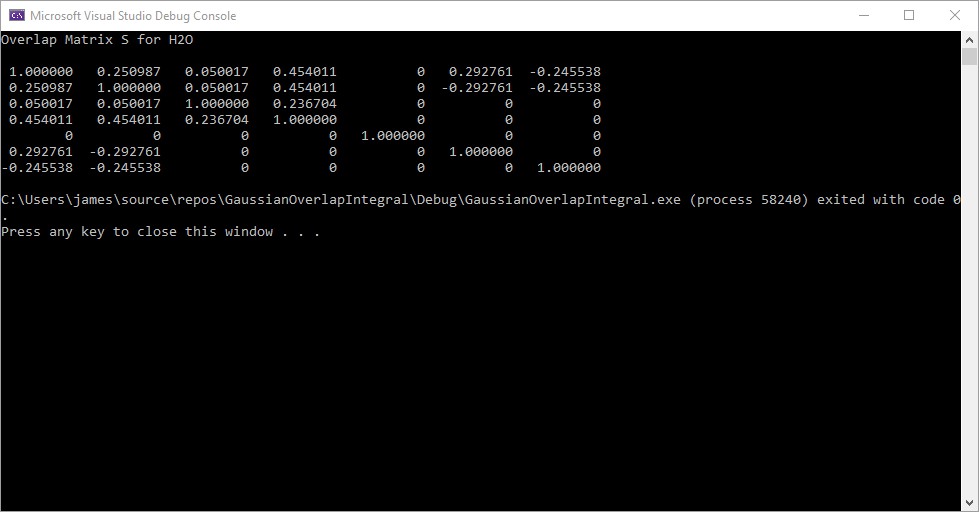
Blog Entry © Friday, November 1, 2024, by James Pate Williams, Jr. Calculation of the Overlap Matrix for the Water Molecule (H2O) Using a Contracted Set of Gaussian Orbitals
Reference: https://content.wolfram.com/sites/19/2012/02/Ho.pdf
I reproduced most of the computations in the MATHMATICA reference. The water molecule is a planar molecule that lies in the YZ-plane.
Blog Entry (c) Saturday, October 26, 2024, by James Pate Williams, Jr. Interpolation by Polynomials and Cramer’s Rule Calculations of Matrix Determinants and Inverses
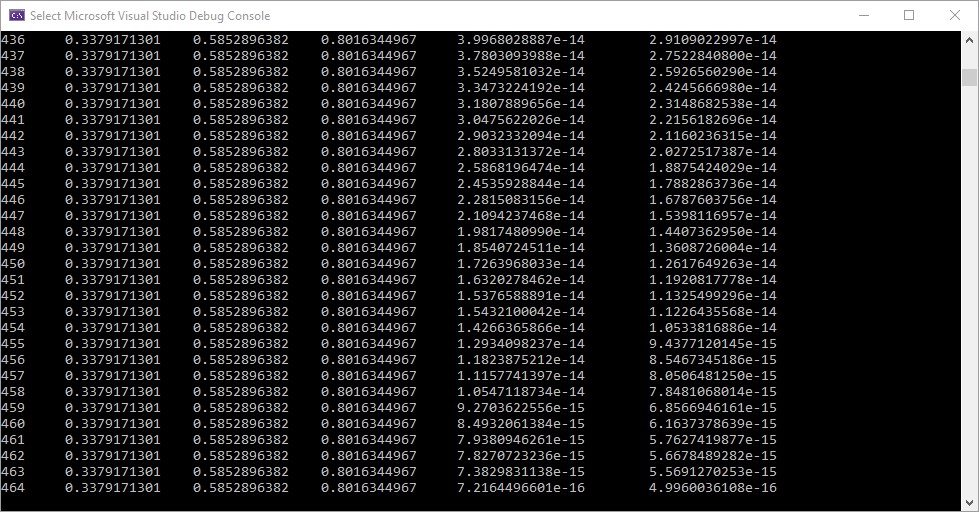
Blog Entry (c) Friday, October 25, 2024, by James Pate Williams, Jr. Optimization Methods
The optimization methods that were programmed are the Simplex Algorithm, the Steepest Descent method, and Newton’s Method. The Simplex Algorithm was given to me by Microsoft Copilot. The other two methods are from Elementary Numerical Analysis: An Algorithmic Approach 3rd Edition (c) 1980 by S.D. Conte and Carl de Boor.

Blog Entry (c) Saturday, October 19, 2024, New Ab Initio Calculations to Determine the Ground State Energies of the Helium-Hydrogen Cation and the Hydrogen Molecule
Using my STO-4G curve fit for N = 4 basis Gaussian type 1s orbitals I was able to get better results than found using the N = 3 basis wavefunctions in the graduate-level textbook Modern Quantum Chemistry Introduction to Advanced Electronic Structure Theory by Attila Szabo and Neil S. Ostlund. My recreation for N = 3 discovered -2.97867 atomic units ground state energy for the helium-hydrogen ion and -1.11651 atomic units for the hydrogen molecule using the textbook’s basis wavefunctions. The percentage errors were 3.98002% and 4.15928% respectively. My STO-4G basis wavefunctions found a ground state energy for the helium-hydrogen ion of -2.94937 atomic units and for the hydrogen molecule -1.14344 atomic units, which have percentage errors of 0.98349% and 2.86607% respectively.
Blog Entry (c) Friday, October 18, 2024, by James Pate Williams, Jr. Ab Initio Quantum Chemical Calculation
On Wednesday, October 16, 2024, I bought an Amazon Kindle book named “Modern Quantum Chemistry: Introduction to Advanced Electronic Structure Theory” by Attila Szabo and Neil S. Ostlund. It cost me $10.69 which is a real bargain. In Appendix B there is a listing for a FORTRAN program to perform an ab initio Hartree-Fock Self Consistent Field calculation for a two-electron heteronuclear molecule namely the helium-hydrogen cation. I successfully translated the program from FORTRAN to C++. I had to remember that FORTRAN stores matrices in column major order and C/C++ stores matrices in row major order. I took the transposes of two FORTRAN COMMON matrices to get the correct C++ storage. The authors of the book did an extensive treatment of the test calculation. The application is only 823 lines of monolithic C++ source code. I used FORTRAN like array indexing starting at 1 instead of the C initial beginning index of 0. I think I will try to get in touch with the authors to get permission to post the source code and results on my blog.
P. S. I got permission from Dover Books to publish my source code and results. I think I will reconsider posting the C++ source code. The actual ground state energy of the cation is -2.97867. My calculation and the book’s computation are in percentage errors of about 4%. The book’s value is a little closer to the exact value than my result. The book calculation was done in FORTRAN double precision on a Digital Equipment Corporation PDP-10 minicomputer. My recreation of the book’s endeavor was executed on an Intel Itanium Core 7 and Windows 10 Professional machine using Win32 C++. The C++ compiler was from Microsoft Visual Studio 2019 Community Version.
Note I added a calculation for a homonuclear molecule, namely, the hydrogen diatomic molecule.

