Category: Quantum Mechanics and Quantum Chemistry
Blog Entry Tuesday, May 28, 2024, Quantum Mechanics by James Pate Williams, Jr.
Recent Email that I Wrote on May 23, 2024
Does the following thought experiment make sense?
Suppose we have a positively charged quantum mechanical particle in a finite potential energy well. Also suppose there is a free negatively charged quantum mechanical particle outside the potential energy well. There is a measurable probability that the positively charged particle will tunnel through the potential energy well and perhaps be attracted to the negatively charged particle. Likewise, the negatively charged particle has a finite probability of penetrating the potential energy well and hooking up with the positively charged particle should it still be trapped in the well. There is no “spooky action at a distance” to use Albert Einstein’s 1930s definition of quantum entanglement in this example since this electromagnetic attraction is a local phenomenon (?). The positively charged particle cannot exert an attractive force until it tunnels through the energy barrier or otherwise the negatively charged particle winds up breaking into the well. I don’t know exactly how quantum electrodynamics would explain this example. Perhaps the positively charged particle is a positron (antimatter lepton) and the negatively charged particle is a plain vanilla electron. We know that the local result of the interaction of our two matter-antimatter particles is an annihilation event whereby two energetic photons are created, or other products are generated.
https://en.wikipedia.org/wiki/Annihilation#/media/File:Electron_Positron_Annihilation.png
Quantum Mechanical Angular Momentum Ladder Operators by James Pate Williams, Jr. Copyright Thursday, May 23, 2024, All Applicable Rights Reserved


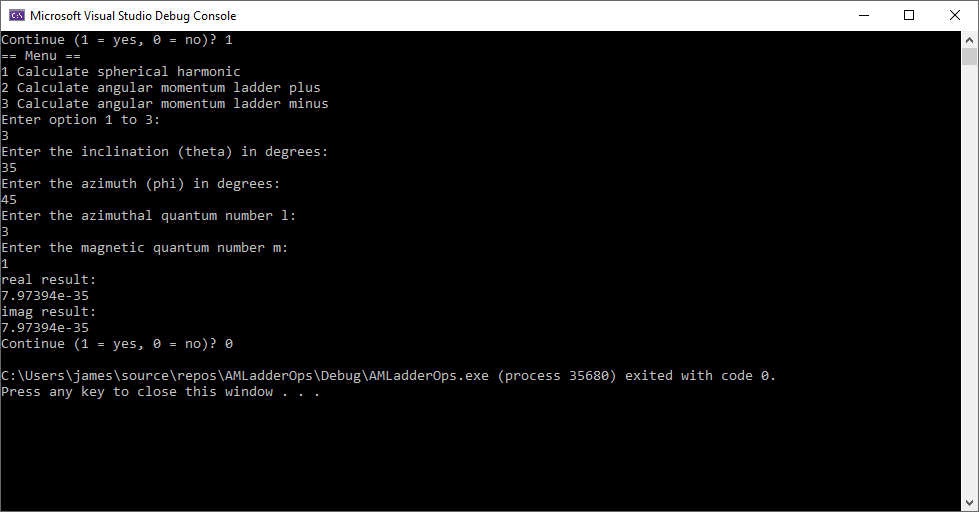

Several Problems from Schiff Chapter 7 (c) May 19-24, 2024, by James Pate Williams, Jr.
A Few Problems from Schiff Chapter 6 (c) May 19-20, 2024, by James Pate Williams, Jr.
Electron Probability Distribution Function Etc. (c) James Pate Williams, Jr. December 2023
More than Four Dimensions Why Worry a Blog Entry by James Pate Williams, Jr. December 27, 2023
Some modern physical models of our universe require more than Einstein’s four dimensions: three spatial dimensions and one time dimension. Why do people worry about introducing more dimensions into our understanding of chemistry and physics? When Erwin Schrödinger introduced his famous quantum mechanical two-body solution of the time independent hydrogen-like atom wave equation he went four dimensions to three spatial dimensions. Later, Wolfgang Pauli espoused his famous Pauli Exclusion Principle that simply stated no two electrons (fermions) in an atomic orbital can have the same quantum spin number. Atoms live in a four-dimensional quantum number space augmented by three spatial dimensions and one time dimension.
Revised Translated Source Code from May 15, 2015, by James Pate Williams, Jr.
A New Calculus of Variations Solution of the Schrödinger Equation for the Lithium Like Atom’s Ground State Energy
This computation took a lot longer time to reach a much better solution than my previously published result.
 Numerical Explorations
