/*
* MuellersMethod.c (c) Sunday, July 21, 2024 by
* James Pate Williams, Jr. BA, BS, MSwE, PhD
* Translated from the FORTRAN 77 source code
* found in "Elementary Numerical Analysis: An
* Algorithmic Approach" by S. D. Conte and Carl
* de Boor Originally coded in FORTRAN IV in 1982 then
* into C# in March 2015 Finished Tuesday,
* July 23, 2024 The complex division method is
* from "A Numerical Library in C for Scientists
* and Engineers" by H. T. Lau Chapter 1
*/
#include <complex.h>
#include <math.h>
#include <stdio.h>
#include <stdlib.h>
//#define DEBUG
static _Lcomplex HornersMethod(_Lcomplex coeff[], _Lcomplex z, int degree) {
int i = 0;
_Lcomplex c = coeff[degree];
for (i = degree; i >= 1; i--) {
_Lcomplex product = _LCmulcc(c, z);
c._Val[0] = product._Val[0] + coeff[i - 1]._Val[0];
c._Val[1] = product._Val[1] + coeff[i - 1]._Val[1];
}
#ifdef DEBUG
_Lcomplex sum = { 0 };
for (i = 0; i <= degree; i++) {
_Lcomplex term =
_LCmulcc(cpowl(z, _LCbuild(i, 0.0)), coeff[i]);
sum._Val[0] += term._Val[0];
sum._Val[1] += term._Val[1];
}
long double delta = fabsl(cabsl(c) - cabsl(sum));
if (delta > 1.0e-12)
exit(-5);
#endif
return c;
}
static void comdiv(
long double xr, long double xi,
long double yr, long double yi,
long double* zr, long double* zi)
{
long double h, d;
if (fabs(yi) < fabs(yr)) {
if (yi == 0.0) {
*zr = xr / yr;
*zi = xi / yr;
}
else {
h = yi / yr;
d = h * yi + yr;
*zr = (xr + h * xi) / d;
*zi = (xi - h * xr) / d;
}
}
else {
h = yr / yi;
d = h * yr + yi;
*zr = (xr * h + xi) / d;
*zi = (xi * h - xr) / d;
}
}
#ifdef DEBUG
static _Lcomplex MyComplexDivide(_Lcomplex numer, _Lcomplex denom) {
long double norm2 =
denom._Val[0] * denom._Val[0] +
denom._Val[1] * denom._Val[1];
_Lcomplex result = { 0 };
result._Val[0] = (
numer._Val[0] * denom._Val[0] +
numer._Val[1] * denom._Val[1]) / norm2;
result._Val[1] = (
numer._Val[1] * denom._Val[0] -
numer._Val[0] * denom._Val[1]) / norm2;
return result;
}
#endif
static _Lcomplex ComplexDivide(_Lcomplex numer, _Lcomplex denom) {
_Lcomplex result = { 0 };
comdiv(
numer._Val[0], numer._Val[1],
denom._Val[0], denom._Val[1],
&result._Val[0], &result._Val[1]);
#ifdef DEBUG
_Lcomplex myResult = MyComplexDivide(numer, denom);
long double delta = fabsl(cabsl(result) - cabsl(myResult));
if (delta > 1.0e-12)
exit(-6);
#endif
return result;
}
static int Deflate(
_Lcomplex coeff[], _Lcomplex zero,
_Lcomplex* fzero, _Lcomplex* fzrdfl,
_Lcomplex zeros[], int i, int* count,
int degree) {
_Lcomplex denom = { 0 };
(*count)++;
*fzero = HornersMethod(coeff, zero, degree);
*fzrdfl = *fzero;
if (i < 1)
return 0;
for (int j = 1; j <= i; j++) {
denom._Val[0] = zero._Val[0] - zeros[j - 1]._Val[0];
denom._Val[1] = zero._Val[1] - zeros[j - 1]._Val[1];
if (cabsl(denom) == 0.0) {
zeros[i] = _LCmulcr(zero, 1.001);
return 1;
}
else
*fzrdfl = ComplexDivide(*fzrdfl, denom);
}
return 0;
}
static void Mueller(
_Lcomplex coeff[], _Lcomplex zeros[],
double epsilon1, double epsilon2,
int degree, int fnreal, int maxIts, int n, int nPrev) {
double eps1 = max(epsilon1, 1.0e-12);
double eps2 = max(epsilon2, 1.0e-20);
int count = 0, i = 0;
_Lcomplex c = { 0 };
_Lcomplex denom = { 0 };
_Lcomplex divdf1 = { 0 };
_Lcomplex divdf2 = { 0 };
_Lcomplex divdf1p = { 0 };
_Lcomplex fzero = { 0 };
_Lcomplex fzr = { 0 };
_Lcomplex fzdfl = { 0 };
_Lcomplex fzrdfl = { 0 };
_Lcomplex fzrprv = { 0 };
_Lcomplex four = _LCbuild(4.0, 0.0);
_Lcomplex h = { 0 };
_Lcomplex hprev = { 0 };
_Lcomplex sqr = { 0 };
_Lcomplex zero = { 0 };
_Lcomplex p5 = _LCbuild(0.5, 0.0);
_Lcomplex zeropp5 = { 0 };
_Lcomplex zeromp5 = { 0 };
_Lcomplex diff = { 0 };
_Lcomplex tadd = { 0 };
_Lcomplex tmul = { 0 };
_Lcomplex umul = { 0 };
_Lcomplex vmul = { 0 };
for (i = nPrev; i < n; i++) {
count = 0;
Label1:
zero = zeros[i];
h = p5;
zeropp5._Val[0] = zero._Val[0] + p5._Val[0];
zeropp5._Val[1] = zero._Val[1] + p5._Val[1];
if (Deflate(
coeff, zeropp5, &fzr, &divdf1p,
zeros, i, &count, degree))
goto Label1;
zeromp5._Val[0] = zero._Val[0] - p5._Val[0];
zeromp5._Val[1] = zero._Val[1] - p5._Val[1];
if (Deflate(
coeff, zeromp5, &fzr, &fzrprv,
zeros, i, &count, degree))
goto Label1;
hprev._Val[0] = -1.0;
hprev._Val[1] = 0.0;
diff._Val[0] = fzrprv._Val[0] - divdf1p._Val[0];
diff._Val[1] = fzrprv._Val[1] - divdf1p._Val[1];
if (cabsl(hprev) == 0)
exit(-2);
divdf1p = ComplexDivide(diff, hprev);
if (Deflate(
coeff, zero, &fzr, &fzrdfl,
zeros, i, &count, degree))
goto Label1;
Label2:
diff._Val[0] = fzrdfl._Val[0] - fzrprv._Val[0];
diff._Val[1] = fzrdfl._Val[1] - fzrprv._Val[1];
if (cabsl(h) == 0)
exit(-3);
divdf1 = ComplexDivide(diff, h);
diff._Val[0] = divdf1._Val[0] - divdf1p._Val[0];
diff._Val[1] = divdf1._Val[1] - divdf1p._Val[1];
tadd._Val[0] = h._Val[0] + hprev._Val[0];
tadd._Val[1] = h._Val[1] + hprev._Val[1];
if (cabsl(tadd) == 0)
exit(-3);
divdf2 = ComplexDivide(diff, tadd);
hprev = h;
divdf1p = divdf1;
tmul = _LCmulcc(h, divdf2);
c._Val[0] = divdf1._Val[0] + tmul._Val[0];
c._Val[1] = divdf1._Val[1] + tmul._Val[1];
tmul = _LCmulcc(c, c);
umul = _LCmulcc(four, fzrdfl);
vmul = _LCmulcc(umul, divdf2);
sqr._Val[0] = tmul._Val[0] - vmul._Val[0];
sqr._Val[1] = tmul._Val[1] - vmul._Val[1];
if (fnreal && sqr._Val[0] < 0.0)
{
sqr._Val[0] = 0.0;
sqr._Val[1] = 0.0;
}
sqr = csqrtl(sqr);
if ((c._Val[0] * sqr._Val[0] + c._Val[1] * sqr._Val[1]) < 0.0) {
denom._Val[0] = c._Val[0] - sqr._Val[0];
denom._Val[1] = c._Val[1] - sqr._Val[1];
}
else {
denom._Val[0] = c._Val[0] + sqr._Val[0];
denom._Val[1] = c._Val[1] + sqr._Val[1];
}
if (cabsl(denom) <= 0.0)
{
denom._Val[0] = 1.0;
denom._Val[1] = 0.0;
}
if (cabsl(denom) == 0)
exit(-4);
tmul = _LCmulcr(fzrdfl, -2.0);
h = ComplexDivide(tmul, denom);
fzrprv = fzrdfl;
zero._Val[0] = zero._Val[0] + h._Val[0];
zero._Val[1] = zero._Val[1] + h._Val[1];
if (count > maxIts)
goto Label4;
Label3:
if (Deflate(
coeff, zero, &fzr, &fzrdfl,
zeros, i, &count, degree))
goto Label1;
if (cabsl(h) < eps1 * cabsl(zero))
goto Label4;
if (max(cabsl(fzr), cabsl(fzdfl)) < eps2)
goto Label4;
if (cabsl(fzrdfl) >= 10.0 * cabsl(fzrprv)) {
h = _LCmulcr(h, 0.5);
zero._Val[0] = zero._Val[0] - h._Val[0];
zero._Val[1] = zero._Val[1] - h._Val[1];
goto Label3;
}
else
goto Label2;
Label4:
zeros[i] = zero;
}
}
int main(void)
{
double epsilon1 = 1.0e-15;
double epsilon2 = 1.0e-15;
int degree = 0, fnreal = 0, i = 0, maxIts = 1000;
int n = 0, nPrev = 0;
while (1) {
_Lcomplex* coeff = NULL;
_Lcomplex* zeros = NULL;
printf_s("Degree (0 to quit) = ");
scanf_s("%d", °ree);
if (degree == 0)
break;
n = degree;
coeff = calloc(degree + 1, sizeof(_Lcomplex));
if (coeff == NULL)
exit(-1);
zeros = calloc(n, sizeof(_Lcomplex));
if (zeros == NULL)
exit(-1);
for (i = degree; i >= 0; i--) {
printf_s("coefficient[%d].real = ", i);
scanf_s("%Lf", &coeff[i]._Val[0]);
printf_s("coefficient[%d].imag = ", i);
scanf_s("%Lf", &coeff[i]._Val[1]);
}
Mueller(
coeff, zeros, epsilon1,
epsilon2, degree, fnreal,
maxIts, n, nPrev);
printf_s("\n");
for (i = 0; i < degree; i++) {
printf_s("zero[%d].real = %17.10e\t", i, zeros[i]._Val[0]);
printf_s("zero[%d].imag = %17.10e\n", i, zeros[i]._Val[1]);
}
printf_s("\n");
for (i = 0; i < degree; i++) {
_Lcomplex func = HornersMethod(coeff, zeros[i], degree);
printf_s("func[%d].real = %17.10e\t", i, func._Val[0]);
printf_s("func[%d].imag = %17.10e\n", i, func._Val[1]);
}
printf_s("\n");
free(coeff);
free(zeros);
}
return 0;
}
Category: Bessel Functions of the First and Second Kind
Blog Entry © Sunday March 15, 2026, by James Pate Williams, Jr. Graphing Integer Order Bessel Functions of the First Kind and the real Gamma Function
Blog Entry © Saturday, March 14, 2026, by James Pate Williams, Jr. Power Series Solution of a Second Order Linear Ordinary Differential Equation
// SecondOrderLinearODE.cpp (c) Friday March 13, 2026
// by James Pate Williams, Jr., BA, BS, MSwE, PhD
// Solves the Bessel Equation of the First Kind for Order 0
// Using the power series found in the reference below -
// References: https://math.libretexts.org/Bookshelves/Calculus/Calculus_(OpenStax)/17%3A_Second-Order_Differential_Equations/17.04%3A_Series_Solutions_of_Differential_Equations
// https://mathworld.wolfram.com/BesselDifferentialEquation.html

#include "framework.h"
#include <Windows.h>
#include "SecondOrderLinearODE.h"
#include <string>
#include <vector>

#define MAX_LOADSTRING 100

// Global Variables:
HINSTANCE hInst;                                // current instance
WCHAR szTitle[MAX_LOADSTRING];                  // The title bar text
WCHAR szWindowClass[MAX_LOADSTRING];            // the main window class name
WCHAR fTitle[128];
double chi[1025], eta[1025], coeff[65];

// Forward declarations of functions included in this code module:
ATOM                MyRegisterClass(HINSTANCE hInstance);
BOOL                InitInstance(HINSTANCE, int);
LRESULT CALLBACK    WndProc(HWND, UINT, WPARAM, LPARAM);
INT_PTR CALLBACK    About(HWND, UINT, WPARAM, LPARAM);

int APIENTRY wWinMain(_In_ HINSTANCE hInstance,
                     _In_opt_ HINSTANCE hPrevInstance,
                     _In_ LPWSTR    lpCmdLine,
                     _In_ int       nCmdShow)
{
    UNREFERENCED_PARAMETER(hPrevInstance);
    UNREFERENCED_PARAMETER(lpCmdLine);

    // TODO: Place code here.

    // Initialize global strings
    LoadStringW(hInstance, IDS_APP_TITLE, szTitle, MAX_LOADSTRING);
    LoadStringW(hInstance, IDC_SECONDORDERLINEARODE, szWindowClass, MAX_LOADSTRING);
    MyRegisterClass(hInstance);

    // Perform application initialization:
    if (!InitInstance (hInstance, nCmdShow))
    {
        return FALSE;
    }

    HACCEL hAccelTable = LoadAccelerators(hInstance, MAKEINTRESOURCE(IDC_SECONDORDERLINEARODE));

    MSG msg;

    // Main message loop:
    while (GetMessage(&msg, nullptr, 0, 0))
    {
        if (!TranslateAccelerator(msg.hwnd, hAccelTable, &msg))
        {
            TranslateMessage(&msg);
            DispatchMessage(&msg);
        }
    }

    return (int) msg.wParam;
}

//
//  FUNCTION: MyRegisterClass()
//
//  PURPOSE: Registers the window class.
//
ATOM MyRegisterClass(HINSTANCE hInstance)
{
    WNDCLASSEXW wcex = { 0 };

    wcex.cbSize = sizeof(WNDCLASSEX);

    wcex.style          = CS_HREDRAW | CS_VREDRAW;
    wcex.lpfnWndProc    = WndProc;
    wcex.cbClsExtra     = 0;
    wcex.cbWndExtra     = 0;
    wcex.hInstance      = hInstance;
    wcex.hIcon          = LoadIcon(hInstance, MAKEINTRESOURCE(IDI_SECONDORDERLINEARODE));
    wcex.hCursor        = LoadCursor(nullptr, IDC_ARROW);
    wcex.hbrBackground  = (HBRUSH)(COLOR_WINDOW+1);
    wcex.lpszMenuName   = MAKEINTRESOURCEW(IDC_SECONDORDERLINEARODE);
    wcex.lpszClassName  = szWindowClass;
    wcex.hIconSm        = LoadIcon(wcex.hInstance, MAKEINTRESOURCE(IDI_SMALL));

    return RegisterClassExW(&wcex);
}

//
//   FUNCTION: InitInstance(HINSTANCE, int)
//
//   PURPOSE: Saves instance handle and creates main window
//
//   COMMENTS:
//
//        In this function, we save the instance handle in a global variable and
//        create and display the main program window.
//
BOOL InitInstance(HINSTANCE hInstance, int nCmdShow)
{
   hInst = hInstance; // Store instance handle in our global variable

   HWND hWnd = CreateWindowW(szWindowClass, szTitle, WS_OVERLAPPEDWINDOW,
      CW_USEDEFAULT, 0, CW_USEDEFAULT, 0, nullptr, nullptr, hInstance, nullptr);

   if (!hWnd)
   {
      return FALSE;
   }

   ShowWindow(hWnd, nCmdShow);
   UpdateWindow(hWnd);

   return TRUE;
}

static double Factorial(int n)
{
    double factorial = 1.0;

    for (int i = 2; i <= n; i++)
        factorial *= i;

    return factorial;
}

static void ComputeCoefficients()
{
    double a0 = 1.0;

    for (int k = 0; k <= 64; k++)
    {
        double kFactorial = Factorial(k);

        coeff[k] = a0 * pow(-1.0, k) /
            (pow(2.0, 2.0 * k) * pow(kFactorial, 2.0));
    }
}

static void ComputePoints()
{
    double chi0 = -15.0;
    double deltaChi = 30.0 / 1024;

    for (int i = 0; i <= 1024; i++)
    {
        double sum = 0.0;

        for (int k = 64; k >= 0; k--)
            sum += pow(chi0, 2 * k) * coeff[k];

        chi[i] = chi0;
        eta[i] = sum;

        chi0 += deltaChi;
    }
}

static void FindMinMax(
    double x[],
    double& min,
    double& max)
{
    min = x[0];
    max = x[0];

    for (int i = 1; i <= 1024; i++)
    {
        if (x[i] < min)
            min = x[i];
        if (x[i] > max)
            max = x[i];
    }
}

static void DrawTitles(HDC hdc, RECT clientRect, const std::wstring& fTitle,
    int sx0, int sx1, int sy0, int sy1)
{
    HFONT hCustomFont = CreateFont(
        -MulDiv(10, GetDeviceCaps(hdc, LOGPIXELSY), 72), // Height in logical units
        0,                      // Width (0 = default)
        0,                      // Escapement
        0,                      // Orientation
        FW_BOLD,                // Weight (700 = bold)
        FALSE,                  // Italic
        FALSE,                  // Underline
        FALSE,                  // StrikeOut
        DEFAULT_CHARSET,        // Charset
        OUT_DEFAULT_PRECIS,     // Output precision
        CLIP_DEFAULT_PRECIS,    // Clipping precision
        DEFAULT_QUALITY,        // Quality
        FIXED_PITCH | FF_MODERN,// Pitch and family
        L"Courier New"          // Typeface name
    );

    HFONT hOldFont = (HFONT)SelectObject(hdc, hCustomFont);

    SIZE sz;
    int width = clientRect.right - clientRect.left;

    // Title: fTitle
    GetTextExtentPoint32(hdc, fTitle.c_str(), (int)fTitle.length(), &sz);
    int w = sz.cx;
    int h = sz.cy;
    TextOut(hdc, (width - w) / 2, h, fTitle.c_str(), (int)fTitle.length());

    // x-axis title: "x"
    std::wstring xTitle = L"x";
    GetTextExtentPoint32W(hdc, xTitle.c_str(), (int)xTitle.length(), &sz);
    w = sz.cx;
    TextOutW(hdc, sx0 + (sx1 - sx0 - w) / 2, sy1 + 2 * h, xTitle.c_str(), (int)xTitle.length());

    // y-axis title: "p(x)"
    std::wstring yTitle = L"J0(x)";
    GetTextExtentPoint32W(hdc, yTitle.c_str(), (int)yTitle.length(), &sz);
    w = sz.cx;
    TextOutW(hdc, sx1 + w / 5, sy0 + (sy1 - sy0) / 2 - h / 2, yTitle.c_str(), (int)yTitle.length());

    SelectObject(hdc, hOldFont); // Restore original font
}

static void DrawFormattedText(HDC hdc, char loctext[], RECT rect)
{
    // Draw the text with formatting options
    DrawTextA(hdc, loctext, (int)strlen(loctext), &rect, DT_SINGLELINE | DT_NOCLIP);
}

//
//  FUNCTION: WndProc(HWND, UINT, WPARAM, LPARAM)
//
//  PURPOSE: Processes messages for the main window.
//
//  WM_COMMAND  - process the application menu
//  WM_PAINT    - Paint the main window
//  WM_DESTROY  - post a quit message and return
//
//
LRESULT CALLBACK WndProc(HWND hWnd, UINT message, WPARAM wParam, LPARAM lParam)
{
    switch (message)
    {
    case WM_CREATE:
        ComputeCoefficients();
        ComputePoints();
        break;
    case WM_COMMAND:
        {
            int wmId = LOWORD(wParam);
            // Parse the menu selections:
            switch (wmId)
            {
            case IDM_ABOUT:
                DialogBox(hInst, MAKEINTRESOURCE(IDD_ABOUTBOX), hWnd, About);
                break;
            case IDM_EXIT:
                DestroyWindow(hWnd);
                break;
            default:
                return DefWindowProc(hWnd, message, wParam, lParam);
            }
        }
        break;
    case WM_PAINT:
    {
        PAINTSTRUCT ps;
        HDC hdc = BeginPaint(hWnd, &ps);

        ComputePoints();
        double xMin = 0, yMin = 0;
        double xMax = 0, yMax = 0;
        FindMinMax(chi, xMin, xMax);
        FindMinMax(eta, yMin, yMax);

        double h = 0, pi = 0, plm = 0, theta = 0;
        float xSpan = (float)(xMax - xMin);
        float ySpan = (float)(yMax - yMin);
        RECT rect = { };
        GetClientRect(hWnd, &rect);
        float width = (float)(rect.right - rect.left + 1);
        float height = (float)(rect.bottom - rect.top - 32 + 1);
        float sx0 = 2.0f * width / 16.0f;
        float sx1 = 14.0f * width / 16.0f;
        float sy0 = 2.0f * height / 16.0f;
        float sy1 = 14.0f * height / 16.0f;
        float deltaX = xSpan / 8.0f;
        float deltaY = ySpan / 8.0f;
        float xSlope = (sx1 - sx0) / xSpan;
        float xInter = (float)(sx0 - xSlope * xMin);
        float ySlope = (sy0 - sy1) / ySpan;
        float yInter = (float)(sy0 - ySlope * yMax);
        float px = 0, py = 0, sx = 0, sy = 0;
        POINT wPt = { 0 };
        int i = 0;
        float x = (float)xMin;
        float y = (float)yMax;
        wcscpy_s(fTitle, 128, L"Bessel Function of the First Kind Order 0");
        DrawTitles(hdc, rect, fTitle, (int)sx0, (int)sx1, (int)sy0, (int)sy1);


        px = (float)chi[0];
        py = (float)eta[0];

        sx = xSlope * px + xInter;
        sy = ySlope * py + yInter;
        MoveToEx(hdc, (int)sx, (int)sy0, &wPt);

        while (i <= 8)
        {
            sx = xSlope * x + xInter;
            wPt.x = wPt.y = 0;
            MoveToEx(hdc, (int)sx, (int)sy0, &wPt);
            LineTo(hdc, (int)sx, (int)sy1);
            char numberStr[128] = "";
            sprintf_s(numberStr, 128, "%5.4lf", x);
            SIZE size = { };
            GetTextExtentPoint32A(
                hdc,
                numberStr,
                (int)strlen(numberStr),
                &size);
            RECT textRect = { 0 };
            textRect.left = (long)(sx - size.cx / 2.0f);
            textRect.right = (long)(sx + size.cx / 2.0f);
            textRect.top = (long)sy1;
            textRect.bottom = (long)(sy1 + size.cy / 2.0f);
            DrawFormattedText(hdc, numberStr, textRect);
            x += deltaX;
            i++;
        }

        i = 0;
        y = (float)yMin;

        while (i <= 8)
        {
            sy = ySlope * y + yInter;
            wPt.x = wPt.y = 0;
            MoveToEx(hdc, (int)sx0, (int)sy, &wPt);
            LineTo(hdc, (int)sx, (int)sy);

            if (i != 0)
            {
                char numberStr[128] = "";
                sprintf_s(numberStr, 128, "%+5.3lf", y);
                SIZE size = { };
                GetTextExtentPoint32A(
                    hdc,
                    numberStr,
                    (int)strlen(numberStr),
                    &size);
                RECT textRect = { 0 };
                textRect.left = (long)(sx0 - size.cx - size.cx / 2.0f);
                textRect.right = (long)(sx0 - size.cx / 2.0f);
                textRect.top = (long)(sy - size.cy / 2.0f);
                textRect.bottom = (long)(sy + size.cy / 2.0f);
                DrawFormattedText(hdc, numberStr, textRect);
            }

            y += deltaY;
            i++;
        }

        HGDIOBJ nPenNew = NULL;
        HGDIOBJ hPenOld = NULL;

        nPenNew = CreatePen(PS_SOLID, 2, RGB(0, 0, 255));
        hPenOld = SelectObject(hdc, nPenNew);

        HRGN clipRegion = CreateRectRgn(
            (int)sx0, (int)sy0,              // Left, Top
            (int)(sx1), (int)(sy1)           // Right, Bottom
        );

        // Apply clipping region

        SelectClipRgn(hdc, clipRegion);


        px = (float)chi[0];
        py = (float)eta[0];

        sx = xSlope * px + xInter;
        sy = ySlope * py + yInter;
        wPt.x = wPt.y = 0;
        MoveToEx(hdc, (int)sx, (int)sy, &wPt);

        for (size_t j = 1; j <= 1024; j++)
        {

            px = (float)chi[j];
            py = (float)eta[j];

            sx = xSlope * px + xInter;
            sy = ySlope * py + yInter;
            LineTo(hdc, (int)sx, (int)sy);
        }

        DeleteObject(nPenNew);
        nPenNew = NULL;

        SelectObject(hdc, hPenOld);
        DeleteObject(clipRegion);

        EndPaint(hWnd, &ps);
    }
    break;
    case WM_DESTROY:
        PostQuitMessage(0);
        break;
    default:
        return DefWindowProc(hWnd, message, wParam, lParam);
    }
    return 0;
}

// Message handler for about box.
INT_PTR CALLBACK About(HWND hDlg, UINT message, WPARAM wParam, LPARAM lParam)
{
    UNREFERENCED_PARAMETER(lParam);
    switch (message)
    {
    case WM_INITDIALOG:
        return (INT_PTR)TRUE;

    case WM_COMMAND:
        if (LOWORD(wParam) == IDOK || LOWORD(wParam) == IDCANCEL)
        {
            EndDialog(hDlg, LOWORD(wParam));
            return (INT_PTR)TRUE;
        }
        break;
    }
    return (INT_PTR)FALSE;
}
Blog Entry © Wednesday, November 6, 2024, by James Pate Williams, Jr. Particle in a Finite Spherical Three-Dimensional Potential Well
The Bessel functions are from A Numerical Library in C for Scientists and Engineers (c) 1995 by H. T. Lau, PhD.
Blog Entry Friday, June 14, 2024 (c) James Pate Williams, Jr.
For the last week or so I have been working my way through Chapter 3 The Solution of Nonlinear Equations found in the textbook “Numerical Analysis: An Algorithmic Approach” by S. D. Conte and Carl de Boor. I also used some C source code from “A Numerical Library in C for Scientists and Engineers” by H. T. Lau, PhD. I implemented twenty examples and exercises from the previously mentioned chapter.
Text and Exercise from “Boundary Value Problems Second Edition” by David L. Powers in Progress (c) Wednesday, April 17, 2024, James Pate Williams, Jr.
Java Bessel Function Application by James Pate Williams, Jr.
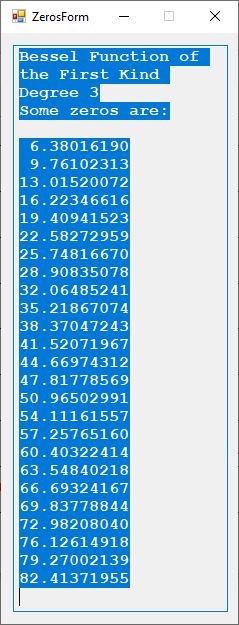
Bessel Functions of the First and Second Kind and Their Derivatives and Some Zeros for n = 3 by James Pate Williams, Jr.




 Numerical Explorations