#include <math.h>
#include <iostream>
using namespace std;

long double f(long double x)
{
	return powl(8.0, x) - powl(2.0, x) -
		2.0 * (powl(6.0, x) - powl(3.0, x));
}

long double g(long double x)
{
	return powl(8.0, x) * logl(8.0) - powl(2.0, x) * logl(2.0) -
		2.0 * (powl(6.0, x) * logl(6.0) - powl(3.0, x) * logl(3.0));
}

long double Newton(long double x, int maxIts, int& iterations)
{
	long double x0 = x;
	long double x1 = 0.0;

	iterations = 0;

	while (true) {
		long double dx = 0.0;
		long double fx = f(x0);
		long double gx = g(x0);
		x1 = x0 - fx / gx;
		dx = fabsl(x1 - x0);
		iterations++;
		if (dx < 1.0e-15)
			break;
		if (fabsl(fx) < 1.0e-15)
			break;
		if (iterations == maxIts)
			break;
		x0 = x1;
	}

	return x1;
}

int main() {
	int iterations = 0, maxIts;
	long double x0 = 0.0, x1 = 0.0;

	while (true) {
		cout << "x0 = ";
		cin >> x0;
		if (x0 == 0)
			break;
		cout << "maximum iterations = ";
		cin >> maxIts;
		x1 = Newton(x0, maxIts, iterations);
		cout << "x1 = " << x1 << endl;
		cout << "iterations = ";
		cout << iterations << endl;
	}

	return 0;
}
Category: C++ Computer Applications
Blog Entry Monday, July 8, 2024, (c) James Pate Williams, Jr. Relatively Fast 64-bit Trial Division Using Henri Cohen’s Algorithm
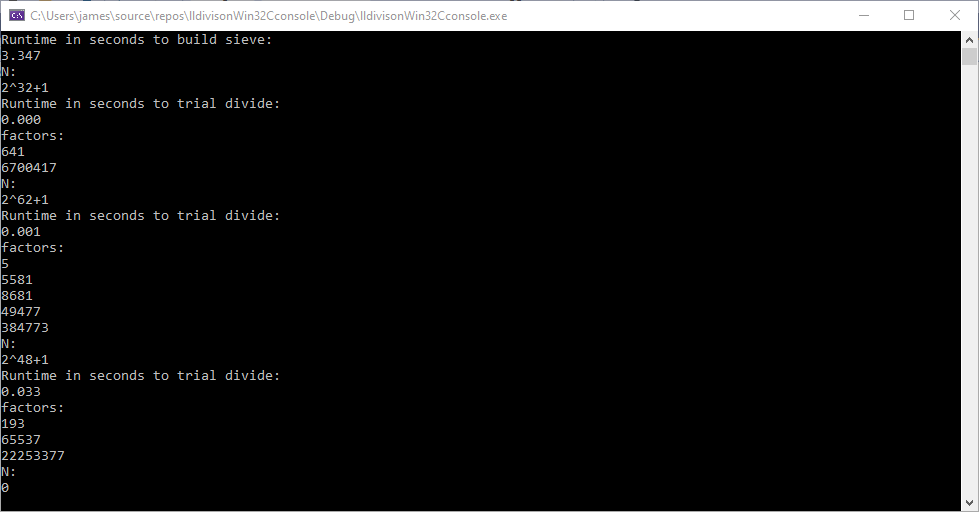
The sieve of Eratosthenes handles primes up to an upper bound of 100,000,000. The number of primes is 5,761,455. Below are a few examples runs of the app. I have also created C source code for trial division and other factoring algorithms that use Professor Emeritus Arjen K. Lenstra’s Free Large Integer Package also known as lip.

Blog Entry Monday, June 24, 2024 (c) James Pate Williams, Jr. Computing Binomial Coefficients and Pascal’s Triangle in the C Language
Enter n (<= 18) below:
5

Enter k (<= 18) below:
0

1       1

Enter n (<= 18) below:
5

Enter k (<= 18) below:
1

5       5

Enter n (<= 18) below:
5

Enter k (<= 18) below:
2

10      10

Enter n (<= 18) below:
0
Enter n (<= 18) below:
0

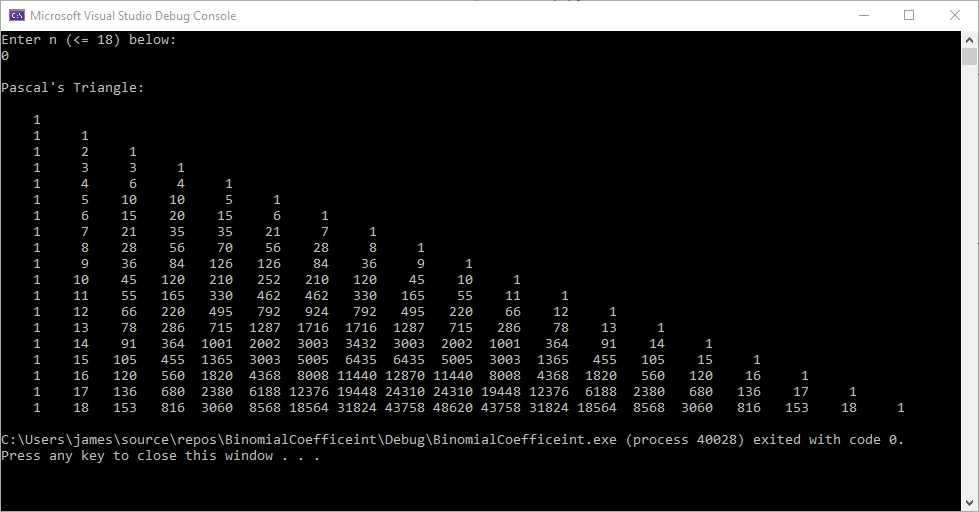
Pascal's Triangle:

    1
    1     1
    1     2     1
    1     3     3     1
    1     4     6     4     1
    1     5    10    10     5     1
    1     6    15    20    15     6     1
    1     7    21    35    35    21     7     1
    1     8    28    56    70    56    28     8     1
    1     9    36    84   126   126    84    36     9     1
    1    10    45   120   210   252   210   120    45    10     1
    1    11    55   165   330   462   462   330   165    55    11     1
    1    12    66   220   495   792   924   792   495   220    66    12     1
    1    13    78   286   715  1287  1716  1716  1287   715   286    78    13     1
    1    14    91   364  1001  2002  3003  3432  3003  2002  1001   364    91    14     1
    1    15   105   455  1365  3003  5005  6435  6435  5005  3003  1365   455   105    15     1
    1    16   120   560  1820  4368  8008 11440 12870 11440  8008  4368  1820   560   120    16     1
    1    17   136   680  2380  6188 12376 19448 24310 24310 19448 12376  6188  2380   680   136    17     1
    1    18   153   816  3060  8568 18564 31824 43758 48620 43758 31824 18564  8568  3060   816   153    18     1

C:\Users\james\source\repos\BinomialCoefficeint\Debug\BinomialCoefficeint.exe (process 40028) exited with code 0.
Press any key to close this window . . .
// BinomialCoefficient.c (c) Monday, June 24, 2024
// by James Pate Williams, Jr. BA, BS, MSwE, PhD

#include <stdio.h>
#include <stdlib.h>
typedef long long ll;

ll** Binomial(ll n)
{
    ll** C = (ll**)calloc(n + 1, sizeof(ll*));

    if (C == NULL)
        exit(-1);

    for (int i = 0; i < n + 1; i++)
    {
        C[i] = (ll*)calloc(n + 1, sizeof(ll));

        if (C[i] == NULL)
            exit(-1);
    }

    if (n >= 0)
    {
        C[0][0] = 1;
    }

    if (n >= 1)
    {
        C[1][0] = 1;
        C[1][1] = 1;
    }

    if (n >= 2)
    {
        for (int i = 2; i <= n; i++)
        {
            for (int j = 2; j <= n; j++)
            {
                C[i][j] = C[i - 1][j - 1] + C[i - 1][j];
            }
        }
    }

    return C;
}

ll Factorial(ll n)
{
    ll fact = 1;

    if (n > 1)
    {
        for (int i = 2; i <= n; i++)
            fact = i * fact;
    }

    return fact;
}

ll BC(ll n, ll k)
{
    return Factorial(n) / (Factorial(n - k) * Factorial(k));
}

int main()
{
    int i = 0, j = 0;
    ll** C = Binomial(20);

    while (1)
    {
        char buffer[256] = { '\0' };

        printf_s("Enter n (<= 18) below:\n");
        scanf_s("%s", buffer, sizeof(buffer));
        printf_s("\n");

        ll n = atoll(buffer);

        if (n == 0)
            break;

        printf_s("Enter k (<= 18) below:\n");
        scanf_s("%s", buffer, sizeof(buffer));
        printf_s("\n");

        ll k = atoll(buffer);

        printf_s("%lld\t%lld\n\n", C[n + 2][k + 2], BC(n, k));
    }

    printf_s("Pascal's Triangle:\n\n");

    for (i = 2; i <= 20; i++)
    {
        for (j = 2; j <= 20; j++)
            if (C[i][j] != 0)
                printf_s("%5lld ", C[i][j]);

        printf_s("\n");
    }

    for (i = 0; i <= 20; i++)
        free(C[i]);

    free(C);
}
Another Blog Entry for Thursday, June 20, 2024 (c) James Pate Williams, Jr. Atkin Primality Certificates
Blog Entry Thursday, June 20, 2024 (c) James Pate Williams, Jr. Some 3D Graphs (Application Edited 2024)
Blog Entry Tuesday, June 18, 2024 (c) James Pate Williams, Jr. FreeLIP Computation of Euler Numbers and Tangent Numbers
FreeLIP is a free large integer package solely created by Professor Emeritus Arjen K. Lenstra of the Number Field Sieve fame. He developed FreeLIP while he was an employee of AT&T – Lucent in the late 1980s. His copyright notice in the header file, lip.h, states copyright from 1989 to 1997. I have been using this excellent number theoretical package since the late 1990s. See the paper by Donald E. Knuth and Thomas J. Buckholtz for the formula for Tangent Numbers. I can’t remember where I got the Euler Numbers recurrence relation. I wrote a C# application in 2015 for computing Euler Numbers. The code below is in the vanilla C computer language. Excellent resources for the Euler and tangent numbers also known as zag numbers are:
Blog Entry Sunday, June 16, 2024 (c) James Pate Williams, Jr. Chapter 4 Matrices and Systems of Linear Equations from a Textbook by S. D. Conte and Carl de Boor
Blog Entry Friday, June 14, 2024 (c) James Pate Williams, Jr.
For the last week or so I have been working my way through Chapter 3 The Solution of Nonlinear Equations found in the textbook “Numerical Analysis: An Algorithmic Approach” by S. D. Conte and Carl de Boor. I also used some C source code from “A Numerical Library in C for Scientists and Engineers” by H. T. Lau, PhD. I implemented twenty examples and exercises from the previously mentioned chapter.
 Numerical Explorations