ASP .NET AJAX Timer Demonstration by James Pate Williams, Jr. BA, BS, MSwE, PhD

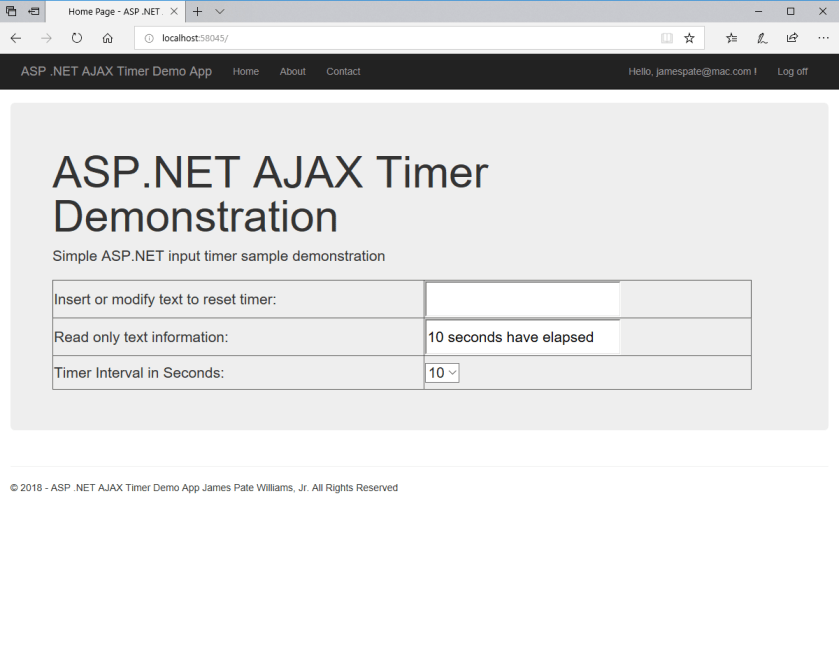
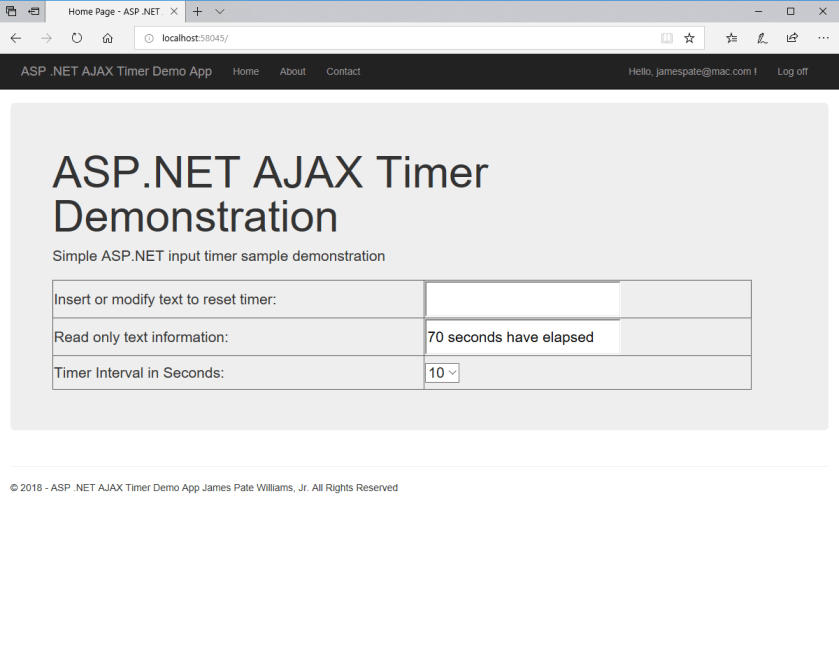
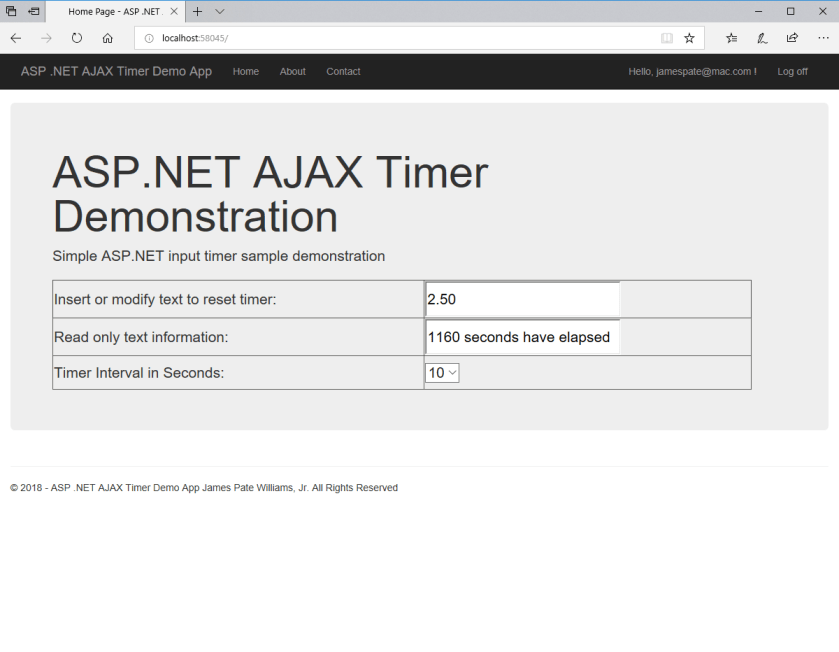
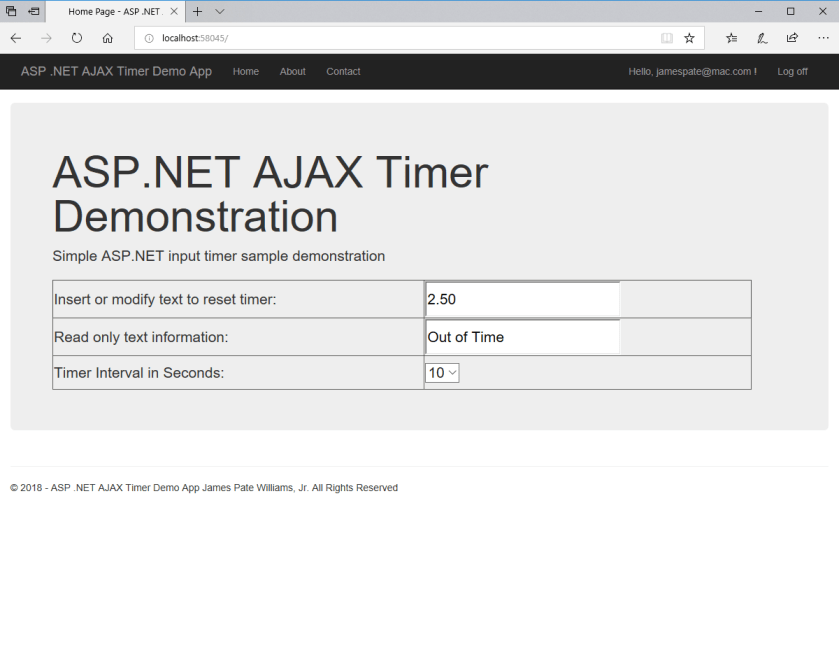
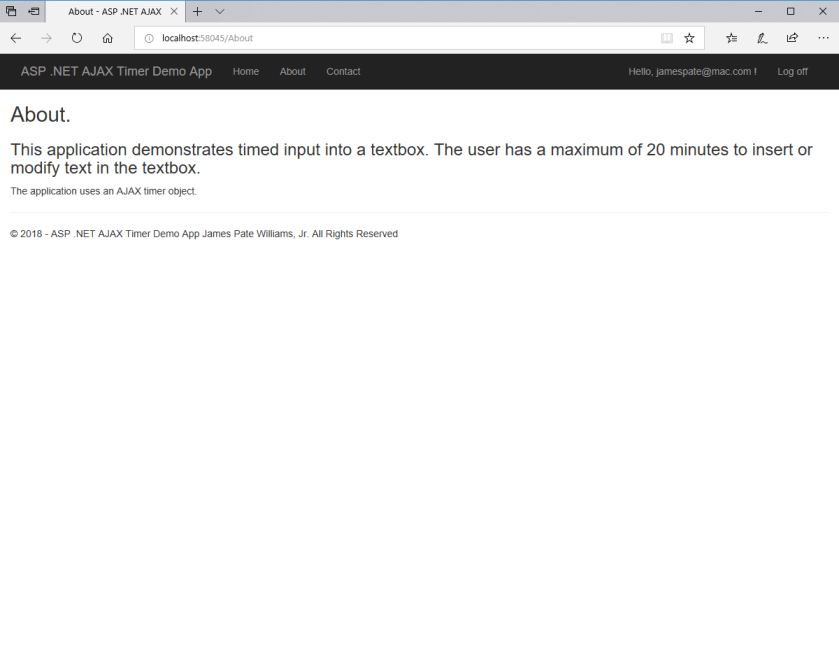
Sometimes in a web application you want to time the user’s input. Suppose you have a one textbox web form and you want to set an inactivity timer of 1200 seconds which is equal to 20 minutes. Every time the user adds or modifies the textbox the timer is reset to 0. The following pictures tell the story of my implementation of such a server-side timer in ASP .NET using an AJAX timer object.

Microsoft Edge 10_13_2018 4_29_27 PMMicrosoft Edge 10_13_2018 4_29_48 PMMicrosoft Edge 10_13_2018 4_30_22 PMMicrosoft Edge 10_13_2018 4_31_27 PMMicrosoft Edge 10_13_2018 4_31_44 PMMicrosoft Edge 10_13_2018 4_51_20 PMMicrosoft Edge 10_13_2018 4_52_03 PMMicrosoft Edge 10_13_2018 4_52_25 PMMicrosoft Edge 10_13_2018 4_57_43 PM

AJAX Timer Demonstration Source Code

Calculating a Few Digits of the Transcendental Number Pi by Throwing Darts by James Pate Williams, BA, BS, MSwE, PhD

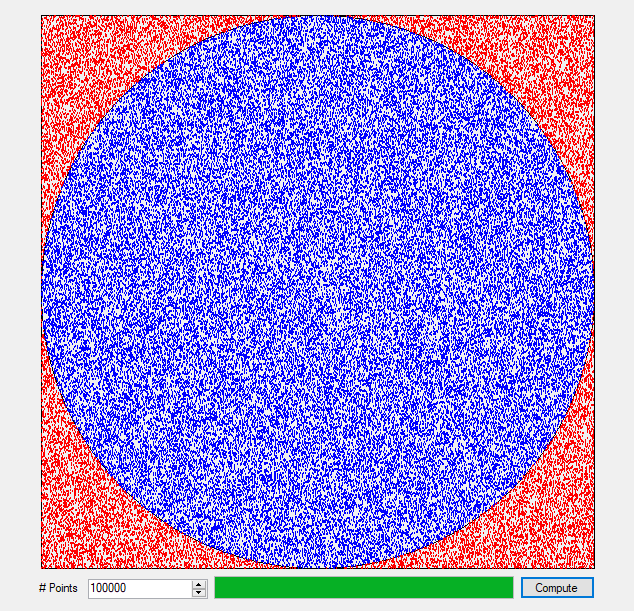
Suppose you have a unit square with a circle of unit diameter inscribed . You can compute a few digits of the transcendental number, pi, 3.1415926535897932384626433832795…, by using the algorithm described as follows. Let n be the number of darts to throw and h be the number of darts that land within the inscribed circle.

h = 0

for i = 1 to n do

Choose two random numbers x and y such that x and y are contained in the interval 0 to 1 inclusive that is x and y contained in [0, 1]

Let u = x – 1 / 2 and v = y – 1 / 2

if u * u + v * v <= 0.25 = 1 / 4 then h = h + 1

next i

pi = 4 * h / n

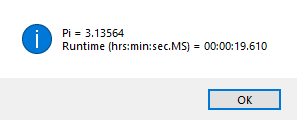
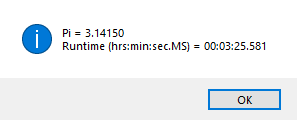
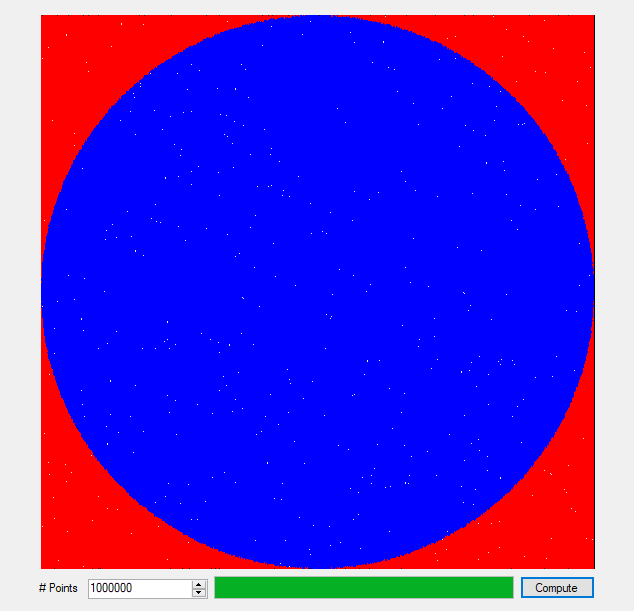
Below are the results of a C# Microsoft Visual Studio simulation project. In the first case we throw 100,000 darts and get two significant digits of pi and then we throw a 1,000,000 darts and five significant digits of pi are computed. Of course, in a previous entry by this author we can calculate hundreds or thousands of digits of pi in relatively little time:

https://jamespatewilliamsjr.wordpress.com/2018/07/01/the-bailey-borwein-plouffe-formula-for-calculating-the-first-n-digits-of-pi/

MainForm 10_16_2018 3_04_04 AMMainForm 10_16_2018 3_05_45 AMMainForm 10_16_2018 3_09_36 AMMainForm 10_16_2018 3_09_54 AM

MonteCarloPi Source Code

Root Finding Algorithms by James Pate Williams, BA, BS, MSwE, PhD

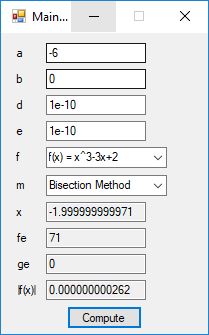
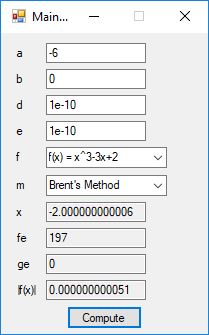
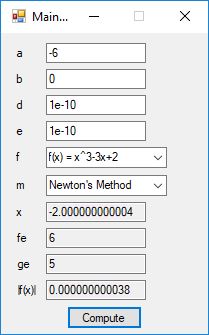
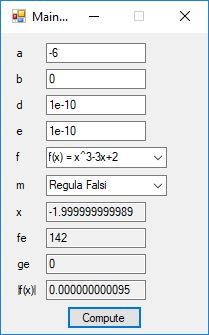
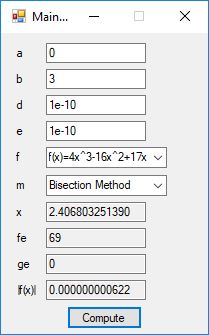
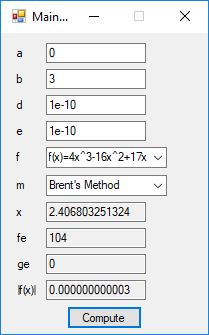
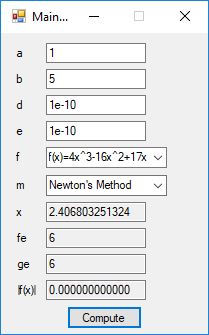
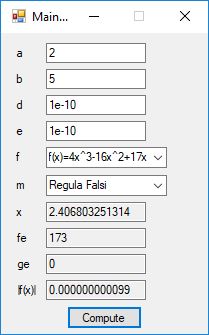
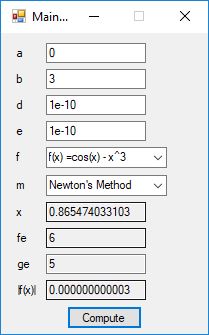
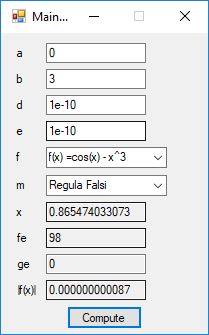
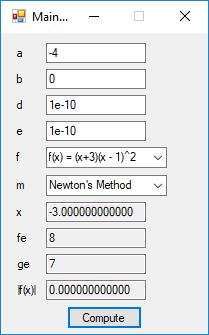
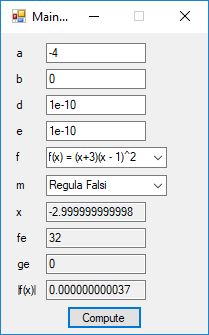
We designed and implemented a C# application that uses the following root finding algorithms:

  1. Bisection Method
  2. Brent’s Method
  3. Newton’s Method
  4. Regula Falsi

https://en.wikipedia.org/wiki/Bisection_method

https://en.wikipedia.org/wiki/Brent%27s_method

https://en.wikipedia.org/wiki/Newton%27s_method

https://en.wikipedia.org/wiki/False_position_method

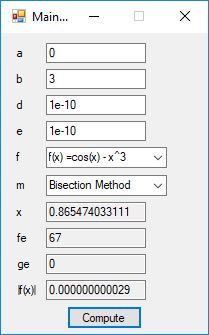
rfa f 1

rfa f 2

bs 0bs 1br 1nm 1rf 1bs 2br 2nm 2rf 2bs 3br 3nm 3rf 3nm 0rf 0

The source code files are displayed below as Word files:

BisectionMethod – Copy

BrentsMethod – Copy.cs

MainForm – Copy.cs

NewtonsMethod – Copy.cs

RegulaFalsi – Copy.cs

Roots of Small Degree Polynomials with Real Coefficients by James Pate Williams, BA, BS, MSwE, PhD

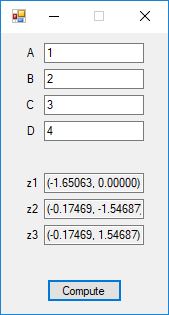
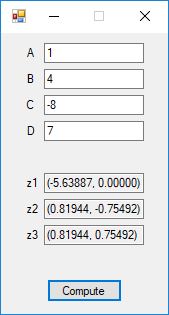
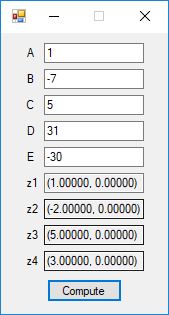
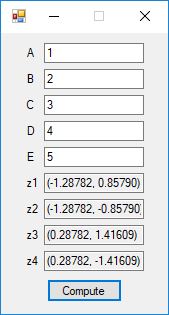
We designed and implemented quadratic formula, cubic formula, and quartic formula solvers using the formulas in the Wikipedia articles:

https://en.wikipedia.org/wiki/Quadratic_formula

https://en.wikipedia.org/wiki/Cubic_function

https://en.wikipedia.org/wiki/Quartic_function

We tested our C# implementation against:

https://keisan.casio.com/exec/system/1181809415

http://www.wolframalpha.com/widgets/view.jsp?id=3f4366aeb9c157cf9a30c90693eafc55

https://keisan.casio.com/exec/system/1181809416

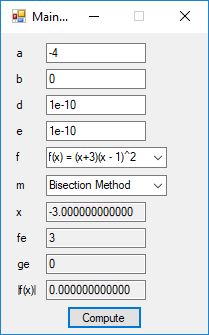
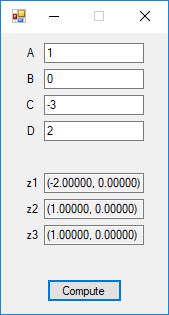
Here are screenshots of the C# application:

sd 0

sd 2 0

sd 2 1

sd 2 2

sd 3 1

sd 3 0

sd 4 0

sd 4 1

C# source code files for the application:

CubicEquation – Copy.cs

IOForm – Copy.cs

MainForm – Copy.cs

QuadraticEquation – Copy.cs

QuarticEquation – Copy.cs

A Simple and Utilitarian C# Matrix Class by James Pate Williams, BA, BS, MSwE, PhD

We designed and implemented a simple and utilitarian C# matrix class for double precision numbers. The class has the binary matrix operators +, -, *, / which are addition, subtraction, multiplication, and division of two matrices. We also include an operator for multiplication of matrix by a scalar and an operator for dividing a matrix by a scalar. We have included functions to compute the p-norm, p, q-norm, and max norm of a matrix. We also can calculate using truncated infinite series the exponential, cosine, and sine function of a matrix. The exponential and trigonometric functions use a powering function that raises a matrix to a non-negative integral power.

Below is a screenshot of the test Windows Forms application. We execute the four binary matrix operators in the order +, -, *, / e.g. A+B, A-B, A*B, A/B. In order to divide by B, the matrix B must be square and non-singular, that is square and invertible.

Matrix Example Application Screenshot

The B matrix has the form of the matrix in the online discussion:

http://www.purplemath.com/modules/mtrxinvr2.htm

We create a project named MatrixExample. In this project we add a Matrix class whose code is given below:

Matrix

I leave it as an exercise for the reader to test the various norms and other functions.


The Bailey-Borwein-Plouffe Formula for Calculating the First n Digits of Pi

The Bailey-Borwein-Plouffe formula for determining the digits of pi was discovered in 1995. This formula has been utilized to find the exact digits of pi to many decimal places.

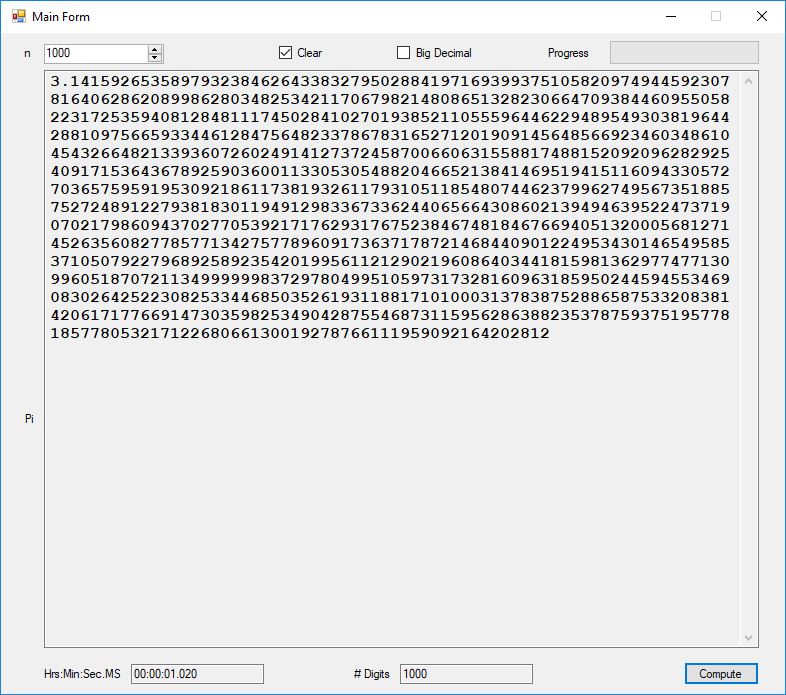
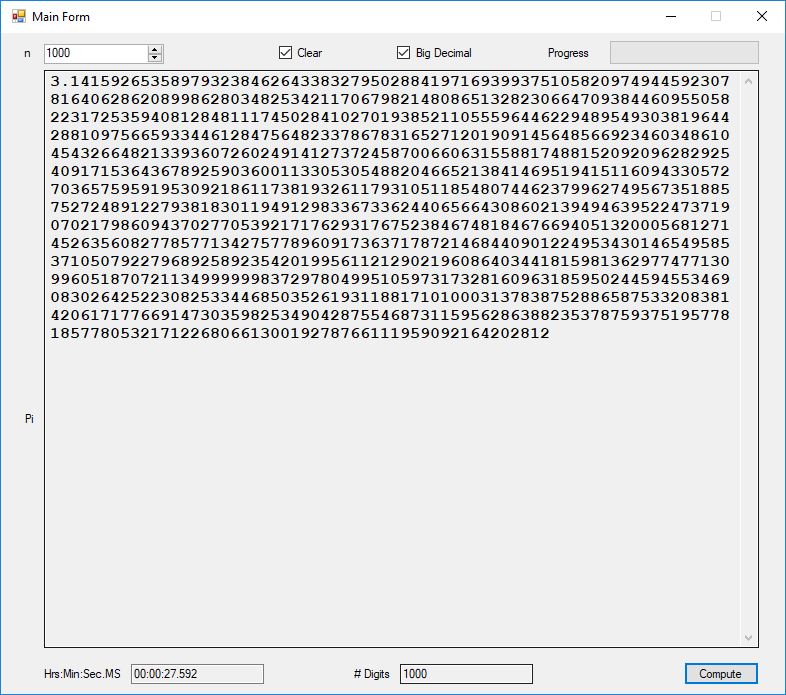
I recently re-implemented my legacy C and FreeLIP program that utilized the BBP formula. The new C# application uses a homegrown big unsigned decimal number package that includes methods for +, -, *, / operators and an exponentiation (power) function. I used short integers (16-bit signed integers) to represent the individual digits of the number in any base whose square can be expressed as a positive short integer. That includes the decimal base 10 and hexadecimal base 16. For this application the base was chosen to be 10. Also, included was a n-digits of pi function that used the C# language’s built-in BigInteger data type.  Below are some screen shots of the program in action.

BBP Formula BI 1000

BBP Formula BD 1000

As you can easily see the BigInteger implementation is an order of magnitude faster that the BigDecimal version (actually around 27+ times faster).

Last, we include a link to a PDF containing data comparing calculations performed on a Intel based desktop versus an AMD based laptop.

Benchmark Calculations Using the Application BigIntegerPi

Microsoft Outlook Add-In by James Pate Williams, Jr. BA, BS, MSwE, PhD

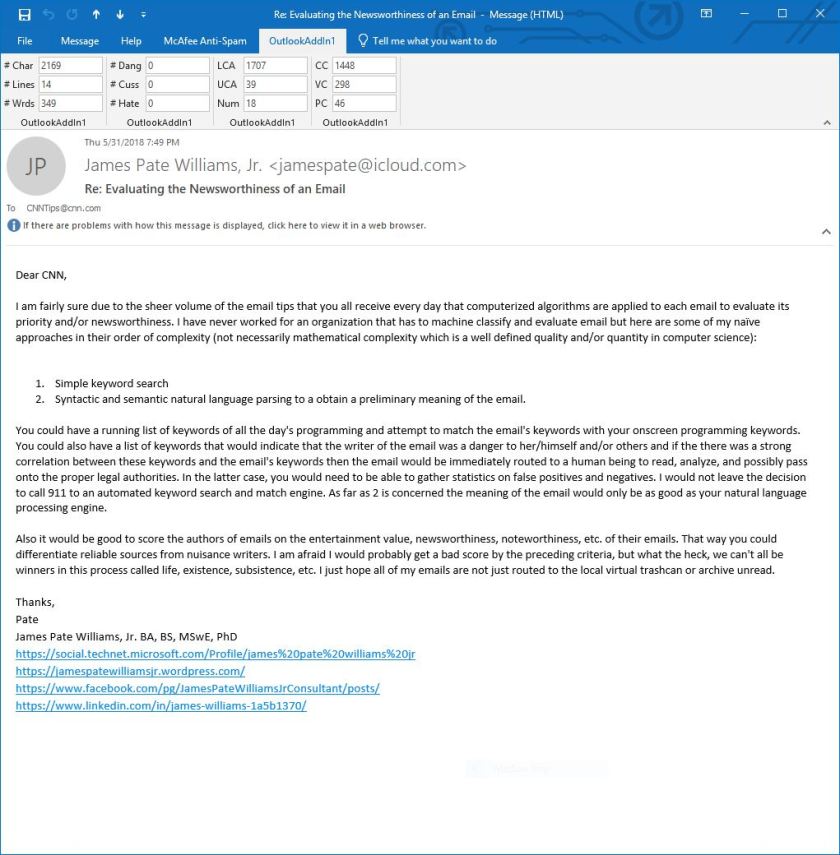
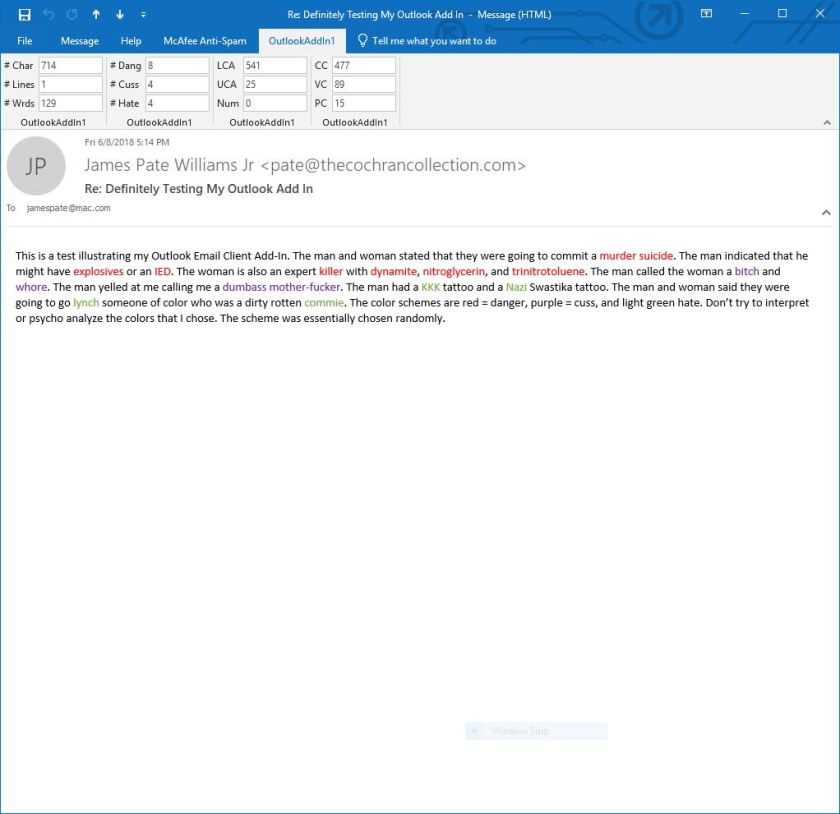
After successfully downloading and installing a free one-month trial evaluation version of Microsoft’s Visual Studio 2017 Professional Graphical User Interface Integrated Development Environment, I decided to try my hand at creating an Office VSTO Add-In. I chose the computer language C# and the Office application Outlook. Among other functions Outlook is a personal computer’s email client for IMAP or POP3. The problem that the add-in solves is a preliminary evaluation of the meaning of an email’s body. The add-in counts the frequency of occurrence of the following (assuming English language):

  1. Characters
  2. Lines Separated by CR/LF
  3. Words
  4. Danger Words – words that indicate danger to the author and/or other people, places, or things
  5. Cuss or Curse Words
  6. Hate and Objectionable Words
  7. Lower Case Characters
  8. Upper Case Characters
  9. Numeric Characters
  10. Consonant Count Including ‘y’
  11. Vowel Count Excluding the Sometimes ‘y’
  12. Punctuation Count {‘.’, ‘,’, ‘;’, ‘:’, ‘?’, ‘!’}

Once an email is opened and in an active inspector the OutlookAddIn1’s Outlook ribbon is displayed with 12 edit boxes that contain the counts enumerated in the preceding numbered list. Below is an email that illustrates night of the frequency tabulations.

Outlook AddIn Test Blog 1

The next email contains danger, cuss, and hate words.

Outlook AddIn Test Blog 2

https://social.technet.microsoft.com/Profile/james%20pate%20williams%20jr

https://www.facebook.com/pg/JamesPateWilliamsJrConsultant/posts/

https://www.linkedin.com/in/james-williams-1a5b1370/

Five Stream Ciphers Created from Five Pseudorandom Number Generators Built Using the Tests of FIPS 140-1 by James Pate Williams, BA, BS, MSwE, PhD

The five pseudorandom number generators are:

  1. Triple-AES based ANSI X9.17 PRNG
  2. Triple-DES based ANSI x9.17 PRNG
  3. RSA based PRNG
  4. Micali-Schnorr PRNG
  5. Blum-Blum-Shub PRNG

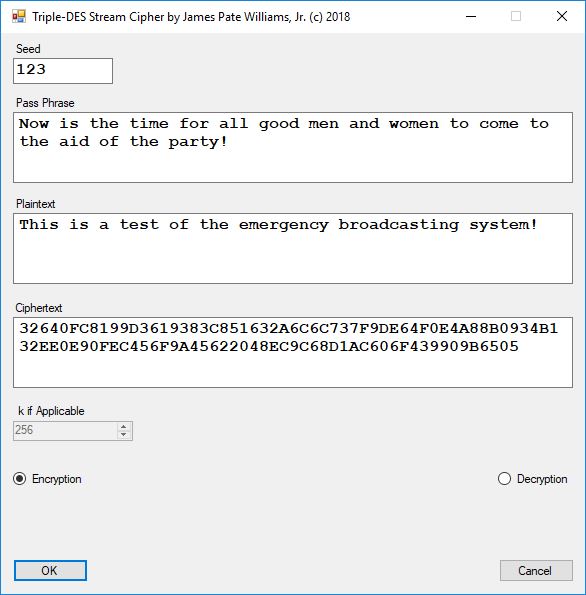
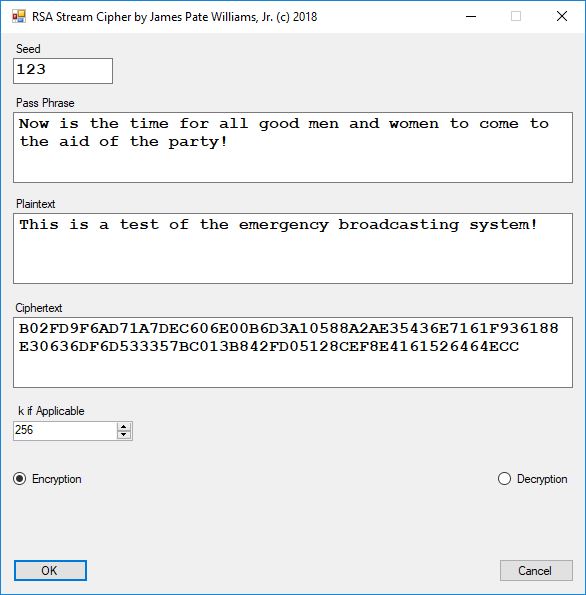
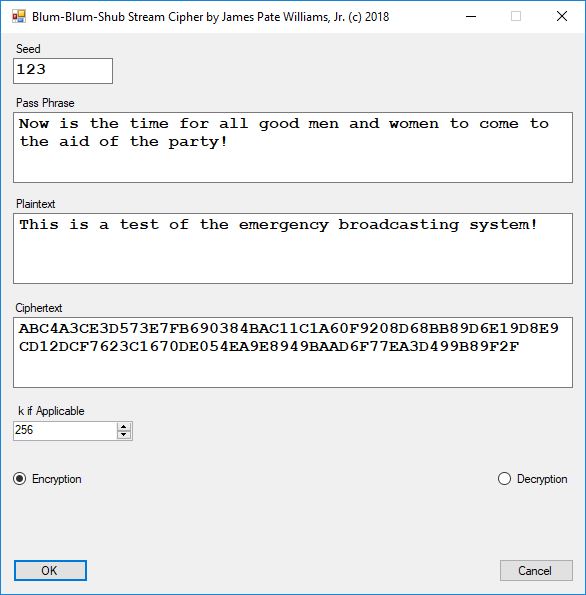
Five stream ciphers were created using 1 to 5. Screenshots of the C# application follow:

sc aessc dessc rsasc mssc bbs

The pass phrase optimally should consist of 147 ASCII characters. If the number of pass phrase ASCII characters is less than 147 then more random ASCII characters are added using the standard C# pseudorandom number generator seeded with the parameter named Seed. The user defined parameter k is used by RSA, Micali-Schnorr, and Blum-Blum-Shub pseudorandom number generators. It is the approximate bit length of the large composite number composed of two large probable prime numbers. The real key lengths of all the stream ciphers is about 1024-bits for 1, 3, 4, and 5 and 296-bits for 2. I’d strongly suggest using 1 and/or 5.

Tests of Six Pseudorandom Number Generators (PRNGs) Using the Now Superseded FIPS 140-1 by James Pate Williams, Jr. BA, BS, MSwE, PhD

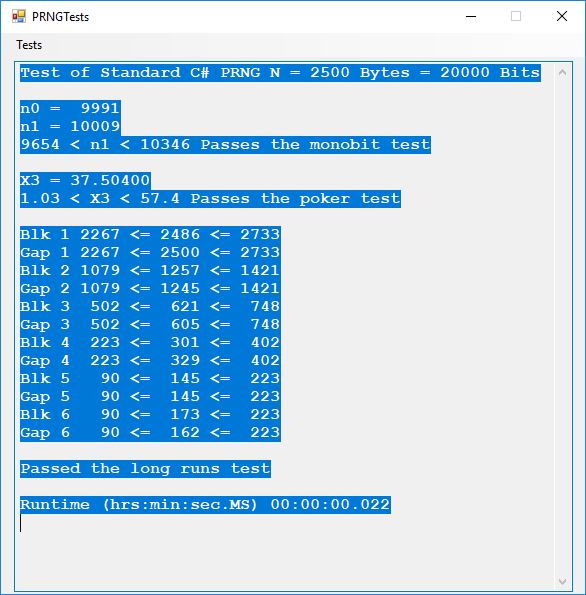
This blog explores six pseudorandom number generators which are enumerated as follows:

  1. Standard C# PRNG
  2. Triple-AES PRNG
  3. Triple-DES PRNG
  4. RSA Based PRNG
  5. Micali-Schnorr PRNG
  6. Blum-Blum-Shub PRNG

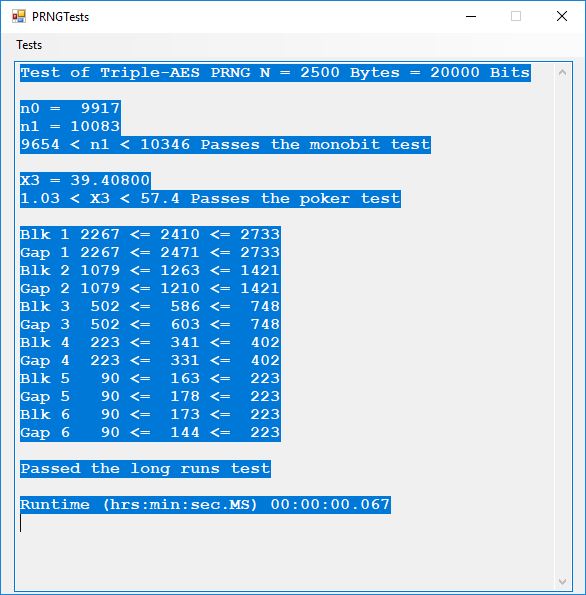
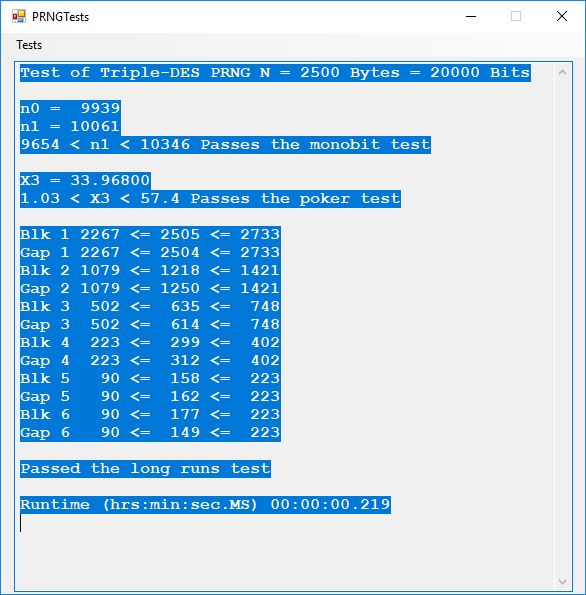
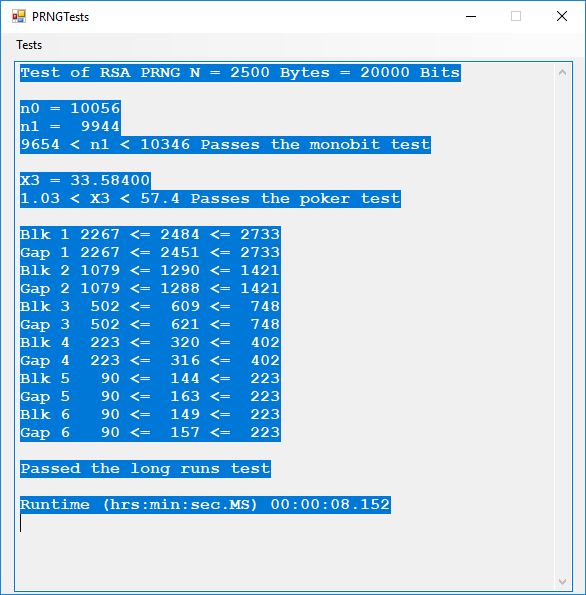
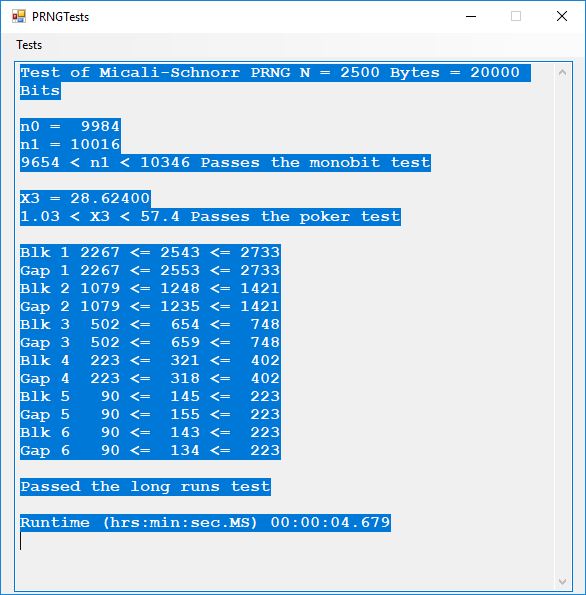
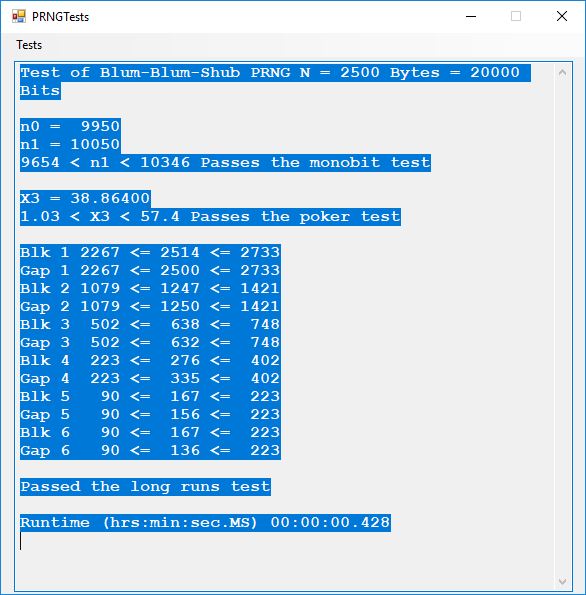
PT 00PT 01PT 02PT 03PT 04PT 05

Here is the order in terms of run-times from the fastest to the slowest: 1, 2, 3, 6, 5, 4.


PRNG Tests Using the Now Superseded FIPS 140-1 by James Pate Williams, Jr., BA, BS, MSwE, PhD

This blog post is dedicated to Section 5.3.1 ANSI X9.17 generator page 173 with 5.11 Algorithm and Section 5.4.4 Five basic tests pages 181-183 especially 5.32 Note of the Handbook of Applied Cryptography by Alfred J. Menezes, Paul C. van Oorschot, and Scott A. Vanstone. I developed a PRNG test program for three PRNGs namely, Triple-AES, Triple-DES, and the C# built-in PRNG.

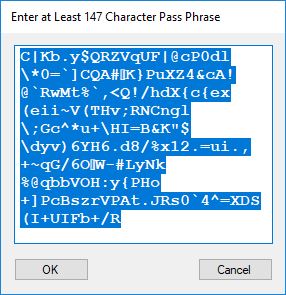
Each time an algorithm is run a randomly generated key is generated based on the time of day and the C# built-in PRNG with a key space of 2147483647 possible seeds. Triple-AES requires a 147 7-bit ASCII key and part of a similar key is used to construct the 296-bit Triple-DES key material. Now onto my C# Windows Forms application’s screenshots.
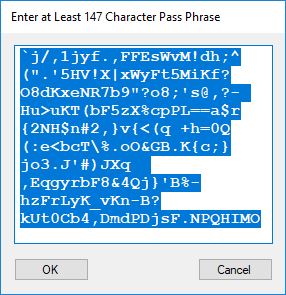
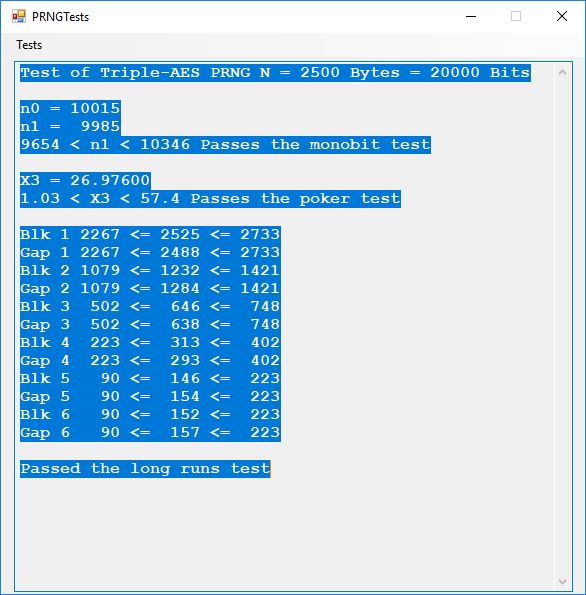
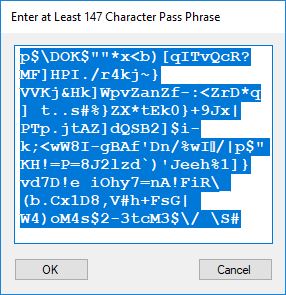
PRNGTests AES Key

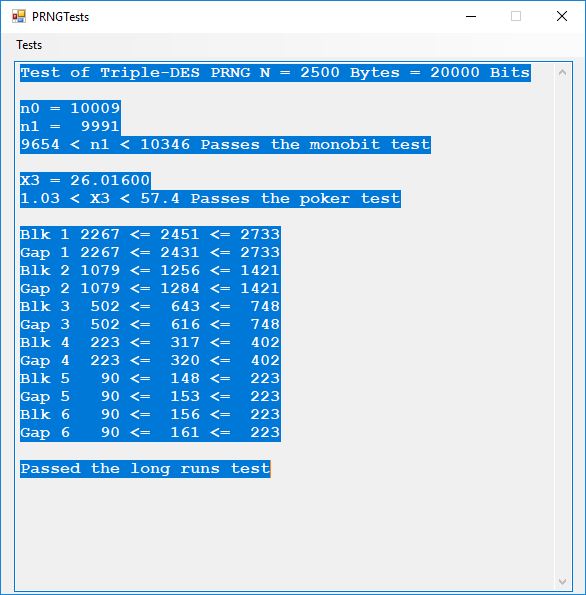
PRNG Tests AES

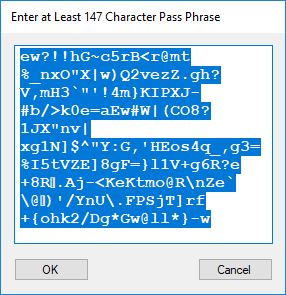
PRNG Tests DES Key

PRNG Tests DES

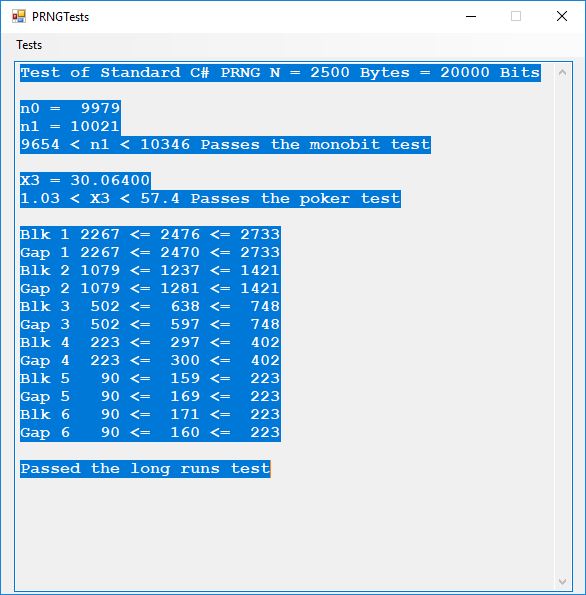
PRNG Tests C#

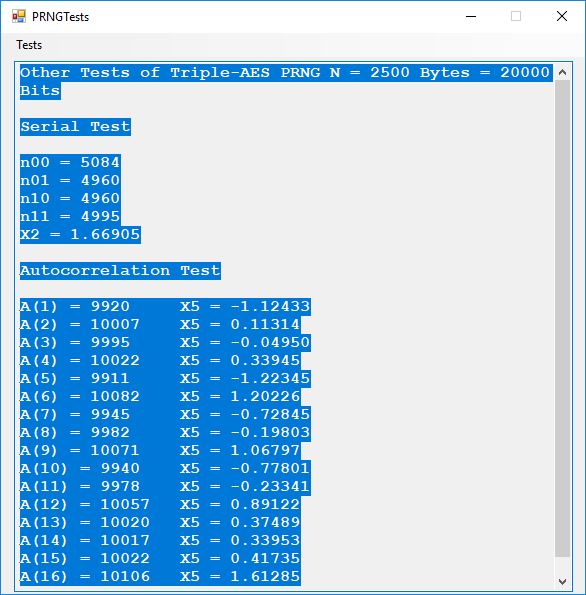
PRNG Tests Other AES

PRNG Tests Other AES Data

PRNG Tests Other DES Key

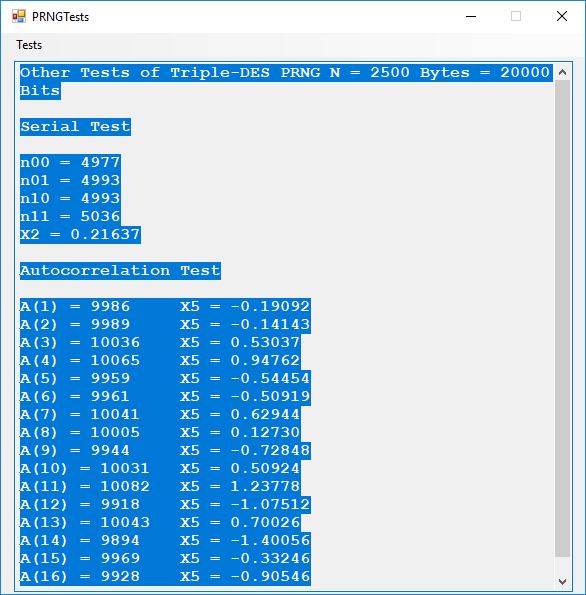
PRNG Tests Other DES Data

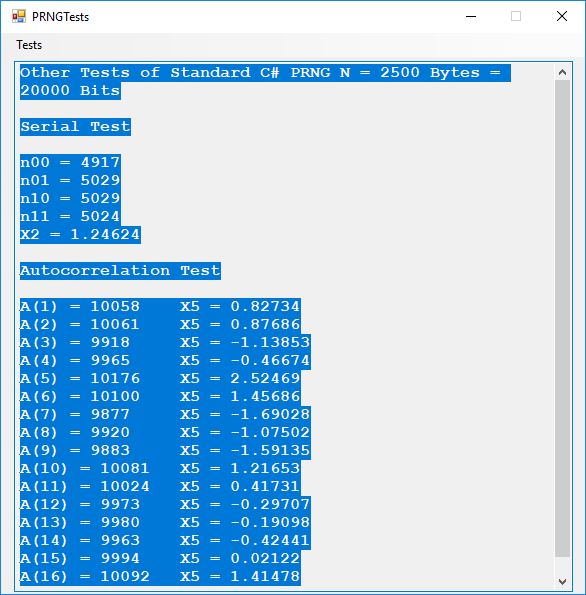
PRNG Tests Other C#

We use the five basic statistical tests of Chapter 5 Section 5.4.4 which are as follows:

  1. Monobit Test also Known as the Single Bit Frequency Test
  2. Serial Test also as the Two-Bit Frequency of Occurrence Test
  3. Poker Test
  4. Runs Test (Not to be confused with Montezuma’s Revenge)
  5. Autocorrelation Test

Below is a copy of a recent email of mine concerning Secret Key Exchange or Distribution:

The linchpin and point of greatest vulnerability in any secret key cryptographic system is the key exchange mechanism. Now suppose that we are living in a post quantum computer world. This means that traditional public key cryptosystems such as RSA (integer factorization problem based) and elliptic curve public key cryptography (discrete logarithm problem based) are effectively broken. That implies that any public key based cryptographic key exchange is compromised over communication channels where Eve, the classical eavesdropper, is listening in on the key exchange between Alice and Bob. Quantum cryptography over fiber optic channels allows the communication endpoints to detect the eavesdropper and thus abort a potentially compromised key exchange. However, quantum cryptography is not readily available everywhere on the vast Internet. The rest of this email missive is devoted to other more exotic means of secret key exchange.
Human to human key exchange is optimal provided that all human beings in the loop are trustworthy. A good way to exchange secret keys is via a diplomatic courier with a diplomatic pouch and the key bits are concealed by a steganographic means.

Now suppose an adversary of an English speaking and reading country has two agents or human intelligence operatives that have infiltrated the country. Further both agents have the same 1024-bit seeded pseudorandom number generator-based stream cipher on their desktops and/or laptops for secure communications. That means they must somehow pass 147 secret 7-bit printable ASCII characters of information between one another for each quasi-one-time pad message. Each character represents 7 bits of the key and there are 5 bits left over after construction of each key. Also, suppose an actual face-to-face meeting between the two spies is inadvisable. Enter the text based social media or library book code. Now suppose the two spies are connected to one another via Facebook but are afraid to use text messaging for direct key exchange or clandestine communication. The solution is to use a shared Facebook page of text to construct the secret key. One spy shares a Facebook post containing at least 147 English characters and the other spy looks up the post. Both spies cut and paste the first 147 English characters of the post into a key constructing application. Voila, now both spies can communicate using their handy dandy stream cipher and email and/or cell phone text messaging of encrypted data in the form of three-digit decimal numbers. An alternative key exchange could be by the classic and readily available book code. Assume both spies have access to the same library, but not concurrent access. Both somehow agree to go and copy 147 characters from the same book in the library’s reference section. They write down the passage and take it home to enter the text into the key generator. Again, we have a means of clandestine key exchange.