Root Finding Algorithms by James Pate Williams, BA, BS, MSwE, PhD

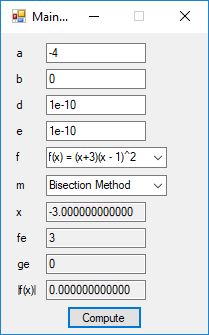
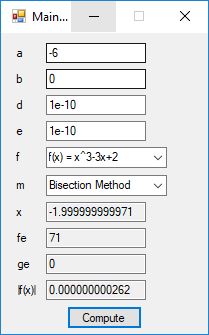
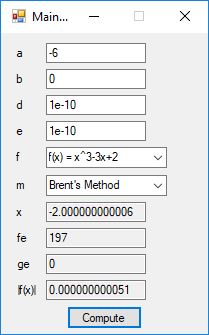
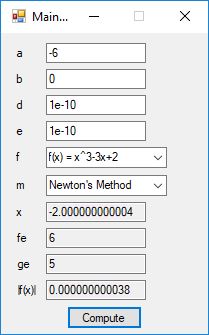
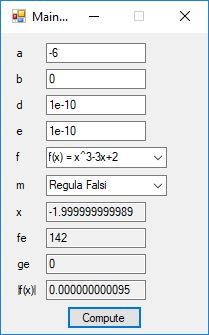
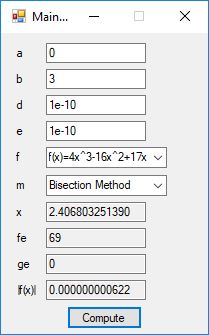
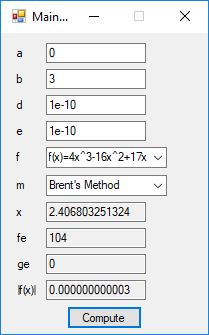
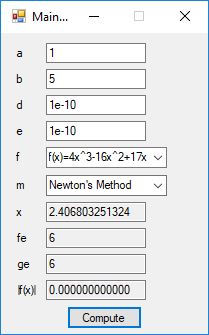
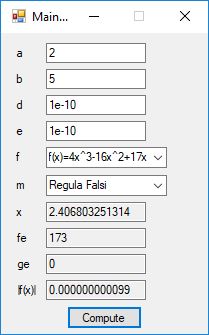
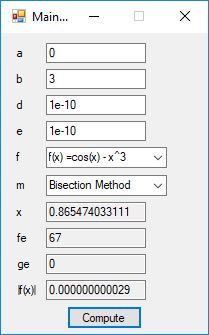
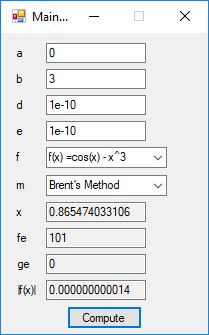
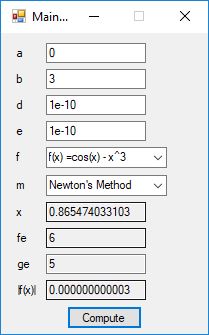
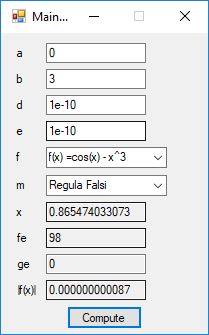
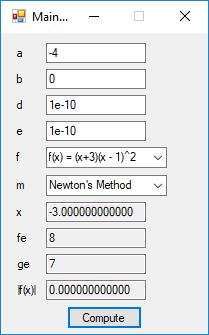
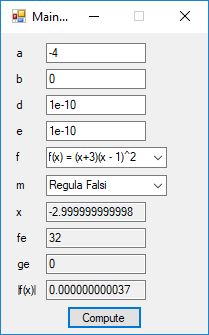
We designed and implemented a C# application that uses the following root finding algorithms:

  1. Bisection Method
  2. Brent’s Method
  3. Newton’s Method
  4. Regula Falsi

https://en.wikipedia.org/wiki/Bisection_method

https://en.wikipedia.org/wiki/Brent%27s_method

https://en.wikipedia.org/wiki/Newton%27s_method

https://en.wikipedia.org/wiki/False_position_method

rfa f 1

rfa f 2

bs 0bs 1br 1nm 1rf 1bs 2br 2nm 2rf 2bs 3br 3nm 3rf 3nm 0rf 0

The source code files are displayed below as Word files:

BisectionMethod – Copy

BrentsMethod – Copy.cs

MainForm – Copy.cs

NewtonsMethod – Copy.cs

RegulaFalsi – Copy.cs

Roots of Small Degree Polynomials with Real Coefficients by James Pate Williams, BA, BS, MSwE, PhD

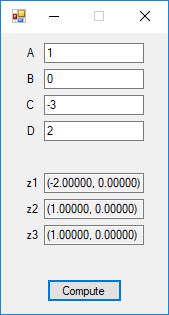
We designed and implemented quadratic formula, cubic formula, and quartic formula solvers using the formulas in the Wikipedia articles:

https://en.wikipedia.org/wiki/Quadratic_formula

https://en.wikipedia.org/wiki/Cubic_function

https://en.wikipedia.org/wiki/Quartic_function

We tested our C# implementation against:

https://keisan.casio.com/exec/system/1181809415

http://www.wolframalpha.com/widgets/view.jsp?id=3f4366aeb9c157cf9a30c90693eafc55

https://keisan.casio.com/exec/system/1181809416

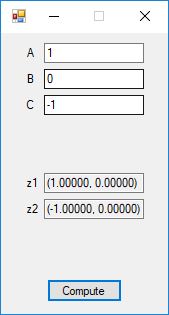
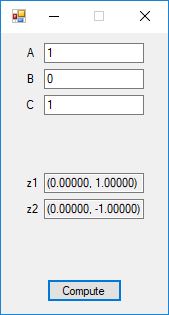
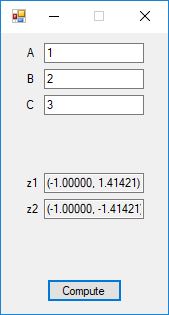
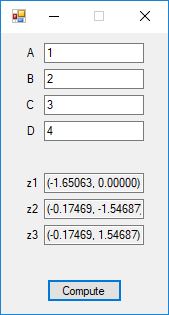
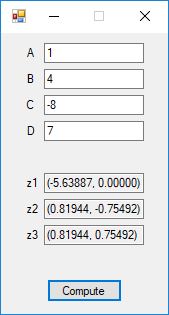
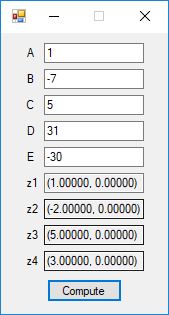
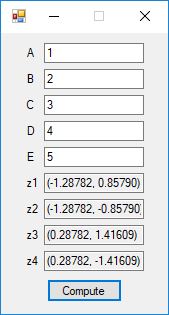
Here are screenshots of the C# application:

sd 0

sd 2 0

sd 2 1

sd 2 2

sd 3 1

sd 3 0

sd 4 0

sd 4 1

C# source code files for the application:

CubicEquation – Copy.cs

IOForm – Copy.cs

MainForm – Copy.cs

QuadraticEquation – Copy.cs

QuarticEquation – Copy.cs

The Bailey-Borwein-Plouffe Formula for Calculating the First n Digits of Pi

The Bailey-Borwein-Plouffe formula for determining the digits of pi was discovered in 1995. This formula has been utilized to find the exact digits of pi to many decimal places.

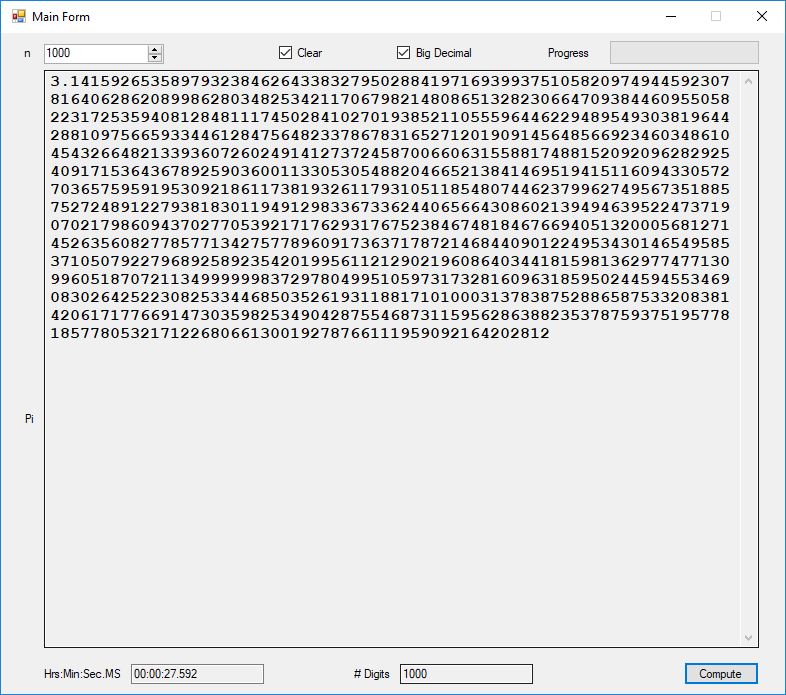
I recently re-implemented my legacy C and FreeLIP program that utilized the BBP formula. The new C# application uses a homegrown big unsigned decimal number package that includes methods for +, -, *, / operators and an exponentiation (power) function. I used short integers (16-bit signed integers) to represent the individual digits of the number in any base whose square can be expressed as a positive short integer. That includes the decimal base 10 and hexadecimal base 16. For this application the base was chosen to be 10. Also, included was a n-digits of pi function that used the C# language’s built-in BigInteger data type.  Below are some screen shots of the program in action.
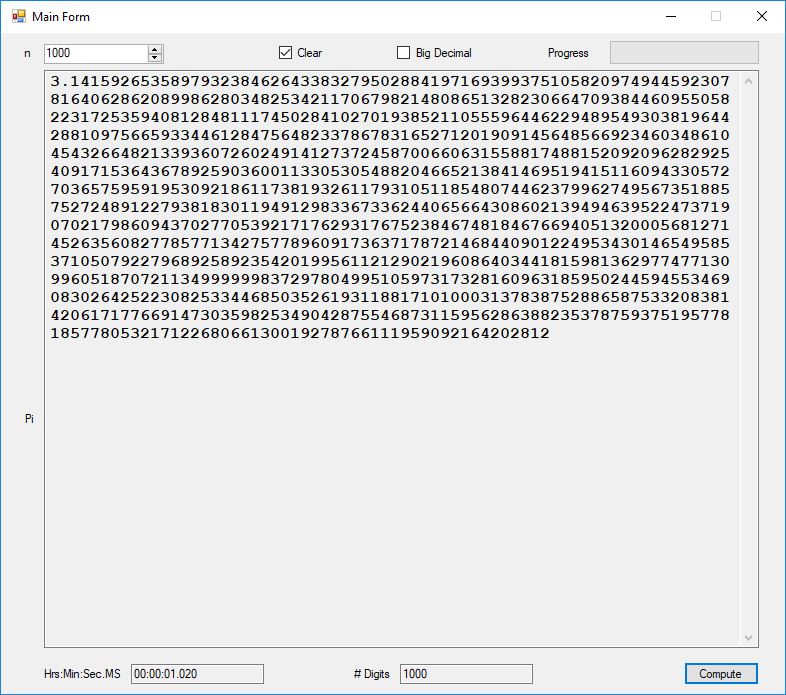
BBP Formula BI 1000

BBP Formula BD 1000

As you can easily see the BigInteger implementation is an order of magnitude faster that the BigDecimal version (actually around 27+ times faster).

Last, we include a link to a PDF containing data comparing calculations performed on a Intel based desktop versus an AMD based laptop.

Benchmark Calculations Using the Application BigIntegerPi